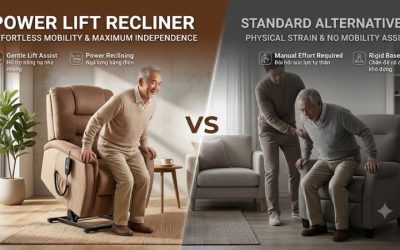
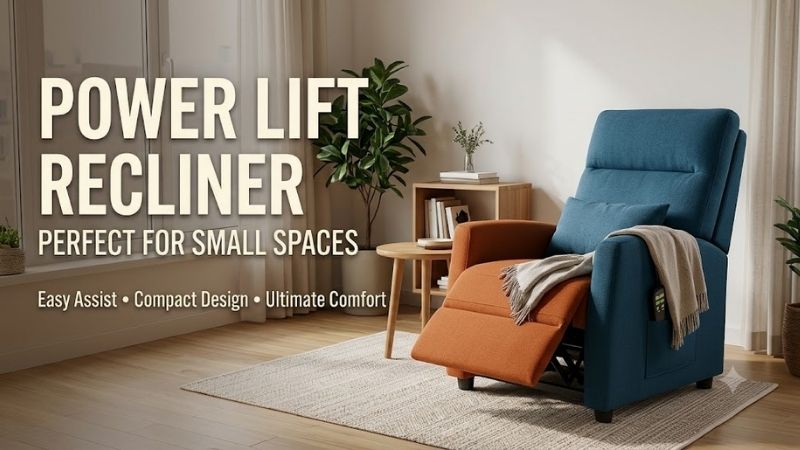
A power lift recliner for small spaces must fit in both its seated and fully raised positions without blocking essential routes. Narrow chair width alone is not enough: rear clearance, footrest travel, seat height, and access to controls all matter. This guide explains how to plan a compact room and compare appropriately sized lift-chair models.
Why a Compact Lift Recliner Is Different From an Ordinary Recliner
A lift recliner performs several movements. It supports sitting, reclines for relaxation, and raises the seated occupant toward a standing position.
This means a compact product has to be evaluated through its complete movement range.
A conventional recliner may move its backrest and legrest without changing the entire seat’s vertical position. A lift chair adds movement that raises and tilts the seating structure.
The extra motion can affect furniture placement, the user’s balance, and the amount of clear floor area required in front of the chair.
Compact Does Not Mean Narrow Only
A 32-inch-wide lift chair may fit beside a small sofa, but its backrest might still require more than a foot of rear clearance.
The footrest can also extend substantially into the room.
Additionally, the area directly in front of the chair must remain suitable for standing and walking away after the lift finishes.
A narrow chair placed beside a coffee table may be less practical than a slightly wider chair with better surrounding access.
A Wall-Hugger Mechanism Is Not Automatically a Lift-Friendly Layout
Some reclining chairs have designs that reduce how far the backrest moves toward the wall.
However, that does not establish how the chair moves during its lifting sequence.
The required operating envelope must be verified using the specific product’s instructions.
A chair should not be installed based only on the rear wall-distance specification.
Compact Lift Recliner Models Worth Comparing
| Model and configuration | Overall width | Seat height | Seat depth | Rear wall distance |
|---|---|---|---|---|
| Pride Genesis LC-150S | 32 in | 18 in | 18 in | 17 in |
| Pride Genesis LC-150M | 33 in | 20 in | 20 in | 18.5 in |
| Pride VivaLift! Tranquil 2 Small | 33.75 in | 18 in | 18.5 in | 13 in |
| Pride VivaLift! Tranquil 2 Medium | 37.5 in | 19.5 in | 20.5 in | 16 in |
| Ashley Next-Gen DuraPella | 35 in | 21 in | 21 in | 14 in |
| Pride VivaLift! Ultra Small | 37 in | 18 in | 18 in | 15 in |
These examples reveal an important pattern: a chair with a compact exterior width does not necessarily have the shortest rear clearance, and the smallest configuration may be inappropriate for a taller user.
Step 1: Create a Complete Floor Plan
Begin by measuring the wall area available for the chair.
Then identify the nearest doorway, table, outlet, walking route, and other furniture.
The goal is not merely to squeeze the chair into the remaining space. The user must be able to operate it and leave it safely.
Measure the Exterior Width
Chair width includes the arms and frame.
However, usable seat width can be much smaller.
For example, the 35-inch-wide Ashley DuraPella has approximately 17 inches between its arms.
A person who needs more hip room may find this model unsuitable despite its compact exterior dimensions.
Always compare interior seating measurements as well as the overall footprint.
Measure Rear Clearance
Published rear distances vary by model and size.
Pride Genesis LC-150S lists 17 inches, while the small Tranquil 2 lists 13 inches.
A four-inch difference may matter when the chair sits between a window and a walkway.
However, these measurements should never be used as substitutes for full operating-clearance instructions.
Measure the Forward Movement
The chair’s legrest extends while reclining, and the lifting mechanism changes the seat’s position.
Neither movement should interfere with a coffee table, storage chest, walker, or another object.
Mark the fully operated footprint on the floor if the manufacturer’s diagrams permit accurate measurement.
Preserve the Standing Area
A person rising from a lift chair needs an appropriate destination for the next movement.
If the chair raises the user directly into a narrow gap or against a table, the transfer can become hazardous.
The standing area is part of the chair’s functional footprint.
Step 2: Match Chair Dimensions to the User
A chair that fits the room but not the person is not an acceptable purchase.
Seat height and depth must be considered alongside the person’s body proportions, foot placement, and transfer ability.
Seat Height
A seat that is too high may leave the user’s feet unsupported when sitting normally.
A seat that is too low can create a difficult transfer despite the powered lift.
The appropriate height depends on lower-leg length and the user’s ability to position their feet.
The published unloaded seat height is a useful starting measurement, but cushion compression and footwear may affect the actual experience.
Seat Depth
The seat should allow the user to sit back comfortably without the front edge creating excessive pressure behind the knees.
A small user may find an oversized 22-inch-deep seat difficult to use correctly.
A taller user may need more depth than an 18-inch seat provides.
This is why manufacturer size recommendations are helpful but do not replace a fit assessment.
Seat Width
The user needs enough width for comfortable positioning without being excessively compressed against the arms.
However, an overly wide chair may reduce lateral support for some people.
The correct width is not necessarily the largest available.
Backrest Height
Head and shoulder contact depend on the relationship between the user’s torso and the chair’s back.
If the back is too short, the head may lack desired support during reclining.
If the chair is excessively large, the user may sit forward rather than against the intended backrest.
Step 3: Choose the Appropriate Motor System
Single-Motor or Three-Position Chairs
Simpler systems often coordinate the backrest and footrest movement.
This may be enough for sitting, relaxing, and standing assistance.
A straightforward remote can also be easier to understand for some users.
However, coordinated movement provides less flexibility when the user wants their feet raised without substantially reclining the back.
Dual-Motor Chairs
Dual-motor models commonly permit independent backrest and legrest adjustment.
That can improve flexibility for reading and relaxing.
However, different manufacturers may use the phrase dual motor to describe different operating arrangements.
Verify the precise movements available.
Advanced Multi-Zone Positioning
Premium chairs may include powered headrest, lumbar, and tilt adjustments.
These features increase comfort options but also add controls.
For an individual who finds a complex remote confusing, extra adjustability may reduce rather than improve usability.
Step 4: Compare Controls and Emergency Operation
The remote control should remain accessible when the chair is fully reclined and while the user is preparing to stand.
A handset that repeatedly falls between cushions may be frustrating and could create unsafe reaching.
Look for a suitable holder or storage location.
Remote Simplicity
A basic up/down toggle may be sufficient when the main function is sit-to-stand assistance.
More advanced remotes should have clearly differentiated functions and intuitive controls.
The intended user should be able to operate the system without relying on another person to interpret every button.
Power Connections
Locate the electrical outlet before installation.
The power cord must remain outside the moving mechanism and should not create a tripping hazard.
Avoid unsupported extension-cord arrangements.
Battery Backup
Some lift chairs provide integrated backup power; others require an optional accessory.
Backup systems may have a limited number of operations.
Verify the exact system rather than assuming the chair can operate normally for hours after a power outage.
Step 5: Consider Delivery and Assembly
A relatively narrow chair can still be heavy and difficult to maneuver through a doorway.
A lift recliner includes a motorized frame and other mechanical components.
The weight may exceed that of an ordinary accent chair.
Doorways and Hallways
Measure the complete delivery route, including turns and stair landings.
Some products have removable backs for assembly.
However, the buyer should not assume that every model can be carried into the home in small pieces.
Floor Protection
The chair should rest on a stable, suitable surface.
Thick carpet, uneven flooring, or inappropriate pads may affect stability and operation.
Use only manufacturer-approved arrangements.
Installation Check
After assembly, verify that the chair completes its intended movement without contacting walls or furniture.
The operating area must remain clear of pets, children, loose objects, and power cords.
Example: Choosing a Chair for a Narrow Bedroom
Consider a hypothetical room with 40 inches of wall width available between a wardrobe and a bedside cabinet.
A 32-inch Pride Genesis Small may appear to fit, leaving eight inches of total remaining width.
However, the buyer still needs to account for control access, electrical connections, rear clearance, and the user’s standing movement.
If the intended user is too tall for its 18-inch seat depth, the model would be a poor choice despite fitting the wall.
A different room arrangement or another chair size may be necessary.
This example illustrates the distinction between physical furniture fit and functional transfer fit.
When a Compact Lift Recliner Is Not the Right Solution
A person unable to bear weight reliably may not be able to complete a transfer simply because a chair raises them.
Likewise, someone who cannot understand the controls or maintain balance after lifting may require a different assistance strategy.
In these situations, choosing the narrowest lift chair does not resolve the underlying safety problem.
A physical or occupational therapist can assess whether a lift recliner, another transfer device, or caregiver assistance is more appropriate.
Frequently Asked Questions
What Is the Smallest Power Lift Recliner?
Compact models such as Pride Genesis LC-150S have a published exterior width of 32 inches. However, the smallest chair is not automatically the best option because seat depth, user height, and operating clearance must also fit.
Can a Lift Recliner Go Against a Wall?
It must be positioned according to the manufacturer’s specified clearance. Some models require more than a foot behind the chair. Additional front clearance is also needed for reclining and lifting.
Can a Power Lift Recliner Fit in a Studio Apartment?
Yes, if the full movement envelope and standing area remain unobstructed. Measure the room and consider how the chair affects walking routes and nearby furniture.
Is a Narrow Lift Chair Suitable for a Large Adult?
Not necessarily. Weight capacity and internal seat width are separate specifications. The user’s body dimensions must be compatible with the chair.
Are Small Lift Chairs Less Powerful?
A compact exterior does not automatically mean a lower weight capacity. Compare the actual rated load, mechanism, and intended user rather than judging by size alone.
Is Battery Backup Essential?
Backup power can be important when the person depends on the chair for transfers during electrical outages. Its functionality and whether it is included must be checked for the exact model.
Conclusion
A power lift recliner for small spaces must fit the person and the complete room, not merely the available wall width. Measure rear and front clearance, check the lifting area, compare seat geometry, and verify remote and battery operation. Compact models such as Pride Genesis and Tranquil 2 demonstrate useful size differences, but the correct choice depends on the user’s ability to transfer safely. Functional space and proper fit take priority over the smallest advertised dimensions.