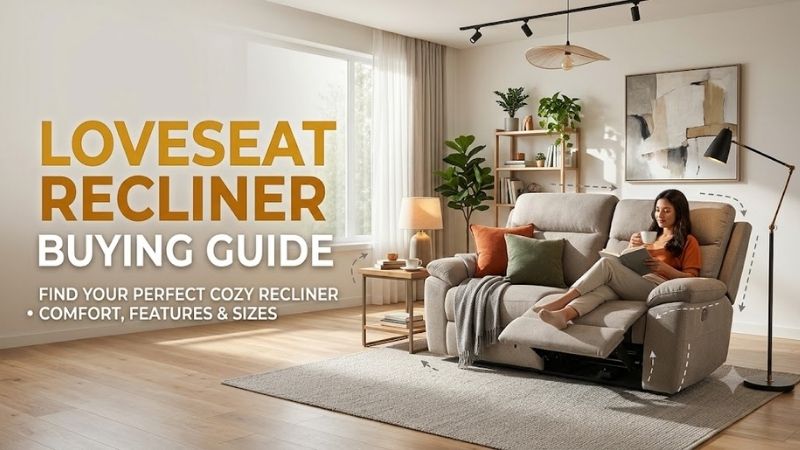
A loveseat recliner buying guide should help you compare two-seat reclining furniture by its actual comfort, mechanism, and room requirements. Manual and power models differ in adjustability and maintenance, while consoles, headrests, and upholstery can influence daily use. This guide explains the measurements, construction details, and ownership costs that matter before purchasing.
What Is a Reclining Loveseat?
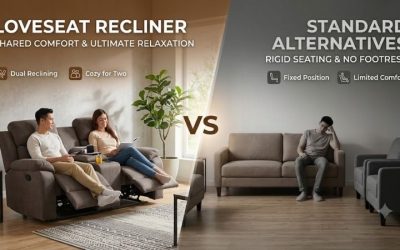
A reclining loveseat is a compact sofa-style seating unit designed for approximately two occupants, with one or more seats that recline.
Many models include independently operated left and right seats. Some contain a fixed center console, while others provide a continuous shared seating area.
The defining feature is the reclining mechanism.
A conventional loveseat typically maintains the same general shape during use. A reclining loveseat changes the backrest and legrest positions, requiring additional room for movement.
This creates different comfort and space-planning requirements.
Dual-Reclining Designs
Dual-reclining loveseats allow the occupants to adjust their seats independently.
This can be useful when one person prefers upright reading and the other wants to recline while watching television.
However, not every loveseat offers the same range of movement.
Some manual systems provide a limited number of positions, while powered systems may allow finer adjustment.
Check the exact functionality rather than assuming two reclining seats means identical operation across models.
Loveseats With a Center Console
A console creates separate seating positions and may include cup holders, storage, and charging accessories.
This can be convenient in a media room.
However, it increases width and prevents occupants from sitting directly together.
For small apartments, the additional footprint may outweigh the convenience.
Compare the Main Loveseat Recliner Types
| Type | Main advantage | Main limitation |
|---|---|---|
| Manual dual recliner | Straightforward mechanism | Requires physical operation |
| Power dual recliner | Precise powered positioning | Electrical dependence |
| Wall-hugger recliner | Reduced rear clearance | Front extension still necessary |
| Recliner with console | Storage and cup holders | Greater width |
| Power headrest recliner | Adjustable upper-body viewing position | Additional motors and cost |
| Zero-gravity-style recliner | Alternative reclining geometry | Marketing terminology varies |
| Reclining loveseat with storage arms | Convenient small-item storage | Bulky arms may reduce seating efficiency |
How to Measure a Reclining Loveseat
The correct measurement process considers the furniture in both upright and fully reclined positions.
Start with the published width, depth, and height.
Then identify the fully extended length and any specified wall clearance.
Width
Width determines how much wall space the furniture occupies.
A 57-inch loveseat can fit in spaces where a 78-inch console model cannot.
However, width alone does not predict seating comfort.
Some compact loveseats have narrow seats or substantial armrests.
Closed Depth
Closed depth describes how far the loveseat projects when upright.
This is useful for initial room planning.
However, the furniture may require substantially more space when the footrests extend.
Fully Reclined Length
Fully reclined length is one of the most important measurements.
It captures the furniture’s larger operating footprint under the manufacturer’s measurement convention.
Do not assume that a loveseat requiring three inches behind the backrest occupies only three more inches when reclined.
Wall Clearance
Wall clearance describes the required space behind the unit.
Wall-hugger models can reduce this requirement.
However, exact values vary by mechanism.
Access Around the Furniture
Leave enough space to operate side-mounted handles and to move around the loveseat when necessary.
Do not place power cables where they can become caught in moving mechanisms.
Manual Reclining Mechanisms Explained
Manual reclining generally uses a handle, lever, pull tab, or body-operated mechanism.
The design may be mechanically simpler than a powered system.
However, operation requires some physical effort.
Pull-Tab Controls
A pull tab releases the reclining mechanism.
The user may then shift body weight or apply pressure to reach the desired position.
This can be straightforward for some people but uncomfortable for those with limited grip or mobility.
External Handles
Side-mounted handles can provide a substantial control point.
However, they require access beside the furniture.
A loveseat pressed tightly between two cabinets may block the handles.
Locking Legrest Positions
Some manual recliners provide defined legrest settings.
These can offer useful control without a motor.
However, the user may not be able to stop the backrest at every imaginable angle.
Maintenance Advantages and Limitations
Manual designs eliminate some electrical components, but they still contain mechanical parts that can wear.
Correct operation, cleaning, and manufacturer-approved maintenance remain important.
Power Reclining Mechanisms Explained
A power recliner uses electrical actuators to change the seating position.
The movement can be controlled through buttons, switches, or other manufacturer-provided interfaces.
Greater Position Control
Some powered loveseats permit fine adjustment between upright and fully reclined positions.
This can be useful when occupants have different comfort preferences.
However, the available movements depend on the product. Not every power recliner adjusts the headrest, lumbar region, and footrest independently.
Powered Headrests
An adjustable headrest changes the upper-back and head-support angle.
This may make it easier to watch television while the main backrest is reclined.
However, comfort depends on body proportions and the range of motion.
A powered headrest is not a medical treatment for neck pain.
USB Ports and Charging
Some power loveseats include USB charging.
This can be convenient, but it should not outweigh the importance of seat comfort or fit.
The electrical components must be used according to the manufacturer’s instructions.
Repair and Power Dependence
Power mechanisms contain wiring, controls, motors, and related parts.
These components may require service over time.
Buyers should review warranty coverage and whether replacement parts are available.
What Does Wall-Hugger Mean?
A wall-hugger or wall-reclining design reduces the rear clearance needed for the reclining motion.
The mechanism may shift the seat forward as the backrest lowers.
However, the footrest still needs to extend.
A Practical Example
Ashley Tulen has a published closed depth of 40 inches, a fully reclined length of 65 inches, and a rear wall clearance of three inches.
The rear clearance is much smaller than the difference between the upright and extended lengths.
That illustrates why buyers must evaluate front and rear space separately.
Wall-Hugger Benefits
A wall-hugger can allow the loveseat to sit closer to a wall when upright.
This may be useful in small living rooms where every inch matters.
Wall-Hugger Limitations
A wall-hugger does not guarantee that the furniture will fit behind a coffee table.
It also does not eliminate side-control access requirements or movement around the recliner.
Seat Comfort and Ergonomics
Comfort should be evaluated using the individual’s body proportions rather than generic descriptions such as plush or orthopedic.
Seat Height
Seat height influences the knee angle and ability to stand.
A seat that is too low may require extra effort to rise from.
A seat that is too high may leave the feet unsupported.
Seat Depth
A deep seat can provide comfortable lounging.
However, shorter occupants may find it difficult to rest against the back cushion while keeping their legs positioned naturally.
Back Height
A taller back may provide contact behind the head and shoulders.
However, it must match the user’s torso height.
Armrest Height
Armrests should allow comfortable positioning without forcing the shoulders upward.
Oversized padded arms may reduce usable seat width.
Footrest Support
A footrest should support the legs appropriately in the intended reclining positions.
A very tall person may find that a compact recliner does not provide enough length.
Cushion Construction
Many reclining loveseats use polyurethane foam cushions wrapped in polyester fiber.
Some incorporate springs, webbing, or additional support systems.
The materials and construction influence comfort and durability.
However, the label high-density foam does not establish one standardized firmness or lifespan.
Foam Density Versus Firmness
Foam density describes mass per unit volume.
Firmness describes resistance to compression.
A dense foam can be designed with different firmness levels.
When comparing products, avoid treating these specifications as interchangeable.
Seat Support
A metal-reinforced seat box or other structural support can contribute to the sofa’s construction.
However, product descriptions alone cannot prove its durability.
Frame joints, loading, and manufacturing quality matter.
Back Cushions
Some reclining loveseats use attached back cushions.
These can create a neat appearance but may limit cleaning access.
Looser cushioning may require more frequent adjustment.
Upholstery Choices
Polyester
Polyester upholstery is common and available in many textures.
Its performance depends on fabric construction and care.
Chenille
Chenille can create a soft, textured surface.
However, its fibers and pile may respond differently to abrasion and cleaning than a tight weave.
Faux Leather
Faux leather can provide a smooth surface that is easy to wipe under appropriate conditions.
However, coatings can age and must be cleaned correctly.
Genuine Leather
Leather is available in different finishes and grades.
Its maintenance and wear characteristics depend on the actual upholstery.
A leather label alone does not establish superior durability.
Frame Construction and Mechanism Stability
Reclining furniture combines a load-bearing frame with moving components.
Both need to function properly.
Corner-Blocked Frames
Corner-blocking can reinforce certain frame joints.
However, the actual effectiveness depends on the complete construction.
Metal Seat Supports
Metal reinforcement is common in recliners because the mechanisms experience moving loads.
It can be a relevant design feature but is not an independent durability test.
Mechanism Alignment
The reclining components should operate smoothly according to the manufacturer’s instructions.
Unexpected binding, uneven movement, or damaged parts should not be ignored.
Do not force a mechanism that appears misaligned.
Delivery and Assembly
A loveseat recliner can be heavy.
Some models weigh more than 200 pounds, making delivery planning important.
Measure the building’s doors, stairs, elevators, and turning areas.
Check whether the backrests detach for shipping and whether assembly requires multiple people.
Follow the manufacturer’s instructions for connecting separate components.
Do not rely on informal installation shortcuts.
Warranty and Ownership Costs
The purchase price is only one part of the total cost.
Delivery, assembly, cleaning, and potential mechanism repairs affect long-term value.
Manual furniture can have fewer electrical service requirements, while powered models offer additional comfort adjustments.
A warranty may apply differently to frames, mechanisms, cushions, upholstery, and electronics.
Read the coverage carefully.
Buying Checklist
| Criterion | What to verify |
|---|---|
| Overall width | Fits available wall span |
| Closed depth | Works with current furniture |
| Fully reclined length | Leaves necessary front space |
| Rear clearance | Matches wall placement |
| Seat height | Comfortable for occupants |
| Seat depth | Suitable for body proportions |
| Control type | Manageable manual or power operation |
| Console | Worth the additional width |
| Upholstery | Appropriate care requirements |
| Power | Suitable outlet and cable path |
| Delivery | Entrance and stair dimensions |
| Warranty | Specific component coverage |
Frequently Asked Questions
Is a Manual or Power Loveseat Recliner Better?
Manual models offer simpler mechanisms and do not require electricity. Power models can provide more precise adjustment and easier button operation. The better choice depends on user preference, physical ability, and budget.
How Much Clearance Does a Reclining Loveseat Need?
Check rear wall clearance and fully reclined dimensions. These describe different requirements. A wall-hugger may need little rear space while still extending substantially forward.
Is a Reclining Loveseat Good for Everyday Sitting?
It can be when seat height, depth, firmness, and back support suit the occupants. However, a recliner should be evaluated in both upright and extended positions.
Are Powered Headrests Worth Paying For?
They can be useful for people who frequently adjust their viewing position while reclining. They are less valuable when the user prefers a simple fixed headrest.
Are Faux-Leather Recliners Easy to Maintain?
Some faux-leather upholstery is designed for easier surface cleaning, but care and durability vary by material. Follow the manufacturer’s instructions and avoid assuming that all coatings age identically.
How Do I Know if a Loveseat Will Fit Through My Door?
Compare package dimensions and manufacturer doorway guidance with the complete delivery route. Hallway turns, stairs, and elevators also matter. Check whether components can be detached for transport.
Conclusion
A suitable reclining loveseat must fit the room, support comfortable sitting, and operate safely in both upright and extended positions. Compare manual and power mechanisms, wall clearance, seat geometry, upholstery, and frame construction rather than relying on style alone. A compact console-free model may be ideal for a small home, while a powered console design may suit a dedicated media room. The best purchase is the one whose actual functions match everyday use.