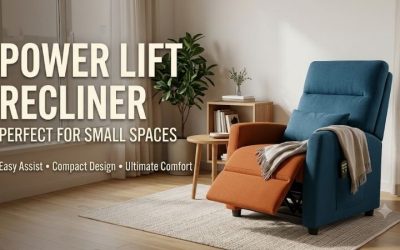
A loveseat recliner for small spaces can offer comfortable seating for two without requiring a full-size reclining sofa. However, narrow width does not guarantee a good fit. The backrest, footrests, and moving mechanisms need operating clearance. This guide explains how to measure the room, compare compact reclining designs, and avoid buying furniture that blocks everyday movement.
Why Small-Space Recliners Require More Planning
A regular loveseat generally occupies one relatively consistent footprint. A reclining loveseat changes dimensions as its seats extend.
This makes furniture placement more complicated.
A compact model may fit neatly between two walls when upright but become impractical when both footrests extend toward a coffee table.
The correct purchase requires planning for the largest position the furniture is intended to reach.
Closed Width Is Not Enough
Width determines how much wall space the loveseat consumes.
However, a model measuring 60 inches wide may still project more than 65 inches from front to back when fully reclined.
If the room has a narrow circulation route, that extension can become more restrictive than the loveseat’s width.
Measure the full operating area rather than choosing solely by the word compact.
Wall-Hugger Does Not Mean Zero Clearance Everywhere
Wall-hugger mechanisms are designed to reduce the amount of space needed behind a reclining chair.
Some move the seat forward as the backrest reclines.
This can allow placement closer to a wall than a conventional recliner.
However, the extended footrest still needs space in front.
A manufacturer’s stated three-inch wall clearance refers to the rear of the furniture, not the entire reclining footprint.
Small-Space Recliner Types Compared
| Type | Main advantage | Main drawback | Best use |
|---|---|---|---|
| Compact manual loveseat | Narrower and mechanically simple | Requires physical operation | Small conventional living room |
| Wall-hugger loveseat | Reduced rear clearance | Footrests still project forward | Sofa positioned near wall |
| Compact power loveseat | Adjustable positions | Electrical connection and higher cost | Everyday reclining |
| Console-free dual recliner | Saves width | No integrated storage | Narrow rooms |
| Console loveseat | Cup holders and storage | Wider footprint | Media-focused seating area |
| Separate reclining chairs | Flexible placement | Often more total floor area | Rooms with separated seating zones |
Measure the Room in Four Directions
Start with the wall where the loveseat will sit.
Record the available width after accounting for door frames, nearby furniture, and any structural obstructions.
Then measure the open floor area in front of the intended position.
Finally, confirm rear clearance and access around the furniture.
Measure the Rear Wall Gap
The manufacturer’s wall-clearance specification tells you how much space the reclining mechanism needs behind the furniture under stated conditions.
Do not assume a quoted measurement is valid for every upholstery configuration or installation.
The wall may also contain baseboards, outlets, or projections that affect placement.
Measure the Front Extension
The fully reclined length is particularly important.
For example, Ashley Tulen measures 40 inches deep while upright and approximately 65 inches when fully reclined.
The difference between these published measurements is 25 inches.
That is a useful planning comparison, although the actual movement distribution depends on the mechanism.
If a coffee table sits 15 inches in front of the upright loveseat, the extended footrest may interfere.
Measure Side Clearance
Manual controls are often mounted on the outside arms.
If the loveseat is pushed tightly against another piece of furniture, the occupant may have difficulty reaching or operating the handle.
Power control panels can also require accessible space.
A product can physically fit between two objects while remaining inconvenient to use.
Measure Delivery Access
A recliner may arrive in substantial boxes or partially assembled sections.
Check doorway width, hallway turns, stairs, and elevators.
Some manufacturers provide minimum doorway-width guidance.
However, the actual delivery route must still be assessed.
Real Compact Recliner Examples
| Model | Width | Upright depth | Fully reclined length | Rear clearance |
|---|---|---|---|---|
| La-Z-Boy Pinnacle Wall Reclining | 57 in | 38 in | 66.5 in | Manufacturer describes placement inches from wall |
| La-Z-Boy Pinnacle Power Wall with Headrest | 56 in | 38.5 in | Verify chosen configuration | Wall-reclining design |
| Ashley Tulen Manual | 63 in | 40 in | 65 in | 3 in |
| Ashley Draycoll Manual with Console | 78 in | 40 in | 67 in | 3 in |
| Ashley Mitchiner Manual with Console | 77 in | 40 in | 70 in | 3 in |
These examples show that a console-free reclining loveseat can save considerable width. However, narrow models still require a meaningful front operating area.
Example: Planning a Recliner in a 10 × 11-Foot Room
Consider a hypothetical living room measuring 120 × 132 inches.
Suppose the reclining loveseat is positioned against the 120-inch wall.
A 63-inch-wide model leaves 57 inches of wall span for other objects, before considering any side clearance.
If its fully reclined length is 65 inches, the remaining room depth along that direction is 67 inches.
However, the room may also contain a coffee table, television stand, desk, or doorway.
The available walking area can therefore be much smaller.
The best approach is to mark the full reclining footprint on the floor using removable tape. This makes it easier to see whether nearby furniture interferes with the intended movement.
Manual Versus Power Reclining in a Small Room
Manual Recliners
A manual loveseat uses handles, levers, or pull tabs to release the reclining mechanism.
It does not need a nearby electrical outlet for ordinary operation.
That can simplify furniture placement.
However, operating the mechanism may require physical effort, and the available positions can be more limited.
A buyer should check whether both occupants can operate the controls comfortably.
Power Recliners
A power loveseat uses an electric motor to adjust the reclining position.
It may permit more precise movement and offer additional powered headrest or lumbar features.
However, the furniture needs an appropriate power supply.
Cables should not cross walking routes or become trapped in moving mechanisms.
Battery accessories, when offered, have their own compatibility and charging requirements.
Which Is Better for a Compact Room?
Manual models offer simpler placement when outlets are limited.
Powered models may be more convenient when occupants regularly adjust seating positions.
Neither mechanism inherently saves more space. Compare the exact dimensions.
Should You Choose a Center Console?
A center console can hold drinks, remotes, and small accessories.
In a media room, this may eliminate the need for some side-table storage.
However, the console usually adds width and separates the two seats.
For a narrow apartment, that trade-off can be substantial.
When a Console Helps
A center console is useful when the loveseat serves primarily as television or gaming seating.
Two cup holders can reduce the need for separate drink tables.
A storage compartment may help keep remotes organized.
When a Console Wastes Space
A couple who prefer sitting close together may dislike a fixed divider.
The extra width may also prevent the loveseat from fitting between an entryway and another piece of furniture.
A compact console-free model can offer more practical value even when it has fewer features.
Seat Height and Depth for Small-Space Comfort
A loveseat’s size should not be reduced at the expense of appropriate seating support.
Seat Height
A low seat can feel relaxed but may require more effort when standing.
A high seat may suit some taller occupants but leave shorter people with insufficient foot contact.
The correct height depends on body proportions and cushion compression.
Seat Depth
Deep seats provide more room to lounge.
However, a shorter occupant may struggle to sit upright while using the backrest.
A relatively shallow seat can feel more supportive during conversation or reading.
Footrest Length
The extended legrest must support the intended occupant comfortably.
A compact frame may be less suitable for a very tall person.
Compare the complete chair fit rather than only the exterior width.
Upholstery Choices for Apartments
A small living room often serves several purposes, increasing the likelihood of spills and surface wear.
Polyester upholstery is common in budget recliners. Faux leather can provide a smooth surface but has its own cleaning and aging considerations.
Performance fabric may offer resistance to certain stains, but it is not automatically waterproof or immune to wear.
Choose upholstery based on documented care instructions and the household’s actual use.
Do not assume that thick plush upholstery is more durable than a tighter woven fabric.
Common Buying Mistakes
Measuring Only the Upright Sofa
A recliner’s largest usable footprint occurs when its mechanism is extended.
Measure both positions.
Assuming Wall-Hugger Means No Floor Clearance
Wall-hugger designs reduce rear requirements, not necessarily front extension.
Buying a Console Model Without Checking Width
The center console can add substantial wall-space requirements.
Ignoring Control Access
A tightly positioned loveseat may block side-mounted handles or power panels.
Forgetting the Power Cable
Electrical recliners need appropriate cable routing and outlet access.
Frequently Asked Questions
What Is the Best Loveseat Recliner for a Small Space?
A compact console-free wall-reclining loveseat is a strong starting point. The La-Z-Boy Pinnacle and Ashley Tulen illustrate two different options, but the best fit depends on the full reclining footprint and occupant comfort.
How Much Room Does a Wall-Hugger Loveseat Need?
Follow the manufacturer-specific rear-clearance requirement and fully extended dimensions. A model needing only a few inches behind its backrest can still extend substantially in front.
Is a 60-Inch Reclining Loveseat Small?
It can be relatively compact compared with wider console-equipped models. However, width alone does not establish room fit. Depth, footrest extension, and nearby furniture also matter.
Can a Reclining Loveseat Fit in a Studio Apartment?
Yes, when the complete open configuration preserves practical room access. Mark the intended floor footprint before purchasing.
Are Power Recliners Better for Small Apartments?
Not automatically. Power controls may improve convenience but add electrical requirements. A manual loveseat can be simpler when the room lacks a suitable nearby outlet.
Is a Reclining Loveseat Better Than Two Recliner Chairs?
A loveseat can provide a more unified seating arrangement, while separate chairs allow independent placement. The more space-efficient option depends on actual product dimensions and the room layout.
Conclusion
A loveseat recliner for small spaces is worth buying when its full reclining dimensions fit without obstructing circulation or essential furniture. Prioritize complete operating clearance, appropriate seat height and depth, accessible controls, and manageable delivery. A console-free wall-hugger may save width, while powered models add convenience at greater cost and complexity. Measure the room in both seating positions before committing.