Key takeaways
- A sleeper sofa is a strong choice when the room needs comfortable daytime seating and occasional overnight accommodation in the same location.
A sleeper sofa vs alternatives comparison should consider more than whether guests can sleep on the furniture. Sleeper sofas, futons, Murphy beds, daybeds, trundles, and air mattresses have different requirements for floor space, mattress comfort, storage, and everyday use. This guide compares their practical strengths and limitations to help you choose the right solution for your room and budget.
Quick Verdict: Should You Buy a Sleeper Sofa?
A sleeper sofa is a strong choice when the room needs comfortable daytime seating and occasional overnight accommodation in the same location.
Its main advantage is that it performs two functions without requiring a permanently exposed bed.
However, the conversion mechanism and mattress can create compromises. A sleeper sofa may be heavy, require substantial extension clearance, and cost more than ordinary seating.
A Murphy bed may be more appropriate when a room is used for sleeping regularly but needs open floor space during the day. A daybed is worth considering when a conventional mattress is more important than sofa-like seating. A futon may offer lower-cost flexibility, while an air mattress provides temporary accommodation without requiring another large permanent furniture piece.
| Furniture type | Main advantage | Main limitation | Best starting situation |
|---|---|---|---|
| Sleeper sofa | Conventional seating plus guest bed | Mechanism, weight, and open clearance | Multipurpose living room |
| Futon | Simple convertible design | Seating and sleeping compromises vary | Budget room |
| Murphy bed | Full bed stored vertically | Wall installation and cost | Daily sleeping in multipurpose room |
| Daybed | Uses a conventional-style mattress | Less like a normal sofa | Guest room or home office |
| Trundle bed | Secondary bed stored below another | Requires rollout floor area | Children’s room or guest room |
| Air mattress | Stores away between visits | Setup, inflation, and comfort limitations | Infrequent guests |
| Folding guest bed | Portable framed mattress | Storage space and handling | Occasional overnight accommodation |
| Regular sofa | Focused everyday seating | No dedicated guest bed | Homes with separate sleeping space |
Understanding the Core Difference: Seating Versus Sleeping Priority
The most useful way to compare these alternatives is to determine which function matters more.
A sleeper sofa prioritizes familiar daytime seating while incorporating a sleeping mechanism.
A Murphy bed prioritizes a conventional sleeping arrangement that can be stored vertically.
A daybed maintains a mattress-based surface throughout the day and night.
An air mattress prioritizes temporary storage and occasional use rather than permanent seating.
These design priorities influence comfort, maintenance, and the space required.
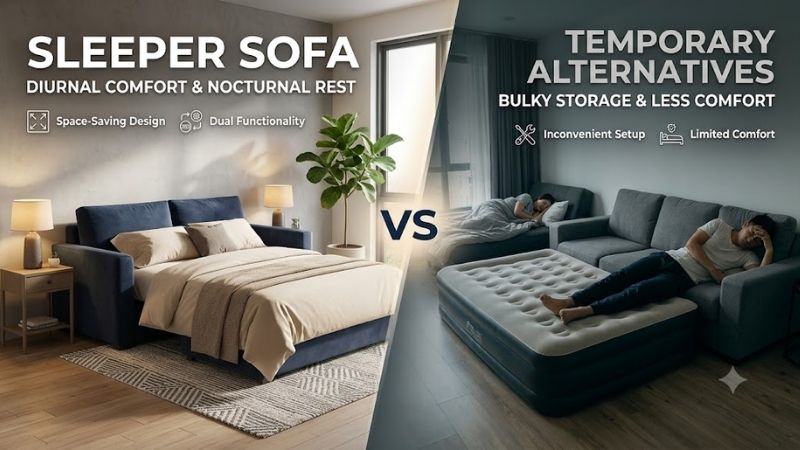
A Sleeper Sofa Is Not Necessarily a Space-Saving Bed
A sleeper sofa saves the space that would otherwise be occupied permanently by a separate guest bed.
However, it still requires a large sleeping footprint when opened.
If a small room has a coffee table, desk, and bookcase occupying the necessary area, the sleeper may be difficult to use.
The relevant measurement is therefore the entire room in its nighttime configuration.
A Sofa That Converts Frequently Needs a Practical Mechanism
A guest bed used twice a year can require a little effort without becoming inconvenient.
A sofa bed used every night must be easy to convert repeatedly.
If opening the furniture requires moving several other heavy items, the household may eventually find the arrangement impractical.
Conversion effort should be considered alongside mattress comfort.
Sleeper Sofa vs Futon
Futons are among the most common alternatives to sleeper sofas because both provide convertible seating and sleeping.
However, the underlying structure and experience can differ.
Conversion Mechanism
Many futons convert by changing the position of a backrest or frame.
Some use a mattress that folds with the furniture.
Traditional sleeper sofas may store a separate mattress inside a more conventional upholstered couch.
This means a futon can be mechanically simpler, although not every model is equally easy to open.
Everyday Seating
A futon may offer a relatively firm, flat seating surface.
Some users enjoy this simplicity, while others prefer the cushioning and back support of a conventional sofa.
A sleeper sofa can provide a more traditional living-room appearance but may be heavier and more expensive.
Sleeping Comfort
Futon mattresses vary in thickness, material, and support.
A substantial futon mattress may be comfortable for some sleepers, but a thin budget model may not be.
Likewise, a sleeper sofa with a poor mattress can feel uncomfortable despite its higher price.
The mattress and foundation matter more than the category name.
Cost and Maintenance
Futons are available at relatively accessible prices, making them attractive for students and temporary apartments.
However, frames and mattresses may be sold separately.
A complete price comparison must include all required components.
Which Is Better?
Choose a futon when simple conversion and cost matter most.
Choose a sleeper sofa when conventional daytime seating and appearance are priorities.
Sleeper Sofa vs Murphy Bed
A Murphy bed folds into a wall-mounted or cabinet-like structure when not in use.
This makes it a fundamentally different space-planning solution from a sleeper sofa.
Sleeping Surface
A Murphy bed can accommodate an appropriate conventional mattress, subject to the specific bed system’s requirements.
This may provide more mattress choices than a thin folding sleeper-sofa mattress.
For someone sleeping in the room every night, that flexibility can be valuable.
However, mattress thickness, weight, and compatibility restrictions still apply.
Daytime Floor Space
A Murphy bed can free the area normally occupied by a mattress when raised.
However, the cabinet or mounting structure occupies wall space.
The room also needs sufficient clearance to lower the bed safely.
A sleeper sofa remains visible as seating during the day, which is useful when the room is primarily a living area.
Installation and Safety
Murphy beds require installation according to their manufacturer’s specifications.
Some systems require secure wall or structural anchoring.
Improperly installed wall beds can create serious injury hazards.
A renter may also face restrictions on installing permanent furniture.
Never substitute household fasteners or improvise wall mounting.
Cost
Murphy beds generally involve a more substantial furniture system and installation than basic sofa beds.
However, their value can be stronger when they replace a permanent bed in a room used for other activities during the day.
Which Is Better?
Choose a Murphy bed when comfortable regular sleeping and daytime floor recovery are the main priorities.
Choose a sleeper sofa when the room needs conventional seating every day.
Sleeper Sofa vs Daybed
A daybed uses a mattress within a frame designed to function as both a bed and a seating surface.
Unlike many sleeper sofas, its mattress may remain horizontal throughout ordinary use.
This can simplify sleeping arrangements.
Mattress Comfort
A daybed may accommodate a conventional twin mattress, depending on the model.
This provides an opportunity to choose mattress firmness and construction according to the expected sleeper.
However, a daybed is not automatically comfortable for sitting.
A deep twin mattress can make it difficult to sit upright against the back frame without additional cushions.
Everyday Seating
A daybed often needs large back pillows to create a sofa-like sitting position.
Those pillows must be moved when someone sleeps.
A sleeper sofa generally offers more purpose-designed seated cushions and armrests.
Room Fit
Daybeds occupy a permanent mattress-sized footprint.
A twin daybed is approximately 75 inches long before accounting for the frame, but actual exterior dimensions vary.
This can work well along a wall in a home office or guest room.
A sleeper sofa may occupy less depth while closed but substantially more when opened.
Which Is Better?
Choose a daybed when a conventional mattress and immediate sleeping access matter.
Choose a sleeper sofa when ordinary seated comfort is the main daytime requirement.
Sleeper Sofa vs Trundle Bed
A trundle bed stores a secondary sleeping platform beneath a main bed or daybed.
It can provide additional sleeping accommodation without permanently exposing both mattresses.
However, it does not perform exactly the same function as a sleeper sofa.
Two Sleeping Surfaces
A trundle may allow two people to sleep on separate mattresses.
This can be useful for children or guests who prefer separate sleeping spaces.
However, the trundle typically requires floor clearance to roll out.
Some designs remain low to the floor, while others can elevate.
Daily Seating
A trundle bed alone does not provide conventional living-room seating.
It may be paired with a daybed, but the result is still different from an upholstered sofa.
A household requiring comfortable everyday television seating may prefer a sleeper sofa.
Floor Space
The trundle can reduce occupied floor area when stored.
However, the open configuration may extend substantially into the room.
A narrow bedroom must be measured for full rollout.
Which Is Better?
Choose a trundle when additional beds are needed, especially in a guest room or children’s bedroom.
Choose a sleeper sofa when one piece of furniture needs to function as the main couch.
Sleeper Sofa vs Air Mattress
An air mattress is a practical alternative when overnight guests visit rarely and the household does not want to keep extra large furniture permanently.
It can be deflated and stored in a closet or container between uses.
However, comfort and setup differ from a sleeper sofa.
Storage Advantages
A deflated air mattress occupies relatively little storage space compared with a permanent sofa or daybed.
This can be attractive in a small apartment with no dedicated guest room.
However, the household must have enough floor space to inflate and use the mattress when needed.
A queen air mattress still requires approximately queen-sized sleeping area.
Setup and Inflation
Many air mattresses require an electric or manual pump.
The setup process can be straightforward, but it adds an extra step when guests arrive.
The mattress must also be deflated and dried appropriately before storage.
Overnight Comfort
Air mattresses can feel different from foam or spring mattresses.
Air pressure may change with temperature, loading, or minor leakage.
Some guests find them comfortable for short stays; others dislike the sensation.
A low air mattress may also make getting up more difficult for certain adults.
Durability
Punctures, valve problems, and air loss are common practical concerns with inflatable designs.
A sleeper sofa avoids these particular issues but introduces mechanical and upholstery maintenance.
Which Is Better?
Choose an air mattress when overnight guests are infrequent and storage space is available.
Choose a sleeper sofa when the household also needs permanent seating and wants guest accommodation immediately accessible.
Sleeper Sofa vs Folding Guest Bed
A folding guest bed usually consists of a mattress and a collapsible frame that can be stored upright or folded between uses.
It can offer a more bed-like support structure than an air mattress while remaining portable.
Mattress and Support
Folding beds may use foam, spring, or other mattress constructions.
The frame must safely support the intended load.
A thin folding mattress may still provide a different sensation from a substantial conventional bed.
Storage Requirements
A folding guest bed may occupy a narrow footprint when stored upright, but its height and weight can make it difficult to hide.
The owner needs a suitable storage location.
Moving and Setup
Some folding beds use casters, while others must be carried.
A heavy folding bed may be inconvenient in a home with stairs.
Which Is Better?
Choose a folding guest bed when you want occasional mattress-based sleeping without dedicating a room to a sofa.
Choose a sleeper sofa when permanent seating is also needed.
Comparing the Alternatives for Small Homes
| Living situation | Strong starting option | Why |
|---|---|---|
| Studio used for living and sleeping | Murphy bed or suitable sleeper sofa | Different balance of mattress comfort and seating |
| Living room with occasional guests | Sleeper sofa | Everyday seating plus overnight function |
| Home office used as guest room | Daybed or compact sleeper | Appropriate secondary room furniture |
| Children’s shared guest space | Trundle bed | Separate sleeping surfaces |
| Rare overnight visitors | Air mattress or folding guest bed | Avoids permanent extra seating |
| Student apartment | Futon or budget convertible sofa | Accessible multifunctionality |
| Guest room prioritizing mattress comfort | Daybed or suitable bed system | More conventional sleeping surface |
Which Alternative Is Most Comfortable for Sleeping?
Sleeping comfort depends on mattress quality, firmness, support, body proportions, and personal preference.
A Murphy bed using a suitable conventional mattress may offer greater mattress flexibility than a basic sofa bed.
A daybed can also use a conventional mattress, subject to frame specifications.
However, a premium sleeper sofa with a well-designed dedicated mattress may be comfortable for many guests.
An air mattress or thin futon may be sufficient for short stays but less appealing for certain sleepers.
No category should be declared universally comfortable without evaluating its actual surface.
Overnight Use Frequency Matters
For a guest staying once a year, a simple temporary solution may be reasonable.
For weekly visitors or a person using the bed every night, consistent support, setup convenience, and durability become more important.
Choose based on expected use rather than the maximum number of functions advertised.
Which Option Saves the Most Space?
The answer depends on whether space is measured during the day, during sleep, or during storage.
A Murphy bed can recover a large amount of floor space when raised, but requires wall and cabinet space.
A sleeper sofa provides permanent seating but needs an extended footprint when opened.
An air mattress can disappear into storage between visits but offers no daily seating.
A daybed occupies a permanent mattress-sized area but does not require a substantial conversion process.
Therefore, the most space-efficient choice is the one that suits how the room is used throughout the day.
Cost and Long-Term Value
Sleeper Sofa
The purchase includes seating and a bed, but may also involve mechanism maintenance and specialty mattress replacement.
Futon
Initial cost can be relatively accessible, although frame and mattress may be sold separately.
Murphy Bed
Upfront cost and installation can be substantial.
However, it may provide long-term value in a room used for sleeping every night.
Daybed
A daybed frame and suitable mattress can be practical for secondary rooms.
Additional back cushions may be needed for comfortable seating.
Air Mattress
Initial cost and storage requirements are often low, but punctures, air loss, and replacement may affect ownership value.
Folding Guest Bed
The purchase provides a separate bed that can be stored, but it still requires enough space and may be heavy to move.
Common Buying Mistakes
Comparing Only Closed Dimensions
Every convertible bed needs sufficient open-room clearance.
Assuming a Sofa Bed Is Always Worse Than a Futon
Actual mattress and support construction determine comfort.
A well-designed sleeper can outperform a poorly constructed futon.
Buying a Murphy Bed Without Checking Installation Requirements
Proper anchoring and structural compatibility are essential.
Choosing an Air Mattress for Frequent Use Without Considering Maintenance
Inflation, air-pressure changes, and puncture risk may become inconvenient.
Ignoring Everyday Seating
A daybed or futon may provide useful sleeping accommodation but different sitting comfort from a conventional sofa.
Frequently Asked Questions
Is a Sleeper Sofa Better Than a Futon?
A sleeper sofa often provides a more traditional couch appearance and seating structure. A futon may offer simpler conversion and lower cost. Sleeping comfort depends on mattress and frame construction rather than category alone.
Is a Murphy Bed Better Than a Sleeper Sofa for Daily Use?
A Murphy bed may provide more conventional mattress options and free floor space when raised. A sleeper sofa provides everyday seating. The right choice depends on whether sleeping comfort or seating function is the greater priority.
Is a Daybed More Comfortable Than a Sleeper Sofa?
A daybed can use a conventional mattress, but comfort depends on that mattress and its support. A premium sleeper with a dedicated mattress may also be comfortable. Compare actual products.
Is an Air Mattress Cheaper Than a Sleeper Sofa?
It often requires less initial spending, but it provides no permanent seating and has different maintenance needs. The correct value comparison depends on guest frequency and existing furniture.
What Is Best for a Very Small Guest Room?
A daybed, compact sleeper loveseat, or folding guest bed may be practical. Measure the room and consider whether seating is needed during the day.
Which Alternative Is Best for Couples Staying Overnight?
A suitably sized queen sleeper, Murphy bed, or appropriate conventional guest bed may work well. Check actual sleeping width and length; do not assume every sofa bed provides a standard queen surface.
Conclusion
A sleeper sofa is the better choice when a room needs comfortable everyday seating and occasional guest accommodation. Futons offer simpler convertible alternatives, Murphy beds prioritize a stored conventional sleeping surface, and daybeds provide mattress-based seating and sleeping. Trundles, air mattresses, and folding beds suit different guest arrangements. Choose according to the room’s daytime and nighttime use, sleeping comfort, conversion effort, and long-term ownership cost.