Key takeaways
- A straight body pillow is a versatile starting choice for side sleepers who want one long cushion to hug and position between the knees. It can provide contact along several parts of the body without requiring a specialized contour.
A body pillow can provide cushioning along the torso, between the knees, or in front of the upper body, but it is not always the most practical way to address sleeping discomfort. A smaller knee pillow may provide more targeted leg cushioning, while a regular bed pillow can be easier to position and wash. Pregnancy pillows offer more structured support, lumbar cushions address different positioning needs, and wedge pillows create elevation rather than simply providing side-sleeping contact.
Quick Verdict: Body Pillow or a More Targeted Alternative?
A straight body pillow is a versatile starting choice for side sleepers who want one long cushion to hug and position between the knees. It can provide contact along several parts of the body without requiring a specialized contour.
A dedicated knee pillow is more appropriate when the primary need is cushioning between the legs. A C-shaped or U-shaped pregnancy pillow may be worthwhile when several support areas are desired simultaneously, but these designs occupy substantially more mattress space.
An ordinary rectangular pillow may be enough for occasional knee or arm cushioning. A wedge pillow is preferable when the objective is body elevation rather than hugging or lateral support.
| Support option | Primary function | Main advantage | Main drawback | Best starting use | |—|—|—|—|—| | Straight body pillow | Long, flexible cushioning | Supports multiple body regions | Occupies considerable mattress length | General side sleeping | | Knee pillow | Targeted support between legs | Compact and purpose-specific | Does not support upper body | Knee cushioning | | C-shaped pregnancy pillow | Curved multi-area contact | Can replace several pillows | Fixed shape and greater bulk | Wraparound comfort | | U-shaped pregnancy pillow | Support on both sides | Cushioning for position changes | Large mattress footprint | Surrounding body support | | Regular bed pillow | Flexible general cushioning | Already available, easy to replace | May be too short or compressible | Occasional support | | Lumbar cushion | Local back support | Compact targeted positioning | Not designed for full-body cushioning | | Wedge pillow | Inclined support | Changes body elevation | Less flexible for hugging | | Adjustable body pillow | Customizable filling or positioning | Can adapt thickness | Requires adjustment and maintenance |
What Makes a Body Pillow Different?
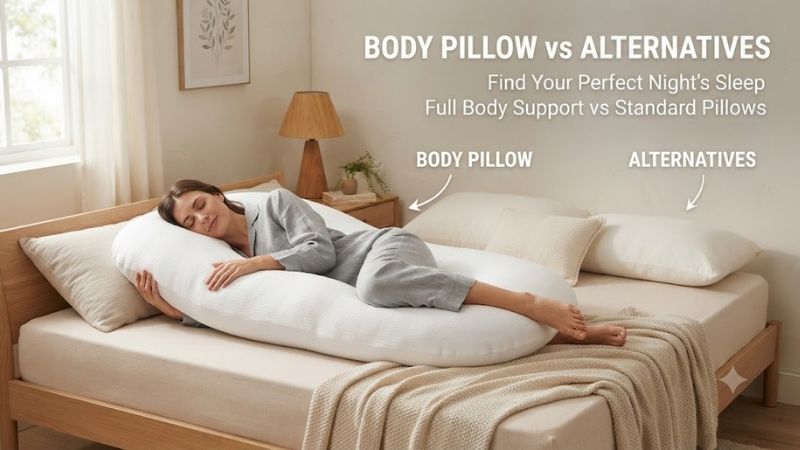
The defining feature of a body pillow is its extended shape.
Rather than supporting only the head, it is designed to contact other body regions. Its length allows a sleeper to place one section near the arms and another between the legs.
That flexibility can make a body pillow convenient, but the longer form is not automatically advantageous.
A person who only needs cushioning at the knees may find a full-length pillow unnecessary. Another person who wants to hug a pillow while sleeping may strongly prefer its extended surface.
Support Versus Positioning
A body pillow provides cushioning and may influence how comfortably the user rests in a particular position.
However, it does not guarantee ideal spinal alignment.
The amount of support depends on filling thickness, compression, body proportions, and mattress characteristics.
A soft body pillow may flatten significantly beneath the upper leg, while a firmer one may create an uncomfortable degree of separation.
The correct choice is the product that allows a comfortable, natural resting position.
Why Dimensions Matter
A common straight body-pillow size is approximately 20 × 54 inches, although actual products vary.
That is considerably longer than a standard head pillow.
The added length may be useful when cushioning both the upper and lower body.
However, a large pillow can also interfere with another sleeper, create additional laundry, and be difficult to store.
Buy based on the support areas you actually need rather than assuming maximum length is better.
Body Pillow vs Knee Pillow
This is one of the most useful comparisons for side sleepers.
A body pillow provides an extended cushioning surface, while a knee pillow is designed to support the legs within a smaller area.
Both can be comfortable, but they solve different practical problems.
Targeted Knee Cushioning
A dedicated knee pillow may have a contoured shape intended to rest between the knees or thighs.
Its compact dimensions can make it easier to position and transport than a full body pillow.
For someone whose only complaint is uncomfortable knee contact during side sleeping, a knee pillow may be sufficient.
However, a small contoured pillow may not remain in the preferred position if the sleeper moves frequently.
Whole-Body Contact
A body pillow can extend from the upper torso toward the knees or lower legs.
This creates opportunities to hug the pillow while using another section for leg cushioning.
A person who wants both functions may prefer one straight body pillow over separate cushions.
Thickness and Hip Position
The effective thickness between the knees affects how the upper leg rests.
A dedicated knee pillow may retain a relatively defined shape, especially when made from molded foam.
A soft body pillow may compress more substantially.
Neither is automatically healthier. Excessive separation can be uncomfortable, while inadequate cushioning may not meet the user’s preferences.
Movement During Sleep
A knee pillow can shift when a person turns over.
Some contoured designs include features intended to help positioning, but these should not be treated as restraints.
A straight body pillow can also require repositioning.
People who frequently change sides should consider which arrangement they can move comfortably without disrupting sleep.
Which Is Better?
Choose a knee pillow for compact, targeted leg cushioning.
Choose a body pillow when you also want upper-body contact or a longer resting surface.
Body Pillow vs Regular Bed Pillow
Many people first experiment with side-sleeping support by placing an ordinary pillow between their knees.
This can be a reasonable way to determine whether additional cushioning feels useful before purchasing a specialized product.
However, an ordinary pillow may differ substantially from a dedicated body pillow in length and filling behavior.
Versatility
A conventional pillow can support the head, be hugged, or be placed between the knees.
Its main advantage is simplicity.
If the household already owns a suitable pillow, no additional purchase may be necessary.
Length Limitations
A standard bed pillow is much shorter than a conventional full-length body pillow.
It generally cannot provide continuous contact along the upper torso and lower legs at the same time.
Someone who wants several support areas may find the shorter pillow inconvenient.
Fill Compression
A very soft head pillow may compress almost completely between the knees.
Conversely, a high-loft firm pillow may create excessive separation.
The effectiveness depends on its actual fill rather than the fact that it is labeled a bed pillow.
Maintenance and Storage
Regular pillows are easier to pair with commonly available pillowcases.
They may also be simpler to wash and store than oversized body pillows.
This can make them more practical for occasional use.
Which Is Better?
Use a regular pillow when the need is occasional, limited, or still uncertain.
Consider a body pillow when longer cushioning provides a clear comfort advantage.
Body Pillow vs Pregnancy Pillow
Pregnancy pillows are commonly body pillows with specialized shapes intended to provide cushioning around several body regions.
The terms overlap, but a straight body pillow differs from a large C-shaped or U-shaped maternity design.
The best choice depends on the areas requiring support and how freely the user needs to move.
Straight Body Pillows During Pregnancy
A straight pillow can be placed in front of the body and between the legs.
It may provide useful cushioning without occupying both sides of the mattress.
This makes it a practical starting option when the user mainly wants one or two support areas.
However, it must be repositioned if the desired contact changes.
C-Shaped Pregnancy Pillows
A C-shaped design wraps around selected parts of the body.
It may provide head, back, or leg cushioning depending on the model and how it is used.
This can reduce the need to arrange several ordinary pillows separately.
The trade-off is a relatively fixed shape.
If the curve does not match the person’s proportions, the pillow may feel awkward or create pressure.
U-Shaped Pregnancy Pillows
A U-shaped pillow provides cushioning on both sides of the body.
For someone who frequently changes sides, this may reduce the need to move the entire pillow.
However, the large footprint can interfere with a partner’s sleeping area and make getting out of bed more complicated.
Safety and Medical Considerations
Pregnancy pillows are primarily comfort accessories.
They do not replace medical guidance about positioning, pain, or pregnancy complications.
A pillow should not create excessive abdominal pressure or restrict comfortable movement.
People with specific pregnancy-related medical concerns should follow their maternity clinician’s recommendations.
Which Is Better?
Choose a straight body pillow when flexible, relatively simple cushioning is sufficient.
Consider a C-shaped or U-shaped design when surrounding support offers a meaningful benefit and the mattress has enough space.
Body Pillow vs Lumbar Support Pillow
A lumbar support pillow is generally designed to provide cushioning or positional support around the lower back.
It is commonly used while sitting, although some products are intended for resting positions.
This is different from a body pillow that runs along the side of the body.
Localized Support
A lumbar cushion focuses on a relatively small area.
Its shape may be useful in a chair or reclined seated position.
However, a support intended for sitting should not automatically be placed beneath the lower back during sleep.
The intended use matters.
Body Pillows for Back Contact
A body pillow can rest behind the torso while the user lies on one side.
This may provide a comfortable surface.
However, it is less precisely shaped for a particular lumbar support arrangement.
Why More Support Is Not Always Better
A thick cushion beneath the lower back can alter positioning.
If the resulting arrangement is uncomfortable, the product is not appropriate simply because it is labeled ergonomic.
Persistent back pain should be assessed rather than managed solely through pillow stacking.
Which Is Better?
Choose lumbar support when the need is specific to a supported back position, particularly seated use.
Choose a body pillow when the goal is flexible cushioning along the side of the torso or legs.
Body Pillow vs Wedge Pillow
A wedge pillow changes body elevation.
A body pillow primarily provides cushioning along a particular body region.
These functions are different enough that one product should not generally be substituted for the other without considering the intended outcome.
Upper-Body Elevation
An upper-body wedge may provide a continuous incline beneath the torso.
For adults with nighttime reflux, head-of-bed elevation is sometimes recommended as part of appropriate management.
A body pillow does not provide the same stable inclined surface.
Side-Sleeping Comfort
A body pillow can be hugged or positioned between the knees.
A wedge generally has a fixed triangular support profile.
It may be useful for certain elevated side-sleeping arrangements, but it is less flexible for targeted cushioning.
Storage and Portability
A foam wedge may have a rigid shape that occupies substantial storage space.
A body pillow can sometimes be compressed or repositioned more readily, depending on filling.
However, large U-shaped body pillows can be bulkier than ordinary wedges.
Which Is Better?
Choose a wedge for appropriate inclined support.
Choose a body pillow for hugging, knee cushioning, and flexible contact along the body.
Do not rely on one to perform the other’s primary function.
Body Pillow vs Adjustable Body Pillow
Adjustable body pillows allow the user to alter the filling amount, and some flexible designs can be rearranged into different shapes.
These features can help when ordinary fixed-fill pillows do not provide the preferred thickness.
Adjustable Loft
An adjustable shredded-fill pillow can be made thinner or fuller within the manufacturer’s permitted range.
This may be particularly useful for knee cushioning because the desired thickness depends on body proportions and mattress behavior.
However, changing the fill may require experimentation.
Filling Redistribution
Shredded foam, latex, and certain textile fillings can shift during use.
A pillow may need periodic fluffing to restore an even surface.
Some people appreciate this moldability.
Others prefer the consistency of a fixed-fill pillow.
Storage of Extra Filling
Removed filling must be kept clean and dry.
In a small apartment, this adds a storage requirement.
A fixed-fill pillow may be more convenient when its thickness already feels comfortable.
Which Is Better?
Choose adjustable filling if you are uncertain about loft or want to fine-tune cushioning.
Choose fixed-fill construction when the existing dimensions and firmness suit your preferences.
Which Pillow Is Best for Side Sleepers?
Side sleeping creates multiple possible contact and cushioning needs.
A person may want support beneath the head, cushioning between the knees, or somewhere to rest the upper arm.
These are separate functions.
Head and Neck Support
A body pillow usually does not replace an appropriate head pillow unless the specific design is intended to support that area.
The head pillow must still suit the sleeper’s shoulder width and mattress.
A poorly fitted head pillow cannot necessarily be corrected by adding a body pillow.
Knee and Leg Positioning
A body pillow can create comfortable separation between the legs.
The correct thickness is individual.
A molded knee pillow may be more precise when only that area requires cushioning.
Upper-Arm Comfort
Hugging a body pillow can provide a resting surface for the upper arm.
However, excessively thick filling may push the arm or shoulder into an uncomfortable position.
Choose a pillow whose compression feels natural.
Mattress Firmness
A soft mattress allows parts of the body to sink farther than a firm one.
This changes the effective position of a body pillow between the legs or alongside the torso.
A pillow that feels comfortable on one mattress may not provide the same sensation on another.
Material Comparison: What Filling Makes Sense?
| Filling | Typical feel | Main advantage | Main limitation |
|---|---|---|---|
| Polyester fiberfill | Soft and fluffy | Lightweight, familiar cushioning | Can flatten |
| Shredded memory foam | Contouring and substantial | May offer adjustable thickness | Heavier and requires fluffing |
| Shredded latex | Responsive and resilient | Quick shape recovery | Price, weight, allergy considerations |
| Down | Soft and compressible | Moldability | Requires loft maintenance |
| Down alternative | Plush synthetic filling | Accessible and widely available | Durability varies |
| Molded foam | Fixed contour | Consistent geometry | Limited adjustment |
| Buckwheat or similar loose fill | Firm and moldable | Adjustable shape | Weight and texture |
Choosing Filling for Knee Support
A moderately supportive filling may retain enough thickness beneath the upper leg.
However, greater firmness is not automatically better.
If the pillow pushes the leg uncomfortably high, the thickness or positioning may be unsuitable.
An adjustable design can be useful when the ideal amount of cushioning is uncertain.
Choosing Filling for Hugging
A softer, more compressible pillow may feel comfortable against the chest and arms.
However, a very soft filling can lose loft.
The best choice depends on whether you prefer plush contact or a more substantial surface.
Temperature and Fabric Covers
Large body pillows create considerable contact with the body.
Plush polyester covers may feel warm to some sleepers, while lighter cotton or other textile covers may feel more comfortable.
However, fiber names alone do not establish a universally cooler product.
The full construction and bedroom conditions matter.
The Hidden Ownership Costs of Body Pillows
A body pillow may appear simple, but its size and shape can increase laundering and storage requirements.
Replacement Pillowcases
Straight rectangular body pillows often have more widely available cover sizes.
C-shaped and U-shaped products may require specialty covers.
Before buying, confirm that replacements can be obtained.
Washing the Insert
Some polyester-filled pillows permit machine washing.
Foam and latex products may require different cleaning methods.
A large insert can also exceed the capacity of a compact household washer.
Drying
A body pillow may retain moisture within its filling.
Ensure complete drying before use or storage.
Storage
A long straight pillow can be awkward in a small closet.
A U-shaped design can occupy substantially more volume.
If the pillow will be stored every morning, measure the actual storage area before purchasing.
Buying Scenarios: Which Alternative Offers Better Value?
Scenario 1: Side Sleeper With Knee Discomfort
Start by considering a dedicated knee pillow or a suitably filled regular pillow.
If the user also wants upper-arm cushioning, a straight body pillow may provide better versatility.
Scenario 2: Pregnant Sleeper Wanting Multiple Contact Points
A C-shaped or U-shaped pregnancy pillow may be appropriate when its shape provides comfortable cushioning around several areas.
However, a straight pillow can be sufficient when the desired support is more limited.
Scenario 3: Small Shared Bed
A straight or compact targeted pillow may be more practical than a large wraparound design.
Measure the complete footprint before buying.
Scenario 4: Person Who Changes Positions Frequently
A straight or flexible pillow may be easier to rearrange.
A U-shaped pillow may offer contact on both sides, but its bulk can be inconvenient.
Scenario 5: Budget-Conscious Shopper
Try a suitable existing pillow before investing in a specialty design.
If it provides the intended comfort, a new full-length product may be unnecessary.
Common Comparison Mistakes
Assuming Bigger Means Better Support
A large pillow may add contact without improving the specific position that feels uncomfortable.
Identify the desired cushioning area first.
Buying a Pregnancy Pillow for Ordinary Knee Support
A specialized curved pillow may be unnecessary when a compact knee pillow would serve the main purpose.
Ignoring Fill Compression
A pillow’s unloaded thickness does not show how much support remains beneath the body.
Evaluate its behavior under normal pressure.
Expecting a Body Pillow to Treat Pain
Body pillows may improve positional comfort for some users but are not guaranteed medical treatments.
Persistent or worsening symptoms require appropriate evaluation.
Frequently Asked Questions
Is a Body Pillow Better Than a Knee Pillow?
A body pillow is more versatile because it can cushion the arms, torso, and legs. A knee pillow is more compact and focused. If knee cushioning is the only goal, the smaller product may be sufficient.
Is a Body Pillow Better Than a Pregnancy Pillow?
A straight body pillow may be easier to reposition and store. C-shaped and U-shaped pregnancy pillows provide more structured contact around several body areas. The better choice depends on comfort needs, mattress size, and movement preferences.
Can I Use a Regular Pillow Instead of a Body Pillow?
Yes, for certain purposes. An ordinary pillow can provide knee or arm cushioning. A body pillow becomes useful when its additional length allows simultaneous contact along multiple regions.
Are Memory-Foam Body Pillows Better Than Polyester?
Shredded memory foam can provide more substantial cushioning, while polyester often feels lighter and softer. Neither is universally better. Choose according to desired thickness, compression, handling, and cleaning.
Can a Body Pillow Improve Spinal Alignment?
A body pillow may help some sleepers maintain a comfortable position, but it cannot guarantee ideal spinal alignment or treat every cause of pain. Support requirements differ according to anatomy, mattress, and sleeping position.
Which Alternative Is Best for a Small Bedroom?
A straight body pillow or compact knee pillow often requires less space than a large C-shaped or U-shaped arrangement. Choose the smallest product that provides the desired cushioning without restricting movement.
Conclusion
A body pillow is the best starting choice when you want flexible cushioning along the torso, arms, and legs, especially during side sleeping. Dedicated knee pillows are more practical for localized leg support, pregnancy pillows offer more structured wraparound comfort, and ordinary pillows can be sufficient for occasional use. Wedge and lumbar cushions serve different positioning needs. Choose based on support location, filling compression, mattress space, and cleaning convenience rather than buying the largest or most specialized design.