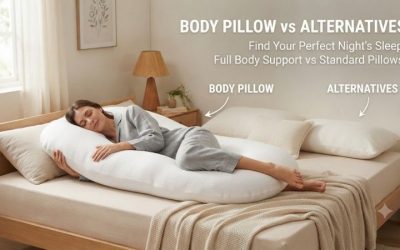
A cooling pillow promises a more comfortable sleeping surface by using materials such as gel-infused foam, ventilated latex, phase-change fabrics, or specialized pillow covers. However, a cooling label does not automatically mean a pillow will stay cool throughout the night, provide better neck support, or outperform traditional alternatives. Many ordinary pillows already offer useful airflow and comfortable cushioning without expensive temperature-related features.
Quick Verdict: Is a Cooling Pillow Worth Buying?
A cooling pillow is worth considering when your existing pillow feels uncomfortably warm and you have already identified an appropriate loft and firmness. A model using ventilated construction or an effective cooling-oriented cover may improve perceived comfort, but the result depends on the complete pillow, its pillowcase, and the surrounding room.
If the primary problem is neck discomfort, a well-fitting conventional latex or adjustable pillow may be a better investment. If you dislike the slow-sinking feel of memory foam, adding gel to another memory-foam pillow may not solve your preference. Down and down-alternative pillows provide different softness characteristics, while buckwheat offers firm, adjustable support with air spaces between hulls.
| Pillow type | Main characteristic | Potential advantage | Main drawback | Best starting buyer | |—|—|—|—|—| | Cooling gel memory foam | Foam with gel-related components | May change initial heat-transfer sensation | Not continuous active cooling | Enjoys memory foam but dislikes warmth | | Phase-change cooling pillow | Heat-buffering material in cover or layer | Can temporarily moderate surface temperature changes | Limited heat-storage capacity | Sensitive to initial surface warmth | | Ventilated latex | Responsive foam with ventilation features | Resilient support and potential airflow | Price, weight, latex sensitivity | | Traditional memory foam | Slow-response contouring | Consistent head and neck cushioning | Some constructions feel warm | | Down pillow | Compressible natural filling | Soft, moldable sensation | Requires fluffing; support varies | | Down-alternative pillow | Synthetic cushioning | Accessible, familiar softness | May flatten over time | | Buckwheat pillow | Adjustable natural hull filling | Firm positioning and internal air spaces | Heavy, noisy, unfamiliar texture | | Adjustable shredded-fill pillow | User-adjustable filling | Customizable loft | Requires fill management |
The best choice depends on your principal discomfort. Cooling construction is one purchasing criterion, not a substitute for proper pillow fit.
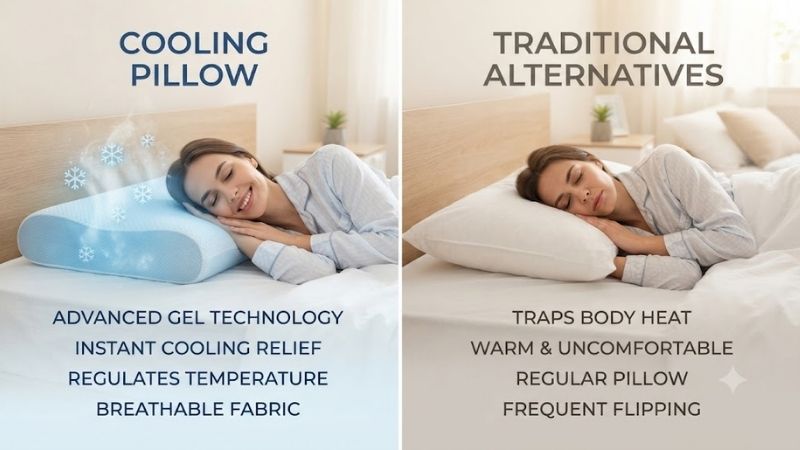
What Makes a Cooling Pillow Different From a Regular Pillow?
A cooling pillow is usually a conventional support pillow with additional materials or construction features intended to influence heat transfer, airflow, or moisture behavior. It does not represent a single standardized pillow type.
Some models use gel-infused memory foam. Others incorporate phase-change materials, perforated latex, shredded filling, or textiles marketed as cool to the touch.
Because these mechanisms differ, two cooling pillows can provide substantially different experiences despite using the same marketing description.
Initial Coolness Versus All-Night Temperature Comfort
One of the most important distinctions is between a surface that feels cool when first touched and a pillow that remains comfortable after several hours of use.
Initial coolness is influenced by how rapidly heat moves from the skin into the material. Certain textile finishes or gel-containing surfaces may feel noticeably cool when the head first contacts them.
However, as the pillow absorbs heat and approaches the temperature of its surroundings, that sensation can diminish. Without a mechanism for continually removing heat, a passive pillow cannot indefinitely maintain the original cool-to-the-touch feeling.
This is why a brief hand test in a store does not establish overnight performance. A pillow that initially feels impressive may provide little meaningful benefit once the material has warmed.
When comparing products, look for meaningful evidence about sustained comfort rather than relying solely on phrases such as instant cooling or cooling all night.
Airflow and Heat Transfer Are Different Properties
Ventilated pillows attempt to improve air movement through or around their structure. Perforations, open-cell foam, or gaps between shredded filling can create pathways for air.
However, those spaces may become smaller when the head compresses the pillow. The pillowcase and internal liner can also influence airflow.
A dense gel-foam pillow may transfer heat at the surface differently from an open latex pillow, but neither construction guarantees superior overall performance without a meaningful comparison.
If overheating is your main concern, evaluate the entire design: core, cover, loft, foam density, and surrounding bedding.
Cooling Pillow vs Traditional Memory Foam
Traditional memory foam is known for its slow-response contouring. When pressure is applied, the foam gradually conforms to the shape of the head and neck, creating a cushioned, enveloping sensation.
Cooling memory foam generally preserves this fundamental behavior while introducing additional temperature-oriented features.
The most important buying question is whether you already enjoy how memory foam supports your head.
Support and Pressure Distribution
Both conventional and gel-infused memory foam can provide contouring support, depending on their firmness and shape.
A molded pillow may offer consistent dimensions and a predictable support profile, which can benefit someone who already knows the loft they need.
However, excessive loft can push a back sleeper’s head forward or create an uncomfortable sideways tilt for a side sleeper. A cooling cover cannot correct a support-height mismatch.
When comparing two memory-foam models, prioritize their contour height and expected compression before evaluating the cooling treatment.
Gel Infusion: What It Can and Cannot Do
Gel infusion may modify how a foam material absorbs or transfers heat. Some products incorporate gel particles, while others use a separate gel layer near the surface.
These configurations should not be treated as identical.
A separate surface layer can feel different from gel distributed throughout the foam. The quantity and placement of gel also influence how much any thermal behavior changes.
However, the presence of gel does not prove that the pillow remains cooler all night. Meaningful comparisons require comparable test conditions, including room temperature, duration, and the location of temperature measurements.
Which One Is Better?
Choose conventional memory foam when you enjoy its contouring feel and have no significant temperature discomfort. A well-fitting ordinary model may provide better value than a more expensive cooling version.
Consider gel-infused or otherwise cooling-oriented memory foam when you prefer the underlying support and want to explore a different surface sensation.
Avoid either option if you dislike slow-response foam or need more adjustability than the fixed shape provides.
Cooling Pillow vs Latex Pillow
Latex provides a different type of cushioning from traditional memory foam. It usually responds more quickly after pressure is removed and produces a relatively buoyant sensation rather than a slow-sinking contour.
This distinction can influence both perceived temperature comfort and sleeping-position flexibility.
A sleeper who feels trapped in dense memory foam may prefer latex even without specialized cooling additives.
Responsive Support
Latex tends to rebound promptly when the sleeper moves.
This can be convenient for combination sleepers who change positions frequently during the night.
However, fast response does not guarantee proper neck support. A latex pillow that is too high or too firm can still create discomfort.
Choose the height and contour appropriate to your normal sleeping position rather than assuming latex’s resilience automatically produces better alignment.
Ventilated Latex Construction
Many molded latex pillows include ventilation holes. These are intended to create air pathways through the foam.
The practical benefit depends on the hole arrangement, foam structure, cover, and degree of compression.
A latex pillow with ventilation holes is not automatically cooler than every gel-infused memory-foam pillow. However, its construction may appeal to someone who prioritizes both responsiveness and an open foam design.
Material Composition and Allergies
Latex pillows can contain natural rubber latex, synthetic latex, or blends.
Buyers should read the material description carefully. A known latex allergy warrants particular caution and may make alternative materials more suitable.
Which One Is Better?
Choose latex when resilient support and easier movement are major priorities.
Choose cooling memory foam when you prefer contouring and want a potentially different temperature sensation.
A high-quality conventional latex pillow may deliver better overall satisfaction than a poorly fitted premium cooling pillow.
Cooling Pillow vs Down Pillow
Down pillows are fundamentally different from most cooling foam pillows.
Down filling creates a soft, compressible structure rather than a stable molded contour. The sleeper can often reshape the pillow by moving or fluffing the fill.
This can feel luxurious, but it also means effective support height may change through the night.
Softness and Moldability
Down pillows can be comfortable for sleepers who dislike fixed foam shapes.
A person may fold, compress, or redistribute the filling to create a preferred surface.
However, someone requiring consistent side-sleeping loft may find a lightly filled down pillow insufficient. The filling can compress beneath the head, reducing support.
A firmer or more generously filled model may behave differently.
Temperature Comfort
Down is commonly used for insulation, but a down pillow’s actual temperature behavior depends on fill amount, shell fabric, and construction.
It would be inaccurate to describe every down pillow as hot or every cooling foam pillow as cooler.
A lightweight down pillow with a suitable cotton shell may feel comfortable to some warm sleepers. Another person may prefer the sensation of ventilated latex.
Cleaning and Maintenance
Down pillows may require specific washing and drying procedures. Improper drying can leave moisture within the filling.
They may also need regular fluffing to restore preferred loft.
Cooling foam pillows often have removable washable covers but cores that should not be machine-washed.
For buyers, maintenance convenience depends on the exact product rather than the category alone.
Which One Is Better?
Choose down if softness, moldability, and a traditional pillow feel matter more than a specialized cooling feature.
Choose cooling foam if you prefer a more predictable contour and are comfortable with the relevant cleaning restrictions.
Cooling Pillow vs Down-Alternative Pillow
Down-alternative pillows typically use synthetic filling intended to provide soft cushioning without animal down.
They are widely available in different price categories and firmness levels.
For someone considering an expensive cooling pillow, a well-constructed down-alternative model may be a practical comparison because the difference in support and feel can be more meaningful than the presence of a cooling label.
Support and Loft Retention
Synthetic fiberfill can produce a fluffy surface, but long-term loft retention varies.
Some products flatten relatively quickly, particularly when the filling is loosely packed or subjected to frequent compression.
Others use more structured filling arrangements.
A down-alternative pillow should therefore be evaluated according to fill quantity, construction, and actual support characteristics.
Warmth and Fabric Construction
Polyester filling and covers can have different thermal behavior from foam and cellulose-based textiles.
However, a synthetic pillow is not automatically warmer. Fabric thickness, internal air spaces, and the pillowcase influence comfort.
A light down-alternative pillow may feel preferable to a dense foam pillow for someone who dislikes extensive head contact.
Washing Convenience
Some down-alternative pillows permit machine washing, subject to the manufacturer instructions and washer capacity.
This can make them attractive to families who prioritize easy cleaning.
However, washing can cause certain fillings to clump or shift if the instructions are not followed.
Which One Is Better?
Choose down alternative for a traditional soft feel, broad availability, and potentially convenient cleaning.
Choose a specialized cooling pillow when its temperature-related construction and support features address a clearly identified preference.
Cooling Pillow vs Buckwheat Pillow
Buckwheat pillows contain hulls rather than conventional foam or fiberfill.
The hulls can move and settle around the head, creating a comparatively firm and shapeable support surface.
This is one of the most distinctive alternatives to cooling foam because it offers a different balance of adjustability and structural stability.
Adjustable Height
Many buckwheat pillows allow users to remove or add hulls.
This can help accommodate different sleeping positions.
However, the adjustment process is more involved than switching between two molded contours. Removed hulls need clean, dry storage.
Air Spaces Between Hulls
Buckwheat hulls create spaces within the filling.
These spaces can permit air movement, although the extent depends on compression and the surrounding cover.
This construction may appeal to warm sleepers who dislike dense foam.
However, buckwheat should not automatically be described as superior in measured cooling performance without comparable evidence.
Firmness and Noise
Buckwheat pillows often feel firm and may produce rustling sounds when the sleeper moves.
Some people enjoy the stable support, while others find the texture or noise distracting.
A person who prefers plush cushioning may dislike buckwheat despite its adjustability.
Weight and Maintenance
Buckwheat pillows can be relatively heavy. The hull filling generally requires different care from the removable cover and is not ordinarily washed like textile fiberfill.
The filling must remain dry and free from contamination.
Which One Is Better?
Choose buckwheat if firm, adjustable support and an open filling structure are attractive.
Choose cooling foam or latex if you prefer a quieter, more conventional cushioning surface.
Cooling Pillow vs Adjustable Shredded-Fill Pillow
Adjustable shredded-fill pillows deserve separate consideration because they address one of the main reasons people replace pillows: incorrect loft.
A cooling surface is of limited value when the underlying pillow is too high, too low, or uncomfortable in the primary sleeping position.
Why Adjustability May Matter More Than Cooling
A side sleeper with broad shoulders may require more loft than a back sleeper on a plush mattress.
A fixed-height cooling pillow may provide excellent surface sensation but inadequate support.
An adjustable shredded-fill pillow allows the user to change the amount of material inside, potentially creating a more suitable height.
For a buyer who has repeatedly struggled with pillow fit, this can be more useful than an expensive cooling treatment.
Trade-Offs of Shredded Filling
Shredded foam or latex may shift during sleep.
Some designs require periodic fluffing or redistribution.
Removed filling also creates additional storage requirements.
A heavily filled shredded pillow may feel substantial or warm depending on its materials and fabric construction.
When the Adjustable Option Wins
Choose adjustable filling if support height is uncertain or you frequently change sleeping positions.
Choose a fixed cooling contour when you already know your preferred pillow geometry and are primarily trying to improve surface temperature comfort.
The Most Important Comparison: Cooling Versus Proper Neck Support
A pillow’s primary mechanical function is to support the head and neck comfortably during sleep.
Cooling features cannot compensate for unsuitable height, shape, or firmness.
This is especially important because many cooling pillows are sold in fixed molded configurations.
Side Sleepers
Side sleepers commonly need sufficient loft to fill the space between the head and mattress.
The required height depends on shoulder width and how deeply the shoulder sinks into the mattress.
A pillow that is too low may allow the head to tilt toward the mattress. A pillow that is too high can tilt it in the opposite direction.
Cooling gel, phase-change fabric, or ventilated foam does not eliminate these fit requirements.
For side sleepers, begin with a suitable loft and then compare cooling-oriented constructions within that category.
Back Sleepers
Back sleepers generally need comfortable support beneath the head and neck without excessive forward elevation.
A very tall cooling pillow can push the chin toward the chest.
The preferred height depends on body proportions and mattress characteristics.
A moderately contoured or adjustable design may be more practical than choosing the thickest cooling pillow available.
Stomach Sleepers
Stomach sleeping often involves substantial neck rotation.
A thick, firm pillow may increase discomfort.
A very low-loft design may be more comfortable for some stomach sleepers, but cooling should remain secondary to an appropriate sleeping position.
Combination Sleepers
People who alternate between back and side sleeping may benefit from responsive latex or adjustable shredded filling.
A strongly sculpted cooling pillow may restrict comfortable movement between positions.
The right choice depends on the actual support profile, not the cooling technology.
Which Pillow Is Best for Hot Sleepers?
No single material can be declared universally best for hot sleepers.
The pillow’s actual performance depends on several interacting characteristics.
| Priority | Strong starting option | Main consideration |
|---|---|---|
| Avoid slow-sinking foam | Latex | Responsive support |
| Initial cool-to-touch sensation | Phase-change or cooling textile | Effect may diminish |
| Adjustable support height | Shredded foam or latex | Filling maintenance |
| Traditional soft surface | Down or down alternative | Loft compression |
| Firm moldable support | Buckwheat | Weight and noise |
| Familiar foam contour | Gel-infused or ventilated memory foam | Fixed shape and thermal limitations |
| Easy surface cleaning | Pillow with washable cover | Core care restrictions still apply |
The Pillowcase Can Change the Result
A cooling pillow is commonly used with an ordinary pillowcase.
The pillowcase sits between the skin and the specialized surface, affecting the sensation the sleeper actually experiences.
A thick flannel or plush case may reduce the initial cool feeling of a treated cover.
A lighter textile may allow more of the underlying surface behavior to be perceived.
However, a thin case does not guarantee a cooler night.
Choose an appropriately fitted pillowcase whose construction suits the pillow and your preferences.
Mattress and Room Temperature Still Matter
A pillow cannot compensate fully for a hot bedroom.
If the mattress retains substantial warmth, the duvet is heavily insulating, or room temperature remains uncomfortable, replacing the pillow alone may have limited impact.
A better purchasing decision considers the entire sleep environment rather than treating cooling as an isolated pillow property.
Durability and Long-Term Value
Pillow durability is not determined by the presence of gel, latex, down, or another premium material alone.
It depends on construction quality, use, cleaning, and the ability of the pillow to maintain suitable support.
Foam Durability
Foam can soften, deform, or lose some recovery with prolonged use.
Actual lifespan varies by formulation and manufacturing quality.
A cooling treatment does not automatically improve durability.
Latex Durability
Well-made latex can provide resilient support, but material quality and handling matter.
A latex pillow may eventually deteriorate, particularly with unsuitable exposure to heat or other conditions.
Down and Fiberfill
Down and synthetic filling may require fluffing.
Loss of loft, clumping, and uneven distribution can affect comfort over time.
Buckwheat Hulls
Hull filling can change condition with use and may need replacement or maintenance.
The cover and seams must also remain intact.
What Should Trigger Replacement?
Replace a pillow when it no longer provides comfortable support, becomes significantly damaged, or cannot be maintained hygienically.
A fixed replacement schedule is less useful than evaluating the condition of the actual product.
Is a Premium Cooling Pillow Worth the Money?
A premium cooling pillow may offer meaningful value when it combines appropriate support, quality construction, and a temperature-related feature you genuinely appreciate.
However, price does not guarantee sustained cooling.
A lower-priced latex pillow may provide better comfort than an expensive gel pillow if the latter has the wrong loft.
Similarly, an adjustable shredded-fill pillow may offer better value when support fit is the unresolved problem.
Compare Total Ownership Cost
Consider replacement covers, cleaning requirements, durability, and return policies.
A specialty pillow requiring proprietary covers may cost more to maintain.
A pillow that cannot be returned after opening may also represent a higher purchasing risk.
Choose Evidence Over Marketing
When comparing cooling claims, determine whether the manufacturer provides useful comparative testing.
If the description consists only of phrases such as icy sensation, cooling technology, or sleeps colder, treat the performance as unverified.
Common Buying Mistakes
Choosing Cooling Technology Before Pillow Height
A cool-feeling surface does not make an unsuitable pillow comfortable.
Select the correct support profile before comparing temperature features.
Assuming Gel Guarantees All-Night Cooling
Passive gel systems do not provide unlimited heat removal.
Initial sensation and sustained comfort are different outcomes.
Paying More for a Familiar Material With New Marketing
A gel-infused foam pillow may retain the slow-response feel you already dislike.
Switching to a different underlying support material may be more useful.
Ignoring the Return Policy
Pillow fit is subjective.
A realistic trial or suitable return arrangement can be more valuable than additional marketing features.
Frequently Asked Questions
Are Cooling Pillows Better Than Regular Pillows?
Not automatically. Cooling pillows may offer a different initial temperature sensation or ventilation design, but ordinary pillows can provide excellent comfort and support. The better choice depends on your temperature preferences, sleeping position, and the pillow’s construction.
Is Latex Cooler Than Memory Foam?
Some latex constructions may provide a more open and responsive feel than dense memory foam, but there is no universal guarantee of lower sleeping temperature. Ventilation, fabric covers, foam design, and room conditions influence the result.
Do Gel Cooling Pillows Stay Cold All Night?
Not necessarily. Gel can influence heat transfer or absorption, but passive cooling capacity is limited. A pillow that feels cool initially may warm during use. Long-duration comparative testing is more informative than a brief cool-to-the-touch demonstration.
Are Buckwheat Pillows Good for Hot Sleepers?
Buckwheat hulls create spaces within the filling and provide firm, adjustable support. Some warm sleepers may enjoy this construction, but buckwheat pillows can be heavy and noisy. Their cooling performance should not be assumed superior without appropriate evidence.
Is Down Better Than Cooling Foam?
Down is often preferable for shoppers who enjoy soft, moldable cushioning. Cooling foam may be better for someone who likes a consistent contour and wants temperature-oriented features. Neither category is universally better for comfort.
What Should I Buy if My Pillow Is Hot and Hurts My Neck?
Prioritize correcting the support problem first. A pillow with appropriate height and firmness is more important than a cooling treatment. Consider adjustable filling, suitable latex, or another support shape, and seek professional evaluation if neck pain persists or worsens.
Conclusion
Cooling pillows are worth considering when temperature discomfort is the main issue and the underlying support already suits your sleeping position. Choose latex for responsive cushioning, adjustable shredded fill for customizable loft, down or down alternative for traditional softness, and buckwheat for firm, moldable support. Gel and phase-change technologies may improve particular temperature sensations, but neither guarantees all-night cooling. The best pillow combines appropriate support, comfortable materials, realistic thermal expectations, and manageable maintenance.