A weighted blanket provides distributed pressure through glass beads, plastic pellets, or heavy knitted materials, but that sensation is not comfortable or appropriate for everyone. Traditional comforters, duvets, cotton blankets, body pillows, and other bedding alternatives can offer warmth, cushioning, or a sense of comfort without the same weight or handling requirements. Choosing between them requires understanding what problem you actually want to solve: feeling cold, wanting more comforting contact, reducing bedding movement, supporting your sleeping position, or creating a more relaxing nighttime routine.
Quick Verdict: When Is a Weighted Blanket the Better Choice?
A weighted blanket is worth considering for an adult who enjoys evenly distributed pressure, can move and remove the blanket independently, and does not find the additional weight uncomfortable. It may provide a different sensory experience from a traditional comforter because the pressure is part of the intended design rather than simply a byproduct of insulating fill.
However, a weighted blanket is not automatically the best solution when someone wants warmth, softer bedding, improved sleeping posture, or relief from a medical condition.
A conventional comforter or duvet is usually more practical when temperature control and easy handling are the priorities. A body pillow is more appropriate when the main objective is targeted cushioning between the knees or alongside the torso. A lightweight cotton blanket is worth considering for warm sleepers who want coverage without substantial pressure.
| Product category | Primary function | Main advantage | Main limitation | Best starting buyer |
|---|---|---|---|---|
| Weighted blanket | Distributed pressure | Distinctive weighted sensation | Heavy, harder to move and clean | Adult who enjoys pressure |
| Traditional comforter | Insulation and soft coverage | Familiar warmth and cushioning | Not designed for distributed pressure | Wants conventional bedding |
| Duvet and removable cover | Adjustable bedding system | Can change insert warmth and cover | Requires insert and cover management | Wants seasonal flexibility |
| Cotton blanket | Lightweight or moderate coverage | Simple, familiar fabric | Little sustained weighted pressure | Prefers lighter bedding |
| Fleece blanket | Soft, insulating coverage | Cozy surface at relatively low weight | Can feel too warm | Wants plush warmth |
| Body pillow | Targeted cushioning | Supports selected body areas | Occupies mattress space | Side sleeper needing cushioning |
| Heavy knitted throw | Substantial textile feel | Decorative and comforting | Bulk and weight vary | Wants weight without bead filling |
These are general categories rather than a ranking of medical effectiveness.
What Makes a Weighted Blanket Different?
A weighted blanket is designed to create a distributed load across the body. Manufacturers achieve this through weighted filling held in sewn compartments or through substantial knitted textile construction.
Unlike a conventional comforter, the total weight is a primary feature.
However, the amount of pressure felt by the user depends on more than the blanket’s advertised pounds.
Dimensions, weight distribution, body position, and the amount of fabric resting on the mattress all affect the experience.
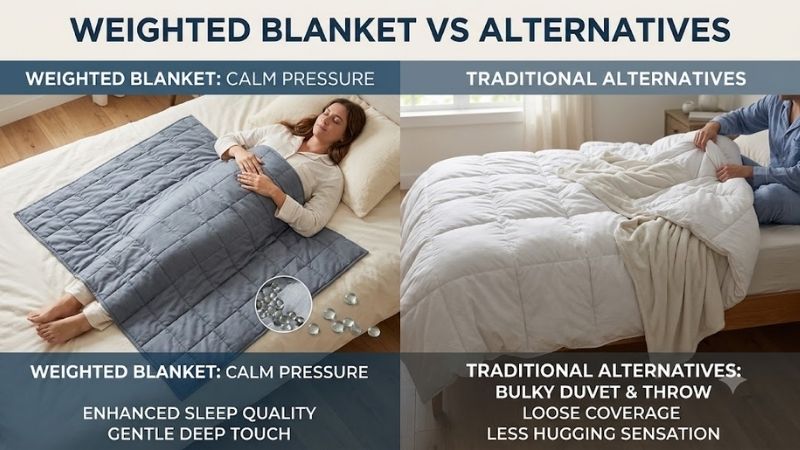
Distributed Pressure Versus Ordinary Bedding Contact
A traditional comforter rests against the body primarily to provide insulation and soft coverage.
A weighted blanket deliberately adds mass.
Some adults enjoy this because it creates a more noticeable sense of contact.
Others may perceive it as restrictive, particularly when changing positions.
Neither response is inherently wrong. Sensory comfort is individual.
Why the Same Weight Can Feel Different
Consider two hypothetical blankets weighing 15 pounds.
One measures 48 × 72 inches, while the other measures 60 × 80 inches.
Their nominal areas are approximately 24 and 33.3 square feet, respectively.
| Example | Total weight | Surface area | Average weight per sq. ft. |
|---|---|---|---|
| Smaller blanket | 15 lb | 24 sq. ft. | 0.625 lb |
| Larger blanket | 15 lb | 33.3 sq. ft. | 0.45 lb |
The smaller blanket has more mass per unit area.
However, these figures do not measure actual pressure on the sleeper because part of the blanket may rest on the mattress and the load is not distributed perfectly uniformly.
The comparison illustrates why total pounds alone cannot predict comfort.
The Limitations of the 10% Rule
A frequently quoted shopping guideline suggests a blanket weighing approximately 10% of the user’s body weight.
That rule can provide a reference point, but it is not a universal medical recommendation.
Body weight does not account for strength, mobility, breathing concerns, sleeping position, or personal pressure preferences.
A person who finds a lighter blanket comfortable should not automatically increase the weight merely to match a formula.
The ability to move and remove the blanket independently is more important.
Weighted Blanket vs Traditional Comforter
This is the most useful comparison for buyers who are unsure whether they want pressure or simply a more comfortable top layer.
A comforter is primarily designed to provide insulation and soft bedding coverage.
A weighted blanket is designed to provide noticeable mass and distributed pressure.
Both may feel cozy, but their main functions differ.
Warmth and Insulation
A conventional comforter contains insulating fill held within a fabric shell.
Its warmth depends on filling material, fill amount, loft, quilting, and other construction details.
A weighted blanket may also provide warmth, but its weight is not a reliable measurement of insulation.
A 15-pound weighted blanket is not necessarily warmer than a much lighter winter comforter.
The comforter may contain insulating materials that trap air efficiently, while the weighted blanket’s dense filling contributes more mass than loft.
Ease of Movement
An ordinary comforter is generally easier to lift and reposition than a substantially weighted blanket.
This can matter for people who turn frequently during sleep.
A person who dislikes the sensation of heavy bedding may find a conventional comforter more comfortable even when both products feel equally warm.
Cleaning and Handling
Many comforters can be washed when the care label and machine capacity permit.
Weighted blankets require more careful consideration because of their concentrated mass, compartment construction, and possible filling restrictions.
A weighted blanket that becomes significantly heavier when wet may exceed the capabilities of some household machines.
Which Should You Choose?
Choose a traditional comforter when warmth, soft coverage, and straightforward handling are the main goals.
Choose a weighted blanket when the pressure sensation itself is the intended benefit and the product can be used safely.
Weighted Blanket vs Duvet
A duvet is an insulating insert used with a removable cover.
This creates a flexible bedding system because the cover can be washed separately and the insert can sometimes be changed according to season.
A weighted blanket uses a different approach. Although some weighted products also have removable covers, their primary purpose remains distributed mass.
Seasonal Flexibility
A duvet system allows the buyer to use a lighter insert in warmer conditions and a heavier insulating insert in colder seasons.
This can provide more direct control over warmth than relying on one weighted blanket throughout the year.
However, changing duvet inserts requires storage for the unused item.
Removable Covers
A weighted blanket with a removable cover can simplify cleaning.
Yet the weighted insert itself may still require special care.
A duvet cover may be easier to remove and launder, depending on its size and material.
For someone who launders bedding frequently, this difference can influence long-term convenience.
Bed Appearance
Duvets commonly provide substantial loft and a full, cushioned appearance.
Weighted blankets may have a flatter profile, particularly when filled with glass beads.
A chunky-knit weighted blanket can create a different decorative effect.
A buyer who wants a full, fluffy bed may prefer a duvet even if the weighted option costs more.
When a Duvet Is Better
A duvet is usually more appropriate when the goal is adjustable insulation, washable covers, and conventional bed styling.
A weighted blanket is worth considering when tactile pressure is a specific personal preference.
Weighted Blanket vs Cotton Blanket
Cotton blankets offer a comparatively straightforward alternative.
They are available in woven, knitted, waffle, and other constructions, with different weights and textures.
A cotton blanket can provide coverage without requiring the substantial mass associated with many weighted products.
Lightweight Comfort
A lightweight cotton blanket may be suitable for someone who wants an extra layer without feeling restricted.
It can also be easier to fold, reposition, and store.
However, not all cotton blankets are lightweight. A dense cotton weave can feel relatively substantial.
Temperature Comfort
Cotton blanket warmth depends on construction and fabric weight.
A loosely woven cotton blanket may behave differently from a densely knitted one.
A weighted blanket can also vary considerably in insulation.
The word weighted does not establish whether the product is appropriate for a warm room.
Pressure Sensation
An ordinary cotton blanket provides contact against the body but is not designed to create the same level of distributed pressure as a weighted product.
This may be an advantage for someone who dislikes heavy bedding.
It may be a limitation for someone specifically seeking the weighted sensation.
Maintenance
Many cotton blankets have familiar care requirements, although washing instructions vary.
A lighter blanket can also be easier to manage in a household washer.
For older adults or people who struggle with heavy laundry, this may be a meaningful practical advantage.
Which Should You Choose?
Choose cotton when breathable-feeling coverage, ease of handling, and simple layering matter most.
Choose weighted bedding only when the additional pressure is desirable and manageable.
Weighted Blanket vs Fleece Blanket
A fleece blanket typically prioritizes softness and insulation rather than substantial mass.
Polyester fleece can create a plush surface that some sleepers enjoy during cooler weather.
However, its sensory experience differs from weighted pressure.
Warmth Without Heavy Mass
Fleece can feel warm while remaining relatively lightweight.
This is useful for someone who wants a cozy blanket but dislikes the effort involved in lifting and folding heavy bedding.
The amount of insulation depends on fleece thickness and construction.
Surface Texture
Fleece offers a plush or brushed surface.
Weighted blankets may use cotton, polyester, viscose, or other covers, so their texture varies.
A plush weighted cover may feel similar to fleece at the surface, but the additional mass changes the overall experience.
Warm Sleeping Conditions
Some fleece blankets can feel excessively insulating in warm bedrooms.
A thick plush weighted blanket may also create substantial warmth.
If overheating is the concern, compare total insulation rather than simply choosing the lighter product.
Cleaning and Durability
Fleece is often relatively straightforward to maintain when the care label permits, but some fabrics can pill or change texture.
Weighted blankets introduce additional cleaning complexity because of their mass and internal construction.
Which Should You Choose?
Fleece is appropriate when softness and warmth are the main priorities.
Weighted bedding is more appropriate when the user specifically enjoys sustained distributed pressure.
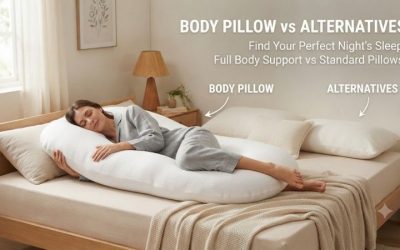
Weighted Blanket vs Body Pillow
A body pillow provides targeted cushioning rather than pressure distributed across much of the body.
This makes it a fundamentally different alternative.
For some buyers, a body pillow may address the actual reason they are shopping for a weighted blanket.
Support for Side Sleepers
A side sleeper may want cushioning between the knees or a surface to hug.
A body pillow can provide that support.
A weighted blanket does not necessarily keep the knees separated or support the upper arm in a preferred position.
If the problem is positional discomfort, a body pillow may be more relevant than a heavier blanket.
Sensory Comfort
Some people enjoy hugging a body pillow because it provides a sense of contact and resistance.
A weighted blanket creates a different sensation through distributed mass.
Neither experience should be treated as a medically guaranteed anxiety intervention.
Movement During Sleep
A body pillow can be moved or repositioned independently of the top bedding.
A weighted blanket covers a larger area and may require more effort to adjust.
However, large C-shaped and U-shaped body pillows can occupy substantial mattress space.
Warmth
A body pillow may contact only selected areas of the body.
A weighted blanket may cover much more of the sleeper.
Depending on materials and room conditions, this can affect perceived warmth.
Which Should You Choose?
Choose a body pillow when knee, arm, or torso cushioning is the main goal.
Choose a weighted blanket when you specifically prefer distributed pressure across the body.
Weighted Blanket vs Heavy Knitted Throw
Heavy knitted throws deserve separate consideration because they can provide a substantial textile sensation without loose weighted beads.
Some knitted products are marketed as weighted blankets, while others are simply heavy decorative throws.
The construction and intended use matter more than the product name.
Bead-Free Weight
A chunky-knit weighted blanket derives its mass from thick yarn.
This eliminates the particular issue of glass beads leaking from stitched compartments.
However, the product can still be heavy and difficult to clean.
Airflow
Open knitted structures contain visible spaces that may allow air movement.
This can appeal to people who dislike densely quilted bedding.
However, large yarn loops and substantial mass do not guarantee cool sleeping conditions.
Storage Bulk
A chunky knitted blanket may occupy considerable space when folded.
This is particularly important for apartment dwellers.
A flat quilted weighted blanket may fold more compactly despite weighing a similar amount.
Snagging
Large knitted loops can catch on jewelry, sharp objects, or pets’ claws.
A damaged loop may affect the appearance and construction.
Which Should You Choose?
A heavy knitted throw can be attractive when appearance and bead-free construction matter.
A conventional weighted blanket may be more practical when compact storage and controlled filling distribution are priorities.
Weighted Blanket vs Compression-Style Alternatives
Some adults look for weighted blankets because they enjoy the sensation of close contact around the body.
Compression-oriented products offer a different mechanism: tension or close-fitting fabric rather than gravitational weight.
These categories should not be treated as equivalent.
How Compression Differs From Weight
A weighted blanket uses mass to apply force.
A compression product uses tension or elastic resistance.
The pressure distribution can differ substantially.
A person comfortable with one sensation may dislike the other.
Why Safety Matters
Compression products can restrict movement when poorly designed or used inappropriately.
They should not be treated as safer substitutes merely because they weigh less.
The user’s ability to move freely and breathe comfortably remains essential.
Medical Claims
Products marketed for sensory comfort, anxiety, or sleep should not automatically be considered therapeutic devices.
Evidence and suitability depend on the exact product and user.
Practical Recommendation
Choose ordinary bedding or a body pillow when the goal is general comfort.
Consider specialized compression products only with a clear understanding of their intended use, safety requirements, and individual suitability.
Are Weighted Blankets Actually Better for Sleep?
Some research has explored weighted blankets for sleep disturbance, anxiety symptoms, and other outcomes.
The findings are promising in certain adult groups, but the evidence is not strong enough to conclude that weighted blankets improve sleep for every person.
What Research Can Suggest
Certain studies have reported improved subjective sleep or other measures among selected adult participants using weighted blankets.
However, results may depend on the population, comparison group, study duration, and outcomes measured.
Why Findings Should Be Interpreted Carefully
Some studies use self-reported outcomes rather than extensive objective sleep measurements.
Others have small samples or specific clinical populations.
A benefit observed in one group may not generalize to healthy adults or people with different conditions.
Comfort Is a Valid Reason to Buy
A weighted blanket does not need to provide a clinically measurable improvement to be enjoyable.
Someone may simply like the sensation.
However, enjoying a product is different from proving that it treats insomnia or anxiety.
When an Alternative May Be Better
If the primary problem is insufficient warmth, choose bedding based on insulation.
If the problem is uncomfortable sleeping posture, consider appropriate pillows or mattress support.
If sleep difficulties are persistent or severe, seek professional evaluation rather than relying entirely on bedding purchases.
Comparing Weight, Warmth, and Ease of Movement
One common purchasing error is treating weight and warmth as interchangeable.
A heavy blanket may not provide the insulation of a lofty comforter.
Likewise, a lightweight comforter can feel warm without creating substantial distributed pressure.
| Category | Designed for weighted pressure? | Primary warmth function | Relative handling consideration |
|---|---|---|---|
| Glass-bead weighted blanket | Yes | Varies by fabric and layers | High mass |
| Knitted weighted blanket | Yes, when designed accordingly | Varies by yarn and construction | High mass and possible bulk |
| Down comforter | No | Insulation | Often relatively lightweight for its warmth |
| Down-alternative duvet | No | Insulation | Depends on fill and weight |
| Cotton blanket | No | Light to moderate coverage | Often manageable |
| Fleece blanket | No | Insulation and plushness | Often lightweight |
| Body pillow | No | Targeted cushioning | Localized item rather than full cover |
These comparisons explain design purpose rather than providing exact warmth or pressure measurements.
Safety: Who Should Not Use a Weighted Blanket?
A weighted blanket should never prevent independent movement or comfortable breathing.
The user must be able to reposition and remove it without assistance.
This is more important than meeting a body-weight formula or choosing a premium construction.
Infants
Weighted blankets, weighted swaddles, weighted sleepers, and other weighted objects are unsafe for infant sleep.
The American Academy of Pediatrics and US Consumer Product Safety Commission warn against using weighted sleep products for infants.
An infant should sleep on an approved firm, flat surface without loose or weighted bedding.
Children
Adult-weight guidelines should not be used to select weighted blankets for children.
Suitability depends on developmental ability, independent removal, size, and other factors.
Appropriate professional guidance is important before considering weighted products for children with specific needs.
Adults With Mobility Limitations
Someone who cannot remove the blanket independently may be at risk.
A weighted blanket must never be used to restrain a person or prevent them from leaving the bed.
Respiratory or Circulatory Conditions
People with relevant breathing difficulties, significant circulation problems, or other medical concerns should seek individualized guidance.
The fact that a blanket is sold for adults does not establish suitability for every health condition.
Signs a Weighted Blanket Is Unsuitable
Stop using it if you experience restricted movement, breathing difficulty, pain, distress, overheating, or a persistent sensation of being trapped.
Do not increase the weight to force a more noticeable effect.
Cleaning: Weighted Blanket vs Ordinary Bedding
Maintenance can determine whether a weighted blanket remains practical over time.
Many conventional blankets and duvet covers are easier to handle because they contain less mass.
Washing-Machine Capacity
A heavy weighted blanket may exceed the capabilities of a household washing machine, especially after absorbing water.
A conventional cotton blanket or lightweight comforter may be more manageable, depending on size and construction.
Removable Covers
Some weighted blankets include removable covers.
This allows more frequent cleaning of the textile surface without washing the weighted insert every time.
However, the insert still requires its own appropriate maintenance.
Drying
Heavy, layered products may take considerable time to dry.
A weighted insert can remain damp internally even when the outer fabric feels dry.
Follow the manufacturer’s instructions and never store damp bedding.
Professional Cleaning Cost
Some weighted blankets require specialized laundering.
This can increase total ownership cost.
A lower-priced weighted blanket may therefore be less economical than an ordinary comforter when cleaning expenses are considered.
Storage and Portability
A weighted blanket’s storage requirements depend on its size and construction.
Quilted Weighted Blankets
Quilted models may fold into compact shapes.
However, the resulting bundle can be heavy.
The storage shelf or container must safely support that mass.
Chunky-Knit Weighted Blankets
Thick loops may create substantial folded volume.
This can be inconvenient in small closets or drawers.
Ordinary Comforters
Comforters may be bulkier but lighter.
Compressibility depends on fill material and the manufacturer’s storage recommendations.
Body Pillows
A body pillow can occupy considerable length but may be easier to move than a heavy blanket.
Curved body pillows can be awkward to store.
Travel
Weighted blankets are often inconvenient for air travel or frequent relocation.
A lightweight travel blanket or suitable compact pillow may be more practical.
Do not assume that an ordinary travel blanket provides the same pressure sensation.
Cost Comparison: What Are You Paying For?
A weighted blanket’s higher price may reflect filling, compartment construction, premium yarn, removable covers, or branding.
However, spending more does not establish greater therapeutic benefit.
Initial Purchase Cost
Basic weighted blankets may cost more than inexpensive ordinary blankets because of their construction and materials.
Premium knitted products can be considerably more expensive.
Actual retail prices vary.
Long-Term Maintenance
Consider whether the blanket can be cleaned using household equipment.
Replacement covers, professional laundering, or specialized drying requirements may increase ownership cost.
Versatility
An ordinary duvet can be adapted across seasons by changing inserts.
A weighted blanket serves a more specific sensory purpose.
If the buyer does not enjoy that sensation, the product may have limited alternative use.
A Practical Value Example
Consider two hypothetical purchases.
One is a $70 weighted blanket used occasionally because it feels restrictive.
The other is a $50 conventional blanket used comfortably every night.
The weighted product may have more specialized construction, but that does not make it the better value for this user.
These figures are illustrative rather than current retail prices.
Which Alternative Is Best for Your Main Need?
If You Want Warmth
Start with a comforter, duvet, or appropriately insulating blanket.
Weight is not a substitute for thermal design.
If You Want Comforting Pressure
A weighted blanket may be worth considering if you can use it safely and enjoy the sensation.
Choose manageable weight and appropriate dimensions.
If You Sleep Hot
Consider lightweight cotton bedding, a suitable duvet insert, or an appropriately constructed light blanket.
A knitted weighted design may provide greater airflow than some dense constructions, but it does not guarantee a cool night.
If You Need Knee or Arm Cushioning
Choose a body pillow or another suitable support cushion.
A weighted blanket does not provide the same targeted positioning.
If You Have Limited Laundry Capacity
A conventional washable blanket or duvet cover may be more practical.
A heavy weighted insert can create maintenance difficulties.
If You Want a Decorative Throw
A conventional knit or fleece throw may provide the desired appearance without substantial weight.
Choose a weighted knitted throw only when the mass is genuinely desirable.
Common Buying Mistakes
Assuming Weight Automatically Means Better Sleep
Research does not establish universal sleep benefits.
The correct purchase depends on comfort, safety, and actual needs.
Choosing a Weighted Blanket for Warmth Alone
A lighter insulating comforter may provide greater warmth with easier handling.
Following the 10% Rule Rigidly
The commonly quoted formula does not account for mobility, strength, body positioning, or personal preference.
Choose a manageable blanket.
Ignoring Cleaning Costs
A product requiring specialized laundering can become inconvenient and expensive.
Using Weighted Bedding for Infants
Weighted infant sleep products are unsafe.
Never use an adult weighted blanket in a crib or infant sleep space.
Buying a Large Shared Weighted Blanket
Two people may have different preferences and mobility needs.
A single heavy shared blanket is not necessarily a good solution.
Frequently Asked Questions
Are Weighted Blankets Better Than Regular Comforters?
Not universally. Weighted blankets are intended to provide distributed pressure, while comforters primarily provide warmth and soft coverage. Choose according to whether pressure or insulation is the main priority.
Is a Weighted Blanket Better Than a Body Pillow?
They serve different purposes. A weighted blanket creates pressure over a larger body area, while a body pillow cushions specific regions such as the knees, arms, or torso. A body pillow is often more suitable for targeted positional comfort.
Do Weighted Blankets Really Help With Anxiety?
Some studies have reported benefits for selected adults, but the evidence does not establish that weighted blankets reliably treat anxiety disorders. They may feel comforting to some people and uncomfortable to others. They should not replace appropriate clinical care.
Are Weighted Blankets Hotter Than Regular Blankets?
Not necessarily. Warmth depends on fabric, construction, layers, and insulation. A thick plush weighted blanket can feel warm, while an open-knit design may allow more airflow. Weight alone does not measure thermal performance.
Is a 15-Pound Weighted Blanket Safe for Every Adult?
No. Suitability depends on individual physical abilities, comfort, dimensions, and relevant health concerns. The person must be able to move and remove the blanket independently. A body-weight formula cannot establish safety for everyone.
Are Weighted Blankets Worth the Money?
They can be when an adult enjoys distributed pressure, can use the product safely, and finds its cleaning and handling manageable. They offer less value when the buyer primarily wants warmth, targeted pillow support, or an uncomplicated washable blanket.
Conclusion
A weighted blanket is the better choice when comfortable distributed pressure is the specific goal and the user can move and remove it independently. Traditional comforters and duvets are more appropriate for adjustable warmth, cotton or fleece blankets offer simpler coverage, and body pillows provide targeted cushioning. Compare the actual purpose, weight, dimensions, safety, cleaning, and long-term cost instead of assuming specialized weighted bedding is automatically better for sleep.