Key takeaways
-
Slatted foundation: A practical fixed support system with potential airflow advantages.
-
Solid foundation: A stable, even supporting surface when compatible with the mattress.
-
Traditional box spring: Primarily useful for certain conventional innerspring mattresses.
-
Bed risers: A simple way to increase bed height without changing the mattress’s sleeping angle.
-
Wedge pillow: A relatively inexpensive way to elevate part of the upper body without purchasing an adjustable base.
Choosing an adjustable bed base vs alternatives comes down to how much control, support, and convenience you need from your bed. Adjustable bases offer customizable sleeping positions, while platform beds, slatted foundations, and box springs deliver simpler support at a generally lower cost. This comparison explains which option fits your mattress, sleeping habits, bedroom, and budget.
Quick Verdict: Adjustable Bed Base vs Alternatives
An adjustable bed base is the better choice if you regularly want to elevate your head or legs, whether for reading, relaxing, or finding a more comfortable resting position. It offers positioning flexibility that a standard fixed foundation cannot provide.
However, a platform bed is often the better overall value for sleepers who prefer a flat mattress, want simpler furniture, or do not need powered adjustments.
Other alternatives address more specific needs:
-
Slatted foundation: A practical fixed support system with potential airflow advantages.
-
Solid foundation: A stable, even supporting surface when compatible with the mattress.
-
Traditional box spring: Primarily useful for certain conventional innerspring mattresses.
-
Bed risers: A simple way to increase bed height without changing the mattress’s sleeping angle.
-
Wedge pillow: A relatively inexpensive way to elevate part of the upper body without purchasing an adjustable base.
None is universally superior. The right choice depends on whether you value adjustable positioning, support, storage space, straightforward maintenance, or initial cost.
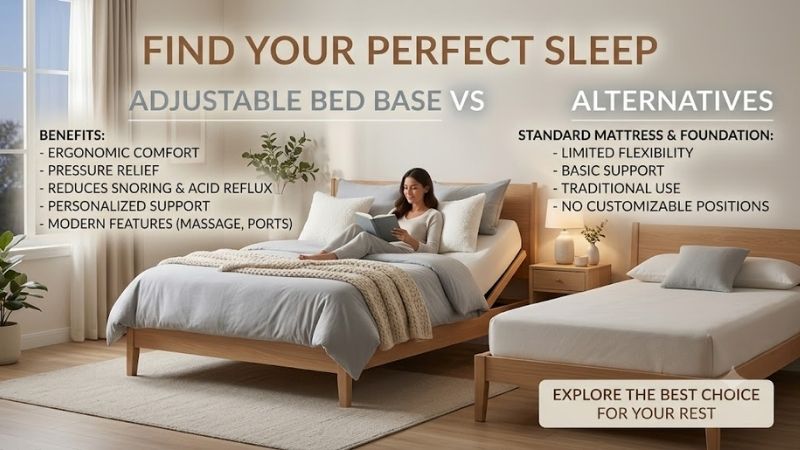
Adjustable Bed Base vs Alternatives: Quick Comparison Table
| Bed Support Option | Adjustable Head and Foot | Mattress Support | Relative Cost | Main Limitation | Best For |
|---|---|---|---|---|---|
| Adjustable bed base | Yes, depending on model | Designed for compatible flexible mattresses | Higher | Motorized parts and compatibility requirements | Customized resting positions |
| Platform bed | No | Flat slatted or solid platform | Low to high | No powered elevation | Everyday bedroom use |
| Slatted foundation | No | Series of wood or metal slats | Generally lower | Slat spacing must match mattress requirements | Simple mattress support |
| Solid foundation | No | Continuous rigid support | Generally lower | Weight and ventilation considerations | Flat, stable support |
| Traditional box spring | No | Designed around certain innerspring systems | Low to moderate | Not suitable for many modern mattresses | Compatible traditional innerspring beds |
| Bed risers | No | Existing bed frame still provides support | Generally low | Only changes height; requires compatible legs | Raising a bed |
| Wedge pillow | Upper-body elevation only | Requires an existing mattress and base | Generally low | Cannot adjust the entire mattress | Occasional upper-body elevation |
Relative costs describe broad product categories, not live retail pricing. Individual designs and brands can overlap substantially.
What Is an Adjustable Bed Base?
An adjustable bed base is a supporting bed structure that allows the mattress to move into different positions, typically by raising the head, foot, or both.
Most residential models use electric motors controlled by a remote or an integrated application. Some include independently adjustable sections, while simpler designs offer fewer positioning options.
Unlike a standard bed foundation, an adjustable base changes the angle of the mattress itself.
How an Adjustable Bed Base Works
A typical adjustable base includes a structural frame, articulated support sections, electric actuators, and a control system.
When activated, the motorized mechanism raises or lowers specific portions of the support deck.
A compatible mattress flexes with the moving sections while remaining supported.
Depending on the model, available features may include:
-
Independent head and foot elevation.
-
Preset positions for reading or relaxing.
-
A marketed zero-gravity position.
-
Programmable position memory.
-
Under-bed lighting.
-
USB charging connections.
-
Massage or vibration functions.
-
Adjustable leg heights.
Not every base includes these features, and the available articulation angles vary by model.
What Does Zero Gravity Mean?
In adjustable-bed marketing, zero gravity generally refers to a reclined position that elevates the upper body and legs.
It is intended to distribute body weight differently from lying completely flat.
However, there is no single universal consumer-bed angle that guarantees optimal comfort for everyone. Manufacturers may implement their zero-gravity presets differently.
This position may feel comfortable for some sleepers, but it should not be treated as a proven medical treatment or an ideal position for every body type.
What an Adjustable Base Cannot Do
An adjustable base changes positioning rather than the mattress’s underlying firmness.
It cannot:
-
Repair a sagging mattress.
-
Restore worn-out cushioning.
-
Eliminate all back pain.
-
Guarantee reduced snoring or sleep apnea symptoms.
-
Make an incompatible mattress safe to bend.
-
Replace a medically prescribed positioning device.
Those distinctions matter because many of the advertised benefits of adjustable beds depend on the individual sleeper and the exact equipment.
Adjustable Bed Base vs Platform Bed
A platform bed is one of the strongest alternatives to a motorized adjustable base because it provides an integrated mattress support system without necessarily requiring a separate foundation.
Design and Support Differences
An adjustable base uses moving sections to change the mattress angle.
A platform bed provides a fixed supporting surface, usually consisting of wooden or metal slats or a solid deck.
Both can support modern mattresses when the construction meets manufacturer requirements.
The major distinction is not whether one inherently provides better structural support, but whether the sleeping surface can move.
Comfort and Sleeping Position
An adjustable base allows sleepers to experiment with different head and leg positions.
A platform bed maintains a consistent flat sleeping surface.
If you normally sleep comfortably on a flat mattress, the platform bed may meet your needs without additional mechanisms.
For people who spend significant time reading or watching television in bed, powered elevation can be more convenient than stacking pillows.
Bedroom Appearance and Storage
Platform beds come in many designs, including low-profile frames, upholstered models, and versions with integrated drawers.
Storage-focused platform beds can be particularly useful in apartments and smaller bedrooms.
Adjustable bases may offer under-bed clearance, but the moving structure, motors, and legs can limit storage options.
Some adjustable bases fit inside compatible decorative bed frames, although this depends on clearance and manufacturer specifications.
Cost and Maintenance
A fixed platform frame generally has fewer mechanical components.
An adjustable base adds motors, controls, hinges, and associated electronics.
These components increase functionality but also introduce possible repair needs.
Which Should You Choose?
Choose an adjustable bed base if changing the sleeping or lounging position is a meaningful daily benefit.
Choose a platform bed if you want reliable fixed support, decorative flexibility, and potentially better storage options without paying for motorized features.
Adjustable Bed Base vs Slatted Foundation
A slatted foundation supports a mattress using a series of spaced wooden or metal supports.
Unlike an adjustable base, the structure remains stationary.
Structural Support
Slatted foundations distribute weight through the slats and the surrounding frame.
A well-constructed foundation can support many foam, latex, and hybrid mattresses.
However, the number, width, strength, and spacing of the slats are important.
For some mattresses, widely spaced slats can allow excessive material deflection and may conflict with warranty requirements.
Manufacturers commonly specify maximum acceptable gaps. Always follow the requirements of your exact mattress rather than assuming all slatted foundations are interchangeable.
Airflow and Moisture
Slatted systems leave open spaces below the mattress.
These openings can allow more air movement beneath the mattress than an uninterrupted solid support panel.
That does not necessarily mean the bed will sleep cooler, since perceived sleep temperature depends on mattress construction, bedding, and room conditions.
Adjustable bases may also use ventilated or segmented support surfaces, so airflow is design-dependent.
Installation and Maintenance
A conventional slatted foundation does not need a power outlet, remote control, or motor.
Installation usually involves attaching or positioning the slats according to the frame design.
Adjustable beds require additional attention to electrical connections, moving clearances, and controls.
Which Is Better?
A slatted foundation is better when simplicity, cost, and mattress support are the main priorities.
An adjustable bed base is better when independent head or foot elevation is an important requirement.
Adjustable Bed Base vs Solid Foundation
A solid foundation consists of a firm, stationary supporting surface beneath the mattress.
Some products use a continuous panel, while others combine a closely supported deck with a structural frame.
Stability and Surface Support
A suitable solid foundation can provide consistent support across the mattress underside.
This can be useful for mattresses that require minimal gaps between supporting components.
However, the foundation must be sufficiently strong for the mattress and sleeper load.
An adjustable base also supports the mattress, but its deck is divided into sections so that it can bend.
Consequently, choosing between these options should depend on required positioning and verified support compatibility rather than assuming a solid surface is automatically stronger.
Ventilation Considerations
A completely solid support surface may restrict airflow underneath the mattress.
In humid rooms, moisture management becomes particularly important.
Some mattress manufacturers recommend specific support configurations to maintain appropriate ventilation.
An adjustable base may offer different ventilation characteristics depending on its deck construction.
Which Is Better?
Choose a solid foundation if the mattress manufacturer permits or recommends one and you want a stationary supporting surface.
Choose an adjustable base if flexible positioning justifies the additional cost and complexity.
Adjustable Bed Base vs Traditional Box Spring
Although adjustable bases and box springs both sit beneath mattresses, they are fundamentally different products.
How Box Springs Work
A traditional box spring contains springs or a resilient support structure inside a frame.
Historically, this design was used with conventional innerspring mattresses to provide a degree of shock absorption and support.
Modern retail terminology can be confusing because some products marketed as box springs are actually rigid foundations without springs.
Mattress Compatibility
Traditional box springs are not universally compatible with newer mattresses.
Many memory foam and latex mattresses require stronger, more consistent support than an older spring-based box spring can provide.
Some hybrid mattresses are also unsuitable for use with particular box spring designs.
An adjustable base has a separate compatibility issue: the mattress must be capable of repeated bending without compromising its construction.
For example, some mattresses with traditional interconnected coils may not be suitable for an adjustable frame.
Manufacturer compatibility approval is essential in either case.
Do You Need a Box Spring With an Adjustable Base?
Generally, no.
An adjustable base serves as the mattress’s support structure and ordinarily replaces the function of a box spring or conventional foundation.
Placing a traditional box spring between an adjustable base and mattress would interfere with the intended articulated movement and is not an appropriate standard installation.
Which Is Better?
Choose a traditional box spring only when it is compatible with the mattress and intended bed frame.
Choose an adjustable base when you have a compatible mattress and want motorized positioning.
For many modern foam and hybrid mattresses, a suitably constructed fixed foundation may be more appropriate than either an old-fashioned box spring or an unnecessary motorized base.
Adjustable Bed Base vs Bed Risers
Bed risers and adjustable bed bases can both change aspects of bed height, but they solve different problems.
Height Adjustment vs Position Adjustment
Bed risers raise an existing bed frame by supporting its legs at a higher position.
They do not independently elevate the mattress’s head or foot sections.
Adjustable bed bases change the sleeping surface angle and may also offer adjustable leg heights.
If you simply want additional space beneath the bed, risers can be a more direct solution.
Storage and Accessibility
Risers may increase clearance for storage containers.
They can also change the height at which someone gets into or out of bed.
However, increasing bed height can create accessibility and stability concerns, especially when the frame is not designed for risers.
Not every bed frame or adjustable base is compatible with aftermarket risers.
Never place a motorized base on generic risers unless the manufacturer explicitly approves that configuration and its load requirements.
Which Is Better?
Choose risers if you only need to raise a compatible bed frame.
Choose an adjustable base if your objective is to change body positioning while resting.
Adjustable Bed Base vs Wedge Pillow
A wedge pillow is a useful alternative when the primary goal is occasional upper-body elevation.
Unlike an adjustable base, it changes body position through cushioning rather than moving the mattress.
Positioning Differences
A wedge pillow creates an inclined surface for part of the upper body.
An adjustable bed raises a section of the mattress itself and may offer separate leg elevation.
This makes the adjustable base more flexible for experimenting with different combinations of upper- and lower-body angles.
Convenience and Flexibility
A wedge pillow requires no electricity and can usually be moved or stored when not needed.
However, its fixed shape and angle can limit how precisely it supports different body types.
An adjustable base can change positions without requiring the user to rearrange large pillows.
The trade-off is added cost, weight, and mechanical complexity.
Which Is Better?
A wedge pillow is a reasonable option for someone who wants limited, occasional elevation without replacing the bed foundation.
An adjustable base is more appropriate for users who frequently change positions and want consistent motorized adjustment.
For medical positioning needs, consult a qualified clinician rather than relying on general furniture marketing claims.
Mattress Compatibility: The Most Important Buying Requirement
An adjustable base is only useful when the mattress is specifically suitable for articulated support.
Material category provides a starting point, but it is not sufficient to confirm compatibility.
| Mattress Type | Typical Adjustable Base Compatibility | Important Considerations |
|---|---|---|
| Memory foam | Often compatible | Thickness, construction, and manufacturer approval |
| Polyfoam | Often compatible | Foam construction and repeated bending suitability |
| Latex | Often compatible | Flexibility, weight, thickness, and support requirements |
| Hybrid | Model-dependent | Coil design and manufacturer approval |
| Traditional innerspring | Often more restricted | Interconnected coils may resist articulation |
| Adjustable air mattress | Model-dependent | Air chamber and hose construction |
| Specialty mattress | Must be verified | Unique support, edge, or internal component requirements |
Memory Foam Mattresses
Memory foam mattresses can often flex with adjustable bed bases.
However, not all foam models are approved for powered articulation.
Check the mattress manufacturer’s requirements for maximum thickness, support structure, and permitted bed bases.
Latex Mattresses
Many latex mattresses can work with adjustable foundations because latex is resilient and flexible.
Nevertheless, latex mattresses can be relatively heavy.
The adjustable base must support the combined weight of the mattress, sleepers, and permitted bedding or accessories.
Hybrid Mattresses
Some hybrid mattresses use individually pocketed coils that accommodate adjustable positioning.
Others have construction details that restrict how far the mattress can bend.
Compatibility should be confirmed for the exact model, rather than inferred from the word “hybrid.”
Traditional Innerspring Mattresses
Certain older innerspring designs use connected coil systems that do not flex appropriately with adjustable bases.
Bending an incompatible mattress can damage internal components or affect support.
An adjustable-ready innerspring mattress may still be suitable, but explicit approval is required.
Performance Differences in Everyday Use
Sleeping Comfort
An adjustable base creates more choices for body positioning.
A fixed foundation provides consistent support in one horizontal configuration.
Additional positioning options do not automatically make the mattress more comfortable for every sleeper.
For some people, proper mattress firmness, pillow height, and pressure distribution may matter more than the ability to elevate the bed.
Back Comfort
A raised head or leg position may feel more comfortable for certain individuals.
However, the relationship between spinal comfort, body position, and mattress support is highly individual.
An adjustable base should not be assumed to treat chronic back pain or correct an unsuitable mattress.
If pain persists, medical evaluation is more appropriate than relying solely on a furniture upgrade.
Reading and Watching Television
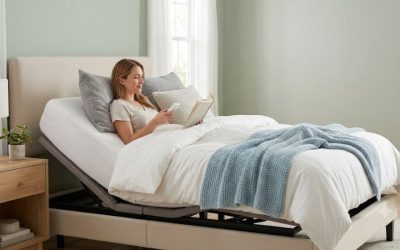
Adjustable bases have a practical advantage for people who regularly sit up in bed.
They can raise the upper body while continuing to support the mattress.
A stationary platform bed requires pillows, wedges, or a supportive headboard to create a comparable seated posture.
For frequent bedroom lounging, this difference can justify the adjustable base’s additional cost.
Noise and Movement
An adjustable base may produce some motor sound while changing positions.
Noise levels depend on the motor, mechanism, installation, and load.
Fixed foundations have no adjustment motors, although poorly assembled bed frames or aging box springs may develop creaks.
Neither product category can be assumed silent without relevant testing.
Electricity and Power Outages
Most powered adjustable bases require an electrical outlet.
They ordinarily remain stationary during a power outage.
Some models have emergency lowering features or battery-based backup systems, but these capabilities are model-specific.
A platform bed, box spring, or conventional foundation does not rely on electricity for its supporting function.
Advantages and Disadvantages of Adjustable Bed Bases
Main Advantages
-
Customizable head and foot positioning.
-
Convenient adjustment for reading and relaxing.
-
Available independent positioning for couples using compatible split configurations.
-
Potentially useful presets and remote controls.
-
Compatible with many modern mattresses when explicitly approved.
-
Additional convenience features on certain models.
Main Disadvantages
-
Generally higher purchase cost.
-
Greater weight and more complicated relocation.
-
Electrical and mechanical components may eventually require service.
-
Mattress compatibility restrictions.
-
Possible limitations with decorative bed frames and under-bed storage.
-
Some models have restrictive return policies.
-
Positioning changes may disturb a partner when using one shared mattress.
The value of these features depends heavily on how frequently they will actually be used.
Which Bed Base Is Best for Different Sleepers?
Side Sleepers
Side sleepers often prioritize pressure relief around the shoulders and hips.
A suitable mattress on a stable fixed foundation may already provide everything necessary.
An adjustable base can offer additional lounging positions, but it is not automatically better for side sleeping.
Some side sleepers may find strongly elevated positions uncomfortable.
Back Sleepers
Back sleepers may appreciate the ability to experiment with slight head or leg elevation.
However, appropriate lumbar support and mattress firmness remain important.
A well-matched mattress on a fixed foundation may be just as suitable for someone who prefers sleeping flat.
Stomach Sleepers
Stomach sleepers generally benefit from a relatively flat, supportive surface.
Strong head or foot elevation can create awkward body angles for some individuals in this position.
For dedicated stomach sleepers who do not need powered elevation for another reason, a conventional platform bed may be the more practical purchase.
Couples With Different Position Preferences
A split adjustable configuration can be particularly useful for couples who prefer different head or foot angles.
For example, a split king arrangement commonly uses two twin XL mattresses with independently controlled bases.
This allows each sleeper to adjust their own side without requiring the other side to move.
However, split beds can introduce a seam between the mattresses, require suitable bedding, and cost more than a conventional fixed bed.
Apartment Dwellers
An adjustable bed can be useful in an apartment, but its weight, dimensions, and installation access deserve attention.
Narrow stairways, elevators, and small bedrooms may complicate delivery and setup.
A lightweight platform frame may be easier to transport, assemble, or move between apartments.
For renters who relocate frequently, simpler construction can be a meaningful advantage.
Older Adults and People With Mobility Limitations
Some users may appreciate being able to reposition the head or legs electronically.
However, a typical consumer adjustable bed does not provide the same functions as a medical or hospital bed.
Safe transfers depend on bed height, stability, surrounding clearance, and the person’s needs.
For significant mobility limitations, consult a qualified healthcare professional or occupational therapist before choosing equipment.
How to Choose Between an Adjustable Bed Base and Alternatives
Decide Whether Adjustable Positioning Is Necessary
Start with your daily habits.
If you spend considerable time reading, watching television, or relaxing in bed, adjustable positioning may have clear practical value.
If you primarily sleep flat and rarely use your bed for other activities, a stationary foundation may be sufficient.
Buying extra functions that you seldom use can increase costs without substantially improving daily comfort.
Verify Mattress and Frame Compatibility
Before purchasing an adjustable base, confirm:
-
The mattress manufacturer explicitly permits adjustable foundation use.
-
The mattress size matches the base.
-
The base supports the full expected load.
-
Any decorative bed frame has adequate internal clearance.
-
The headboard and footboard will not interfere with movement.
-
The installation meets both mattress and base warranty requirements.
Compatibility should be confirmed for the exact products, not assumed from general mattress type or bed size.
Examine Weight Capacity
Manufacturers specify different weight limits and may describe them using different conventions.
Determine whether the stated maximum includes the mattress, users, and accessories.
Compare the rating against the expected total supported weight.
Never assume a higher-priced base automatically has greater load capacity.
Measure Bedroom Clearance
Adjustable foundations contain moving components that may require unobstructed space.
Measure the available room and check the manufacturer’s clearance instructions.
Also account for space around outlets, power cords, and any under-bed storage.
For standard fixed foundations, confirm the support dimensions, leg placement, and mattress requirements.
Evaluate Controls and Accessibility
An adjustable base should be easy for its intended user to operate.
Consider remote button size, labeling, backlighting, and whether manual controls remain accessible.
A complicated application is not necessarily an improvement over a simple remote.
For shared beds, confirm whether each sleeper can control their own side independently.
Review Warranty and Return Terms
Adjustable bases may have different warranty terms for structural components, electrical parts, and motors.
A long advertised warranty does not necessarily mean every component receives identical coverage.
Some adjustable foundations are also excluded from standard sleep trials or returns.
For comparison, a fixed foundation may have a simpler warranty structure, but this varies by manufacturer.
Check the policies before buying.
Consider Maintenance and Repairs
A stationary platform bed usually needs occasional hardware checks and cleaning.
A powered adjustable base may require inspection of cables, moving components, and electrical connections according to manufacturer instructions.
Keep cords away from mechanisms and avoid placing objects where they could be caught during movement.
Do not attempt unauthorized modifications or electrical repairs.
Cost vs Value: Is an Adjustable Bed Base Worth It?
The extra cost of an adjustable bed base is justified primarily by the usefulness of its positioning functions.
It is not automatically an upgrade in mattress support.
Consider three typical situations.
Scenario 1: A sleeper with a comfortable mattress who sleeps flat
A compatible platform bed or slatted foundation may provide everything required. An adjustable base is unlikely to offer strong value unless the sleeper wants new positioning options.
Scenario 2: Someone who reads or relaxes in bed every evening
Powered head elevation can substantially improve convenience compared with repeatedly arranging pillows.
For this person, an adjustable base may be worth the additional investment.
Scenario 3: A couple with different resting preferences
A split adjustable setup can provide independent positioning.
However, the benefit must be weighed against the cost, two-mattress configuration, and possible gap between sleeping surfaces.
The most valuable option is the one whose features you will actually use, not necessarily the one with the longest list of functions.
Common Mistakes to Avoid
Assuming Every Mattress Works With an Adjustable Base
Mattress flexibility varies significantly.
Even two mattresses in the same broad category may have different compatibility requirements.
Always seek manufacturer approval before purchasing.
Buying Based Only on Massage or Smart Features
Massage functions, lighting, and application controls can be convenient.
However, they should not distract from more important specifications such as load capacity, mattress compatibility, adjustment range, reliability, and return policies.
Ignoring the Total Bed Height
Some adjustable bases have adjustable legs, while others sit at a fixed height.
Adding a tall mattress can create an inconveniently high sleeping surface.
Measure the complete height of the proposed setup before buying.
Choosing a Box Spring for an Incompatible Foam Mattress
A conventional box spring may not provide the support required by many modern foam mattresses.
Using an unsupported foundation can affect comfort, durability, and warranty coverage.
Expecting a Bed Base to Fix a Worn Mattress
Neither an adjustable foundation nor a platform bed can restore severely degraded cushioning or internal support.
When mattress deterioration is the primary problem, replacing the mattress may be a more appropriate solution.
Frequently Asked Questions
Is an adjustable bed base better than a platform bed?
An adjustable base is better for sleepers who value customizable head and foot elevation. A platform bed is often better for shoppers who want fixed mattress support, straightforward maintenance, and potentially lower costs. Neither design is inherently better for every sleeper.
Can you use a regular mattress on an adjustable base?
Only if the mattress is specifically compatible with articulated support. Many foam, latex, and hybrid mattresses can work, but suitability varies by construction and model. Confirm compatibility with the mattress manufacturer before use.
Do adjustable bed bases wear out mattresses faster?
An incompatible mattress may experience excessive stress when repeatedly bent. A mattress specifically approved for an adjustable base is designed to accommodate that movement within its intended use conditions. Actual wear depends on construction, use, loading, and maintenance.
Is a box spring necessary with an adjustable bed base?
No. An adjustable bed base generally replaces the traditional mattress foundation. A separate box spring should not be installed between the mattress and moving base unless an unusual manufacturer-approved configuration explicitly requires it.
Can you put an adjustable bed base inside a regular bed frame?
Some adjustable bases are designed to fit within compatible decorative frames. Others operate as standalone structures. Verify interior dimensions, support requirements, moving clearances, and manufacturer instructions before combining them.
Are adjustable bed bases worth it for back sleepers?
They can be worth considering when a back sleeper prefers adjustable head or leg positions. However, comfort varies by person, and a suitable mattress on a fixed foundation may provide equally satisfactory sleep. An adjustable base is not a guaranteed remedy for back pain.
Conclusion
When choosing an adjustable bed base vs alternatives, prioritize the function you actually need. An adjustable base is worth considering for frequent position changes, personalized lounging, and independent adjustment in compatible split-bed setups. A platform bed or suitable slatted foundation is usually the more practical choice when fixed support, simplicity, and budget matter most. Traditional box springs serve a narrower range of compatible mattresses, while risers and wedge pillows address specific height or elevation needs. Before buying, verify mattress compatibility, load capacity, bedroom clearance, and warranty requirements so your chosen base supports both your sleeping habits and long-term mattress use.