Key takeaways
- Check blackout curtain labels for the whole panel, including coating and lining, before choosing washing, drying or professional cleaning.
What's inside
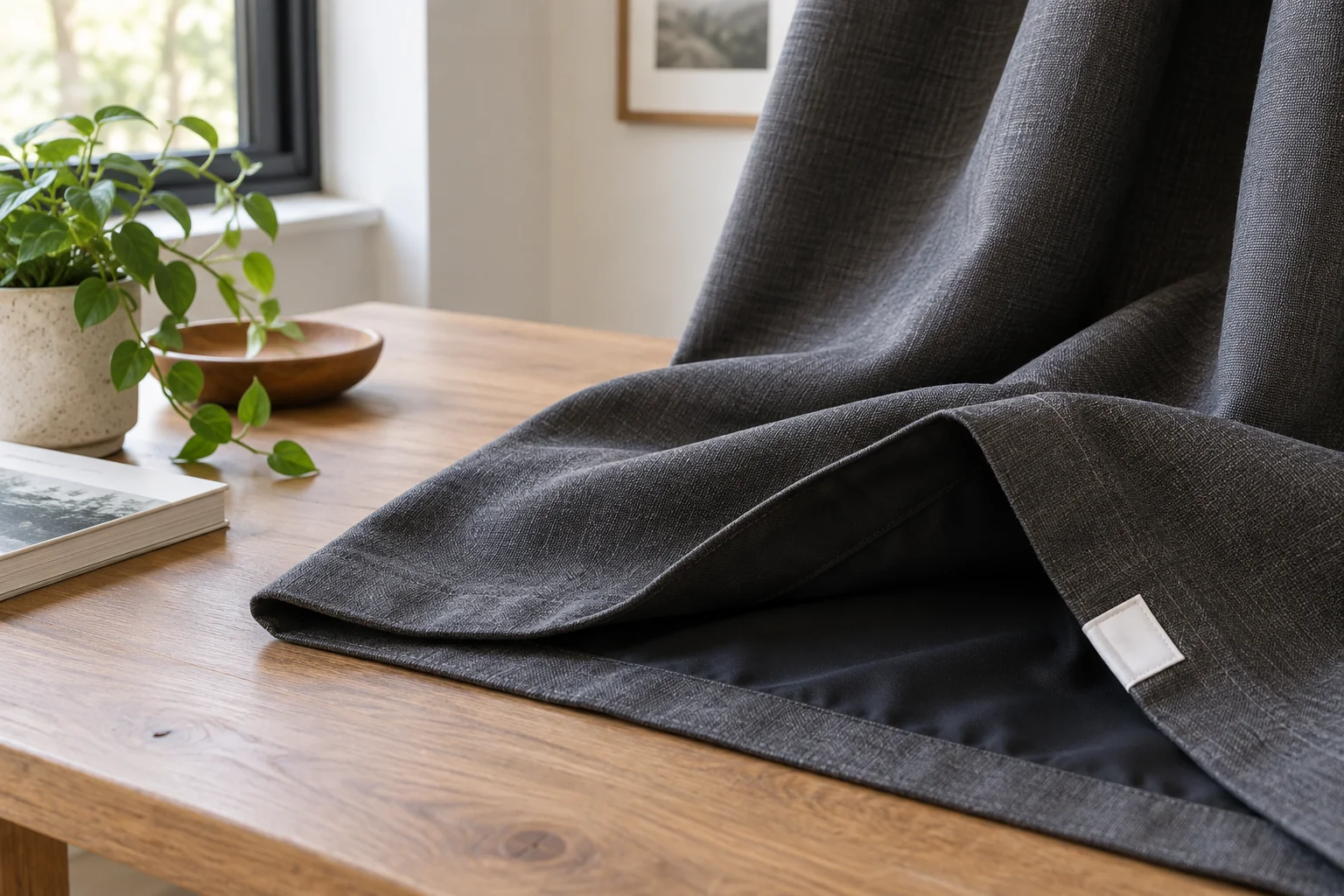
Blackout curtains are not all washed the same way. The face fabric, lining, coating and attached trim form one finished product, and its care label governs the cleaning decision. Read the label on the actual panel before treating it as ordinary washable polyester or assuming that professional dry cleaning is always the safer alternative.
Identify the whole curtain, not only the face fabric
Find the sewn care label and product name while the panel is accessible. Record the article number, size and lining option if available. A retailer may offer standard-lined and blackout versions under a similar collection name. The instructions for the first version should not automatically be applied to the second.
Look at both sides without scraping or pulling layers apart. Record whether the lining is sewn in, separately removable according to the product instructions, or a coating on the fabric. Appearance alone does not reliably identify the coating chemistry. “Blackout” describes a light-blocking function, not a universal laundering method.
If a care label is missing, use the purchase record to ask the maker for the exact product instructions. A label from another curtain in the room may belong to a different purchase. Do not proceed with washing simply because the face fabric resembles a machine-washable item you own.
Why product-specific instructions matter
Dunelm’s curtain-care guide recommends professional dry cleaning in line with the F symbol for its blackout or thermal coated curtains and linings. In contrast, the US listing for IKEA KORGMOTT article 40597149 gives machine-wash instructions and says not to dry clean. These are examples of differing product guidance, not interchangeable alternatives.
The practical lesson is to match the label, model and market. Neither the word blackout nor the fiber name selects the cleaning route. When a current webpage disagrees with the sewn label on an older panel, ask the manufacturer to resolve the difference before booking a service or starting the washer.
Use a whole-panel care worksheet
| Question | Record | What it prevents |
|---|---|---|
| Which panel? | Brand, article number and lining option | Using instructions for a similar version |
| Which components? | Face, lining, coating and attached trim | Following only face-fabric advice |
| Which cleaning route? | Exact label wording and symbols | Assuming wash or dry clean is universally suitable |
| Which drying and finishing? | Permitted drying, ironing and any restrictions | Choosing a safe wash but incompatible finish |
| What hardware? | Hooks, rings or removable fittings | Leaving unsuitable fittings attached |
| What condition? | Existing cracks, loose seams or sticky areas | Confusing pre-existing deterioration with a new result |
| What is unresolved? | Questions for maker or professional cleaner | Guessing when information is incomplete |
Worked example: polyester does not settle the question
Imagine two hypothetical polyester curtain pairs. Pair A has a complete label permitting machine washing under stated conditions. Pair B has a coated backing and a professional-cleaning instruction. The homeowner writes separate records rather than grouping both pairs into one laundry load.
For Pair A, they also check drying and finishing restrictions before removing it. For Pair B, they give the cleaner the label and explain the backing construction and any existing damage. They do not choose a gentle machine cycle for Pair B as an unofficial substitute. This example concerns reading instructions, not a claim that one construction cleans better than another.
Plan removal and reinstallation before cleaning
Photograph the heading arrangement and keep compatible removable fittings organized by panel. Follow the product’s instructions for taking fittings off. Do not force out parts that are sewn or permanently attached. Get help for large panels and use suitable access equipment rather than balancing on furniture beneath the window.
If dimensions matter to the finished fit, record the existing length and width in a consistent way. This provides a reference, not permission to stretch a cleaned curtain back into shape. Check any stated shrinkage guidance for the exact product before hemming or making another irreversible change.
Confirm that the available cleaning and drying equipment can handle the panel according to its instructions. A permitted washing method does not mean every domestic machine has suitable capacity. Do not cram a bulky curtain into a drum or invent a folded drying arrangement that conflicts with its care directions.
Stop when the condition needs assessment
Flaking, sticking layers, brittle coating or damaged seams should be discussed with the maker or an appropriate cleaner before treatment. Do not scrape the backing, use adhesive tape to test it or apply heat to flatten a damaged patch. A small test cannot guarantee that an entire coated panel will tolerate a process its label excludes.
After the approved cleaning, inspect the dry curtain before rehanging. Keep the care record and service receipt with the product details. The next cleaning decision should begin with that specific panel’s instructions, not with a general rule remembered from another set of blackout curtains.