Key takeaways
- Identify the leather collection and care instructions before choosing a sofa cleaner. Compare aniline and protected-leather care requirements.
Identify the leather before choosing a cleaner
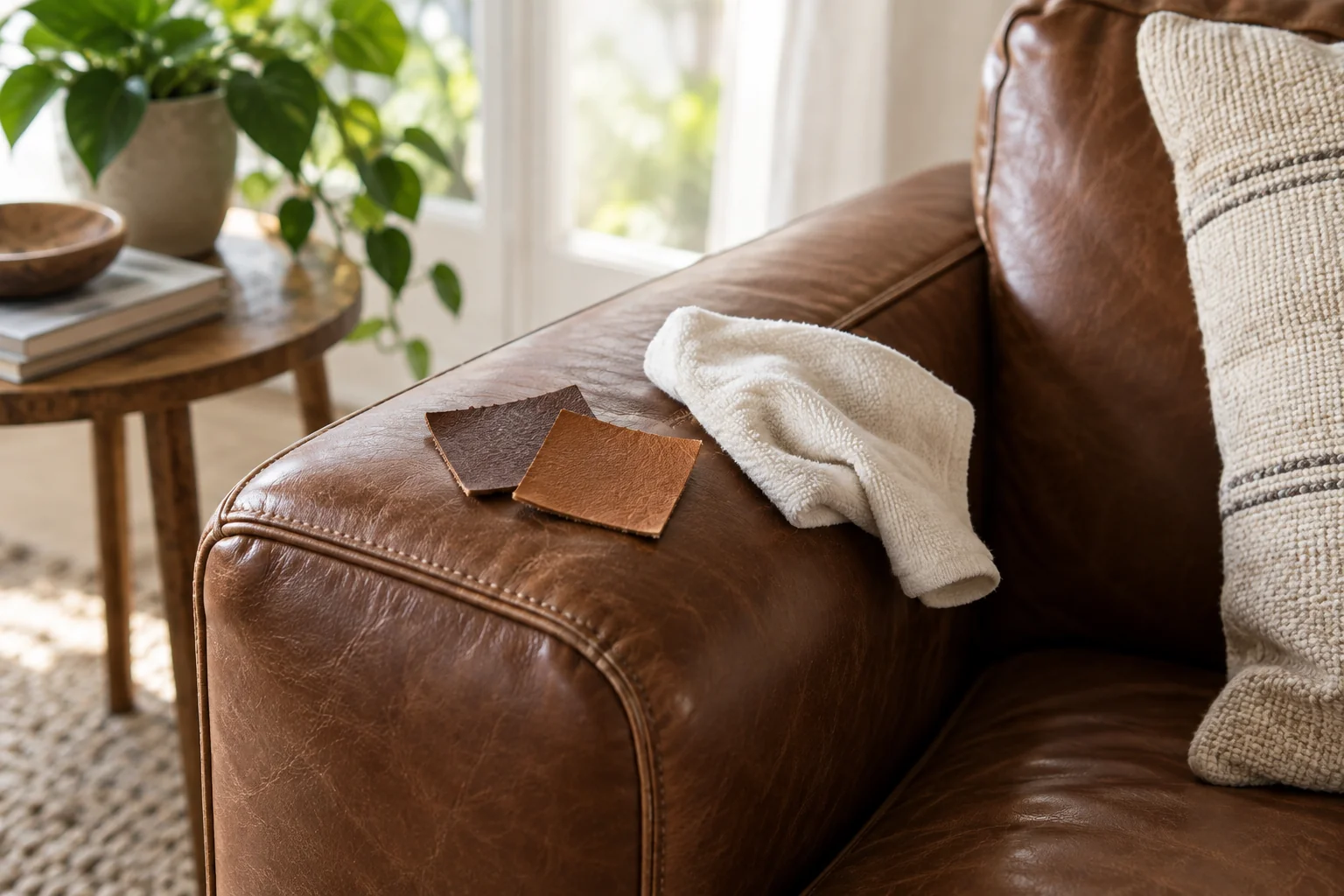
A cleaner labeled for leather is not automatically suitable for every leather sofa. Start with the furniture maker’s description of the specific leather collection and its care instructions. Aniline, protected or pigmented finishes can require different treatment, and the surface’s appearance is not enough to establish compatibility.
This guide helps you assemble a care record before applying anything. It is not a method for identifying leather by wetting, scratching or exposing it to a solvent. If the upholstery remains unidentified, keep liquids and treatment products off it while you obtain the correct instructions.
Read care codes within their own system
American Leather’s care-code guidance illustrates an important distinction. Its Code A aniline guidance calls for dry care and excludes water or cleaning agents. Its Code P category, described as pigmented or Aniline Plus, permits a lightly water-dampened cloth followed by drying. Its nubuck guidance has separate restrictions.
Those letters belong to that manufacturer’s system. Do not transfer them to a different brand or confuse them with fabric upholstery codes. The words in an online listing are useful clues, but the applicable care document should resolve what is permitted on your particular sofa.
A finish description is also not a stain diagnosis. Even when routine wiping is permitted, it does not follow that a household degreaser, ink remover or conditioner is approved. Keep routine maintenance and treatment of a specific mark as separate questions.
Build a leather care record
| Field | Where to look | What to record |
|---|---|---|
| Furniture identity | Order and maker’s label | Brand, model and purchase details |
| Leather collection | Order swatch or upholstery specification | Exact collection and color code |
| Finish category | Manufacturer care information | Its wording, not a visual guess |
| Routine method | Applicable care document | Approved tools and moisture restrictions |
| Proposed product | Product instructions and maker confirmation | Explicit compatibility and exclusions |
| Unresolved issue | Photograph and support response | Mark, location and approved next step |
Save the document with the collection name rather than only bookmarking a retailer’s general advice page. If the sofa was bought used, ask the manufacturer whether the label and photographs can identify the upholstery. Describe uncertainty plainly; a secondhand seller’s description may be incomplete.
Compare the care instruction with the cleaner label
Make two short lists: what the sofa’s instructions allow, and what the proposed cleaner’s directions cover. Compatibility requires agreement. A product that says suitable for protected leather may explicitly exclude aniline or nubuck; the broad word leather on the front of its package does not override that exclusion.
Also check whether the furniture maker specifies a particular product or process. If one document permits a treatment and the other prohibits it, stop and request clarification. Do not use a hidden-area trial to justify a product already ruled out by the instructions.
When the maker does approve a test procedure, follow that procedure and its observation interval exactly. A quick change-free appearance is not proof that every finish or future application will behave the same way. Record the outcome without treating it as a universal endorsement.
A worked comparison with two different sofas
Illustrative example: Sofa A’s care record identifies its leather as aniline and specifies dry care only. Sofa B’s record identifies a protected finish and permits the maker’s stated damp-wipe routine. Both sofas look brown, but their recorded instructions differ.
A shopper finds a cleaner labeled for protected leather, with aniline excluded. It fails Sofa A’s compatibility check immediately. Sofa B still requires a separate check: does its furniture maker permit that cleaner, or only the stated routine? The protected label is relevant information, not automatic approval.
The useful outcome is two separate care cards, not a shared bottle chosen because the sofas look similar. If the maker has not answered the product question for B, write pending instead of filling the gap with an assumption.
Describe a stain without experimenting on it
For a specific mark, record when it appeared, what substance is known to be involved and whether anyone has already applied a product. Photograph it in ordinary light without editing away color differences. This gives the manufacturer or a qualified leather-care professional useful context.
Follow any immediate spill instructions already supplied for that leather. Do not add water, heat, abrasive pads or a homemade mixture simply to see what happens. A treatment intended for another finish can make later assessment harder.
Peeling, color transfer, cracking and a surface stain are not interchangeable descriptions. Report what you see rather than choosing a repair product from a photograph online. A cleaning guide cannot establish whether a finish needs professional repair.
Keep the record usable for everyone
Store approved care information where other household members can find it. Label the record with the sofa and leather collection, and list prohibited products alongside the permitted routine. If you change upholstery or acquire another chair, create a new record rather than copying the old one.
The goal is a repeatable compatibility decision: identified leather, applicable instructions and a permitted method. That sequence is more reliable than shopping by color, softness or a cleaner’s broad marketing label.