Key takeaways
- Match a no-rinse cleaner label to your vinyl plank care guide with a compatibility worksheet, dilution example and traceable first-use record.
What's inside
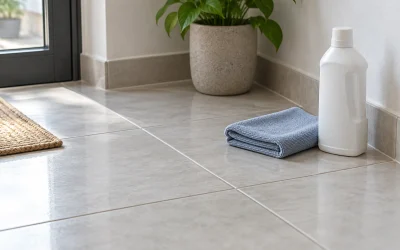
“No rinse” describes a cleaner’s intended use; it does not establish compatibility with every vinyl plank floor. Check the flooring manufacturer’s care instructions and the cleaner’s exact label together. The suitable product, dilution, application method, and floor condition all need to agree.
Identify the floor before choosing a bottle
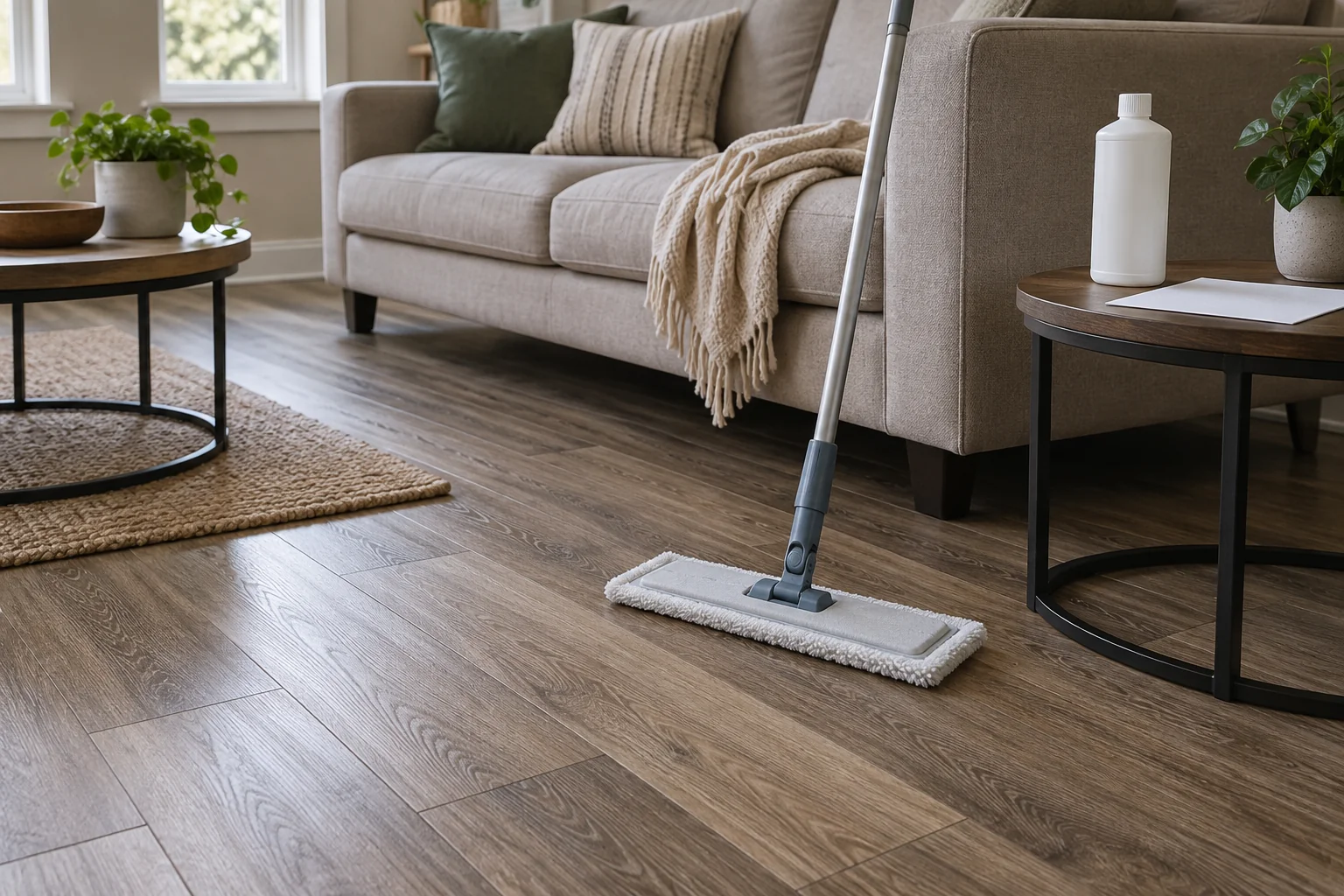
Find the flooring brand, collection, product code, and installation record. Keep the care document for that collection rather than assuming all floors sold as LVP have identical restrictions. A landlord, installer, leftover carton, or purchase invoice may provide the missing identification.
Also note whether the surface has a later polish, treatment, or coating. The original floor description may not tell you how that added layer should be maintained. If you cannot identify the surface or a previous treatment, ask the flooring supplier before experimenting with a new product across the room.
Read the two sets of instructions side by side
Shaw’s luxury vinyl care page recommends appropriate neutral-pH cleaning and directs owners to their care guide for products to use and avoid. It also advises removing loose dirt before wet cleaning. That is a floor-maker’s perspective; it does not certify every bottle marketed for hard surfaces.
As a cleaner-label example, Bona’s 2024 technical sheet for its 850 ml Hard-Surface cleaner describes a ready-to-use, rinse-free formulation for specified sealed hard surfaces including vinyl. The statement belongs to that formulation and document. Check the current label for the bottle sold in your region.
| Question | Floor instructions | Cleaner instructions |
|---|---|---|
| Surface type | Exact floor collection and any restrictions | Explicitly listed suitable surfaces |
| Product type | Approved or excluded cleaner categories | Cleaner, polish, restoration or disinfecting product |
| Preparation | Loose-soil removal and condition limits | Required preparation |
| Concentration | Any applicable restriction | Ready-to-use or exact dilution |
| Application | Tool and moisture limits | How and where to apply |
| After cleaning | Drying and access instructions | Rinse requirement or no-rinse direction |
Separate cleaner from polish
Bottles that promise shine, restoration, protection, or a refreshed finish may have a different purpose from routine soil removal. Read the product category, not just the prominent phrase on the front. A floor that excludes polishes does not become compatible because another part of the bottle says no rinse.
Likewise, a cleaner’s suitable-surface list can include several materials while your floor has a narrower approved-care specification. If the two documents conflict, ask the flooring manufacturer to resolve the conflict. Do not pick whichever instruction uses less effort or whichever description sounds more reassuring.
Worked example: the label changes the preparation
Consider two hypothetical bottles, both labeled no rinse. Bottle A is ready to use. Bottle B is concentrated and its label directs 10 milliliters per liter of water. For a two-liter batch of B, the stated ratio would require 20 milliliters of concentrate. These quantities are an arithmetic example, not a recipe for any named cleaner.
Using B undiluted would ignore its preparation instructions, while adding an invented dilution to A would ignore its ready-to-use directions. The same front-label phrase therefore leads to different preparation steps. Record the actual bottle’s instructions on your worksheet rather than keeping a universal household dilution rule.
Make the first use traceable
Once compatibility is established, follow the floor and cleaner instructions for any initial-area check. Use a clean tool and a known product amount. Note the area, time, mixture if applicable, and drying result. A patch check supplements the instructions; it cannot authorize a product the floor maker excludes.
Do not combine cleaners in a bottle or mix a new solution with an unidentified remainder. Keep products in their labeled containers and prepare only what the instructions permit. Clear the cleaning area so people do not walk onto a wet surface while you are observing the result.
If the floor looks streaky afterward
Pause before adding more cleaner. Record whether the pad was clean, the preparation matched the label, and the appearance remained after drying. Those details are more useful than immediately switching products, because each additional treatment makes the starting condition less clear.
A no-rinse label does not mean every accidental overapplication should be left untouched. Follow the floor manufacturer’s advice for correcting residue, including any permitted rinsing and drying method. Do not flood seams or use steam as an improvised reset. Ask for instructions when the cause or previous treatment is uncertain.
Keep one approved routine on file
If several people clean the room, include a photograph of the exact bottle and a short preparation note in that record. Distinguish the floor cleaner from nearby furniture or bathroom products. This makes a refill or shopping substitution visible before someone assumes that similar packaging means the same instructions.
Save the floor care sheet, the exact cleaner label, and the preparation instructions together. Update the record if you change formulation, region, or floor treatment. A simple two-document match is more reliable than remembering that a previous bottle happened to say “vinyl” and “no rinse.”