Key takeaways
- Read cleaner contact time and rinsing as separate stages of the same label directions. Includes a sequence table and two common reading mistakes.
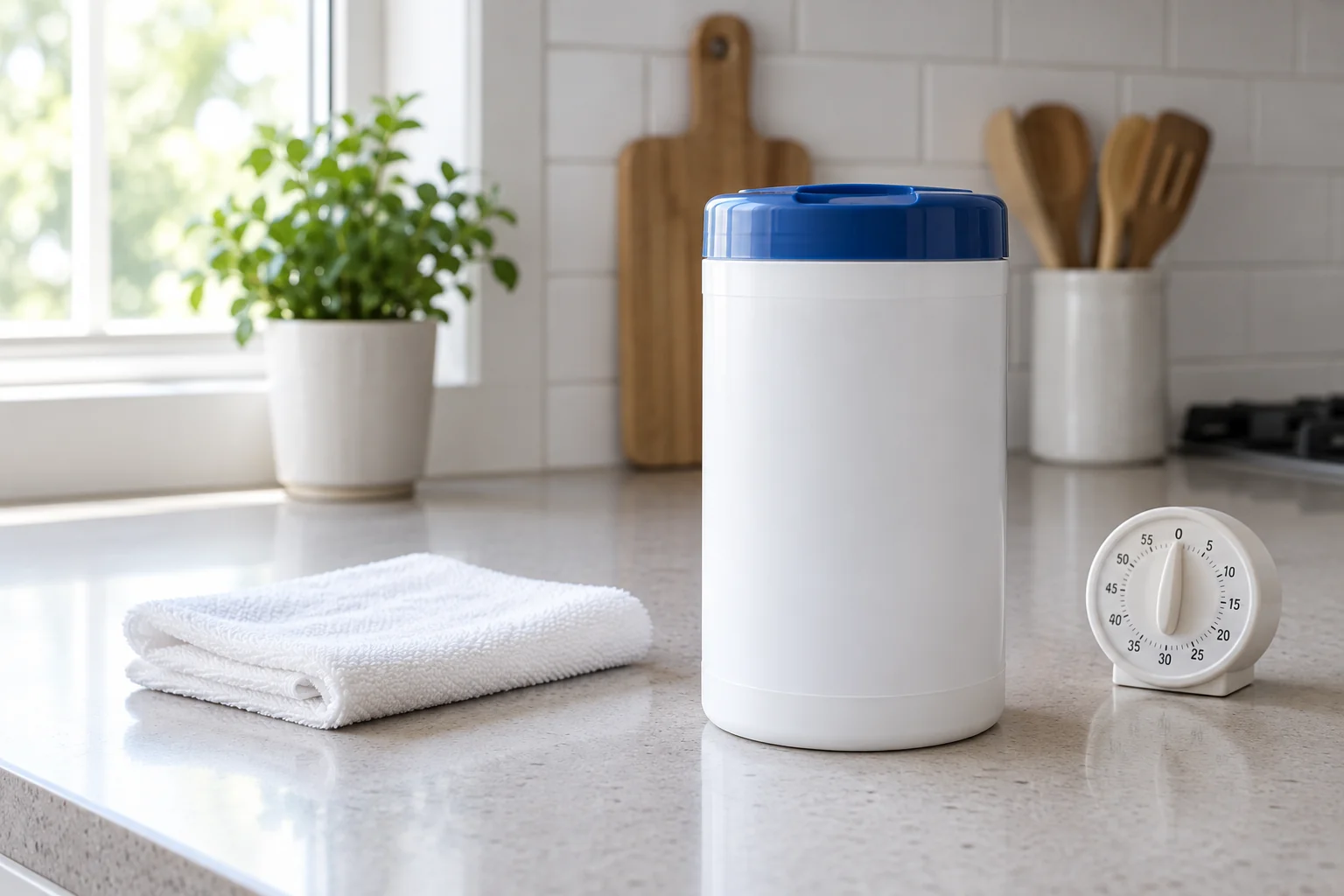
Contact time and rinsing describe different parts of a cleaning product’s directions. Contact time specifies a required treatment interval under stated conditions. A rinse instruction tells you what to do afterward for the stated use. Read both in the same label section before treating a surface.
Choose the intended task before reading the clock
A package may provide separate instructions for cleaning, sanitizing and disinfecting. It may also distinguish hard surfaces, soft surfaces and food-contact uses. Select the section that applies to your intended task and material; do not combine the shortest time from one section with the finish step from another.
The EPA’s disinfectant guidance explains that directions identify the use site, application method and contact time. For the applicable disinfectant treatment, the surface must remain visibly wet for that interval. The label’s permitted use and conditions remain essential.
A household cleaner without the relevant disinfection directions should not acquire a disinfection claim because someone leaves it in place longer. Equally, a product that can perform several tasks needs the correct directions for the task being claimed. A timer measures elapsed time; it does not identify the right procedure.
Read the treatment and finishing instructions together
Clorox Puerto Rico’s Disinfecting Wipes page provides a concrete regional example: its cleaning and disinfecting directions call for four minutes of visible wetness, and its separate note requires rinsing food-contact surfaces after the recommended time. This is an example of two requirements working in sequence, not a rule for every wipe or market.
Match any online direction to the exact product in your hand. Names, formulations and instructions can differ. If the container label and a webpage appear inconsistent, ask the manufacturer which directions apply before using the product for that task.
Keep the full label available, including precautions and surface exclusions. A cropped photograph of the time statement leaves out information needed to decide whether treatment is appropriate in the first place.
Turn the relevant label section into a sequence
| Stage | Read on the label | Do not substitute |
|---|---|---|
| Before application | Permitted surface and any soil removal | A general kitchen or bathroom description |
| Application | Product form and specified method | A different dilution or another cleaner |
| Treatment interval | Required condition for the complete time | A quick wipe followed by a dry surface |
| After treatment | Rinse, wipe or drying requirement for this use | A finish step copied from another section |
Recognize two common sequence mistakes
In the first mistake, a person sees a four-minute treatment requirement, applies the product and immediately wipes it dry. They then wait four minutes before using the surface. The clock has advanced, but the required treatment condition was not maintained. Waiting beside a dry surface does not recreate the missing wet interval.
In the second mistake, the treatment interval is completed correctly but the person ignores a rinse required for that particular use. Finishing the first stage does not cancel the second. The complete procedure ends only when the label’s relevant finishing directions have also been followed.
These examples explain the reading error; they are not a new treatment recipe. Use the actual product’s time, wetness requirements and finishing directions. Do not adopt the illustrative interval for a different cleaner, target organism or surface.
Check the surface as carefully as the product
Identify the material and its finish, then compare the surface maker’s care instructions with the cleaner’s permitted uses. A hard-looking countertop may include a coating, edge joint or adjacent material with different restrictions. Permission for one broad material name should not be stretched across the entire assembly.
If the cleaner requires sustained wetness but the surface maker prohibits that treatment, find a mutually permitted approach with the relevant suppliers. Do not shorten the required contact time to make an incompatible method appear acceptable. That changes the directions instead of resolving the conflict.
Keep food-contact and non-food-contact areas distinct when the label does. A nearby decorative surface and a preparation area may need different finishing steps even when they look similar. Record the intended use before choosing the applicable paragraph.
Make a concise instruction card for shared cleaning
For a shared household task, create a small card naming the exact product, approved surface, selected label section and required finishing step. Keep it with access to the complete label. The card is a reminder, not a replacement for directions or permission to use a substitute product.
Update it if the product changes. Do not leave an old timer setting as the only surviving instruction after replacing a bottle or canister. A familiar scent or brand color does not establish that the new container has identical directions.
When a statement is unclear, ask the maker a specific question: which section applies to this surface and use, and what follows the contact interval? That produces a more useful answer than asking whether the cleaner needs to sit for a while. Reading the entire sequence prevents both premature removal and a missed rinse.