Key takeaways
- Recover the correct sofa care instructions using model and fabric identifiers, purchase records and a practical missing-label evidence sheet.
What's inside
If your sofa’s cleaning label is missing, its color, texture, or apparent fiber type is not enough to choose a cleaner. First identify the furniture model and exact upholstery option, then obtain care instructions that match them. A sofa sold in several fabrics can require different care even when the frames look identical.
Look for identification, not just a cleaning letter
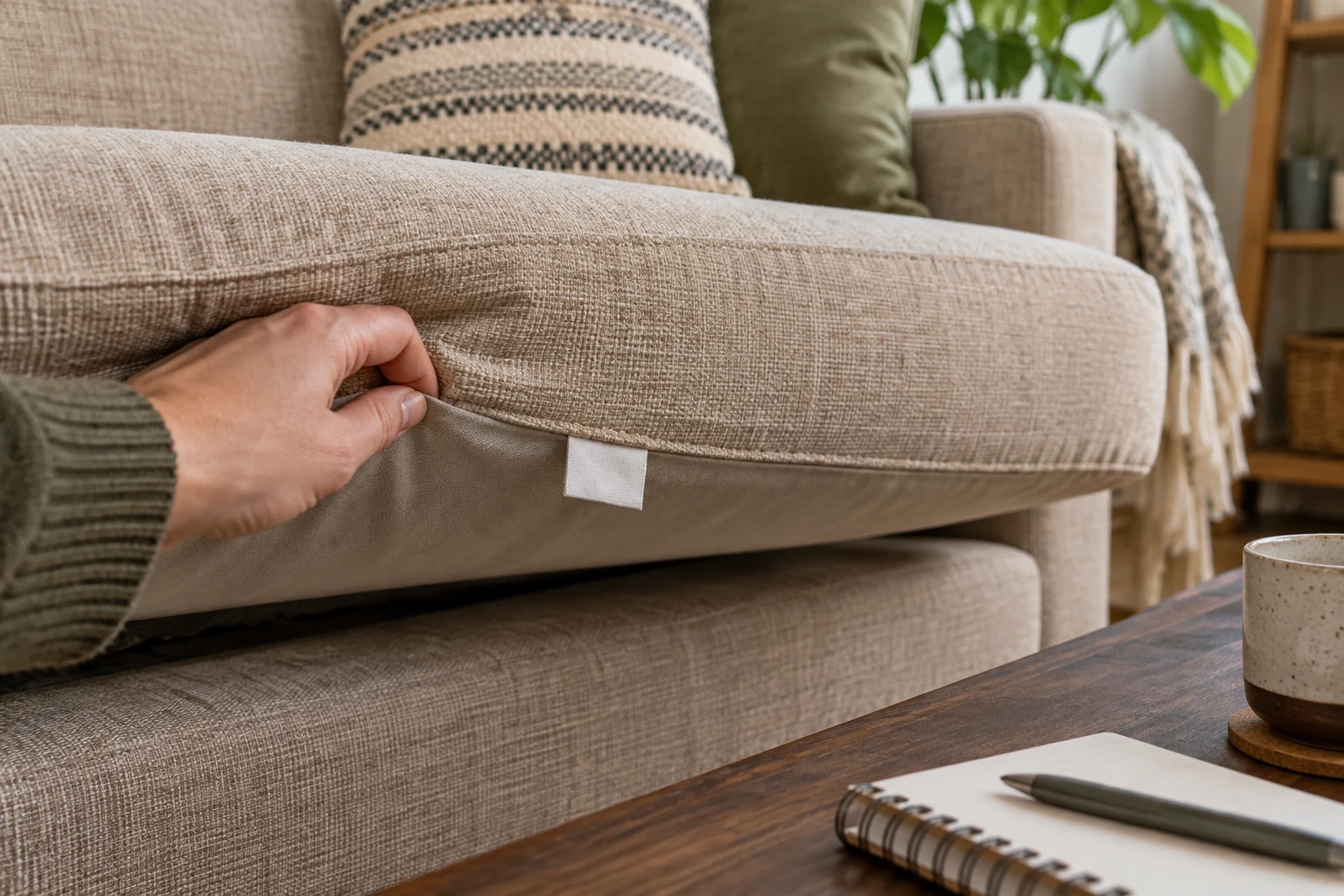
Start with areas you can reach safely: beneath removable seat cushions, along visible seams, and on accessible frame labels. Ashley’s care guide identifies the area under a cushion or beneath the unit as label locations for its upholstery. This does not mean every brand puts its label in the same place.
Photograph every label you find before deciding that it is irrelevant. A style number, upholstery code, order reference, or production label may let the seller recover the missing care information. Avoid cutting the dust cover, removing staples, or tipping a heavy reclining sofa merely to search underneath it. Ask the seller for the model’s label location if access is difficult.
Separate the frame from the fabric option
A product name may identify only the sofa design. Your receipt might add a color name or cover number that distinguishes its upholstery. Preserve spaces, punctuation, and leading zeros when copying identifiers; a photograph helps avoid transcription errors.
La-Z-Boy’s product identification guidance distinguishes its style number from the fabric number labeled COVER. That is a useful example of why finding the furniture family alone is not the final step. Other manufacturers use different labels, so ask them what each code means rather than interpreting an unfamiliar number yourself.
| Evidence | What to record | What it cannot establish alone |
|---|---|---|
| Order confirmation | Seller, date, item number, chosen upholstery | Whether the sofa was later recovered |
| Frame label | Model, serial or production details | The care of a replacement cover |
| Fabric identifier | Cover code, pattern and color | Permission to wash the entire cushion |
| Photographs | Overall sofa, seams, weave and all labels | Reliable fiber or finish identification |
| Care document | Matching product, region and revision | Suitability for unrelated cleaners |
| Support reply | Explicit match between identifiers and method | A result guarantee for an existing stain |
Recover the purchase trail
Search your email for the seller, furniture name, order number, and words such as upholstery or swatch. Check whether a household member placed the order. A delivery confirmation may have the complete item description even when the receipt uses an abbreviated name.
For secondhand furniture, ask the previous owner for the original receipt or order screenshot with personal information removed. Also ask whether cushions were replaced, the sofa was reupholstered, or a stain treatment was applied. A correct frame model does not override those changes. If the fabric is a later replacement, the upholsterer’s invoice may be the relevant record.
Keep current catalog pages as clues, not proof. A manufacturer may reuse a style name while changing available covers. An archived order or a support response tied to your identifiers is more useful than a visual match to today’s promotional photograph.
Send a question that support can answer
Instead of asking “How do I clean a gray sofa?”, send the model and cover identifiers, purchase date, label photos, and the precise problem. Ask whether the supplied care instructions apply to the frame upholstery, removable cover, or both. Mention any previous treatment and whether the label is absent or merely unreadable.
A reusable message is: “Please confirm the care instructions for this model and upholstery code. The cleaning label is missing. Can you identify the approved routine care and spot-cleaning method, and whether the removable cover has separate laundering instructions? Attached are the order details and existing labels.”
Worked example: similar appearance, unresolved instructions
This scenario is illustrative. A buyer finds an order for a sofa called Harbor in Sand, plus a frame label, but no cover number. A current Harbor listing offers three beige fabrics. Selecting the closest photograph would leave three plausible choices. The buyer sends the old order number to the original seller, who retrieves the actual cover option and its care sheet.
The useful result is the documented match, not the apparent color match. If the seller cannot retrieve it, the evidence sheet should remain marked “unconfirmed.” Recording that limit prevents another household member from treating a guess as an approved cleaning method later.
What to do while identification is unresolved
Pause experiments with water, alcohol, steam, foam, deodorizer, and protector sprays. An inconspicuous patch test does not identify the upholstery or substitute for instructions. Do not remove a zipped cover on the assumption that the zipper makes it machine washable; see our guide to removable cushion covers for that separate decision.
Keep people from spreading an existing spill and contact the manufacturer or a qualified upholstery cleaner with your evidence. Explain that the material remains unconfirmed before booking any treatment. If no reliable identification is possible, professional assessment may still reveal limits rather than a guaranteed cleaning method.
Once you obtain matching instructions, save the document and support reply with your receipt, and photograph the identifiers in one folder. The next spill should begin with that record, not another round of visual guessing.