Our Top Picks
 Yaheetech Lift Top Coffee Table with Hidden Storage38.6 inches38.6 x 19.7 x 21.7 inches33.7 poundsCheck on Amazon
 Yaheetech Lift Top Coffee Table for Living Room39.37x19.69x17.72 inch39.5 x 17.72 x 17.72 inches43.43 poundsCheck on Amazon
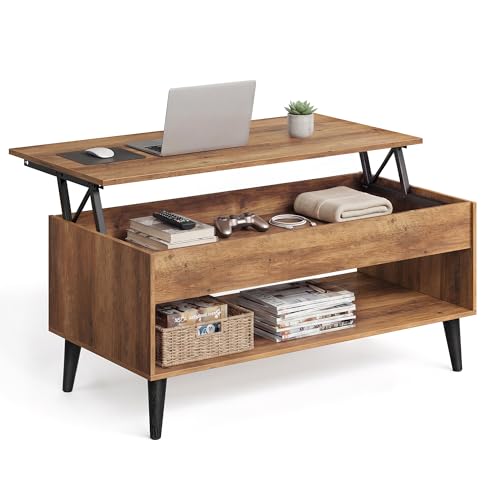 VASAGLE Lift Top Coffee Table with Hidden Storage19.7"D x 39.4"W x 22.8"H19.7 x 39.4 x 22.8 inches38.2 poundsCheck on Amazon
The Short Answer
Yes, if you regularly eat, work, or game from the sofa and your living room has no space for a separate desk or dining spot. A lift-top table raises its surface from the usual 16 to 18 inches up to roughly 24 to 27 inches, which puts a laptop or dinner plate at a comfortable height for someone seated on a sofa with an 18-inch seat. If you use your coffee table mainly to hold a candle and a remote, the mechanism is dead weight you will pay for and never use, and a plain table with a drawer serves you better. The deciding question is simple: do you find yourself hunching over the coffee table more than a couple of times a week? If yes, buy one.
What You Actually Get
A lift-top coffee table is a standard rectangular table, usually 39 to 47 inches long and 20 to 24 inches deep, with a top panel mounted on a pair of gas springs or scissor hinges. Pull the top toward you and it rises 8 to 10 inches and slides forward a few inches so it hovers over your lap. Beneath the top is a hidden storage cavity, typically 4 to 6 inches deep and large enough for a laptop, a few throw blankets, or board games. Most also add open shelves or a drawer at the ends.
Yaheetech Lift Top Coffee Table with Hidden Storage & Lower Shelf, 38.6"
Chosen because it specifies 38.6".
View on AmazonYaheetech Lift Top Coffee Table for Living Room, Wooden Small Center Tables with Large Storage Shelf Drawer and Hidden Compartment Modern, Black
Chosen because it specifies Black.
View on AmazonVASAGLE Lift Top Coffee Table with Hidden Storage, Gas Spring
Chosen because it specifies Gas Spring.
View on AmazonThe gas springs on this class of table are the same cylinder type used in office chairs; they open smoothly with one hand and hold the top steady for typing.
What you do not get, even at the high end, is a real desk. The raised top is about 20 inches deep, and the storage cavity beneath means the lifted surface cantilevers toward you rather than sitting on legs, so pushing down hard on the front edge produces a little flex.
Pros
- Turns the sofa into a functional workstation or dining spot without adding another piece of furniture to the room.
- Raises the surface from about 17 inches to 24 to 27 inches, which is within the range of a standard desk height for a seated person on a sofa.
- Hidden storage swallows clutter such as laptops, chargers, and remotes; a typical cavity holds the equivalent of two shoeboxes.
- Gas-spring mechanisms open with one hand and hold position without latches.
- Entry prices are low; a functional table costs about the same as a basic fixed coffee table.
- Looks like an ordinary coffee table when closed, so it does not read as “office furniture” in the living room.
- Useful for people with limited mobility who find bending to a low table uncomfortable.
Cons
- Cheap models are almost all particleboard; a spilled drink that sits at the seam swells the board permanently.
- The raised top has a weight limit, often 30 to 50 pounds, so heavy objects have to come off before you lift it.
- Assembly typically takes 60 to 90 minutes and involves 40 or more screws and cam locks.
- Only the top section lifts; anything on the fixed end shelves stays at coffee-table height.
- The lifted top blocks your view of the TV if you sit directly across from it, which matters in a small room.
- Gas springs lose pressure over time, usually after 5 to 8 years of daily use, and replacements need to match the original length and force.
- Most designs are rectangular only, so they pair awkwardly with curved sectionals or round rugs.
Who Should Buy It
Buy a lift-top table if you work from home without a dedicated office, eat dinner in front of the TV more nights than not, live in an apartment under about 900 square feet, or have kids who do homework in the living room. It is also a strong choice for anyone who needs a place to stash a laptop or gaming controllers out of sight quickly. Measure your sofa seat height first; the table works best when the raised top lands 6 to 8 inches above the seat cushion, so a sofa with an 18-inch seat wants a table that lifts to about 24 to 26 inches.
Who Should Skip It
Skip it if your coffee table is decorative, if you already have a desk and a dining table you actually use, or if your living room is formal enough that a laminate top would look out of place. Skip it as well if you have a sectional with a chaise or a large L-shape; a lift-top needs to sit within about 14 to 18 inches of the sofa edge to be usable, and sectionals often push the table farther away. Households with toddlers should think twice, since the lifting mechanism and the storage lid are pinch points, and the top can be pulled open by a curious child.
Cheaper Alternatives
| Option | Cost | Trade-off |
|---|---|---|
| C-shaped sofa side table that slides under the couch | Check on Amazon | Puts a laptop at 24 to 28 inches right over your lap, but the surface is small (about 16 by 12 inches) and it holds nothing when not in use. |
| Adjustable-height laptop tray or lap desk | Check on Amazon | Cheapest fix for working from the sofa; stores in a closet but offers no coffee-table function at all. |
| Storage ottoman with a flip tray top | Check on Amazon | Hides more than a lift-top and doubles as seating, but the surface stays at 16 to 18 inches and is soft-edged. |
| Fixed coffee table with drawers | Check on Amazon | Sturdier and often better looking, with no height adjustment. |
| Nesting coffee table set | Check on Amazon | Pull the smaller table out and use it beside you at the sofa; still low, but flexible for guests. |
| Height-adjustable crank or pneumatic desk used as a coffee table | Check on Amazon | Far stronger surface and true desk height, but looks like office furniture and has no closed storage. |
What to Look For in a Lift Top Coffee Table
Lift Mechanism Type
Most lift-top tables use one of two systems. Gas-spring (strut) models raise the top with a smooth, damped motion and hold it at the top with little effort. Scissor or lever-style frames use a mechanical linkage, often with a handle or latch, and can feel more abrupt. Spec sheets usually name the mechanism; if a listing does not, treat that as a reason to read the questions section before buying. Also look at how the top travels. A top that rises and tilts toward you is easier to type on than one that rises straight up, because your wrists stay at a natural angle.
Height Range and Your Sofa
The number that matters is the lifted height compared with your own seating. Typical sofa seats sit roughly 17 to 19 inches off the floor, and ergonomic guidance for desks generally places the work surface near elbow height when you are seated, commonly in the high 20s of inches for a standard chair. A sofa is lower and softer, so a lifted top in the mid 20s often feels right for a laptop. Measure the seat height of your own sofa, then compare it to both the closed height and the maximum lifted height on the spec sheet.
Frame and Top Materials
Construction tells you more than finish photos. Engineered wood (MDF or particleboard) with a veneer or laminate surface is common and fine for light use, but it relies on the quality of its fasteners. Metal frames and thicker panels tend to resist racking when the table is raised and loaded. Check whether the hinge points and the lift brackets are steel, and whether the manufacturer lists a load capacity for the lifted top separately from the fixed shelf below. Rounded or beveled edges are a practical bonus if kids or pets share the room.
Storage Space and Footprint
The hidden compartment is a selling point, but its usable depth depends on the mechanism. A scissor frame can eat into the interior, leaving less room than the outer dimensions suggest. Look for the stated interior depth and think about what you would actually keep there: remotes and coasters fit anywhere, while a laptop, charger, and board games need real space. Then compare the table footprint with the gap in front of your sofa. A common layout guideline leaves around 14 to 18 inches between sofa and table so you can stand and sit without turning sideways.
Which Setup Fits Which Situation?
| If you… | Choose… |
|---|---|
| Eat or work from the sofa most days | A model whose lifted height lands in the mid 20s of inches and whose top tilts toward you |
| Mostly want hidden storage and a tidy room | A lift-top with the largest stated interior depth, even if the lift range is modest |
| Share the space with young children | Rounded corners, a smooth damped lift, and a latch or friction hold so the top cannot drop suddenly |
| Have a small living room | A compact footprint with a rectangular top, so it can sit close to the sofa without blocking the walkway |
| Use heavy equipment such as a gaming laptop or monitor | A metal-framed model with a stated load capacity for the raised top, not just the lower shelf |
| Rarely eat or work there | A standard coffee table or a nesting set, since a lift mechanism adds moving parts you would hardly use |
Common Mistakes When Buying a Lift Top Coffee Table
- Ignoring the closed height. A table that rises well but sits taller than the sofa seat when closed looks awkward and makes it hard to put your feet up.
- Trusting a single capacity number. A listed weight may refer to the fixed tabletop, while the lifted section holds less. Read which part the figure covers.
- Forgetting the lifted depth. When the top rises it often moves toward you. If the table sits too close to the sofa, it can press against your knees.
- Skipping assembly details. Many lift-tops arrive in pieces with a mechanism to install. A poorly seated strut or a missed bolt is a common cause of wobble and sticking.
- Buying for looks alone. A glossy finish may show every fingerprint and ring from a mug. Matte or textured surfaces hide wear better.
- Overlooking floor protection. Hard plastic feet can scratch wood or laminate floors; felt pads solve this easily.
FAQ
How high does a lift-top coffee table go?
Most rise 8 to 10 inches from a closed height of 16 to 19 inches, landing between 24 and 27 inches. That is a few inches below a standard 29-inch desk but well suited to someone sitting on a sofa cushion 17 to 19 inches off the floor.
How much weight can the lifted top hold?
Budget tables are typically rated for 30 to 45 pounds on the raised top and 50 to 100 pounds when closed; check the listing. A laptop, a dinner plate, and a drink are well within that. A stack of textbooks or a person leaning on it with both arms is not.
Do lift-top tables wobble or feel flimsy?
Tightening every cam lock during assembly and placing the table on a level floor reduces most of it.
How long do the gas springs last?
With daily use, the springs on a mid-range table generally stay firm for 5 to 8 years before the top starts to drift down slowly. In 2026 most manufacturers list the strut force rating in the manual, which makes ordering a match straightforward.