Key takeaways
- Protected leather is nearly impermeable to drool, muddy paw prints, and small accidents when wiped promptly; most cleanup is a damp cloth.
- Hair, dander, and fleas have nowhere to hide, which matters for allergy sufferers.
- Dog claws leave faint scuffs that blend into the surface over time rather than snagged loops and pulled threads.
- Minor scratches can be treated at home with a $15 to $25 recoloring balm in an afternoon.
- Lifespan of 10 to 20 years for a well-built leather sofa versus 5 to 8 for most fabric sofas in a pet home.
- Leather does not trap odor in the fibers, so a pet-heavy room smells cleaner.
- Tufted and distressed finishes, common on leather designs, are especially forgiving of wear.
The Short Answer
Yes, with one condition: the leather has to be pigmented (protected) top-grain or full-grain, not aniline and not bonded. Protected leather shrugs off dog hair, drool, muddy paws, and most accidents better than any fabric, and it gets a light patina from claws rather than the pulled threads that ruin upholstery. If you have a cat that scratches furniture, or you fall in love with a soft aniline hide, the answer flips to no; those combinations end badly and expensively. For the common case of a dog household choosing between a $1,500 leather sofa and a $700 fabric sofa, leather is the better buy because it will still look presentable years after the fabric has been replaced.
What You Actually Get
“Genuine leather” on a listing covers a wide range, so the details matter. At the top are full-grain hides with the natural surface intact and top-grain hides that have been lightly sanded and then coated with a pigmented finish. Both are real leather through the entire thickness, typically 1.0 to 1.4 millimeters on sofas, and both can be cleaned with a damp cloth and conditioned to stay supple. Below that sits split leather and bonded leather, which is shredded leather fiber glued to a fabric backing under a polyurethane skin; it peels within two to four years in a pet household and is not worth considering.
Our top picks

As an Amazon Associate we earn from qualifying purchases at no extra cost to you.
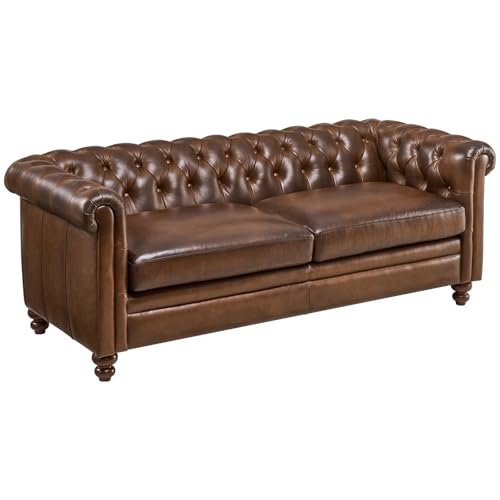
Two examples show what the real thing costs. The Hydeline Magnum 84-inch Top Grain Leather Sofa in chestnut brown lists at about $1,699 and pairs the hide with a kiln-dried solid wood frame, pocket coils, and high-resiliency foam, which are the components that let a sofa survive a 70-pound dog jumping on it for a decade. The ONBRILL 80-inch Full-Grain Leather Chesterfield Sofa is about $1,499.99 and uses a tufted design that hides scuffs particularly well because the surface is already broken up by seams and buttons. Expect a quality leather sofa to weigh 150 to 220 pounds, sit 18 to 20 inches high, and offer seat depth around 21 to 23 inches.
What you also get is a surface that does not hold hair. Pet hair sits on top of leather and wipes off with a hand, whereas it works into fabric weaves and needs a vacuum. Odors behave the same way: leather does not absorb smells the way foam-backed fabric does, provided liquids are wiped up within a few minutes.
Pros
- Protected leather is nearly impermeable to drool, muddy paw prints, and small accidents when wiped promptly; most cleanup is a damp cloth.
- Hair, dander, and fleas have nowhere to hide, which matters for allergy sufferers.
- Dog claws leave faint scuffs that blend into the surface over time rather than snagged loops and pulled threads.
- Minor scratches can be treated at home with a $15 to $25 recoloring balm in an afternoon.
- Lifespan of 10 to 20 years for a well-built leather sofa versus 5 to 8 for most fabric sofas in a pet home.
- Leather does not trap odor in the fibers, so a pet-heavy room smells cleaner.
- Tufted and distressed finishes, common on leather designs, are especially forgiving of wear.
Cons
- Cats that scratch furniture will puncture leather, and a puncture cannot be buffed out; it needs filler and color repair.
- Upfront cost is roughly double a comparable fabric sofa: $1,200 to $3,000 for real top-grain or full-grain versus $600 to $1,500 for performance fabric.
- Aniline and semi-aniline leather absorb liquids and stain permanently; they are the wrong choice for pets even though they feel the best.
- Leather is cold in winter and sticky in summer for people and pets alike, and dogs slide on it more than on fabric.
- It needs conditioning every 3 to 6 months or it dries out and scratches more easily.
- Large dogs with untrimmed nails will still leave visible marks on light-colored hides.
- Bonded leather sold as “genuine” is a trap; it fails faster than cheap fabric.
Who Should Buy It
Dog owners with medium to large breeds, anyone with pet allergies, households with more than one animal, and buyers who expect to keep the same sofa for a decade should buy protected leather. Choose a medium or dark color with some surface variation, a tufted or distressed style if you like the look, and a solid hardwood frame; the sofa itself should outlast the leather’s first light scratches by many years. If your dog is allowed on the furniture, add a throw over the favored cushion and trim nails every two to three weeks.
Who Should Skip It
Skip leather if you have a cat that has ever scratched upholstery, if you want a very light color, if your budget tops out around $800, or if you prefer the softness of an unfinished aniline hide. Also skip it if nobody in the house will condition it; a neglected leather sofa in a dry climate cracks in a few years, and at that point fabric would have been the better value. Puppies in the teething stage are a temporary skip; a $30 waterproof cover on the existing sofa will get you through the year before you invest.
Cheaper Alternatives
| Option | Cost | Trade-off |
|---|---|---|
| Performance fabric sofa (polyester or solution-dyed acrylic, 25,000+ double rubs) | $700 to $1,500 | Resists stains and scratches well for 5 to 8 years but holds hair and odor, and claw snags cannot be repaired. |
| Microfiber sofa | $500 to $1,000 | Very hard for claws to grip and cleans easily, but shows water rings and wears shiny on arms within a few years. |
| Faux leather (polyurethane) sofa | $400 to $900 | Looks similar and wipes clean, but the coating cracks and peels within 3 to 5 years, faster with heavy pet use. |
| Existing sofa plus full waterproof slipcover | $30 to $80 | Protects what you own for a few years; covers shift, look casual, and need weekly washing. |
| Leather-look vinyl sofa | $300 to $700 | Completely waterproof and scratch tolerant, but hot, stiff, and clearly not leather up close. |
| Secondhand top-grain leather sofa | $300 to $900 | Real leather at fabric prices, but you inherit unknown wear, possible odors, and no warranty. |
FAQ
Will my dog’s nails scratch a leather sofa?
On pigmented top-grain leather, blunt nails leave faint scuffs that usually buff out with conditioner. Sharp or long nails can score the finish, especially on light colors. Trimming nails every two to three weeks and keeping a throw on the dog’s favorite seat prevents nearly all of it.
Is leather better than fabric for dog hair and allergies?
Yes. Hair and dander sit on the surface of leather and wipe off; they embed in fabric and require vacuuming. For allergy sufferers this is the single biggest advantage, and it holds true for every grade of real leather.
What is the best leather color for pets?
Medium browns, cognac, and distressed or two-tone finishes hide scuffs and stray hairs best. Black shows light-colored hair and dust; cream and white show every scratch and paw print. If you want a light sofa, choose a heavily pigmented finish and accept more frequent wiping.
How do I tell real top-grain leather from bonded leather when shopping?
Real leather has an irregular grain, smells like leather, and the listing names the grade explicitly: top-grain or full-grain. Bonded leather is often listed as “genuine leather” or “leather match,” has a perfectly uniform printed grain, and is priced far below $1,000 for a full-size sofa. In 2026 a truly all-leather sofa rarely sells for less than about $1,200, so a suspiciously low price is a reliable warning sign.