Key takeaways
- Backless settee or bench sofa: top at seat height, about 17 to 20 inches. Disappears visually.
- Low-back sofa or loveseat: back height of 26 to 30 inches. Works with taller beds and thick mattresses.
- Standard sofa: back height 32 to 36 inches. Only works if there is a walkway behind it, so it reads as a separate seating zone rather than a barrier.
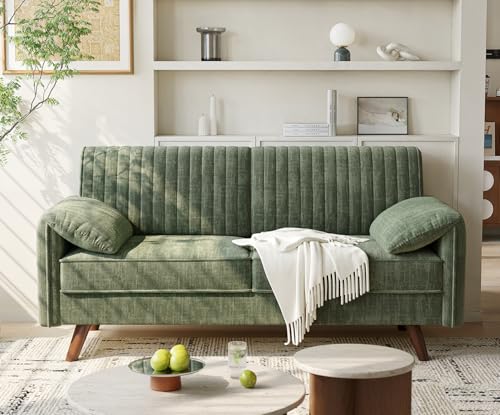
Putting a sofa in front of a bed works well when the sofa is lower than the mattress top, no wider than the bed, and leaves at least 30 inches of walkway between it and the next obstacle, so in most bedrooms the right piece is a backless or low-back loveseat, settee or bench sofa between 48 and 72 inches long rather than a full living room sofa. The layout turns the foot of the bed into a seating area for reading, putting on shoes or watching a TV on the opposite wall, but it fails quickly when the room is too short.
Check the room length first
The limiting dimension is the distance from the headboard wall to the opposite wall. Add up the pieces:
| Item | Typical depth |
|---|---|
| Headboard and frame overhang | 2–6 in |
| Queen or king mattress length | 80 in (California king 84 in) |
| Gap between footboard and sofa | 0–4 in (or up to 18 in if you want to walk between them) |
| Bedroom loveseat or settee depth | 26–34 in |
| Walkway in front of sofa | 30–36 in |
| Dresser or TV console on the opposite wall | 16–20 in |
That totals about 154 to 180 inches, or roughly 13 to 15 feet, for a queen bed with a sofa at the foot and a dresser opposite. Without the dresser, a 12-foot room can work if the sofa is shallow. Under 12 feet, a slim bench at 16 to 20 inches deep is the better choice.
| Room length (headboard to opposite wall) | What fits at the foot of a queen bed |
|---|---|
| Under 11 ft | Nothing, or a 14–16 in deep storage bench only |
| 11–12 ft | Bench or backless settee, 16–22 in deep |
| 12–13.5 ft | Low-back loveseat 26–30 in deep, no furniture opposite |
| 13.5–15 ft | Loveseat 30–34 in deep plus a dresser or TV console opposite |
| Over 15 ft | Sofa with a walk-through gap behind it, or a small seating group |
Height: keep the back below the mattress
The single most common mistake is a sofa whose back is taller than the top of the bed. It blocks the view from the bed, makes the bed look boxed in and creates a wall in the middle of the room. Most mattresses on a standard frame sit 22 to 28 inches off the floor; many loveseats have backs of 30 to 36 inches.
- Backless settee or bench sofa: top at seat height, about 17 to 20 inches. Disappears visually.
- Low-back sofa or loveseat: back height of 26 to 30 inches. Works with taller beds and thick mattresses.
- Standard sofa: back height 32 to 36 inches. Only works if there is a walkway behind it, so it reads as a separate seating zone rather than a barrier.
A useful rule: keep the sofa back within 2 inches of the mattress top, or lower.
Width: match or stay inside the bed
A sofa that sticks out past the sides of the bed narrows the walkways along the bed and looks unplanned. Aim for a sofa equal to the bed width or 6 to 12 inches shorter.
| Bed size | Bed width | Sofa length to aim for |
|---|---|---|
| Full | 54 in | 42–54 in (bench or settee) |
| Queen | 60 in | 48–60 in |
| King | 76 in | 60–76 in |
| California king | 72 in | 58–72 in |
With a king bed, a 72-inch apartment sofa can fit neatly if the room is long enough.
Which style fits which bedroom
Backless settee or upholstered bench
Best for most bedrooms. Gives a place to sit while dressing, fits shorter rooms and does not block anything. Versions with a lift-up lid or drawers store blankets and extra pillows.
Low-back loveseat
Best when you want to actually lounge: reading, coffee in the morning, watching TV. Pick one with a tight back (no loose back cushions that end up on the floor) and a seat depth of 20 to 22 inches so it stays shallow.
Chaise or daybed
A chaise placed at the foot of a large bed, or angled in a corner, is the lounging option. Chaises are 26 to 32 inches wide but 55 to 70 inches long, so placed lengthwise across the foot of a king bed they work; placed perpendicular they rarely fit.
Full sofa with walkway behind
In a primary suite of 16 feet or longer, a sofa set 24 to 36 inches away from the footboard, facing a TV or fireplace, creates a sitting room. Leave the gap wide enough to walk through, or close it to almost nothing. The awkward middle ground of 6 to 18 inches just collects clutter.
Material and practical choices
- Match or contrast the headboard: the same fabric reads as a set; a contrasting leather or bouclé reads as a deliberate accent. Avoid near-matches that look like a mistake.
- Legs vs skirt: raised legs of 4 to 6 inches let a robot vacuum pass under and make a small room feel bigger.
- Pets: a sofa at the foot of the bed becomes a step for dogs and cats. Choose tightly woven performance fabric or leather rather than loose weaves that snag.
- Sun exposure: a sofa under or near a window can fade within a couple of years; solution-dyed fabrics resist fading better.
Layouts that solve specific problems
| Problem | Layout fix |
|---|---|
| Nowhere to sit while getting dressed | Backless bench sofa tight against the footboard |
| Want a reading spot but room is short | Corner loveseat or chair instead of the foot of the bed |
| TV opposite the bed | Low settee, back under mattress height, so the view stays clear |
| Studio apartment needs a “bedroom” division | Standard sofa with its back to the bed, 24–36 in gap, plus a rug under each zone |
| Kids pile onto the parents’ bed | Durable loveseat at the foot gives them their own spot |
When not to do it
Skip the sofa if it would leave less than 30 inches to a closet door, the bathroom door or the main path to the bed, or if the bedroom door swings into its space. In a tight room, a chair in a corner or a pair of floor cushions gives you seating without making the bed hard to get around. Finally, consider how often you will use it: many bedroom sofas end up as clothes holders, and if that is the likely outcome, a lidded storage bench does the same job in half the depth.