Our Top Picks
The Varier Variable balans kneeling chair is a strong buy if you’re between roughly 150–190 cm (4’11″–6’3″), under about 110 kg (240 lb), and sitting at a standard 72–76 cm desk with an open kneehole — and a poor buy if you have knee or shin problems, need to lean back on calls, or want one chair to do everything. Designed by Peter Opsvik in 1979 and first produced by Stokke, it remains the benchmark kneeling chair because it does one thing well: it makes slouching physically awkward. Below is the fit math, assembly reality and sitting-schedule guidance that product pages leave out.
What the Variable balans does to your posture
A conventional chair locks your hips at about 90°, which flattens the lumbar curve and invites the pelvis to roll backward — that’s slouching. The Variable balans tilts the seat forward so your thighs drop and your hip angle opens to roughly 110–120°. Your pelvis rolls slightly forward on its own, and your spine falls into its natural S-curve without a backrest forcing it there.

Varier Ergonomic Kneeling Chair, Rocking Knee Stool for Home Office Desk
Chosen because it specifies Rocking Knee Stool for Home Office Desk.
View on Amazon
Varier Ergonomic Kneeling Chair, Rocking Knee Stool for Home Office Desk
Chosen because it specifies Rocking Knee Stool for Home Office Desk.
View on Amazon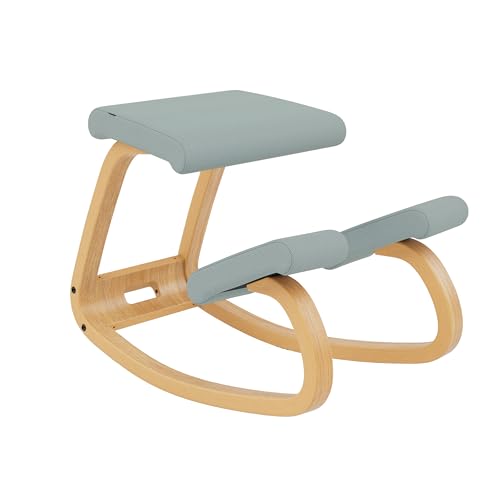
Varier Ergonomic Kneeling Chair, Rocking Knee Stool for Home Office Desk
Chosen because it specifies Rocking Knee Stool for Home Office Desk.
View on Amazon
Varier Variable Plus Ergonomic Kneeling Chair with Backrest Natural/Grey| Active Sitting Posture Support Home Office Desk Chair | 10 Year Guarantee
Chosen because it specifies Active Sitting Posture Support Home Office Desk Chair and 10 Year Guarantee.
View on AmazonTwo mechanics matter more than anything the marketing says:
- Your shins carry the load, not your kneecaps. The lower pads support the flat of the shin just below the knee. If your kneecaps are resting on the pads, the chair is set up wrong or you’re too tall for it. Expect roughly two-thirds of your weight on the seat and a third through the shins.
- The curved runners keep you moving. The bentwood base rocks like a rocking chair, so you can tilt forward while typing and backward while thinking. This is deliberate — Opsvik’s design principle is that the best sitting position is the next one. The rocking also prevents the blood-pooling stiffness static kneelers cause.
The common misconception: it does not “fix” your back by itself. It removes the chair features that let you slump. If your pain comes from discs, joints or injury rather than posture, the open-hip position may help or may not — that’s a physiotherapist question, not a furniture question.
Fit: height, weight and desk clearance
The Variable balans has no adjustments — the seat and shin pads are fixed distances on one plywood frame — so fit is binary. Here are the numbers that decide it:
| Measurement | Figure | What it means for you |
|---|---|---|
| Footprint (W × D) | ~52 × 72 cm | Deeper than it looks; the runners extend fore and aft |
| Seat height | ~50 cm at the rear | Slightly higher than a typical chair mid-point |
| Chair weight | ~7 kg (15 lb) | One-handed carry; no casters |
| Rated user weight | ~110 kg / 240 lb | Over this, the shin pads sit too compressed |
| Comfortable user height | ~150–190 cm | Fixed pad spacing is the limiting factor |
| Desk height pairing | 72–76 cm | Standard desks only; too tall for low tables |
| Clear floor space | ~60 × 90 cm | Room to rock fully forward without hitting the desk |
| Under-desk kneehole needed | ~60 cm wide, ~55 cm deep | Shins and pads live inside your desk kneehole |
The edge cases:
- Under ~150 cm: your knees won’t reach the shin pads properly and you’ll perch on the seat edge, which loads the tailbone. This is the most common fit failure.
- Over ~190 cm: the fixed geometry rolls your hips too far forward and concentrates pressure on the sitting bones. The Varier Thatsit balans, which has adjustable knee pads and a backrest, exists largely for this buyer.
- Knee, shin or hip injuries; late pregnancy; limited mobility: getting in requires sliding one shin onto a pad, and load travels through the shins all session. This is a real limitation, not a preference.
- Desks with a central drawer unit or modesty panel: the shin pads need to slide under the desk with you. A pedestal drawer in the kneehole makes the chair unusable at that desk — measure before buying.
The “original” versus the rest of the line
The Varier Variable balans original kneeling chair — “the original” is Varier’s own positioning, referring to the 1979 Opsvik design now sold under the Varier brand — is the simplest, cheapest entry in the family, usually running $300–$450 new depending on fabric. The frame is laminated beech plywood; covers come in polyester or wool-blend options. Two siblings matter if the fit math above fails you:
- Variable with backrest (Variable Plus): adds a padded backrest on the same base. It costs more and partially defeats the posture concept, but it suits people who spend hours on calls and genuinely need something to lean into.
- Thatsit balans: taller frame, height-adjustable knee pads, backrest. The right pick for users at the top of the height range or anyone who wants adjustment. Typically priced meaningfully above the Variable.
Budget kneeling chairs in the $80–$150 range copy the shape on a steel frame with casters. The functional difference isn’t comfort — it’s that fixed, non-rocking frames lose the dynamic movement that makes the Variable tolerable for long sessions.
Assembly, moving and what wears first
The chair arrives flat-packed in a box roughly picture-frame sized and under 10 kg — it fits every doorway and most car trunks, and renters can take it anywhere. Assembly is bolting the two curved runners to the seat and shin-pad crosspieces with the supplied hex key: about 15 minutes solo, no second person needed, nothing to level or calibrate.
Three realities owners learn later:
- Retighten the screws after the first two weeks. The laminated wood compresses slightly under cyclic load and the runners can develop a faint wobble. A two-minute pass with the hex key fixes it; repeat yearly.
- The shin-pad fabric and foam wear first. The front edge of the foam flattens where shins press, and the cover fabric pills there before anywhere else — typically a multi-year timeline, not months. Pads can be reupholstered; the plywood frame itself routinely lasts decades and registering the chair with Varier extends the warranty on wooden parts.
- Runner bottoms scuff on hard floors. The bare wood rockers slide and can pick up marks or leave faint ones on softer floors. A rug or self-adhesive felt strips solve it — worth doing on day one if you’re a renter protecting a deposit.
How long to sit — and when to switch chairs
Shin pressure is the limiting factor early on, not your back. A realistic adaptation schedule:
- Week 1–2: 20–30 minute sessions, two or three times a day. Shins feel tender; that’s normal and fades.
- Settled pattern: most users land at 45–90 minute blocks, then naturally want to stand, perch or lean. Listen to it — that’s the design working, not failing.
- Switch chairs when: your shins tingle or go numb, you catch yourself hovering your knees off the pads to rest them, you feel tailbone pressure from perching, or you have a long stretch of calls where you’d slouch backward anyway.
The honest answer to “can it be my only chair?”: some people do it, but the chair rewards movement and penalizes stillness. The better setup is the Variable as your task chair for focused work, plus a conventional chair or standing interval for everything else. Alternating two mediocre postures beats one “perfect” posture held all day — which is, again, the whole Opsvik argument.
Decision matrix
| Your situation | Verdict |
|---|---|
| Healthy knees, slouch at a standard desk, 150–190 cm, under 110 kg | Strong fit — the exact user it’s built for |
| Under 150 cm or shopping for a child | Poor fit — fixed pads won’t align; look at adjustable kneelers |
| Over 190 cm or over ~110 kg | Skip; consider the Thatsit balans instead |
| Knee/shin injury, knee replacement, circulation issues in lower legs | Avoid — shins bear load every session |
| Fidgeter, restless sitter, back-to-back deep-work blocks | Excellent — rocking base is made for movement |
| Long calls, need to recline, want one do-everything chair | Only as a second chair — there’s nothing to lean on |
| Small apartment, shared desk, moves rooms often | Good — 7 kg, no wheels, stores against a wall |
| Renter with hardwood floors | Fine with a rug or felt strips under the runners |
| Standing desk only | No — fixed height suits standard desks, not perching |
FAQ
Does it hurt your knees?
It shouldn’t — correctly positioned, your shins rest on the pads, not your kneecaps. If your knees ache, either the pads are hitting the kneecap (a height-fit problem) or you need a chair you can get into without knee load.
Can you use it as your only office chair?
Some people do. Most are happier pairing it with a conventional chair and alternating every hour or two. The chair has no backrest, no arms and no adjustments — by design, it’s a posture tool, not a throne.
Will it fit under my desk when not in use?
Usually yes — at ~51 cm tall and 52 cm wide it tucks under most desks, as long as your kneehole is clear of drawers or CPU mounts.