Key takeaways
- A swivel accent chair is worth considering when one sitting position needs to face several directions.
Swivel accent chair vs alternatives compares rotating decorative seating with stationary armchairs, recliners, rocking chairs, and office chairs. Each design changes how you use a room, but a swivel mechanism does not automatically improve comfort or save space. This guide explains the practical trade-offs in seating support, movement, dimensions, maintenance, and value.
Quick Verdict: Should You Buy a Swivel Accent Chair?
A swivel accent chair is worth considering when one sitting position needs to face several directions.
This is particularly useful in open-plan living rooms where occupants alternate between watching television, speaking with others, and looking toward a window.
However, a conventional armchair may be more practical when the desired seating direction never changes.
A recliner is more relevant when adjustable back and leg support are priorities. A rocking chair or glider provides a different movement experience, while a task-oriented office chair is generally more suitable for prolonged work at a desk.
The best alternative depends on the function the chair must perform.
Quick Comparison Table
| Seating type | Main advantage | Main limitation | Best use |
|---|---|---|---|
| Swivel accent chair | Changes facing direction | Requires rotation clearance | Conversation and multipurpose rooms |
| Fixed armchair | Simple, stable seating arrangement | Must be repositioned to face another direction | Reading or permanent layout |
| Recliner | Adjustable lounging posture | Footrest and backrest movement need space | Television and relaxation |
| Rocking chair | Back-and-forth movement | Needs rocking clearance | Relaxed sitting |
| Swivel glider | Rotation plus gliding | More movement and mechanical complexity | Specialized relaxation |
| Office chair | Task-oriented adjustment | May look less suitable in a living room | Desk work |
| Accent stool | Compact occasional seating | Usually limited back support | Brief supplementary seating |
| Lounge chair with ottoman | Separate leg support | Two furniture pieces | Extended lounging |
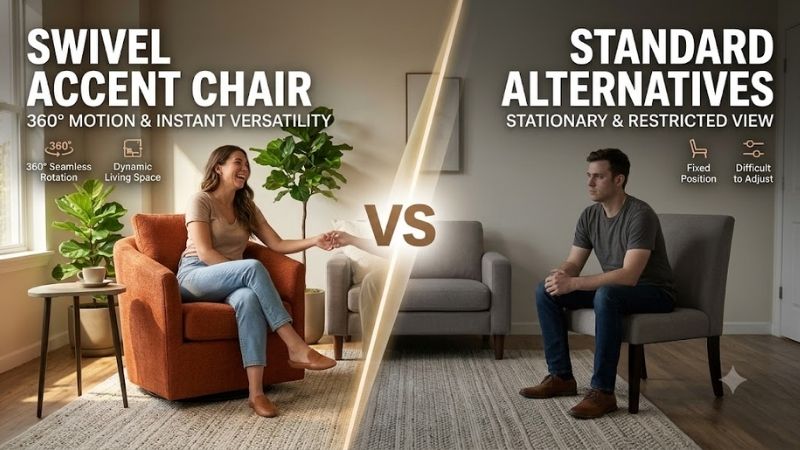
Swivel Accent Chair vs Fixed Armchair
A conventional fixed armchair provides a stable seating orientation.
A swivel chair adds rotation without requiring the occupant to stand and move the furniture.
This is the central difference.
Placement and Room Layout
A fixed armchair can often sit relatively close to a wall.
Its orientation remains consistent during use.
A swivel chair may need additional clearance for its back and arms as it rotates.
In a very tight corner, the stationary design can be easier to accommodate.
However, when several seating directions are desirable, the swivel may reduce the need to rearrange furniture manually.
Comfort
Neither design is inherently more comfortable.
Seat height, depth, cushioning, backrest geometry, and arm positioning influence the actual experience.
A deep fixed lounge chair may be more comfortable for reading than a small decorative swivel model.
Conversely, a generously cushioned swivel chair may provide excellent casual seating.
Durability and Maintenance
A fixed chair generally lacks the additional rotating mechanism.
That reduces one potential maintenance point.
A swivel chair introduces bearings, mounting hardware, or another moving connection.
However, it is inaccurate to assume all swivel chairs are less durable. Construction quality and use matter.
Which Is Better?
Choose a fixed armchair when the room layout is permanent and the chair needs little directional flexibility.
Choose a swivel accent chair when rotation creates a meaningful convenience.
Swivel Accent Chair vs Recliner
A recliner changes the body position by adjusting the backrest or legrest.
A swivel accent chair changes the direction the occupant faces.
These features address different needs.
Lounging Comfort
A recliner may provide integrated leg support.
This can make it appealing for television viewing or longer relaxation sessions.
A standard swivel accent chair generally does not include an extending footrest.
Some people pair a swivel chair with an ottoman, but that arrangement is different from a fully integrated reclining system.
Floor Space
A recliner requires clearance for its extended mechanism.
A swivel chair requires clearance for its rotating body.
Which occupies more practical space depends on the exact design.
A compact swivel chair may fit easily where a large recliner would be impractical.
However, an oversized barrel swivel can occupy significant floor area.
Controls and Mechanisms
Manual and power recliners use their own mechanical systems.
Some have motors, switches, or reclining handles.
Ordinary swivel accent chairs generally have simpler rotating bases.
That can reduce operating complexity, but it does not guarantee easier repair or longer life.
Which Is Better?
Choose a recliner when adjustable posture and leg support matter most.
Choose a swivel accent chair when direction changes are more important than reclining.
Swivel Accent Chair vs Rocking Chair
A rocking chair creates a repeated forward-and-backward motion.
It does not necessarily rotate around a central axis.
These movement types feel different and require different floor arrangements.
Movement Experience
A rocker allows the occupant to move through a limited arc.
Some people find this calming or comfortable.
A swivel chair provides directional rotation without the same rocking sensation.
The preferred experience is individual.
Clearance Requirements
A rocking chair needs enough space for its rocking motion.
A swivel chair needs clearance around the rotating body.
A chair can be compact in one direction but restrictive in another.
Compare the actual movement envelope rather than assuming one category always saves space.
Stability
Rocking chairs and swivel chairs have different base geometries.
Neither should be used in ways that exceed its intended motion.
Children should not climb or stand on moving furniture.
Which Is Better?
Choose a rocking chair when rhythmic motion is the principal attraction.
Choose a swivel chair when turning between room activities is the goal.
Swivel Accent Chair vs Swivel Glider
A swivel glider combines rotation with a smoother forward-and-backward gliding movement.
This adds functionality but also more motion requirements.
Combined Movement
A swivel glider can change direction and move along its gliding path.
That may appeal to people who want flexible seating in a nursery or relaxation corner.
However, it needs clearance for both motions.
A standard swivel chair only needs to accommodate its rotating body.
Mechanism Complexity
The additional gliding system introduces moving components.
The chair may also be larger or heavier.
More features do not automatically mean greater comfort.
Nursery Considerations
Swivel gliders are popular for caregiving activities, but the chair must still be stable and used appropriately.
Never leave an infant sleeping unattended on an adult chair, and keep fingers, clothing, and other objects clear of moving components.
Which Is Better?
Choose a swivel glider when both movements are genuinely useful.
Choose an ordinary swivel accent chair for simpler directional flexibility.
Swivel Accent Chair vs Office Chair
This comparison matters in studios and home offices where one chair may be expected to perform several functions.
Although both types can rotate, an office chair is typically designed around desk-oriented tasks.
Workstation Fit
A task chair may offer height adjustment, lumbar support, rolling casters, adjustable arms, and a more upright backrest.
These features can help accommodate different desk configurations.
An accent chair may have a fixed low seat and deep cushion that make keyboard use uncomfortable.
The presence of a swivel base does not make the two products equivalent.
Long-Duration Seating
An office chair may be more suitable for prolonged desk work when properly adjusted.
However, not every office chair is ergonomic for every user.
A decorative accent chair may still be comfortable for short reading or occasional laptop use.
Appearance
Swivel accent chairs often use upholstery and silhouettes intended for living spaces.
Office chairs typically emphasize function.
The better choice depends on whether decorative appearance or task support is more important.
Which Is Better?
Choose a suitable office chair for extended desk work.
Choose a swivel accent chair for living-room seating where directional movement and styling are priorities.
Swivel Accent Chair vs Accent Stool
An accent stool may provide supplemental seating without a large backrest or arms.
This can be useful in a compact room.
However, it has different comfort limitations.
Floor Space
A stool may have a relatively small footprint and can sometimes be stored beneath a counter or table.
A swivel accent chair usually occupies more space because of its back and arm structures.
However, some stools also rotate and may have substantial bases.
Seating Support
An accent stool often provides limited back support.
It may therefore be less suitable for lengthy reading or television sessions.
A swivel accent chair generally offers more comprehensive seating contact.
Flexibility
A stool is often easier to move between locations.
A heavier upholstered swivel chair may be less portable.
Which Is Better?
Choose a stool for brief occasional seating.
Choose a swivel accent chair when comfort and back support are more important.
Swivel Accent Chair vs Lounge Chair With Ottoman
A lounge chair and ottoman provide separate support for the upper body and legs.
This can be appealing for extended sitting.
However, the combination occupies more floor space than the chair alone.
Leg Support
An ottoman allows the occupant to elevate or rest their legs.
A standard swivel accent chair usually provides no comparable integrated feature.
For someone who regularly lounges with legs extended, the ottoman arrangement may feel more suitable.
Furniture Flexibility
The ottoman can be moved away when open floor space is needed.
However, it can also shift during use or become an obstacle.
A swivel chair focuses on directional movement rather than movable leg support.
Cost and Maintenance
Two separate upholstered pieces may require more cleaning and storage.
The combined purchase may also cost more.
However, value depends on the comfort functions actually used.
Which Is Better?
Choose a lounge chair and ottoman when extended leg support is a primary need.
Choose a swivel accent chair when the room benefits more from easy rotation.
Which Chair Is Best for Different Rooms?
| Room or activity | Strong starting option | Main reason |
|---|---|---|
| Open-plan living room | Swivel accent chair | Changes viewing and conversation direction |
| Fixed reading corner | Supportive fixed armchair or swivel | Depends on directional needs |
| Dedicated television area | Recliner | Adjustable lounging position |
| Nursery seating | Appropriate rocker or glider | Different comfort motion |
| Home office | Ergonomic task chair | Desk-oriented support |
| Very small guest room | Compact armchair or stool | Limited footprint |
| Lounge area | Chair with ottoman | Separate leg support |
| Conversation grouping | Swivel accent chairs | Flexible orientation |
Which Option Saves the Most Space?
Space efficiency depends on more than outside dimensions.
A fixed armchair may use less operating area because it does not rotate.
A swivel chair may be more functional in a multipurpose room because one chair can face different activities.
A recliner can extend considerably forward.
A stool may be physically compact but provide insufficient comfort for regular sitting.
The best choice is the smallest practical furniture arrangement that meets the intended use.
Consider Actual Seating Functions
Suppose a studio includes a sofa facing a television and a dining area nearby.
A swivel accent chair placed between those zones may serve both seating groups.
That could reduce the need for another chair.
However, this only works when the swivel chair’s rotation is unobstructed.
The practical savings come from multifunctional placement, not from a universally smaller footprint.
Cost and Ownership Comparison
A fixed armchair may be mechanically simpler.
A swivel accent chair adds a rotating base.
A recliner can introduce more elaborate moving parts or electrical components.
An office chair may use adjustable hardware and casters.
Each category therefore has different maintenance requirements.
Purchase Price
Prices vary widely within every category.
A premium fixed armchair can cost more than an inexpensive swivel chair.
Do not assume mechanism complexity always determines retail price.
Upholstery Replacement
Some chairs use removable covers, but many have fixed upholstery.
Care and replacement costs depend on the exact model.
Mechanical Servicing
Swivel bearings, reclining hardware, glider assemblies, and chair casters can experience wear.
The type of mechanism influences what may need servicing.
Long-Term Value
A chair that matches its intended activity can provide better value than a more expensive multifunctional model used incorrectly.
Common Comparison Mistakes
Assuming Swivel Means Ergonomic
Rotation does not establish appropriate lumbar support or desk-use suitability.
Assuming a Swivel Chair Saves Space
The rotating body still needs clearance.
Choosing a Recliner When Only Rotation Is Needed
A reclining mechanism may add cost and footprint without providing useful benefits.
Choosing a Stool for Long Sessions
A compact stool may lack adequate back support.
Ignoring Weight and Delivery
Large upholstered accent chairs can be heavy and awkward to move.
Frequently Asked Questions
Is a Swivel Accent Chair Better Than a Regular Armchair?
It is better when you regularly turn toward different activities without moving furniture. A fixed armchair may be simpler and easier to place in a tight corner.
Are Swivel Chairs More Comfortable Than Recliners?
Not inherently. Recliners provide adjustable lounging positions, while swivel chairs primarily change direction. Comfort depends on the specific seat, cushioning, and support design.
Is a Swivel Glider Better Than a Regular Swivel Chair?
A swivel glider adds forward-and-backward motion. It can be useful when that movement is desired, but it generally has more moving requirements and may need extra clearance.
Can a Swivel Accent Chair Replace an Office Chair?
It may be suitable for occasional sitting but is not automatically appropriate for prolonged desk work. A task chair designed for workstation use is generally a better starting category.
Do Swivel Chairs Take Up More Room Than Armchairs?
They may require more operating clearance even when the static dimensions are similar. The result depends on the chair’s shape and rotation axis.
What Is the Best Alternative for a Very Small Apartment?
A compact fixed armchair or an appropriately sized swivel chair may work. If seating is only occasional, an accent stool can save space, although it offers less support.
Conclusion
A swivel accent chair is most useful when directional flexibility improves how a room functions. Fixed armchairs offer simpler placement, recliners add adjustable lounging, rocking chairs and gliders provide different movement, and office chairs better address desk-oriented seating. Stools and ottomans offer other compact or leg-support solutions. Choose according to the activity, body fit, movement clearance, maintenance, and total room layout rather than treating the swivel mechanism as a universal upgrade.