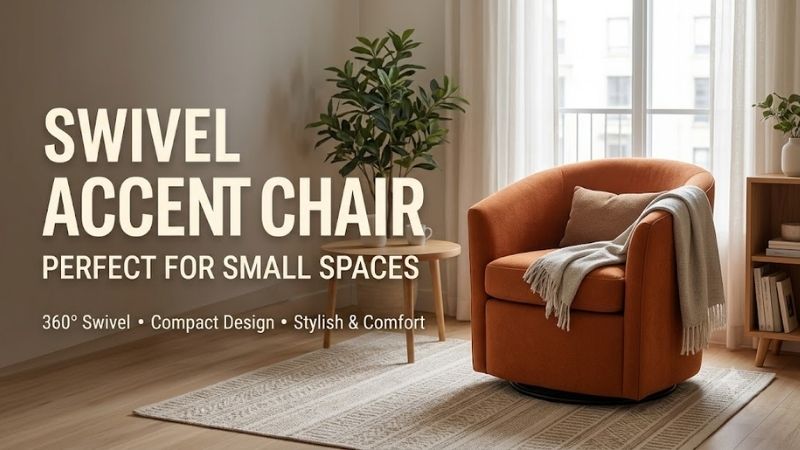
A swivel accent chair for small spaces can make a compact room more flexible by allowing you to face different seating areas without moving furniture. However, the chair still needs enough room to rotate safely. This guide explains how to compare widths, depths, seat heights, swivel clearances, upholstery, and practical layouts before choosing a chair.
Why Swivel Chairs Can Work in Small Rooms
A swivel accent chair allows the seated person to change direction while the chair’s base remains in approximately the same position.
That can be useful in studio apartments and open-plan rooms where one chair may face a television at one moment and a conversation area at another.
However, the benefit depends on whether the chair has enough clearance to rotate.
A compact stationary chair may fit against a wall with little unused space. A swivel chair with a curved or projecting back requires more room around its rotating body.
The buyer must therefore evaluate both the static footprint and the swept area created during rotation.
Compact Width Does Not Guarantee Compact Movement
Imagine two chairs that are each 28 inches wide.
The first has a shallow rectangular body with the swivel axis near its center. The second has an oversized curved back extending well behind the base.
Although their advertised widths match, the second chair may need more clearance near a wall as it turns.
This is why product photographs showing the chair facing forward are insufficient for planning.
The rotating geometry matters.
Swivel Function Can Reduce Furniture Rearrangement
A swivel chair can serve several directions without being physically dragged across the floor.
For example, a chair in a studio might face the sofa during conversation, rotate toward a television, or turn toward a window for reading.
That convenience can make a single chair useful across several activities.
However, a swivel chair does not replace furniture needed for distinct functions. A decorative accent chair may not provide the support necessary for full-time desk work.
Which Swivel Chair Shapes Suit Small Rooms?
| Shape | Main advantage | Main drawback | Best use |
|---|---|---|---|
| Compact barrel chair | Supportive wraparound appearance | Curved back needs rotation room | Conversation corner |
| Low-profile lounge swivel | Visually relaxed silhouette | Low seat may complicate standing | Casual lounging |
| Upright swivel accent chair | Smaller floor projection possible | Less room to curl up | Reading or guest seating |
| Sculptural pedestal swivel | Distinctive design | Base and curved body can be restrictive | Decorative focal point |
| Adjustable-height swivel | Flexible seat position | Additional moving mechanism | Multipurpose seating |
| Oversized swivel lounge chair | Generous cushioning | Large rotating envelope | Larger living room |
The best small-space option is not always the narrowest. An appropriately proportioned chair with an efficient rotation envelope may be more practical.
Step 1: Measure Available Floor Space
Begin by measuring the area where the chair will stand.
Record the distance to the nearest wall, sofa, coffee table, desk, and doorway.
The chair must fit without obstructing normal movement even before it rotates.
Measure Width and Depth Separately
Width affects the space between adjacent objects.
Depth influences how far the chair projects from the wall or into the room.
A product measuring 24 inches wide and 26 inches deep can require meaningfully less floor space than one measuring 34 inches wide and 37 inches deep.
However, the smaller chair may also have a shallower or narrower usable seat.
Choosing dimensions involves balancing occupant comfort against room capacity.
Include Nearby Furniture
A chair positioned next to a side table may rotate into the table’s edge.
Similarly, a curved back may approach a wall much more closely when the chair turns sideways.
Measure from the widest projecting parts of the chair, not just its pedestal.
A small margin around the base does not establish safe rotation clearance.
Consider Door Swing
A chair may fit inside an unused corner but interfere with the swing of a nearby door.
This becomes particularly important in apartments where bedroom, balcony, and closet doors open into the same limited space.
Make sure furniture placement does not obstruct essential access.
Step 2: Plan Rotation Clearance
Most ordinary swivel accent chairs use a circular or near-circular rotating movement.
However, the required clearance depends on where the axis sits relative to the chair body.
A centered chair and an offset swivel design may create different rotation paths.
A Simple Planning Calculation
Suppose a chair has a roughly centered 30-inch-wide body and a similar front-to-back extent.
A simplified radius would be approximately 15 inches from the rotation center to the furthest point along either principal direction.
However, chair corners or a projecting curved back can extend farther than that.
The actual swept radius must account for the furthest point of the finished chair.
For planning, do not assume the chair fits merely because the pedestal is small. Use the real assembled geometry.
Leave Space for the Occupant
The occupant’s arms, feet, and position can extend beyond the chair.
A person may also need room to approach the seat and stand afterward.
A swivel chair that can technically turn without hitting furniture may still create an awkward everyday arrangement.
The practical operating area should include normal human movement.
Do Not Depend on an Arbitrary Universal Clearance
There is no single reliable wall clearance that fits every swivel accent chair.
A narrow, centered pedestal chair differs from a deep barrel chair.
Review manufacturer instructions where available and confirm clearance for the specific design.
Step 3: Compare Small-Space Chair Dimensions
The following real models illustrate the range of available chair sizes.
| Model | Overall width | Overall depth | Seat height |
|---|---|---|---|
| Living Spaces Curl | 24 in | 26 in | 20.5 in |
| IKEA DYVLINGE | 24.75 in | 29.5 in | 16.875 in |
| Living Spaces Caisson | 26.8 in | 25.6 in | 16.9 in |
| Living Spaces Perch | 27.36 in | 25.4 in | Adjustable |
| Living Spaces Penny | 29 in | 32.5 in | 20 in |
| Living Spaces Gemma | 29 in | 32.5 in | 19 in |
These dimensions show that chairs with similar widths can have noticeably different depths and sitting heights.
Shallow Chairs for Conversation
The Curl has a relatively shallow 16.5-inch seat depth.
This may suit an upright occasional sitting position, although the low back geometry and curved design still affect comfort.
A shallow chair can be practical when it is used for conversation rather than extended lounging.
Deep Chairs for Relaxation
Gemma has a 23.5-inch seat depth.
That creates considerably more room for a relaxed posture but also requires more floor depth.
A deep lounge chair is therefore not necessarily the best choice for a tight corner.
Low Versus Higher Sitting Positions
DYVLINGE and Caisson have relatively low seats.
Curl has a much higher seat position.
Neither is automatically better. The correct choice depends on the occupant’s leg length and preferred posture.
The key is to compare internal seat geometry instead of focusing only on the overall chair height.
Step 4: Choose the Right Backrest
Backrest height and shape influence how useful the chair will be.
A low barrel chair can provide a comfortable armrest-like wraparound shape while offering limited upper-back support.
A taller design can provide more back contact but may look bulkier.
Low-Back Barrel Chairs
Low-back designs are common in decorative swivel furniture.
They can feel open and visually unobtrusive.
However, they may not support the shoulder blades or head during extended reclining.
Consider whether the chair will be used for short conversations or lengthy reading sessions.
Mid-Back Chairs
Mid-back designs may create a compromise between support and visual compactness.
They can be useful when the chair serves as regular supplemental seating.
However, the exact curve and cushioning matter more than the category name alone.
High-Back Swivel Chairs
A higher back may provide more contact behind the upper torso.
The trade-off is a taller visual profile and potentially larger rotating envelope.
For a small room, that can make the chair appear more substantial.
Step 5: Evaluate Seat Width and Arm Design
Exterior chair width and usable seat width are different measurements.
A barrel chair with thick wraparound arms can have a large outside dimension and relatively narrow interior seating.
Conversely, a minimal-frame chair may provide more seat width within a smaller footprint.
Thick Upholstered Arms
Thick arms can provide soft contact for resting the elbows.
However, they add width and may restrict the occupant.
A chair marketed as oversized is not necessarily spacious internally.
Open or Minimal Arms
A chair with open sides or slender arms can feel less visually restrictive.
It may also provide more room for movement.
However, the lack of substantial armrests may be uncomfortable for certain users, particularly when standing.
Choose based on the intended occupant, not solely on the visual style.
Step 6: Match Upholstery to Room Use
Small rooms often have high furniture-use intensity.
One accent chair may be used for reading, television, conversation, and occasional work.
That makes upholstery care an important purchasing consideration.
Polyester Upholstery
Polyester is common in swivel accent chairs and available in many textures.
Its durability depends on weave construction, finishing, and actual use.
A polyester label alone does not establish stain resistance.
Wool-Blend Fabric
Wool-blend upholstery can provide texture and a distinctive appearance.
However, some products require solvent-based cleaning.
This may be less convenient in households with frequent spills.
Corduroy
Corduroy offers a pronounced ribbed texture.
It can create an inviting retro look, as seen on IKEA DYVLINGE.
However, the pile and surface grooves require appropriate cleaning.
Faux Leather
Faux leather offers a different visual appearance and may be wiped according to product instructions.
However, coatings can deteriorate over time.
Avoid harsh cleaners unless expressly permitted.
Step 7: Evaluate the Swivel Base
The swivel mechanism should allow controlled rotation while keeping the chair stable during normal use.
Pedestal Bases
A pedestal base is often visually compact.
However, the underlying support structure must be appropriate for the chair’s load and proportions.
A small-looking base should not automatically be considered unstable, just as a large base does not guarantee superior construction.
Star Bases
Some chairs use several radial legs.
IKEA DYVLINGE has a five-legged base, introduced as an update to its earlier four-legged design.
Such structures can affect stability, but performance still depends on correct use and engineering.
Bearing and Rotation Quality
A swivel chair should move smoothly without unexpected catching or excessive looseness.
However, a store demonstration cannot prove long-term bearing durability.
Read the applicable warranty and service terms.
Step 8: Plan Delivery and Assembly
A compact chair can still be difficult to deliver when its curved back and arms form one large piece.
Compare packaging dimensions with the route from the building entrance to the final room.
Some models require only base installation, while others arrive nearly assembled.
A chair described as easy to assemble may still be too heavy or awkward for one person.
Follow the manufacturer instructions and confirm that all swivel fasteners are secured properly.
Common Small-Space Buying Mistakes
Choosing Based Only on Exterior Width
Depth, rotation, and usable seat dimensions also matter.
Placing the Chair Too Close to a Wall
The chair may rotate into the wall or nearby furniture.
Assuming a Compact Chair Is Comfortable for Every User
Small footprints can come with shallow seats or low backrests.
Treating a Decorative Chair as an Ergonomic Office Chair
Occasional swivel seating and long-duration task seating have different design requirements.
Ignoring Fixed Upholstery
Many swivel chairs do not have washable removable covers.
Care requirements can influence ownership value.
Frequently Asked Questions
Are Swivel Accent Chairs Good for Small Spaces?
Yes, when their full rotating envelope fits the room. They can allow the occupant to face different areas without moving the chair itself. However, a stationary chair may require less operating space in a very tight corner.
What Is the Best Swivel Chair Width for a Small Apartment?
There is no universal ideal width. Compact models around 24–29 inches wide illustrate the available options, but seat comfort, depth, and rotation clearance are equally important.
Can a Swivel Accent Chair Sit Against a Wall?
Only when the manufacturer’s required operating clearance is maintained. The chair body may project toward the wall during rotation even when the base remains stationary.
Is a Barrel Swivel Chair Good for a Studio?
It can be, particularly when the room has several conversation or viewing directions. However, an oversized barrel chair may occupy too much floor area.
Should I Choose a Low or High Seat?
Choose according to the occupant’s body proportions and ability to sit and stand comfortably. Low seating may suit relaxed lounging, while a higher seat can be more practical for some users.
Is a Swivel Chair Better Than a Desk Chair?
For decorative occasional seating, it can be. For prolonged desk work, a suitable task chair with appropriate workstation ergonomics is generally a more relevant category.
Conclusion
A swivel accent chair for small spaces works best when its seated dimensions and full rotation path fit naturally into the room. Measure the actual footprint, consider nearby tables and doors, compare usable seat depth and height, and choose upholstery that suits daily maintenance. Compact designs such as Curl, Caisson, and DYVLINGE demonstrate different trade-offs, but the best chair is the one that provides appropriate comfort without obstructing the room.