Key takeaways
- Check whether bleach-cleanable fabric instructions cover cushion trim, filling and surrounding materials before choosing a treatment.
A fabric described as bleach-cleanable does not automatically give permission to bleach the finished cushion. The face fabric, contrasting trim, thread, backing, filling and surrounding furniture may have different instructions. Before choosing that treatment, establish exactly which material the permission covers and whether the furniture maker approves it for the assembled item.
Translate a fabric claim into a component question
“Bleach-safe fabric” might appear on a fabric supplier’s page while your cushion was made and finished by another company. Identify the actual fabric collection and the cushion manufacturer. A similar color, a generic performance-fabric description or an old sample book does not establish that the installed material carries the same care permission.
The Sunbrella upholstery care guide provides directions for particular cleaning situations and distinguishes fabric care from furniture construction. It tells readers to consult the furniture maker about removable covers and cautions that nearby non-Sunbrella fabrics can discolor when exposed to bleach. The useful lesson is the boundary of the instructions: a fabric procedure cannot be assumed to cover every part of a completed cushion or everything around it.
This guide is a permission-checking worksheet, not a bleach recipe. It does not supply a dilution, application time or chemical combination. If a treatment is explicitly approved for the exact item, use the applicable manufacturer instructions and the cleaning product’s precautions in full. Never combine cleaning products to create a substitute method.
Make a material-by-material permission sheet
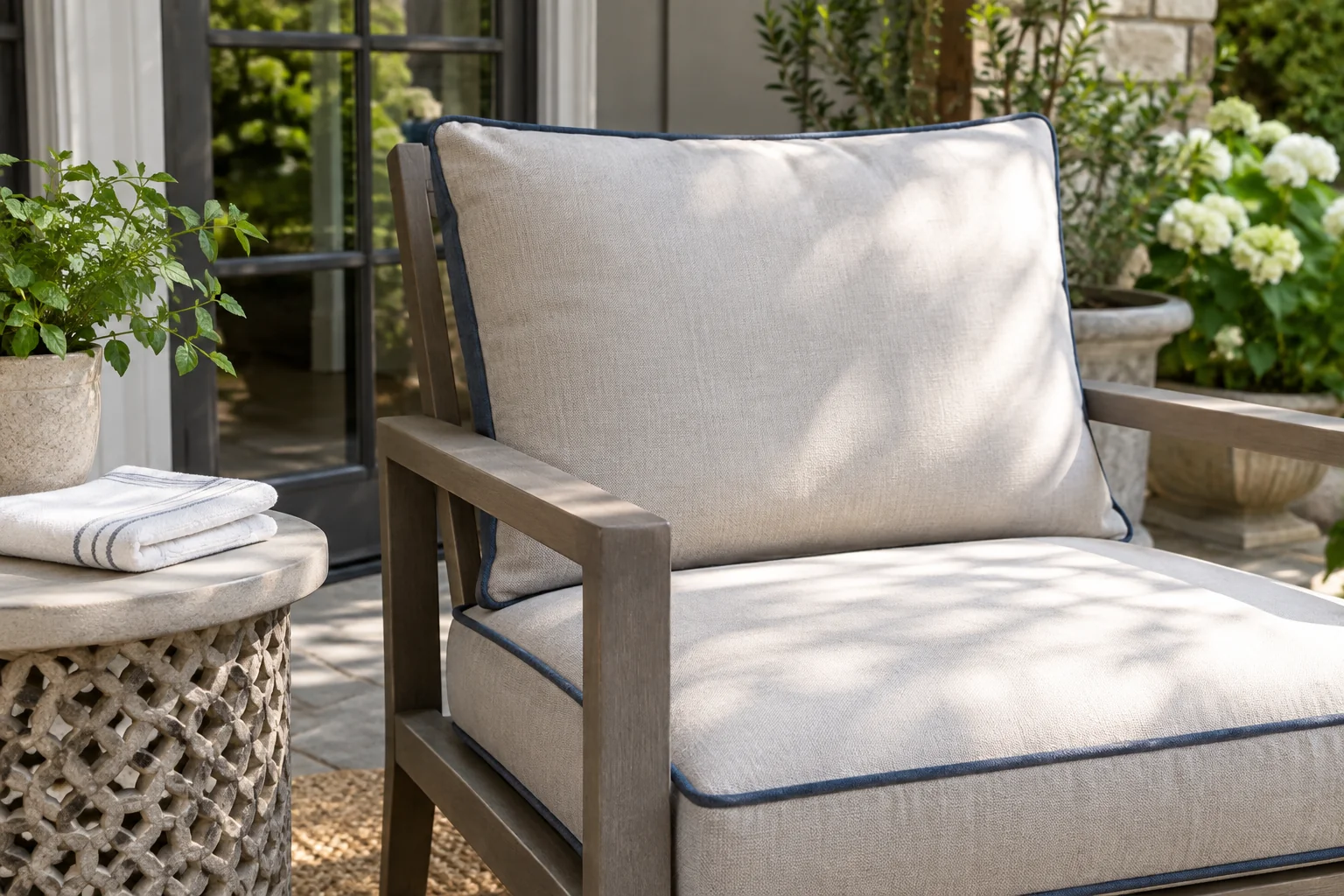
Photograph the cushion from the front, back and edge. Record visible differences such as a contrasting welt, decorative patch or underside panel. Do not cut seams or remove fixed upholstery to identify hidden layers. Unknown construction should remain an unanswered question for the maker rather than being filled in with a guess.
| Part or exposure area | What you know | What must be confirmed |
|---|---|---|
| Main face fabric | Collection, color and source of identification | Whether the proposed treatment applies to this exact material |
| Welt, trim and decorative panels | Same material or visibly different material | Whether these components share that permission |
| Thread, zipper and closures | Manufacturer’s construction information, if available | Whether finished-cover care instructions account for them |
| Backing, lining and filling | Documented construction or unknown | Whether treatment may contact these layers |
| Frame and nearby surfaces | Wood, metal, rug or adjacent cushions | How the approved procedure prevents unintended exposure |
Ask one precise question instead of “Can I bleach it?”
A useful request might read: “I have cushion model A in fabric collection B with contrasting trim C. Does your care instruction permit this treatment on the completed cushion, or only on the specified face fabric? Please identify the approved method and any parts that must not be exposed.” Attach the identification label and photographs. This gives the manufacturer something concrete to answer.
Also state the problem you are trying to address without claiming a diagnosis. Describe a mark’s location, appearance and when it was noticed. “Dark spots along the rear seam” is more useful than confidently naming mold from a photograph. If an earlier cleaner was used, record its name and when it was applied so the next adviser knows the treatment history.
Illustrative example: approved face, unknown edge
Imagine a patio seat with a documented bleach-cleanable face fabric and a contrasting dark welt whose material is unknown. The worksheet contains a yes for the face fabric, an unknown for the welt and no instructions for the completed cushion. The correct decision at this stage is unresolved. One favorable cell does not convert the rest into permission.
The owner sends the model and photographs to the furniture maker. If the reply approves only a different care method for the complete item, that is the method to evaluate. If the maker supplies a specific procedure that addresses all exposed components, the owner can assess whether it can be followed in the available workspace. This fictional example does not predict how any particular fabric will react.
Separate chemical compatibility from convenient access
A zipper, detachable cushion or outdoor setting makes an item easier to reach. None of these features answers the chemical-compatibility question. Conversely, an attached cushion is not automatically unsuitable for every cleaning method; the manufacturer’s instructions must account for its construction. Keep the decision centered on permission and exposure rather than on how easy a cover is to remove.
A hidden-area check, when instructed by the maker, has a limited purpose. A small patch does not establish compatibility with unexposed thread, concealed backing or nearby furniture. Nor does a lack of immediate color change justify increasing a concentration or repeating treatment beyond the documented method. Record the observation without expanding what it proves.
Plan the surroundings before opening a cleaner
Look at where drips, runoff or a damp treated item could contact something else. Include rugs, chair frames, storage boxes and adjacent cushions on the worksheet. If the approved process requires conditions you cannot provide, ask about an alternative or professional care. Do not improvise a chemical treatment simply because the fabric supplier allows it under a different set of conditions.
Save the written answer with the cushion’s care information and update it if the cover or filling is replaced. The aim is a traceable decision for the whole item: identified materials, a defined problem and an approved procedure that covers the actual exposure. That is more useful than a blanket “bleach-safe” label detached from the cushion’s construction.