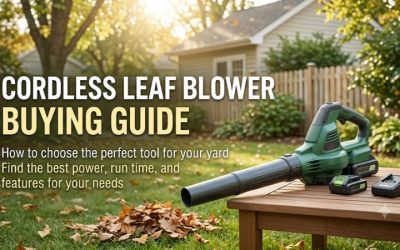
A cordless leaf blower for small spaces should clear a porch or patio without blowing debris into planting beds, parked cars, or the next yard. Look for a low setting you can actually use, a nozzle you can aim, and a battery you can comfortably carry. The right size is the one that lets you finish in a single controlled pass.
Choose a cordless leaf blower for small spaces by surface
Walk the area before shopping. A smooth porch can be cleared with a compact sweeper, while a rough driveway or a narrow strip of grass may need a broader stream. Decide where the debris will go and how close people, windows, gravel, and plants are to that destination. Those details tell you what the tool needs to do.
A porch or patio needs control at the bottom of the trigger
On a compact paved area, a short, accurate pass is often faster than a powerful burst. Pick a blower you can keep at a low usable setting, with the outlet easy to angle around furniture and door thresholds. If a model has two fixed speeds, check whether the lower one suits the work near the walls.
For a porch with light tree litter, start at the far end and work toward one open edge. Keep the door behind you closed where appropriate so debris stays outside. Give each row of material somewhere to go instead of sweeping in circles around chairs. If you have a small collection spot, a broom and dustpan can finish the last step where blowing any farther would send leaves into a shared area.
The stronger model on a product shelf may create more work near furniture. Extra output can move light debris under a low table or send it behind planters you already cleared. A small blower with predictable controls can direct the same debris to one spot. That is the performance advantage you want in a short, bounded area.
Check the nozzle length in relation to your posture. A very short attachment can mean bending for ground-level work. A long tube can be awkward around a tight set of chairs. The right size lets you work with the outlet aimed where you need it and enough space to turn without hitting furniture or walls.
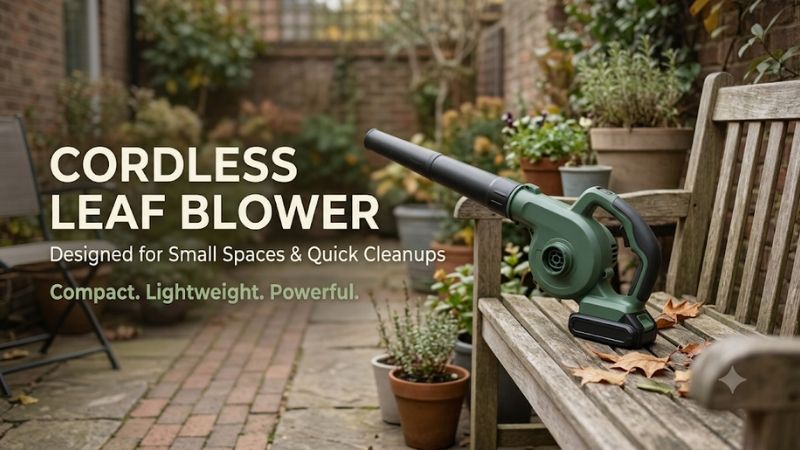
A narrow driveway rewards a predictable clearing path
A driveway beside a vehicle can offer substantial length and little room side to side. Instead of prioritizing the widest possible air stream, decide how the leaves will move along the available strip. Look for a tool that lets you keep a consistent setting as you pass around tires, planters, and the edge of the lawn.
For a straight strip of pavement, moderate airflow can move loose grass and dry leaves without repeatedly scattering them. A compact axial model around the general class of a 300-to-400 CFM blower can be a starting point for those conditions. Different nozzles and speeds change how that figure feels. The goal is to move the strip in a controlled direction.
Walk the driveway with a realistic loading position. A car door may block where you would normally stand, and the narrow end near the garage may have the most leaf buildup. Look at whether you need to use the tool with your other hand and how long the tube will feel when you change direction. A shoe-level pass around the wider open part is simpler than trying to reach under a parked vehicle.
If the main problem is debris trapped in a pavement seam or at a retaining edge, consider a model with a suitable concentrator or use a small broom to free it. For piles of damp leaves on rough ground, a rake may be the quicker first step. The blower then handles the loose debris the hand tool leaves behind.
Mulch, gravel, and planting beds need gentler output
A walkway bordered by loose materials rewards a different airflow pattern from a wide slab. Choose a model with a usable low setting so the stream can move dry leaves without sending mulch chips, gravel, or soil onto the cleaned path. Test the direction with a short pass along the boundary.
The drying state of the debris matters. A brittle leaf sitting on top of bark can be moved gently. A leaf compressed into damp mulch may take a hand rake or simple pickup. Higher output often moves the mulch before it frees the leaf. Decide where targeted hand work saves effort instead of using turbo to remove a handful of pieces.
Look at how the beds join the rest of the space. Instead of blowing toward an open bed and recovering the scattered material later, move along the hard-surface edge and funnel the leaves to a collection end. A long single pass with a low setting is easier to repeat than a series of corrections. Check that the result keeps debris on your property and clear of nearby traffic and people.
If you need to clear loose gravel or an especially dusty hard surface, choose a cleaning method appropriate for the material. A blower can send particles into the air or project small objects. For fine dust or potentially hazardous dust, use the appropriate collection method for that material. Follow the blower manufacturer’s safety instructions and keep the work area clear of others.
A shared patio or balcony turns collection into the main job
In a shared building, the cleanup area includes everything the air stream reaches. Think about neighboring balconies, open doors, walkways, and the people below. Before choosing any blower, make sure the location permits it and that you can collect debris within your own space.
On a small balcony, a broom and dustpan may complete the whole job with less disturbance. A gentle cordless sweeper can make sense on a sizable private surface with a clearly contained collection point, but its stream still needs a safe direction. Use the lowest effective output where appropriate and keep debris from reaching railings, adjacent properties, or common walkways.
Plant stands and outdoor furniture can create pockets of trapped litter. Consider whether a shorter nozzle can reach those spaces or whether moving one item briefly would be easier. Picking up a few leaves by hand is often more efficient than buying extra airpower solely to chase material out from behind furniture that sits inches from a wall.
Check building rules and any local restrictions that apply to equipment and hours. Those requirements can change by location, and a “quiet” model still produces sound. The practical comparison is how the cleanup affects others in the actual space. A simple manual tool can be a strong alternative for an enclosed or shared site.
What makes a compact blower pleasant to use
Small spaces expose differences that a maximum CFM figure can hide. The handle, trigger, tube, and battery determine whether you can guide the air behind a planter and stop before the next bed. Compare performance at the speeds you will use most and the amount of space the assembled blower needs to turn.
Variable trigger or two fixed settings
A variable trigger gives you more flexibility when you repeatedly go from an open patch to a sensitive edge. A two-speed switch can be simpler if most of the work calls for the same output. Choose the control that works when your attention is on the debris and your other hand is occupied.
Try a low-speed task in your mind. You step around a chair, aim along the edge of a bed, then cross bare pavement where more airflow is useful. If you need to change speed every few steps, a responsive trigger can make those changes faster. A switch requiring a position change can be fine on a long open path where the low setting stays useful for several minutes.
A speed lock is helpful on a steady pass. In a tiny area with shifting obstacles, direct control may matter more. Read how each control works and where it sits on the grip. Some users wearing gloves will prefer a larger selector. Others will want to manage short pulses with the trigger while repositioning the tool.
The low end of the speed range is the hard part to judge from a listing. If you can try the blower safely at a retailer or have someone demonstrate one, check whether there is a setting that moves dry material without an abrupt jump in output. A range you can feather through is often more valuable in a small area than a higher maximum figure.
Working weight, balance, and storage length
Compare the tool with the battery you plan to use. Bare-tool weight can tell you little about a kit with a high-capacity pack. A battery heavier than you need can make the blower less convenient for a short task, even when the extra capacity sounds like better value.
Crouching under a table or turning at a gate brings the handle and tube balance into focus. You should be able to point the outlet at the ground without repeatedly correcting the angle. If you have the option to try a display or a friend’s compatible tool, use the same battery size you are considering and imitate the angle of ordinary work.
Storage is part of buying for a small footprint. Check the assembled length and whether the tube can be removed as described in the instructions. Measure the shelf or cabinet where it will live and allow room for the cartridge or pack to come out. Plan charging and battery storage according to the manufacturer’s temperature, location, and handling guidance.
A compact blower is especially useful if it can be brought out quickly. Keep the tool somewhere you can reach without pulling out several other items. Have a separate safe place for the pack, charger, and nozzle attachments. This little setup detail often determines whether the blower actually saves time after every mowing.
A small battery kit or the battery you have
Many small jobs end before a large battery has any practical advantage. Estimate the minutes you will actually spend moving air on each surface, then consider how often you repeat the route. A compact compatible pack can keep the tool lighter, provided it is suitable for the model and covers the ordinary session.
If you have an existing platform, check the necessary compatibility and the manufacturer’s recommendations. A 20V Max label on two brands says little about interchangeability. Compare the exact family and pack. In some product lines, the largest output or stated runtime assumes a particular battery type. Factor that into the decision if you depend on those numbers.
Where a kit includes a larger pack, decide whether the pack would serve other tools. A fuller kit can be economical if you will use the battery in a string trimmer or another compatible item. Paying extra to carry capacity you never use can make a small-space blower feel unnecessarily cumbersome. For most quick cleanups, one appropriately sized pack and a sensible recharge routine can be sufficient.
Check the time and place available for charging. If your main compatible battery lives in another tool, remember to count that. A bare tool looks inexpensive until you discover it is rarely ready for use. Compare the cost of a complete kit if a dedicated charger and pack would make the workflow simpler.
Nozzle shape and cleaning direction
A broad, open outlet can move loose material across a paved area in fewer passes. A narrower outlet can focus the stream along a seam or into a gap. Choose the tube or attachment you will use safely at the right distance, then plan a direction that carries debris to the area where you intend to collect it.
One compact model may have a narrow nozzle and a relatively high MPH claim with modest air volume. That is a reasonable fit for dry litter near a threshold. Another may have greater air volume and a wide tube, which suits an open patio with more loose leaves. The speed number alone does not make either one better near a flower bed.
Check what comes in the box. A nozzle shown in a demonstration may be separate, while another kit includes it. Keep the normal attachment accessible in storage. If a special tube is needed for a rare job, compare whether it is worth buying or whether a broom will do that specific task.
Use the nozzle to control the result. Close to a corner, a direct blast can send debris back toward you. An angled pass that guides leaves away from the wall and into an open space can make a second pass unnecessary. Select the tool and the nozzle angle around that kind of real movement.
Three cordless blower setups for small areas
Use the smallest configuration that can do the frequent work and handle an ordinary variation in leaves or clippings. The examples below start with the finishing point and the surface. They help you decide whether the job needs a compact sweeper, a small axial blower, or a manual tool for part of the route.
A compact sweeper for a stoop and short walk
A small hard-surface sweeper suits a stoop, short sidewalk, or single set of steps covered in light dry material. It is especially useful when storage is limited and the cleanup takes only a few minutes. Start with a compact battery and a tube you can guide along the edges without taking up the whole path.
The Black+Decker LSW221 is an example of this class, advertised at 100 CFM and 130 MPH with a 1.5Ah kit battery. Those two numbers show why volume matters alongside speed. It can provide a focused stream for light cleanup. If the task involves moving a sheet of leaves across grass, another class of tool is likely a better fit.
Keep a short route. Move dry material from the door toward a spot where you can pick it up. A dustpan handles the final pile without sending the same debris into the yard or road. The practical selling point is that you can reach the tool, clear the threshold, and put it away with little setup.
A light axial model for an open patio and narrow drive
A modest axial blower is useful when the patio or drive is large enough that a narrow stream would require too many passes. Look for a comfortable assembled tool with low output near borders and a second setting or enough trigger range to move a broad line of loose leaves once they are away from obstacles.
A Worx WG547 with two speeds and a Ryobi PCLLB01K with variable speed illustrate the purchase choice. The former may be straightforward on a mostly open surface, while variable control can be useful when the same path moves between open pavement and mulch. Compare the full kits and installed battery weight rather than choosing on CFM alone.
Start at the end farthest from the collection point. Clear one side before crossing the space so you can avoid pushing material back into finished sections. Slow down near edges and use a contained final pickup. That approach will also tell you whether a higher-output machine would make a real difference if you are replacing a tool you already own.
A broom-and-blower setup for a mixed shared space
A shared patio or side yard often benefits from two tools. A broom can collect material near people, furniture, or neighboring property. A small blower can clear the open section quickly when the location permits it and the debris can be contained. Match the tool to the surface instead of creating one long route for every kind of material.
Use the broom where you need precise capture or where air would lift fine dust. On an open section with scattered dry leaves, the blower can gather them toward a place already set up for collection. Keeping both tools available means the choice at a particular threshold can be based on conditions rather than on trying to use the same power setting everywhere.
This approach also saves battery. The blower covers the easy parts efficiently and spends less time on spots where the air stream is likely to scatter the debris. Buy the tool for what it will regularly do. Keeping a simple brush, rake, or dustpan in the garage can make compact output feel more capable without increasing price or size.
Conclusion
Choose a compact sweeper for light dry debris on a stoop and a variable-speed axial blower for a larger patio or narrow drive with changing edges. Compare the assembled size and battery weight. Plan where the leaves will go, and keep the lowest usable speed near planting beds, furniture, and shared space.
More from Amazon
Programs that pair well with the guide above. Offers and eligibility are set by Amazon and may change.
Collect the home and kitchen items you want in one registry that guests can shop from.
Create a wedding registrySet up recurring deliveries of everyday items on eligible products. Terms and savings are set by Amazon.
Explore Subscribe & SaveFree shipping on eligible items, Prime Video and more. Eligible new members can start with a free trial.
Start a Prime free trialAudiobooks and podcasts to listen to on the go. Eligible new members can start with a free trial.
Try Audible freeAs an Amazon Associate we earn from qualifying purchases.