Key takeaways
-
Three selectable speed ranges.
-
Variable-speed trigger.
-
Convenient accessory changes.
-
Brushless motor and LED lighting.
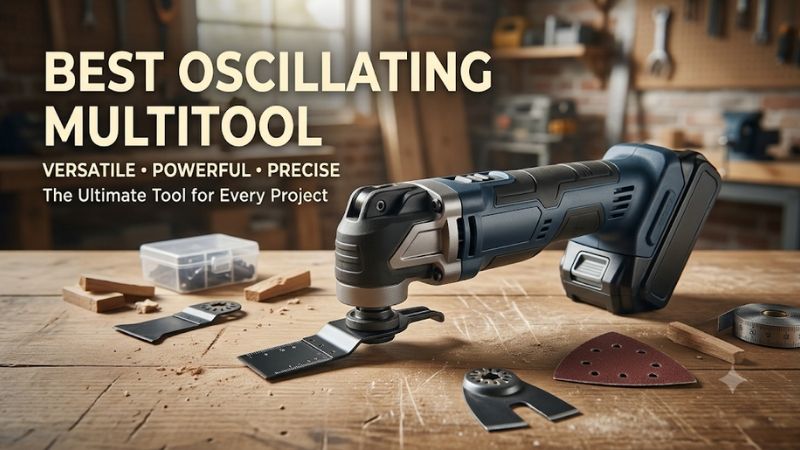
The best oscillating multitool should combine controlled cutting, manageable vibration, convenient blade changes, and reliable accessory compatibility. Whether you’re trimming door jambs, removing grout, making plunge cuts, or sanding tight corners, the right tool can make awkward home repairs easier. This guide compares seven options for DIY users and remodelers.
Quick Verdict: Which Oscillating Multitool Is Best?
For homeowners who want a versatile cordless tool, the DEWALT DCS356B stands out for its three-speed selection, variable-speed trigger, quick-change accessory system, and compatibility with DEWALT 20V MAX batteries. It offers a balanced configuration for trimming wood, removing old materials, sanding, and performing general renovation work.
The Milwaukee M18 FUEL 2836-20 is a stronger candidate for demanding cutting applications where a larger oscillation angle and vibration-control features matter. Its 4.2-degree oscillation angle and brushless motor are designed for aggressive material removal, although a wider angle does not automatically produce a better finish.
For precision-focused installation work, the Bosch GOP18V-34N offers a StarlockPlus accessory interface, slim grip, and vibration control. The Makita XMT04ZB is another excellent alternative for users who prioritize reduced vibration and compatibility with StarlockMax accessories.
Buyers working in restricted spaces should consider the Milwaukee M12 FUEL 2526-20. Its relatively compact battery system, selectable speed, and tool-free blade changes make it useful for detailed work.
The WORX WX696L and WORX WX686L provide more accessible options for users who want general cutting, sanding, and scraping capability without necessarily investing in a premium professional tool system.
Quick Comparison Table
| Model | Power source | Speed range | Oscillation angle | Best for |
|---|---|---|---|---|
| DEWALT DCS356B | 20V MAX cordless | Up to 20,000 OPM | Model-specific | Best overall versatility |
| Milwaukee M18 FUEL 2836-20 | M18 cordless | 10,000–20,000 OPM | 4.2° | Demanding cutting |
| Bosch GOP18V-34N | Bosch 18V cordless | 10,000–20,000 OPM | 3.4° | Precision and control |
| Makita XMT04ZB | Makita 18V LXT cordless | 10,000–20,000 OPM | 3.6° | Low-vibration work |
| Milwaukee M12 FUEL 2526-20 | M12 cordless | 10,000–20,000 OPM | 3.9° | Compact installations |
| WORX WX696L | WORX 20V cordless | 5,000–18,000 OPM | 3.6° | Everyday household DIY |
| WORX WX686L | 120V corded | 11,000–20,000 OPM | 3.2° | Budget corded use |
OPM means oscillations per minute. Manufacturer performance ratings are not standardized independent test results. Package contents and accessory interfaces must be checked for the exact model.
How We Selected These Oscillating Multitools
An oscillating multitool is only as useful as its cutting performance, accessory selection, and ability to operate accurately in confined locations. Unlike a conventional circular saw, an oscillating tool moves its accessory through a small side-to-side arc rather than continuously rotating a blade.
This motion enables specialized operations such as plunge cutting, flush trimming, localized scraping, detail sanding, and grout removal.
Our selection considers manufacturer-documented speed ranges, oscillation angles, motor configurations, blade-changing mechanisms, vibration-control features, battery compatibility, and accessory interfaces.
We also examined practical differences between compact tools intended for occasional home maintenance and higher-output models designed for demanding renovation work.
A model with a wide oscillation angle may remove material aggressively, but cutting performance also depends on blade geometry, sharpness, workpiece material, and feed pressure.
Similarly, a tool advertised with reduced vibration should not be assumed to eliminate hand-arm vibration or make prolonged operation risk-free.
The seven recommendations represent different buyer needs. They are based on documented technical characteristics and practical application analysis rather than unverified personal testing.
Detailed Reviews of the Best Oscillating Multitools
DEWALT DCS356B — Best Overall Oscillating Multitool
The DEWALT DCS356B is a versatile cordless oscillating multitool designed for homeowners, remodelers, and DIY users who need one tool for cutting, sanding, scraping, and detailed material removal. Its brushless motor, three-speed selector, and variable-speed trigger offer a useful balance of control and capability.
Best For: General home renovation, woodworking, flooring repairs, drywall cutouts, and users already invested in DEWALT batteries.
Key Specifications
| Feature | Specification |
|---|---|
| Battery platform | DEWALT 20V MAX |
| Motor | Brushless |
| Maximum no-load speed | 20,000 OPM |
| Speed selection | Three ranges |
| Trigger | Dual-Grip variable speed |
| Accessory changes | Quick-Change system |
| Lighting | Integrated LED |
| Package | Bare tool |
Why We Picked It
The DCS356B offers several practical features without requiring a specialized accessory interface for every task.
The three-speed selector allows users to choose an operating range based on the material and application. The variable-speed trigger provides additional control during operation.
This combination is particularly useful when transitioning between aggressive wood cutting and more delicate tasks involving trim or finished surfaces.
Features and Benefits
DEWALT’s Quick-Change system allows compatible blades and accessories to be replaced without requiring a conventional wrench.
The included universal adapter supports many third-party oscillating accessories, although fit must still be confirmed for individual products.
The integrated LED improves visibility around cabinet interiors, baseboards, and other poorly illuminated areas.
Its brushless motor eliminates carbon-brush maintenance and supports electronic control of motor operation.
Performance and Practical Use
The DCS356B is useful for trimming door jambs during flooring installation, removing damaged sections of drywall, cutting appropriate wood components, and scraping certain adhesives.
For plunge cutting, a suitable wood-cutting blade should be selected according to material thickness and the required opening.
A narrow plunge blade can improve access but may overheat or deflect if excessive pressure is applied.
When cutting nail-embedded wood, use a blade specifically rated for that application. Ordinary wood-only teeth may be damaged by metal contact.
The tool can also accept a triangular sanding attachment for corners and edges that are difficult to reach with a conventional orbital sander.
What Makes It Different
The DCS356B emphasizes convenient operation and speed control rather than a highly specialized accessory system.
Its quick-change interface and established battery platform make it attractive for users who frequently alternate between tasks.
Pros
-
Three selectable speed ranges.
-
Variable-speed trigger.
-
Convenient accessory changes.
-
Brushless motor and LED lighting.
Cons
-
Battery and charger are not included with the bare tool.
-
Vibration and cutting behavior depend on the installed accessory and workload.
Buy If: You want one versatile oscillating tool for varied home repairs and already use DEWALT 20V MAX batteries.
Skip If: Maximum vibration isolation or a StarlockMax accessory system is your primary purchasing requirement.
Milwaukee M18 FUEL 2836-20 — Best for Demanding Cutting
The Milwaukee M18 FUEL 2836-20 is a high-output cordless oscillating multitool designed for demanding renovation and cutting applications. It combines a POWERSTATE brushless motor, 4.2-degree oscillation angle, variable-speed control, and vibration-dampening technology.
Best For: Frequent remodeling, demanding wood cuts, nail-embedded materials, and professional-style renovation work.
Key Specifications
| Feature | Specification |
|---|---|
| Battery platform | Milwaukee M18 |
| Motor | POWERSTATE brushless |
| Speed range | 10,000–20,000 OPM |
| Oscillation angle | 4.2° |
| Speed control | Ten-setting dial |
| Automatic control | Auto-Load feature |
| Lighting | 180-degree LED illumination |
| Blade changes | Tool-free |
Why We Picked It
The 2836-20 has one of the wider documented oscillation angles among the models compared here.
A wider oscillation angle increases the distance traveled by the blade during each cycle, potentially supporting more aggressive cutting when paired with the appropriate accessory.
Milwaukee also incorporates vibration-dampening technology intended to improve operator comfort during repeated use.
Features and Benefits
The Auto-Load feature starts the accessory at a lower speed before increasing output when the tool encounters cutting resistance.
This can make the initial placement of a blade more controllable.
The ten-setting speed dial provides adjustment for cutting, scraping, and sanding applications.
The tool-free accessory-change mechanism reduces the need to locate a separate wrench when changing blades.
Its broad LED illumination helps improve visibility in dimly lit workspaces.
Performance and Practical Use
The M18 FUEL 2836-20 is particularly relevant when cutting hardwood, trimming framing members, or removing appropriate sections of nail-embedded wood.
Use a compatible bi-metal or carbide blade when cutting materials that contain metal fasteners.
For grout removal, select a manufacturer-approved grout accessory and maintain control to avoid damaging adjacent tile.
For sanding, a lower or moderate speed may be preferable depending on the abrasive and material.
Despite its aggressive cutting configuration, it should not replace a reciprocating saw or circular saw for extensive demolition or long straight cuts.
What Makes It Different
Its 4.2-degree oscillation angle, Auto-Load behavior, and vibration-control design are the primary distinguishing features.
Pros
-
Wide oscillation angle.
-
Brushless motor.
-
Automatic speed response.
-
Vibration-dampening features.
Cons
-
Greater capability may be unnecessary for occasional household tasks.
-
Battery choice influences weight and runtime.
Buy If: You regularly perform demanding remodeling and want strong oscillating-tool cutting capability.
Skip If: Your projects are limited to occasional light scraping or small sanding jobs.
Bosch GOP18V-34N — Best for Precision and Accessory Retention
The Bosch GOP18V-34N is an 18V brushless oscillating multitool designed around the StarlockPlus accessory interface, ergonomic handling, and vibration control. Its slim-grip housing makes it particularly interesting for installation and finishing work.
Best For: Precision remodeling, cabinet work, flooring installation, and users prioritizing accessory retention.
Key Specifications
| Feature | Specification |
|---|---|
| Battery platform | Bosch 18V |
| Motor | Brushless |
| Speed range | 10,000–20,000 OPM |
| Oscillation angle | 3.4° |
| Accessory system | Starlock and StarlockPlus |
| Weight | Approximately 2.7 lbs bare |
| Grip | Slim design |
| Lighting | Integrated work light |
Why We Picked It
The Starlock interface uses a three-dimensional connection intended to transfer force securely between the tool and accessory.
This differs from flatter mounting interfaces that rely on different contact arrangements.
Bosch also redesigned the battery orientation to improve handling and reduce interference during certain flush-cutting operations.
Features and Benefits
The tool-free accessory-change mechanism simplifies transitions between plunge blades, sanding pads, and compatible cutting accessories.
The slim grip can improve handling during detailed work.
Bosch advertises substantially reduced vibration compared with its preceding generation, although that claim should not be interpreted as a standardized comparison with every competing model.
Performance and Practical Use
The GOP18V-34N is suitable for trimming door casings, making controlled plunge cuts, preparing flooring edges, and sanding confined areas.
Its 3.4-degree oscillation angle is narrower than the Milwaukee M18 FUEL’s published angle.
However, the difference does not establish that the Bosch will perform every task more slowly.
Accessory design and material properties have a substantial effect on results.
For precision work, controlled feed pressure and careful blade selection often matter more than maximum speed.
What Makes It Different
The StarlockPlus interface and ergonomic configuration are its key advantages.
Pros
-
Secure Starlock accessory connection.
-
Slim grip and redesigned battery orientation.
-
Tool-free blade changes.
-
Documented vibration-control features.
Cons
-
Not compatible with StarlockMax accessories.
-
Some universal accessories may not fit the Starlock interface.
Buy If: You prioritize accurate handling and plan to use compatible Starlock accessories.
Skip If: You already own a large collection of accessories that cannot be mounted on this tool.
Makita XMT04ZB — Best Low-Vibration Oscillating Multitool
The Makita XMT04ZB is an 18V LXT subcompact brushless oscillating multitool designed for demanding trade and renovation applications. It combines Anti-Vibration Technology, a slim barrel grip, and compatibility with Starlock, StarlockPlus, and StarlockMax accessories.
Best For: Frequent remodeling, flooring installation, detail cutting, and users sensitive to excessive tool vibration.
Key Specifications
| Feature | Specification |
|---|---|
| Battery platform | Makita 18V LXT |
| Motor | Brushless |
| Speed range | 10,000–20,000 OPM |
| Oscillation angle | 3.6° |
| Accessory compatibility | Starlock, StarlockPlus, StarlockMax |
| Tool length | Approximately 12 inches |
| Blade changes | Tool-free |
| Motor start | Soft-start system |
Why We Picked It
The XMT04ZB features Makita’s Anti-Vibration Technology, which uses an internal counterbalance mechanism to reduce vibration transmission.
Makita advertises reductions of up to 85 percent under its specified comparison conditions.
That claim is useful context but should not be interpreted as a guarantee for every accessory, cutting material, or operating speed.
Features and Benefits
The tool offers a variable-speed dial, soft-start operation, and a slide switch with lock-on functionality.
The slim barrel grip is designed to improve handling.
Its StarlockMax compatibility provides access to a broader range of accessory classes than tools restricted to standard Starlock or StarlockPlus attachments.
The integrated LED helps illuminate work areas.
Performance and Practical Use
The XMT04ZB is particularly suitable for projects involving repeated plunge cutting, flush trimming, scraping, and detail sanding.
Reduced vibration can make prolonged tool handling more comfortable, although appropriate breaks and exposure management are still important.
For hardwood cutting, use suitable blades and avoid forcing the accessory through dense material.
When removing grout or adhesives, choose the attachment intended for the specific material.
What Makes It Different
The combination of Anti-Vibration Technology and StarlockMax compatibility makes the Makita particularly attractive for demanding mixed-material work.
Pros
-
Advanced vibration-control system.
-
StarlockMax compatibility.
-
Brushless motor.
-
Slim barrel grip.
Cons
-
Requires compatible Starlock-family accessories.
-
Battery and charger are separate from the bare-tool package.
Buy If: You frequently use an oscillating tool and value reduced vibration and broad Starlock compatibility.
Skip If: You need the lowest-cost entry into occasional home maintenance.
Milwaukee M12 FUEL 2526-20 — Best for Tight Spaces
The Milwaukee M12 FUEL 2526-20 is a compact cordless oscillating multitool designed around Milwaukee’s M12 battery platform. Its brushless motor, 3.9-degree oscillation angle, and vibration-isolating construction make it useful for installation work and confined repairs.
Best For: Cabinet interiors, door trimming, tight remodeling areas, and lightweight cordless operation.
Key Specifications
| Feature | Specification |
|---|---|
| Battery platform | Milwaukee M12 |
| Motor | POWERSTATE brushless |
| Speed range | 10,000–20,000 OPM |
| Oscillation angle | 3.9° |
| Speed adjustment | Twelve-setting dial |
| Blade changes | Tool-free |
| Lighting | Integrated LED |
| Battery compatibility | Milwaukee M12 |
Why We Picked It
The 2526-20 provides substantial documented oscillating-tool capability within a compact battery system.
For users working inside cabinets or around installed trim, reduced battery bulk can be beneficial.
Its vibration-isolating design also addresses a common usability problem with oscillating tools.
Features and Benefits
The twelve-setting dial provides fine adjustment across the available operating range.
Its tool-free blade-change system is convenient when switching between cutting, sanding, and scraping attachments.
The integrated LED improves visibility around door frames and other poorly lit areas.
Performance and Practical Use
The tool is suitable for removing small sections of trim, making controlled plunge cuts, and sanding confined corners.
Its 3.9-degree oscillation angle is substantial for a compact cordless model.
However, battery capacity and material resistance influence runtime.
For extensive demanding demolition, a larger tool or a different cutting method may be more appropriate.
What Makes It Different
The 2526-20 combines compact battery geometry, brushless operation, and vibration-control features.
Pros
-
Compact cordless platform.
-
Tool-free blade changes.
-
Twelve speed settings.
-
Vibration-isolating construction.
Cons
-
Runtime depends on the selected battery.
-
M12 batteries are not interchangeable with Milwaukee M18 batteries.
Buy If: You frequently work in restricted areas and already own M12 equipment.
Skip If: You primarily need a tool for extensive heavy-duty cutting.
WORX WX696L — Best Everyday DIY Cordless Option
The WORX WX696L Sonicrafter is a 20V cordless oscillating multitool designed for household repairs and general remodeling. It combines variable-speed control, a multi-angle blade arrangement, and a Universal Fit accessory interface.
Best For: Occasional home improvement, light woodworking, scraping, sanding, and users of WORX Power Share equipment.
Key Specifications
| Feature | Specification |
|---|---|
| Battery platform | WORX 20V Power Share |
| Speed range | 5,000–18,000 OPM |
| Oscillation angle | 3.6° |
| Speed settings | Six |
| Accessory system | Universal Fit |
| Lighting | Integrated LED |
| Blade adjustment | Multiple accessory orientations |
Why We Picked It
The WX696L offers a straightforward approach to multifunction home maintenance.
Its adjustable accessory orientation can be valuable when working beside cabinets, walls, and other obstructions.
The Universal Fit interface supports many oscillating accessories, although the correct mounting procedure must still be followed.
Features and Benefits
An onboard blade wrench helps with accessory changes.
The variable-speed dial allows the operator to adapt output to the installed accessory and material.
The tool can accept compatible blades for wood cutting, scraping attachments, sanding pads, and other applications identified by the manufacturer.
Performance and Practical Use
For home repairs, the WX696L can assist with trimming small wood components, removing certain adhesives, and sanding corners.
It may be especially useful to buyers who already own WORX Power Share batteries.
However, some package configurations have been discontinued, so buyers should verify the exact version and current accessory support before purchasing.
What Makes It Different
Its Universal Fit interface and accessible cordless configuration are its main attractions.
Pros
-
Variable speed.
-
Multi-angle accessory positioning.
-
Compatible Power Share platform.
-
Broad accessory support.
Cons
-
Some package versions have been discontinued.
-
Less appropriate for frequent demanding demolition.
Buy If: You need an occasional-use cordless multitool for varied household repairs.
Skip If: You require a premium professional accessory system or need a package with guaranteed current availability.
WORX WX686L — Best Corded Oscillating Multitool for Casual Users
The WORX WX686L is a corded oscillating multitool with a 2.5-amp motor and adjustable speed. Its operating design is suitable for users who want basic cutting, scraping, and sanding capabilities without managing rechargeable batteries.
Best For: Budget home maintenance, occasional renovations, and stationary garage workshops.
Key Specifications
| Feature | Specification |
|---|---|
| Power source | 120V AC |
| Motor rating | 2.5 amps |
| Speed range | 11,000–20,000 OPM |
| Oscillation angle | 3.2° |
| Tool weight | Approximately 3.2 lbs |
| Accessory changes | Clip-in wrench |
| Application | Cutting, scraping, sanding |
Why We Picked It
The WX686L provides the core functions expected from an oscillating tool without requiring a battery system.
For occasional users working near electrical outlets, a corded design can be economical and convenient.
Features and Benefits
The tool has adjustable speed and a clip-in wrench arrangement for accessory installation.
Its compatible sanding pad helps with detail sanding, while cutting and scraping blades provide additional utility.
The 3.2-degree oscillation angle supports controlled operation for appropriate applications.
Performance and Practical Use
The WX686L is useful for small remodeling jobs, trimming thin wood sections, scraping adhesives, and sanding corners.
Its corded design avoids battery depletion but requires safe cable management.
The electrical cord must remain away from the accessory and workpiece.
The tool should not be overloaded merely because it has continuous access to power.
What Makes It Different
Its main advantage is simple corded operation with the essential functions of a multifunction cutting and sanding tool.
Pros
-
No battery investment.
-
Adjustable speed.
-
Suitable for general household applications.
-
Relatively lightweight.
Cons
-
Requires a power outlet.
-
Blade changes rely on a wrench arrangement.
-
Less convenient for mobile work.
Buy If: You want an economical oscillating tool for occasional repairs near electrical outlets.
Skip If: Cordless mobility and rapid tool-free blade changes are essential.
How to Choose an Oscillating Multitool
Understand Oscillation Angle
Oscillation angle describes how far the accessory moves through its side-to-side arc.
A wider oscillation angle generally increases the travel distance of the blade during each cycle.
This can support aggressive material removal, particularly when cutting suitable wood.
However, a larger angle may also create more vibration, friction, or surface disruption depending on the tool and accessory.
For precision sanding and delicate trimming, controlled movement can be more important than maximum cutting aggression.
Choose a tool according to your regular tasks rather than assuming the highest angle is always best.
Compare Oscillations per Minute
Oscillations per minute indicate how frequently the accessory moves through its operating cycle.
A tool advertising 20,000 OPM completes more oscillations each minute than one operating at 10,000 OPM under equivalent measurement conditions.
However, OPM does not directly measure cutting speed.
Blade geometry, material properties, motor output, feed pressure, and oscillation angle influence actual results.
A sharp, appropriate blade at moderate speed may perform better than an unsuitable blade at maximum speed.
Decide Between Corded and Cordless Power
Cordless oscillating tools offer portability and avoid trailing power cables.
They are particularly useful for trim work, flooring repairs, and renovations where the tool must move between locations.
However, battery weight and runtime matter.
Corded tools provide continuous electrical power without charging interruptions.
For a fixed garage workshop, a corded model may offer good value.
The better option depends on your working environment and existing battery system.
Evaluate Accessory Compatibility
Accessory compatibility is one of the most important ownership considerations.
Different tools use different mounting mechanisms.
Some support universal-style accessories, while others require specific Starlock-family products.
Starlock, StarlockPlus, and StarlockMax are not universally interchangeable across every tool.
For example, the Bosch GOP18V-34N accepts Starlock and StarlockPlus accessories but not StarlockMax.
The Makita XMT04ZB supports all three classes.
Verify exact compatibility before purchasing blades or sanding attachments.
Look for Convenient Blade Changes
Oscillating-tool users frequently switch between cutting, scraping, and sanding.
A tool-free blade-changing mechanism can save time during mixed tasks.
However, the mechanism must retain the accessory securely.
Always disconnect power or remove the battery before changing accessories, according to the manufacturer’s instructions.
Cutting blades may remain hot after operation. Avoid touching the cutting edges directly.
Consider Vibration Control
Oscillating multitools produce high-frequency movement that can transmit vibration into the operator’s hands.
Excessive vibration can contribute to discomfort and increased exposure over time.
Some tools incorporate counterbalance systems or vibration-damping mechanisms.
These features may improve comfort, but actual exposure depends on the application, accessory, material, and duration.
Follow appropriate workplace exposure guidance and take breaks during prolonged operations.
Evaluate Grip Size and Balance
A slim barrel grip can improve handling when working inside cabinets or along trim.
However, grip comfort varies with hand size and working orientation.
A larger battery may shift the tool’s balance and make one-handed positioning less comfortable.
Consider complete operating weight, not bare-tool weight alone.
Maintain the grip and control method required by the tool manufacturer.
Check Lighting Features
Integrated LEDs can improve visibility around door jambs, cabinet interiors, and recessed fasteners.
However, the accessory may cast shadows.
Use additional work lighting when necessary.
Good visibility is essential for following cut marks and avoiding nearby finished surfaces.
Compare Battery Platforms
Existing battery ownership can reduce total tool cost.
A bare DEWALT tool may be economical for DEWALT 20V MAX users, while Milwaukee M12 and M18 owners may benefit from remaining within their existing platforms.
However, battery systems are not interchangeable merely because voltage ratings are similar.
Use only compatible batteries and chargers approved by the manufacturer.
Consider Included Accessories
Some multitools are sold as bare tools, while others include blades, sanding pads, chargers, and cases.
An accessory-rich kit can be attractive, but the included blades may not match your intended tasks.
For example, a kit containing several wood blades may still require a specialized carbide accessory for grout removal.
Compare the entire usable package rather than simply counting accessories.
Choosing Blades and Attachments
Wood Plunge-Cutting Blades
Plunge blades are useful for creating openings and cutting localized sections of wood.
They can help trim door casings or create controlled cutouts.
Choose blade width according to the required opening.
Narrow blades may provide access in restricted areas, while wider blades can support more stable straight cuts in suitable conditions.
Bi-Metal Blades
Bi-metal blades are designed for specified mixed-material cutting applications.
They may be appropriate for nail-embedded wood or certain metals.
However, not every bi-metal blade is suitable for every metal thickness.
Check the manufacturer’s material recommendations.
Avoid forcing the blade when cutting hardened fasteners or unfamiliar materials.
Carbide Blades
Carbide-tipped accessories are used for certain demanding applications involving abrasive materials or compatible metals.
They can provide useful wear resistance.
However, blade performance varies by design.
A carbide accessory intended for grout removal should not automatically be used for other materials.
Scraper Attachments
Scraper blades are useful for removing certain adhesives, old caulk, flooring residue, and other surface materials.
Rigid scrapers suit some firmly attached deposits, while flexible scrapers may be preferable for other applications.
Choose the appropriate attachment and operating speed.
Excessive pressure can damage the underlying surface.
Triangular Sanding Pads
Triangular sanding attachments can access corners and edges that conventional orbital sanders cannot easily reach.
They are suitable for small-area surface preparation and detailed finishing.
However, oscillating tools are generally less efficient than dedicated sanders for large surfaces.
Use the correct abrasive grit and avoid applying excessive pressure.
Grout-Removal Accessories
Specialized grout blades can remove grout from suitable joints.
However, the accessory can damage tile edges or underlying waterproofing if used incorrectly.
Control the blade position carefully.
Older tile installations may contain materials requiring special handling.
Identify the surrounding construction before beginning aggressive removal.
Common Oscillating Multitool Applications
Undercutting Door Jambs
One common application is trimming door jambs so flooring can slide beneath them.
An oscillating tool allows a horizontal cut close to the floor.
Use a flooring offcut or appropriate spacer to establish the correct height.
Maintain controlled pressure and avoid cutting into hidden fasteners.
Removing Old Caulk
A scraper attachment can help remove suitable old caulk or sealant.
However, sensitive surfaces can be scratched.
Begin with conservative speed and pressure.
For delicate finishes, manual removal methods may be safer.
Making Drywall Cutouts
An oscillating tool can create localized drywall openings.
However, hidden electrical cables, plumbing, and structural elements may lie behind the surface.
Inspect the work area before cutting.
Use a suitable blade and controlled depth.
Cutting Nail-Embedded Wood
A manufacturer-approved blade designed for wood and metal can help cut through certain embedded nails.
However, ordinary wood-only blades may lose teeth or become damaged.
Select the correct accessory and use appropriate protective equipment.
Sanding Corners
Triangular sanding pads can reach inside corners and narrow edges.
Start with a suitable abrasive grit and avoid excessive pressure.
For broad sanding operations, a dedicated sander is usually more efficient.
Removing Damaged Flooring
Oscillating tools can make localized cuts in certain flooring materials.
However, the correct accessory depends on the floor composition.
Avoid damaging the subfloor, electrical heating systems, or other hidden components.
Common Buying Mistakes
Choosing Only by Maximum OPM
High OPM does not guarantee fast cutting.
Oscillation angle, accessory design, motor output, and feed pressure also matter.
Ignoring Blade Compatibility
A tool may use an interface that does not accept your existing blades.
Check the mounting system before purchasing.
Buying a Large Tool for Detail Work
A powerful multitool may be unnecessarily heavy or bulky for confined tasks.
Choose manageable dimensions and appropriate controls.
Using the Wrong Blade
Incorrect accessories can damage the material or tool.
Select a blade specifically intended for the cutting application.
Applying Excessive Pressure
Oscillating tools work through repeated small movements.
Forcing an accessory can increase heat, wear, and loss of control.
Use steady, appropriate pressure and let the blade perform the cutting.
Frequently Asked Questions
What is an oscillating multitool used for?
An oscillating multitool is used for localized cutting, scraping, sanding, trimming, grout removal, and other repair operations. Its small oscillating motion makes it particularly useful in restricted areas.
Is a cordless oscillating multitool better than a corded one?
Cordless models offer mobility and eliminate power cords. Corded models avoid battery charging requirements. The better choice depends on workspace, budget, and frequency of use.
What oscillation angle is best?
There is no universal ideal. Wider angles can support aggressive cutting, while controlled movement may be preferable for certain finishing tasks. Accessory selection and tool design remain important.
Can an oscillating multitool cut metal?
Yes, when equipped with a blade approved for the specific metal and thickness. Not every wood-cutting blade can cut metal safely or effectively.
Can an oscillating multitool replace a circular saw?
Not for most long straight cuts. Oscillating tools excel at localized trimming and plunge cuts, while circular saws are more efficient for cutting boards and sheet materials.
Are Starlock accessories universal?
No. Starlock accessory classes have specific compatibility requirements. Verify whether the tool supports Starlock, StarlockPlus, StarlockMax, or another mounting interface.
Conclusion
The best oscillating multitool for general DIY work is the DEWALT DCS356B, thanks to its controllable speed, quick accessory changes, and versatile cordless design. Choose the Milwaukee M18 FUEL 2836-20 for demanding cuts, the Bosch GOP18V-34N for precise handling, or the Makita XMT04ZB for vibration-control features. The Milwaukee M12 FUEL 2526-20 suits tighter spaces, while WORX models offer practical alternatives for occasional home repairs.
More from Amazon
Programs that pair well with the guide above. Offers and eligibility are set by Amazon and may change.
Collect the home and kitchen items you want in one registry that guests can shop from.
Create a wedding registrySet up recurring deliveries of everyday items on eligible products. Terms and savings are set by Amazon.
Explore Subscribe & SaveFree shipping on eligible items, Prime Video and more. Eligible new members can start with a free trial.
Start a Prime free trialAudiobooks and podcasts to listen to on the go. Eligible new members can start with a free trial.
Try Audible freeAs an Amazon Associate we earn from qualifying purchases.