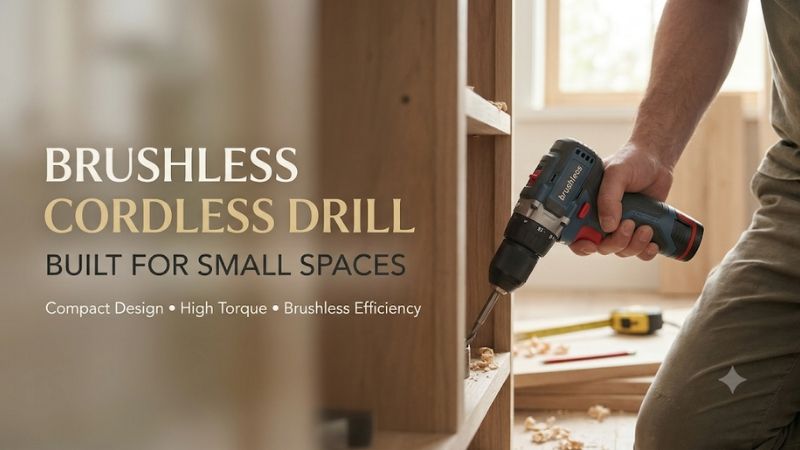
A brushless cordless drill for small spaces should offer enough power for everyday drilling while remaining easy to position inside cabinets, narrow framing bays, and crowded work areas. Head length, battery dimensions, chuck configuration, and working angle all influence accessibility. This buying guide explains how to choose a compact drill without sacrificing essential performance.
Quick Answer: What Makes a Cordless Drill Good for Small Spaces?
The most useful drill for confined work is not necessarily the smallest model available. It is the drill that allows the bit to reach the fastener or drilling location while providing enough clearance for the housing, battery, and operator’s hand.
For many home repair applications, a short brushless drill/driver with a 3/8-inch or 1/2-inch chuck is a practical choice. Models such as the Milwaukee M12 FUEL 3403-20 and DEWALT ATOMIC DCD794 demonstrate how modern cordless systems can combine comparatively short housings with useful drilling capability.
However, compact drill dimensions do not solve every access problem. Right-angle attachments, interchangeable-head systems, and dedicated right-angle drills can sometimes provide better access than conventional pistol-grip models.
Choose the tool according to the direction of approach, required bit length, fastener resistance, and available working space.
Understand the Different Clearance Requirements
Front-to-Back Clearance
Front-to-back clearance is the distance available behind the drilling location. It is frequently the main limitation when working inside cupboards, narrow furniture compartments, and tightly spaced mechanical assemblies.
A conventional drill requires room for its housing, chuck, and installed bit. The manufacturer’s published tool length often describes the body alone and may not account for every installed accessory.
For example, the DEWALT ATOMIC DCD794 has a published 5.88-inch tool-head length. However, a long drill bit can substantially increase the complete working envelope.
When choosing a compact drill, measure from the drilling surface to the nearest obstruction. Consider the actual bit and any attachment before deciding whether the tool will fit.
Side Clearance
Side clearance determines whether the drill can approach a fastener without the motor housing or handle interfering with nearby components.
This becomes important when working close to corners, cabinet walls, brackets, and mechanical equipment.
A narrow housing can help, but the required grip position also matters.
Some workspaces permit the drill body to enter but leave insufficient space for a comfortable hand position. In such cases, a right-angle accessory or manual tool may provide better control.
Vertical Clearance
Vertical clearance is especially important when drilling or driving screws beneath shelves, inside boxes, or under installed fixtures.
Even a short drill may be difficult to position if the battery extends below the handle or the chuck cannot align with the intended hole.
A compact battery can improve accessibility, although battery capacity and performance must remain suitable for the application.
Consider the complete drill-and-battery arrangement rather than comparing bare tools alone.
Working Angle
The drilling angle determines whether the bit can engage the surface correctly.
A compact drill is not beneficial if the operator must approach at an angle that damages the fastener head or produces an inaccurate hole.
Right-angle drill attachments can change the direction of rotation, but they introduce additional length, torque limitations, and accessory compatibility considerations.
Use an alternative configuration when the drilling angle cannot be maintained safely with a conventional tool.
Choose the Right Type of Compact Brushless Drill
Conventional Compact Drill/Drivers
Compact drill/drivers retain the familiar pistol-grip configuration while reducing overall housing length and sometimes weight.
They are suitable for many household applications, including pilot-hole drilling, furniture repair, and installation of brackets or cabinet hardware.
Models such as the Milwaukee M12 FUEL 3403-20 offer short housings without abandoning the conventional three-jaw chuck.
The main advantage is versatility. These drills accept a broad variety of compatible accessories and can perform both drilling and screw-driving operations.
Their main limitation is that they still require axial clearance between the drill body and the workpiece.
Subcompact 12V Brushless Drills
Subcompact 12V-class drills often emphasize reduced weight and comfortable handling.
They can be particularly helpful for repetitive household tasks and projects where the operator frequently works above shoulder height.
The Milwaukee M12 Subcompact Brushless 3401-20, for example, is specified with a housing approximately 5.4 inches long and a 3/8-inch chuck.
Its manufacturer-rated maximum torque is 350 in-lbs.
These characteristics make it relevant to lighter drilling and fastening in restricted spaces, but they should not be interpreted as equivalent to the capability of a much larger high-output drill.
Compact 18V-Class Drills
Compact 18V-class drills provide an alternative for buyers who want a short housing while retaining compatibility with an established higher-voltage battery platform.
The DEWALT ATOMIC DCD794, for example, combines a short tool head with a 1/2-inch ratcheting chuck.
This configuration is useful for general home maintenance and many installation tasks.
However, battery dimensions can partly offset the benefits of a compact housing.
An 18V-class tool fitted with a large battery may be less convenient in restricted areas than a small 12V drill.
Interchangeable-Head Drill/Drivers
Interchangeable-head tools use a common motor housing with removable chucks or specialized attachments.
Depending on the model, available heads may include a standard chuck, offset bit holder, right-angle drive, or hex-drive attachment.
This design can be especially useful for cabinet installation, furniture assembly, and work near corners.
The ability to remove the conventional chuck may shorten the effective tool configuration for certain operations.
However, not every attachment supports the same torque, speed, or accessory types. Compatibility must be checked for the exact product.
Dedicated Right-Angle Drills
A right-angle drill positions its chuck or drive axis at an angle to the motor housing.
This can provide better access between closely spaced structural members or inside mechanical compartments.
Right-angle designs vary substantially in size and output. Some are intended for light installation work, while others are designed for demanding drilling with large bits.
A dedicated right-angle drill is particularly useful when the problem is not simply insufficient head length but an impossible approach angle for a conventional drill.
Why Brushless Motors Are Useful in Compact Drills
Electronic Motor Control
Brushless motors use electronic commutation to manage current through the motor windings.
This can provide efficient energy transfer and enable the manufacturer to optimize motor behavior for different operating conditions.
In compact tools, efficient motor design can help support useful output within a smaller housing.
However, the presence of a brushless motor does not independently establish drilling power, cooling performance, or runtime.
The complete motor, transmission, battery, and electronics must be considered.
Reduced Brush-Related Maintenance
Traditional brushed motors use carbon brushes that wear through friction during operation.
Brushless motors eliminate that particular maintenance component.
This can be advantageous for frequently used tools, although brushless drills still contain mechanical parts, bearings, gears, switches, and electronic components that can wear or fail.
A brushless motor should therefore be regarded as a design feature rather than a guarantee of indefinite durability.
Potential Efficiency Benefits
Improved efficiency can be useful in compact cordless systems where battery size is limited.
However, actual runtime depends on battery energy capacity, material resistance, bit geometry, operating speed, and user technique.
A brushless drill with a small battery may run for less time than a larger brushed drill equipped with a substantially higher-capacity pack.
Compare complete tool configurations rather than motor technology alone.
Select the Right Chuck for Restricted Work
3/8-Inch Chucks
A 3/8-inch chuck supports compatible bits with shanks up to its rated capacity.
It is common on lighter drills and can be useful when the tool is intended primarily for ordinary household fasteners and smaller holes.
The chuck itself may be compact, but size varies by design.
A 3/8-inch chuck does not necessarily make the entire drill shorter than a competing 1/2-inch model.
1/2-Inch Chucks
A 1/2-inch chuck accommodates larger compatible shanks and is common on more capable drill/drivers.
This can provide flexibility when working with different wood-drilling and metal-drilling accessories.
However, a larger chuck may occupy more space at the front of the tool.
When clearance is limited, compare actual chuck dimensions and tool length rather than assuming a larger chuck is automatically advantageous.
Hex Bit Holders
A 1/4-inch hex bit holder can be particularly convenient for driving screws in confined locations.
Some interchangeable-head drill/drivers allow a hex bit to be installed directly without using a conventional three-jaw chuck.
This may reduce overall length and improve access.
However, a hex holder cannot accommodate every conventional round-shank drill bit.
Choose based on the accessories required for the job.
Right-Angle and Offset Attachments
Right-angle attachments redirect rotation to reach fasteners that cannot be approached directly.
Offset attachments can help drive screws close to a wall, edge, or adjacent surface.
Both can expand the usefulness of a compact drill.
Their limitations include added mechanical connections, possible speed or torque restrictions, and additional movement under load.
Use accessories approved for the tool and intended application.
How to Evaluate Compact Drill Performance
Match Torque to the Task
Torque becomes important when drilling larger holes, driving substantial fasteners, or working in dense materials.
However, the highest advertised torque is not necessarily desirable for furniture assembly or smaller fastening tasks.
Excessive force can damage screw heads, strip threads, or cause the drill to rotate suddenly when the bit binds.
A compact drill with moderate output and effective clutch control can be more practical for everyday restricted-space work.
Consider Low-Speed Control
Low-speed operation is important when starting a hole accurately or driving a screw near a delicate surface.
A variable-speed trigger allows the operator to increase rotational speed gradually.
A low mechanical gear provides greater mechanical advantage for demanding operations.
However, precise trigger control depends partly on tool design and operator technique.
Test the drill’s handling characteristics when possible rather than judging control solely by the number of speed settings.
Evaluate Clutch Settings
An adjustable clutch can help manage screw-driving operations in wood, cabinetry, and other materials susceptible to damage.
Start with a conservative clutch setting when working with unfamiliar fasteners.
Increase the setting only as needed to achieve the required result.
Clutch positions do not represent standardized torque measurements, and different drills may behave differently at apparently similar settings.
Consider Sustained Drilling Capability
Compact drills can be highly capable, but repeated demanding operations generate heat in the motor, gearbox, battery, and cutting accessory.
A model suitable for occasional larger holes may not be the best choice for continuous professional drilling.
Follow the manufacturer’s drilling-capacity recommendations and operating limitations.
If a drill repeatedly stalls or becomes excessively hot, stop and reassess the bit, material, operating speed, and tool suitability.
Practical Applications in Small Spaces
Installing Cabinet Hardware
Cabinet installation commonly requires drilling pilot holes and driving screws near internal corners.
A short drill with a controllable trigger can help improve access and reduce the likelihood of damaging finished surfaces.
Use appropriate pilot-hole sizes and clamp components when necessary.
A right-angle or offset attachment can be valuable when a standard chuck cannot approach the fastener directly.
Avoid forcing screws into the wrong alignment because cabinet panels and hardware can be damaged.
Assembling Furniture
Flat-pack furniture often includes small screws, bolts, and fittings that do not require substantial motor power.
A compact brushless drill can speed up assembly when used carefully.
However, many furniture components are made from particleboard or other materials susceptible to damage from excessive torque.
Use low clutch settings, compatible driver bits, and gradual trigger pressure.
For delicate fittings, a hand screwdriver may provide better final control.
Drilling Between Wall Studs
The space between wall studs may be restricted by insulation, wiring, plumbing, or other building systems.
A right-angle drill is sometimes more suitable than a conventional compact model, particularly when drilling through structural members.
Before drilling, identify hidden services and verify that the planned hole complies with relevant building requirements.
Structural drilling can be subject to limits on hole size and location.
Do not assume that a compact drill makes an otherwise unsafe drilling operation acceptable.
Working Under Shelves
Working beneath shelving often restricts vertical clearance.
A short drill with a compact battery may improve accessibility, especially when installing brackets or driving screws near the underside of a shelf.
However, the bit must still align correctly with the fastener.
If the working angle is unsuitable, consider an appropriate right-angle attachment or manual tool.
Repairing Appliances
Appliance service may involve screws located behind panels, inside cabinets, or near mechanical components.
A compact drill can be useful for removing appropriate fasteners after the appliance has been isolated from relevant energy sources.
However, not every appliance fastener is suitable for powered removal.
Follow the manufacturer’s service guidance and avoid disturbing electrical, gas, pressurized, or safety-critical assemblies without appropriate expertise.
Automotive Interior Work
Vehicle interiors contain trim fasteners, brackets, and other hardware positioned in restricted areas.
A compact drill/driver may help remove compatible screws, but excessive torque can damage plastic components or delicate threaded inserts.
Use hand tools where necessary for control.
Avoid drilling near wiring harnesses, airbags, fuel-system components, or other concealed systems without following the vehicle manufacturer’s service procedures.
Battery Selection for Compact Drills
Compact Battery Packs
Small batteries can improve maneuverability by reducing weight and the space required below the handle.
This is particularly useful for cabinet installation and overhead work.
However, smaller packs may provide less runtime or lower power delivery, depending on the battery design.
Choose a compatible battery that satisfies the manufacturer’s requirements for the intended operation.
Extended-Capacity Battery Packs
Larger packs can provide more stored energy and may improve performance under demanding loads.
They are useful when drilling repeatedly or working away from a charger.
However, additional weight and bulk can reduce the benefit of purchasing a short drill.
For confined-space work, a small battery and spare charged pack may be more practical than one oversized battery.
Battery Placement
Battery configuration influences balance and clearance.
Some compact systems use batteries inserted into the handle, while others use slide-style packs beneath the grip.
Neither layout is universally superior.
A battery integrated within the handle may improve clearance in some orientations, whereas a slide-style pack may provide a stable base for standing the tool upright.
Evaluate the actual working position before deciding.
Battery Platform Compatibility
A drill that shares batteries with existing equipment can reduce total purchase cost.
However, similarly labeled battery voltages do not establish interchangeability.
Milwaukee M12, Milwaukee M18, DEWALT 20V MAX, and Makita LXT are distinct platforms.
Use only batteries and chargers approved for the exact tool.
Ergonomics and Handling
Weight Distribution
A lightweight drill can still feel awkward if its center of mass is poorly positioned relative to the grip.
Conversely, a somewhat heavier tool may feel stable when the weight is distributed comfortably.
Consider whether the drill will be used horizontally, vertically, overhead, or in unusual positions.
Evaluate handling with the intended battery and bit installed, not just the bare tool.
Grip Comfort
Grip shape, diameter, texture, and trigger placement affect comfort.
Users performing repetitive installation work may prefer a smaller grip and lighter housing.
However, excessively small grips can be uncomfortable for some operators.
Choose a configuration that allows stable control without awkward wrist positions.
Work Lights
Integrated LED lighting can help illuminate the fastener or drilling area.
However, the chuck and bit may cast shadows, particularly in narrow compartments.
A separate work light may still be necessary.
Do not rely on the drill’s integrated LED as the only illumination source when accurate alignment or inspection is important.
Belt Clips and Storage
Belt clips can help users keep a compact drill accessible during installation work.
However, they must be used appropriately to avoid dropping the tool or striking nearby surfaces.
For home storage, a compact drill may fit more easily into cabinets, drawers, or portable toolboxes.
Store batteries and accessories according to the manufacturer’s instructions.
Common Mistakes When Buying a Small Drill
Comparing Body Length Without the Bit
A short tool body does not guarantee that a long drilling accessory will fit.
Measure the entire arrangement.
Consider whether shorter compatible bits, a different attachment, or a right-angle tool would provide better access.
Assuming a Smaller Drill Is Always Safer
Compactness improves handling in some circumstances, but a small drill can still produce sudden rotational forces if a bit binds.
Use appropriate grip techniques and workpiece support.
Do not exceed the manufacturer’s bit-size and drilling-capacity recommendations.
Choosing Too Little Power
A drill selected solely for minimum weight may struggle with demanding applications.
Repeated stalls can increase frustration and may indicate that the tool is unsuitable for the operation.
Match the required drilling capability to the material, bit, and expected workload.
Choosing Too Much Power
A high-output drill may be unnecessarily heavy for repetitive light-duty installation.
It can also create greater handling challenges when a large bit suddenly stops.
Consider whether a smaller tool provides enough performance before moving to a more powerful model.
Ignoring Accessory Compatibility
Not every right-angle attachment, offset holder, or drill bit is suitable for every drill.
Check shank compatibility, torque limitations, speed recommendations, and manufacturer guidance.
Do not assume an accessory is appropriate merely because it physically fits the chuck.
Frequently Asked Questions
What is the smallest brushless cordless drill worth buying?
There is no universal answer. The appropriate drill must offer enough power and compatible accessories for the intended work. Models such as the Milwaukee M12 Subcompact Brushless 3401-20 and Milwaukee M12 FUEL 3403-20 demonstrate compact designs with different performance priorities.
Is a 12V drill powerful enough for home repairs?
A capable 12V brushless drill can handle many pilot holes, household screws, cabinet installations, and general light-duty repairs. Larger holes and demanding materials may justify a higher-output drill.
Is a right-angle drill better for tight spaces?
It can be when a conventional drill cannot approach the workpiece along the required axis. However, some narrow spaces are better served by a short conventional drill or an offset attachment.
Does a smaller battery reduce drill power?
It can, depending on the battery and tool design. Battery capacity alone does not determine power delivery. Use compatible packs approved for the intended workload.
Can a compact drill handle metal?
Yes, provided the model supports the intended drilling operation and appropriate bits, speeds, cutting methods, and workpiece support are used.
Should I buy a compact drill or compact impact driver?
Choose a compact drill when you need a conventional chuck, drilling versatility, and adjustable clutch control. Choose a compact impact driver primarily for compatible screw-driving applications where its impact mechanism is useful.
Conclusion
A brushless cordless drill for small spaces should be selected according to total working clearance, battery dimensions, chuck design, and realistic drilling requirements. The Milwaukee M12 FUEL 3403-20 and DEWALT ATOMIC DCD794 are compelling conventional compact options, while interchangeable-head and right-angle tools can solve more difficult access problems. Prioritize proper bit alignment, manageable weight, and adequate control over minimum housing length alone.
More from Amazon
Programs that pair well with the guide above. Offers and eligibility are set by Amazon and may change.
Collect the home and kitchen items you want in one registry that guests can shop from.
Create a wedding registrySet up recurring deliveries of everyday items on eligible products. Terms and savings are set by Amazon.
Explore Subscribe & SaveFree shipping on eligible items, Prime Video and more. Eligible new members can start with a free trial.
Start a Prime free trialAudiobooks and podcasts to listen to on the go. Eligible new members can start with a free trial.
Try Audible freeAs an Amazon Associate we earn from qualifying purchases.