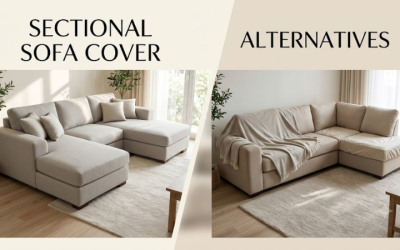
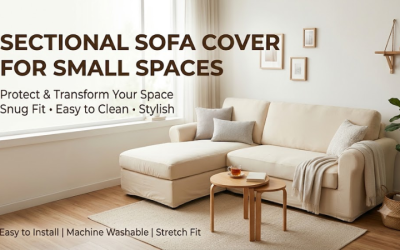
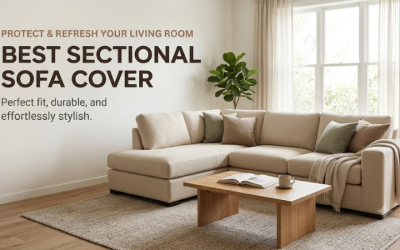
A stretch sofa slipcover for small spaces can refresh an apartment couch without the cost or disruption of replacing the furniture. Yet compact sofas often have unusual proportions, narrow arms, or attached cushions that make generic sizing unreliable. This guide explains how to select a cover that fits closely, remains easy to clean, and avoids unnecessary fabric buildup in a small living room.
Why Fit Matters More in a Compact Living Room
In a small living room, the sofa often occupies a significant portion of the visible space.
An oversized slipcover with loose fabric around the arms and bottom can make the furniture look bulkier, even though its physical dimensions have not changed.
A well-fitted cover can create a cleaner silhouette.
However, that does not mean buying the smallest size possible.
Stretch material placed under excessive tension may expose portions of the sofa, pull out from cushion gaps, and stress the seams.
The correct fit balances sufficient fabric coverage with appropriate tension around the frame.

Quick Comparison of Small-Space Slipcover Designs
| Cover type | Main advantage | Best furniture | Limitation |
|---|---|---|---|
| One-piece stretch | Simple overall coverage | Attached-cushion sofa | More fabric adjustment |
| Two-piece stretch | Separate seating panel | Standard straight sofa | Seat piece may still move |
| Three- or four-piece | Defined individual cushions | Removable seat cushions | Precise measuring required |
| Loveseat-sized stretch | Less excess material | Compact two-seat couch | Cannot fit oversized arms |
| Individual cushion covers | Easy targeted cleaning | Detachable cushions | Frame remains exposed |
| Stretch recliner cover | Designed around movement | Compatible reclining sofa | Product-specific moving clearances |
Step 1: Identify Your Sofa Type
A sofa described as small may still have very different construction from another model of similar width.
Apartment Sofa
Apartment sofas often have narrower arms and a shorter overall length.
A suitable loveseat or compact-sofa slipcover may fit well, but the correct size depends on the manufacturer’s measurement system.
Do not automatically order a loveseat size because the furniture was sold as an apartment sofa.
Loveseat
A loveseat usually seats two people, but its width can overlap with that of compact three-seat designs.
Measure the actual furniture rather than relying on the number of seats.
Sleeper Sofa
A sleeper sofa includes a folding or unfolding mechanism.
A conventional stretch slipcover may need to be removed before the bed is opened.
Choose a product explicitly compatible with the sleeper’s operation if the cover will remain installed.
Reclining Sofa
Reclining furniture requires clearance for moving footrests and backrests.
A regular one-piece sofa cover can restrict movement or become trapped in the mechanism.
Use only designs intended for the furniture’s movement.
Step 2: Take the Measurements That Actually Matter
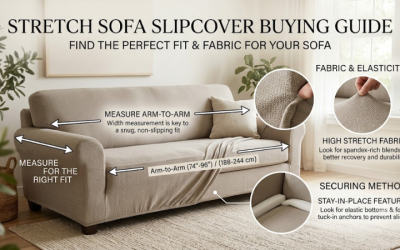
Start with the sofa’s exterior width.
Measure from the outside of one arm to the outside of the other.
Then record seat width, seat depth, back height, and arm dimensions.
Exterior Width Versus Seat Width
Consider a hypothetical sofa measuring 72 inches wide overall.
If its arms are each seven inches wide, the seating area may be only about 58 inches wide.
A manufacturer that sizes by total width and another that sizes by seat width could recommend different products.
Read the measurement diagram before selecting a variant.
Back Height
Tall backs require enough fabric to extend over the upper edge and down the rear.
A cover intended for low-profile furniture may ride upward on a tall sofa.
Arm Shape
Square arms, rounded arms, and rolled arms have different fabric demands.
A rounded or thick arm may require additional stretch and material even when the sofa’s overall width is within range.
Cushion Attachment
Check whether cushions can be removed.
This determines whether separate cushion sleeves are practical.
Step 3: Choose the Right Piece Count
One-Piece Covers
A one-piece cover wraps around the main furniture body and seating surfaces.
This can be useful for a compact sofa with attached cushions.
Installation may be straightforward, but the fabric can pull out of the seat creases when occupants move.
Foam anchors and elastic hems may help.
However, they require suitable places to secure the fabric.
Two-Piece Covers
Two-piece systems typically separate the seat covering from the main sofa shell.
Zenna Home Simply Fit Steps illustrates this format.
Its sofa version is designed around a 74–96-inch width range, which may be too large for some compact loveseats.
Smaller compatible variants should be assessed separately.
Three- and Four-Piece Covers
These often cover the sofa body and individual seat cushions separately.
A three-cushion sofa may use four pieces: one for the frame and three for the seat cushions.
This can help the cover follow cushion movement.
However, it also means the exact number and dimensions of removable cushions are essential.
Step 4: Avoid Buying a Cover That Is Too Large
A common mistake is choosing a larger size to be safe.
This can create more excess fabric than a small room needs.
Fabric Bunching
Excess material may collect near the arms, lower skirt, and junction between seat and back.
It can create an uneven appearance and may need frequent adjustment.
Slipping
Loose fabric can move more easily when a person stands or sits.
The result may be especially noticeable on smooth original upholstery.
Cleaning
A larger cover contains more material, potentially making it harder to wash and dry.
The goal is not to minimize fabric at all costs; it is to select a size within the manufacturer’s stated fit range.
Step 5: Choose Fabric for a Small, Frequently Used Sofa
A sofa in a compact apartment may serve as a reading chair, television seat, guest seating, and occasional work area.
The cover therefore receives frequent contact.
Polyester-Spandex Knits
These are common in stretch slipcovers.
Spandex helps the fabric recover after stretching, while polyester provides much of the main textile structure.
However, the proportion of spandex alone cannot establish the cover’s overall fit or durability.
A correctly patterned lower-stretch design can perform better than an incorrectly sized higher-stretch one.
Jacquard
Textured jacquard covers can visually soften small wrinkles.
They may also create a more decorative appearance than plain fabric.
However, snagging and care requirements vary.
Velvet-Style Fabric
Plush covers can produce a softer-looking sofa.
However, they may show pressure marks, lint, or pet hair depending on the color and texture.
Smooth Knit
A smooth knit creates a simple appearance but may show folds more prominently.
Its practicality depends on fit and cleaning.
Step 6: Consider Color and Room Appearance
A slipcover can change how a small room feels without changing the furniture.
Neutral Colors
Beige, light gray, and similar tones may blend with existing walls or rugs.
However, they can reveal some marks and stains.
Dark Colors
Black, navy, charcoal, and brown can create contrast.
They may conceal certain discolorations but show light pet hair or lint.
Patterns
Small patterns can make wrinkles or minor fabric irregularities less obvious.
However, a highly contrasting pattern can make the sofa visually dominant.
Match the Room Rather Than a Trend
Consider curtains, flooring, rugs, and nearby furniture.
The most useful color is one you can maintain and enjoy beyond one decorating season.
Step 7: Make Installation Possible in a Tight Room
A small apartment may not provide enough space to walk completely around the sofa.
This matters for full fitted covers.
Rear Access
Some covers need to be pulled over the back of the furniture and secured underneath.
If the sofa is pushed firmly against a wall, moving it may be necessary.
Plan enough temporary space to install the cover safely.
Under-Sofa Access
Elastic hems often wrap below the lower furniture edge.
Check the sofa’s feet and base construction.
Do not force a cover beneath components that can damage the fabric.
Furniture Movement
Avoid dragging a heavy sofa across vulnerable flooring solely to install the cover.
Use appropriate furniture-moving assistance when needed.
Step 8: Plan Laundry and Storage
A small home may have a compact washing machine or limited drying space.
Washer Capacity
A large cover may technically be machine-washable but too bulky for the available machine.
Follow both the cover’s care label and the washer’s capacity guidance.
Drying
Air-drying requirements can be inconvenient in small apartments.
Plan a suitable drying area and avoid creating excessive indoor moisture.
Spare Covers
One spare cover can be useful, but multiple bulky sets may require more closet space than expected.
If individual cushion covers are available, partial replacement may be easier.
Step 9: Consider Pets and Children
A removable cover can help protect original upholstery against everyday surface dirt.
However, a generic stretch cover is not automatically waterproof.
Pet accidents may pass through the fabric and reach the sofa beneath.
Likewise, stretch fabric is not guaranteed to resist claw damage.
For frequent liquid accidents, investigate a purpose-designed barrier and verify its material construction rather than relying on the term pet-friendly.
Example: Choosing a Cover for a 68-Inch Apartment Sofa
Imagine a straight sofa measuring 68 inches across the outside arms, with a 55-inch seat width and two removable seat cushions.
A two-cushion design may be appropriate, but only if its overall width and individual cushion measurements match the retailer’s size guide.
A one-piece PiccoCasa cover offered for the 53–67-inch size category might be too small when the manufacturer’s specified width measure is the overall 68 inches.
A larger version could fit, but it may introduce extra fabric.
This example shows why the size-chart method matters more than an approximate sofa category.
Common Buying Mistakes
Choosing by Seat Count
Seat count does not provide enough information about exterior dimensions.
Ignoring Attached Cushions
Separate-cushion covers cannot be installed as intended on every sofa.
Assuming More Stretch Fixes Wrong Geometry
Arm profiles and back shapes still matter.
Forgetting Installation Access
Some full covers require reaching behind and beneath the sofa.
Treating Washable as Easy to Wash
A bulky cover may exceed home laundry capacity.
Frequently Asked Questions
What Is the Best Stretch Sofa Slipcover for Small Spaces?
Choose a correctly sized one- or two-piece cover for compact standard sofas, or a cushion-specific design when removable cushions and measurements permit it.
Is a Loveseat Slipcover Better for an Apartment Sofa?
Not necessarily. Compare actual measurements using the product’s size guide.
Can a Slipcover Make a Sofa Look Smaller?
A closely fitted cover can create a neater visual outline, but it does not reduce the furniture’s physical dimensions.
What Fabric Is Best for a Small Sofa?
A washable polyester-spandex blend is a practical starting point. Texture, softness, fit, and cleaning instructions remain important.
Can I Install a Slipcover Without Moving the Sofa?
Possibly, depending on the cover’s design and how much access exists behind the furniture.
Should I Buy a Spare Cover?
It can be useful when frequent washing is necessary, but account for limited storage and the complete purchase cost.
Conclusion
A stretch sofa slipcover for small spaces should fit the couch’s actual dimensions, remain secure during daily use, and be practical to install and wash. Begin with exterior and seating measurements, then compare cushion construction, fabric, and securing methods. Avoid unnecessarily oversized covers and consider the laundry limitations of a compact home. The right slipcover can refresh a small living room without adding furniture or visual clutter.