A console table behind sofa for small spaces can make an awkward gap useful for charging devices, holding a lamp, or organizing everyday accessories. But a table that looks slim in a photograph may still interfere with movement or furniture placement. Learn how to measure sofa height, available depth, table length, electrical access, and stability before buying.
Can a Console Table Actually Save Space Behind a Sofa?
Yes, when it makes use of an area that would otherwise remain empty and does not interfere with ordinary movement.
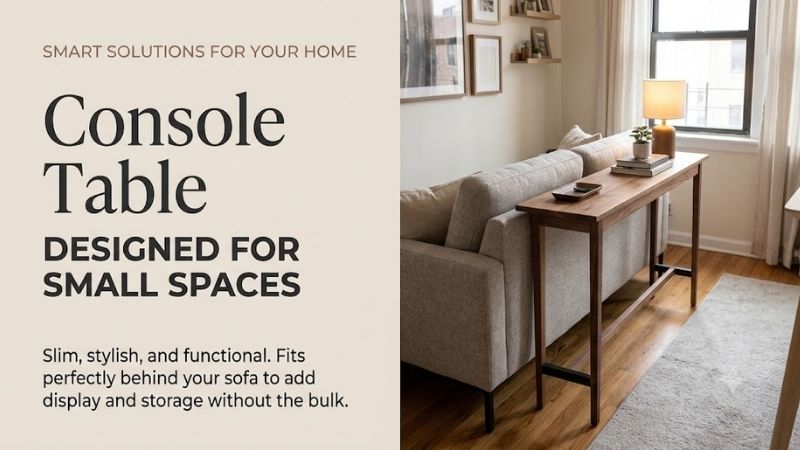
For example, a sofa positioned several inches away from a wall may leave a narrow unused strip. A specially designed table can occupy that space and create a useful surface.
However, buying a console table does not automatically save floor space.
If the sofa must be moved substantially farther into the room to accommodate the table, the arrangement can actually reduce usable space.
The key is understanding whether the space already exists or must be created.
Compare Small-Space Console Designs
| Type | Typical practical advantage | Main trade-off |
|---|---|---|
| Ultra-slim 5–6″ console | Charging ledge in a narrow gap | Minimal tabletop depth |
| Narrow 7–9″ console | More useful for small objects | Needs extra floor depth |
| Medium 10–12″ console | Books and modest decor | May crowd a narrow room |
| Standard 13–16″ console | Larger lamps and accessories | Often unsuitable for sofa-wall gaps |
| Adjustable-height console | Better match across sofa heights | More hardware |
| Console with shelves | Additional open storage | Access can be restricted |
| Console with outlets | Convenient charging | Cord routing and electrical considerations |
Step 1: Measure the Actual Gap
Begin by measuring the distance between the sofa back and wall.
Do this at several points rather than just one.
Sofas often have angled or curved backs, and baseboards can affect how closely table legs fit against the wall.
Consider the Narrowest Point
A table with a six-inch depth cannot fit into a genuinely five-inch-wide gap.
The legs and tabletop may also have different depths.
Always use the maximum assembled depth.
Include the Sofa’s Movement
A sofa may shift backward when occupants sit or when children play nearby.
If the table is positioned immediately behind it, that movement could cause contact.
A reclining sofa introduces additional clearance requirements.
Never place a console in an area needed for a recliner’s operating mechanism.
Do Not Ignore Baseboards
A table whose legs are recessed may fit differently from one with a full-width base.
Measure both upper and lower clearance.
A baseboard may force the furniture farther from the wall than expected.
Step 2: Match Console Height to Sofa-Back Height
A console behind a sofa may be visible from the room or accessible only from the back.
Its height affects both appearance and function.
For a Floating Sofa
When the sofa stands in the center of an open-plan room, the console can define the back edge of the seating area.
A height approximately aligned with the sofa back often provides a balanced appearance.
However, a taller console may be appropriate when used as a room divider, provided its stability and the objects placed on it are suitable.
For a Sofa Against the Wall
A console may act as a narrow ledge behind the cushions.
If its top sits substantially below the sofa back, items may be difficult to reach.
If it extends too high, it can interfere with comfortable use of the sofa or place objects where they may fall toward occupants.
Adjustable-Height Models
An adjustable model such as the VASAGLE 78.7-inch console can help solve a mismatch.
Its reviewed height range is approximately 25.2–35.2 inches.
However, every adjusted configuration must be locked correctly according to manufacturer instructions.
Step 3: Choose a Length That Matches the Room
A console does not have to extend across the entire sofa.
The ideal length depends on the available wall span, nearby furniture, and desired use.
Shorter Tables
A 30–40-inch console can work behind one side of a sofa or a small loveseat.
It might hold a lamp, photo frame, or collection of small accessories.
However, it provides less surface area for multiple occupants.
Medium Tables
A table around 40–60 inches can serve a typical sofa without dominating the wall.
IKEA LACK’s approximately 55-inch length illustrates this category.
However, its relatively large depth may make it better for an open-plan placement.
Longer Tables
A 70–79-inch table can span a long sofa or sectional segment.
The 17 Stories Prebo and VASAGLE models illustrate this class.
Longer frames need careful consideration of assembly, leveling, and anti-tip guidance.
Step 4: Calculate the Footprint
Consider two behind-sofa tables with the same 70-inch length.
| Table depth | Approximate floor footprint |
|---|---|
| 6 inches | 420 sq in |
| 8 inches | 560 sq in |
| 12 inches | 840 sq in |
| 15 inches | 1,050 sq in |
A 70-by-15-inch console uses 2.5 times the rectangular footprint of a 70-by-6-inch console.
This does not mean the narrower table is always better.
The wider model can support larger permitted objects and may offer more substantial storage.
The goal is to select the depth necessary for the intended use without sacrificing valuable floor space.
Step 5: Plan for the Entire Living-Room Layout
Sofa Against a Wall
This arrangement generally favors narrow tables.
The table may provide an outlet-accessible surface but cannot be assumed to replace a full side table.
Floating Sofa
A freestanding sofa can accommodate a more conventional console behind it.
The table may hold lighting and help visually define a conversation zone.
However, keep necessary walking routes open.
Sectional Sofa
A sectional may have several back segments and an angled or L-shaped layout.
One long straight table may not fit the complete arrangement.
Separate appropriately sized tables or a shorter console may work better.
Sofa Near a Doorway
The console should not project into the door swing or main passage.
A shorter table may be preferable even when a longer version would fit behind the sofa itself.
Step 6: Evaluate Charging and Cord Management
Integrated outlets are a popular feature of narrow behind-couch tables.
They can be useful when a wall receptacle becomes inaccessible after positioning the sofa.
However, the power arrangement deserves careful attention.
Outlet Position
A power module mounted at the far end of a long table may not be convenient for every seated user.
Consider where phones and tablets will actually be placed.
Cord Length
The cord must reach an appropriate wall outlet without being stretched.
Avoid running it through moving recliner mechanisms or placing it where people walk.
Electrical Rating
A table’s integrated receptacles have specific limits.
Follow the manufacturer instructions and applicable electrical requirements. Do not connect high-demand appliances or overload the module.
Cable Organization
Use manufacturer-approved clips or appropriate cable-management methods.
Avoid pinching or damaging cords behind heavy furniture.
Step 7: Choose Between Open Shelves and a Simple Top
A console with several shelves may seem better because it holds more.
However, behind-sofa storage can be difficult to access.
Open Shelves
Open shelves work when one side of the console remains accessible.
They can hold appropriate baskets, books, or decorative pieces.
If the table is tightly trapped between the sofa and wall, lower shelves may become impractical.
Simple Narrow Top
A single shallow tabletop is easier to clean and less visually complex.
It may be the better option when the main goal is charging a phone or placing small accessories.
Hidden Storage
Drawers can conceal clutter but need clearance to open.
Check whether the drawers face the sofa or the accessible rear side before buying.
Step 8: Evaluate Stability
Narrow consoles can have long tops supported by relatively shallow bases.
Their proportions make correct placement important.
Anti-Tip Hardware
Use manufacturer-supplied anti-tip hardware when required.
A table that cannot be anchored as instructed may be unsuitable for the chosen location.
Weight Distribution
Avoid concentrating heavy objects at one end or on a projecting edge unless explicitly permitted.
Keep the load within applicable ratings.
Floor Leveling
A long table may wobble on an uneven floor.
Adjustable feet can help when provided by the manufacturer.
Do not improvise unstable supports.
Children and Pets
Children should not climb narrow furniture.
A long console can be pulled or pushed even when it appears secure.
Decorations and lamps should be positioned so accidental contact is less likely to dislodge them.
Example: A Compact 10 × 11-Foot Living Room
Imagine a 120-by-132-inch living room with a sofa positioned against the longer wall.
The household wants a charging surface behind the sofa but cannot afford to move the sofa far into the room.
A six-inch-deep console adds six inches to the overall sofa-wall arrangement, before any clearance needed for cords and furniture movement.
A fifteen-inch-deep console would require nine additional inches.
That difference might affect access to a coffee table or nearby doorway.
If charging is the only intended function, the slimmer model may provide better practical value.
If the sofa is instead positioned in the middle of the room, a broader console may be reasonable because it can help define the seating zone.
Common Buying Mistakes
Buying Based Only on Table Length
Depth and height can make a long console unsuitable.
Forgetting the Sofa’s Reclining Movement
Moving furniture needs its full operating clearance.
Assuming Shelves Are Always Accessible
A table trapped against a wall may have unusable lower storage.
Ignoring Anti-Tip Instructions
Long narrow furniture needs correct stabilization.
Buying an Outlet Table Without Checking the Cord
Power features are only useful when they can be used safely.
Frequently Asked Questions
How Narrow Can a Behind-Sofa Console Table Be?
Some reviewed models are approximately 5.9 inches deep. This can be useful for charging and small items, but such narrow surfaces are not suitable for every lamp or decorative arrangement.
Should the Console Table Be Taller Than the Sofa?
Usually the sofa-back height is a practical reference point, but the right relationship depends on visibility, reach, and intended use. Measure both pieces before purchasing.
Can I Put a Console Table Behind a Reclining Sofa?
Only if the sofa’s full operating clearance and the table’s safety requirements permit it. Do not obstruct moving parts or pinch electrical cables.
Are Long Narrow Tables Stable?
They can be when properly designed, assembled, loaded, and secured according to manufacturer instructions. Their proportions require careful attention to tipping.
Is a Console With Charging Outlets Worth It?
It can be useful where conventional receptacles are difficult to access. If the household already has convenient charging, a basic table may offer better value.
Is a Six-Inch Table Better Than a Twelve-Inch Table?
A six-inch table saves depth, while a twelve-inch table provides more surface area. Choose based on actual placement and object sizes.
Conclusion
A console table behind sofa for small spaces works best when it uses genuinely available space rather than forcing the sofa into the room. Measure the full gap, sofa-back height, table length, base dimensions, and access routes. Check outlet routing, shelving accessibility, and stability before buying. A narrow charging ledge may be the right solution for a wall-backed sofa, while a wider console can suit a floating arrangement.