A stretch sofa slipcover buying guide should help you choose fabric that fits the actual sofa, stays secure during normal use, and remains practical to clean. Stretch covers can conceal cosmetic wear and refresh a living room, but they do not fit every arm shape, cushion arrangement, or reclining mechanism. This guide explains sizing, construction, fabric composition, installation, durability claims, and long-term value.
What Is a Stretch Sofa Slipcover?
A stretch sofa slipcover is a removable fabric covering designed to conform to a sofa using elasticity in the textile, the securing system, or both.
It can protect the original upholstery from some everyday contact and change the furniture’s visible appearance.
However, stretch covers vary significantly.
A one-piece cover may wrap around the entire sofa.
A two-piece system may separate the seat covering from the main frame.
A multi-piece set can provide separate covers for the sofa body and individual cushions.
The correct design depends on the sofa, not simply the buyer’s preferred appearance.
Compare the Main Stretch Slipcover Types
| Type | Main benefit | Main limitation |
|---|---|---|
| One-piece cover | Simple overall installation | Fabric may need frequent retucking |
| Two-piece cover | Separates seating from frame | Seat section may still shift |
| Multi-piece cushion cover | More defined cushion shape | Exact cushion count and size required |
| Velvet-style stretch | Soft plush appearance | Lint and pressure marks may show |
| Jacquard stretch | Decorative texture | Snagging and fit considerations |
| Recliner-specific cover | Designed around moving furniture | Must match mechanism geometry |
| Sectional stretch system | Covers more complex layouts | Orientation and multiple measurements |
Step 1: Identify Your Sofa Construction
The sofa’s frame and cushions determine which cover patterns may work.
Conventional Straight Sofa
A standard straight sofa can be compatible with many universal covers, provided the overall dimensions and arm profiles match.
However, three-seat sofas do not all share the same width or cushion arrangement.
Loveseat
A loveseat may be compact, but its arms can be wide.
This can make its overall width closer to that of a small sofa.
Do not choose solely according to the number of occupants.
Attached-Cushion Sofa
Some sofas have cushions permanently attached to the frame.
Individual cushion covers cannot be installed in their intended way if the cushions cannot be removed.
A one-piece design or another compatible product may be preferable.
Removable-Cushion Sofa
A sofa with separate cushions may work well with a multi-piece slipcover.
However, each cushion must match the advertised shape and size.
Reclining Sofa
A reclining sofa requires a specialized cover that permits the furniture to move correctly.
Never allow a generic cover to obstruct the footrest, reclining mechanism, or control system.
Step 2: Measure the Sofa Using the Correct Reference Points
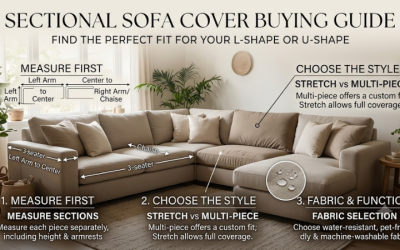
Before ordering, record overall width, seating width, back height, seat depth, and arm dimensions.
Overall Width
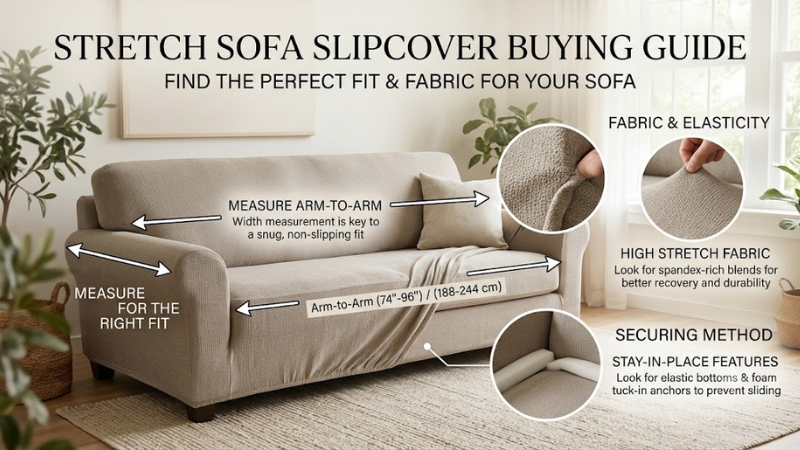
Measure between the outside edges of the arms.
This is commonly used for universal sofa-size categories.
Seat Width
Measure the usable seating area between the arms.
Some size guides use this measurement instead of the overall furniture width.
For example, a sofa may be 88 inches wide overall but have a 74-inch seat width.
Those values must not be mixed.
Back Height
Measure according to the seller’s diagram.
A tall back can pull a short cover upward, exposing the lower sofa.
Arm Height and Shape
Thick rolled arms use material differently from thin square arms.
A stretch cover must have enough fabric to accommodate the contour.
Cushion Dimensions
For individual covers, measure each cushion’s width, depth, and thickness.
Do not assume all cushions are identical.
Step 3: Select the Correct Piece Count
One-Piece Slipcovers
A one-piece design can simplify the initial installation.
The fabric stretches over the sofa and is tucked into cushion gaps where possible.
Its main disadvantage is that movement in one area can affect tension elsewhere.
For example, a person sitting on the middle cushion may pull fabric away from the backrest.
Two-Piece Slipcovers
A two-piece system separates the seat from the main sofa covering.
This can reduce tension across the seating junction.
However, the seat cover may still need adjustment, especially if several loose cushions move independently beneath it.
Three- and Four-Piece Slipcovers
Multi-piece products may give each removable seat cushion an individual covering.
This can create a more tailored appearance.
However, they require more measurements and more careful installation.
Which Is Better?
Choose by actual cushion construction.
A four-piece set is not automatically better than a one-piece cover on a sofa with fixed cushions.
Step 4: Understand Fabric Composition
Polyester
Polyester is widely used because it can be manufactured in different textures and is suitable for many washable household fabrics.
However, polyester alone does not guarantee stretch.
The construction of the knit or blend matters.
Spandex
Spandex provides elasticity and recovery in stretch fabrics.
Some slipcovers use relatively small amounts, while others advertise higher percentages.
However, more spandex does not automatically mean better fit.
Poor pattern geometry cannot be fully corrected by elasticity.
Polyester-Spandex Blends
These are common in ready-made stretch slipcovers.
For example, Zenna Home Simply Fit Steps lists 96% polyester and 4% spandex.
Certain H.VERSAILTEX velvet designs advertise higher spandex content.
These figures describe different products, not directly comparable quality grades.
Microfiber
Microfiber describes very fine fibers rather than one universal fabric structure.
Its softness, density, cleaning requirements, and durability depend on the actual product.
Velvet and Jacquard
Velvet describes a pile-like surface appearance, while jacquard refers to a patterned textile construction.
Neither term by itself establishes stain resistance, scratch resistance, or washability.
Step 5: Compare Fabric Weight and Thickness
Some listings include GSM, or grams per square meter.
A 150 GSM slipcover fabric and a 200 GSM slipcover fabric differ in mass per unit area.
However, this does not directly establish which one will resist abrasion, stretching, or pilling better.
Fiber construction, knit design, finishing, and sewing quality all contribute.
A heavier cover may also require more laundry capacity.
Choose fabric weight as one specification among several rather than a standalone ranking system.
Step 6: Evaluate Anti-Slip Features
A good cover should stay reasonably positioned during normal sitting and standing.
However, no universal cover is guaranteed to remain perfectly smooth.
Elastic Bottoms
An elastic hem pulls fabric around the sofa’s lower edge.
This can help retain the cover.
However, the elastic must fit the frame correctly.
Foam Anchors
Foam pieces can secure excess material in the junction between the seat and back.
Their effectiveness depends on the depth and shape of the cushion gap.
Separate Cushion Sleeves
These move with the seat cushions and can reduce pulling across the entire sofa.
However, a poorly sized sleeve can rotate or bunch.
Straps and Fasteners
Some covers use straps.
They should be installed only as instructed and kept away from moving furniture mechanisms.
Step 7: Check Protection Claims Carefully
Stretch slipcovers can protect the upholstery from some everyday surface contact.
However, protection claims should be specific.
Water-Resistant
The fabric may repel or slow the penetration of some liquids.
It may still allow moisture through seams or after prolonged exposure.
Waterproof
A waterproof claim needs product-specific support.
An ordinary polyester-spandex slipcover should not be treated as waterproof just because it is described as pet-friendly.
Stain-Resistant
Stain resistance may help with certain spills but does not make the cover impossible to stain.
Scratch-Resistant
Some textiles may resist certain everyday contact better than others.
No ordinary slipcover should be assumed immune to pet claws or chewing.
Step 8: Inspect Stitching and Construction
Seams experience tension when the cover is stretched over arms and cushions.
Check whether the product’s pattern includes sufficient material around corners and structural transitions.
Overstretched Seams
A cover that is too small may place excessive stress on stitches.
Visible tension lines are a sign that the fit may be unsuitable.
Loose Material
A cover that is too large may gather around the seating area.
More tucking is not always a reliable fix.
Reinforced Areas
Product descriptions may mention reinforced seams or elastic bands.
These details can be useful, but their performance still depends on overall construction.
Step 9: Choose Fabric According to Household Use
Homes With Pets
Prioritize practical laundering and appropriate fabric texture.
A very loose cover may be pulled out of position when pets jump on the sofa.
However, fit and washing convenience often matter more than generic pet-proof labels.
Homes With Children
Choose a cover that can be removed for cleaning without extensive disassembly.
Avoid unsecured accessories or loose components that could create hazards.
Formal Living Rooms
Appearance may matter more than frequent washing.
A separate-cushion velvet or jacquard design may be attractive when compatible with the furniture.
Frequently Used Family Rooms
A practical, correctly sized washable cover may be more valuable than a delicate decorative fabric.
Step 10: Follow a Reliable Installation Sequence
First, confirm that the cover and sofa are clean and dry.
Identify the cover’s front, back, arms, and cushion sections.
Place the cover loosely over the correct parts of the sofa.
Then align seams with furniture edges.
Work gradually around the frame, stretching and smoothing the fabric evenly.
Secure the elastic hem and manufacturer-approved anchors.
For multi-piece sets, cover individual cushions according to the product’s instructions.
Do not force fabric across edges that create excessive tension.
Finally, sit on the sofa and check whether the cover remains reasonably positioned.
If it repeatedly pulls free, reassess sizing rather than continually stretching harder.
Step 11: Understand Washing and Drying
Machine Washing
Follow the textile’s care label.
Machine-washable covers may still require a particular cycle or water temperature.
Machine Capacity
A large sofa cover can become bulky when wet.
Do not overload the washing machine.
Tumble Drying
Some covers permit tumble drying, while others prohibit it.
Follow the exact label to avoid damage or unwanted changes in fit.
Bleach and Cleaning Products
Use only cleaning products approved for the material.
Harsh cleaners may damage fibers or colors.
Reinstallation
A freshly washed cover should be properly dried according to its instructions before being placed back on the sofa.
Reinstall it evenly to avoid localized overstretching.
Step 12: Calculate Long-Term Value
The purchase price is only one part of ownership.
A cover that is inexpensive but fits poorly may need frequent replacement or adjustment.
A more expensive multi-piece design can be worthwhile if it provides better function on the actual sofa.
However, do not assume a higher price guarantees longer lifespan.
Consider laundry, replacement availability, number of pieces, color consistency, and return terms.
Buying Checklist
| Criterion | What to verify |
|---|---|
| Sofa type | Straight, reclining, sleeper, or sectional |
| Overall width | Fits the selected size system |
| Seat width | Matches when required |
| Back height | Enough vertical coverage |
| Arm shape | Compatible with cover geometry |
| Cushion count | Matches multi-piece set |
| Fabric | Suitable texture and composition |
| Grip | Correct securing method |
| Protection | Actual water or stain claims |
| Cleaning | Wash and dry instructions |
| Price | Exact sofa-size variant |
| Returns | Policy for fit-related problems |
Frequently Asked Questions
How Do I Choose the Correct Stretch Sofa Slipcover Size?
Measure the sofa according to the manufacturer’s size guide, including overall width, seat width, back height, and cushion dimensions where required.
Is a One-Piece or Four-Piece Cover Better?
A four-piece design may provide better cushion definition when the cushions are removable and compatible. A one-piece design may be simpler for fixed-cushion furniture.
Are Polyester-Spandex Slipcovers Durable?
They can be suitable for everyday furniture protection, but longevity depends on fabric construction, fit, washing, and use. Fiber percentages alone do not determine durability.
What Does GSM Mean for Slipcovers?
GSM means grams per square meter. It describes fabric weight, not a guaranteed measure of durability or thickness.
Can a Stretch Slipcover Protect Against Pet Accidents?
It can provide a removable textile layer, but ordinary stretch covers may allow liquid through. Verify whether the exact product provides a suitable waterproof barrier.
Can a Slipcover Fix a Sagging Sofa?
No. A slipcover changes the surface appearance and may provide protection, but it cannot repair broken frames, worn suspension, or collapsed cushions.
Conclusion
A stretch sofa slipcover should be selected according to precise furniture measurements, cushion construction, practical fabric properties, and cleaning requirements. One-piece covers simplify some installations, while multi-piece designs can create better definition around removable cushions. Check fit ranges, securing methods, washing restrictions, and protection claims before ordering. The best product is not the stretchiest or most expensive option, but the one that works reliably with the actual sofa.