Key takeaways
- A power lift recliner is worth considering when the person has difficulty rising from a seated position but retains sufficient movement, strength, balance, and understanding to complete the transfer with appropriate assistance.
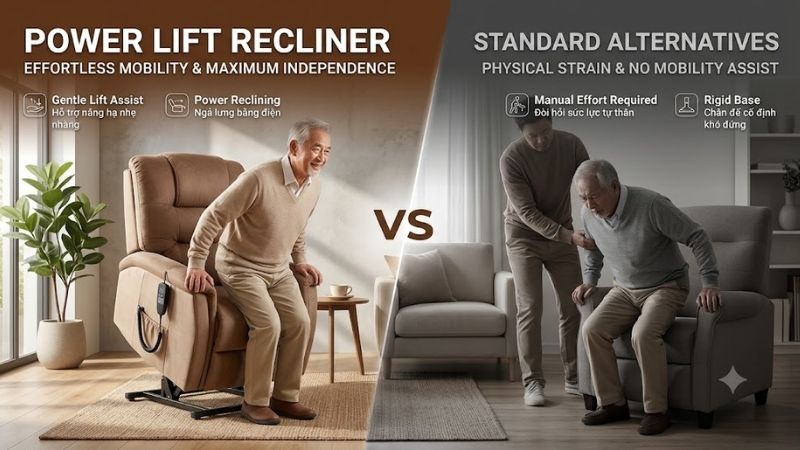
Power lift recliner vs alternatives is a comparison between powered standing assistance and other ways to sit, stand, or rest comfortably. Standard recliners, lift cushions, high-seat chairs, and professional transfer equipment solve different problems. This guide explains where each option fits, what it cannot safely replace, and when an individual mobility assessment matters.
Quick Verdict: Is a Power Lift Recliner the Best Choice?
A power lift recliner is worth considering when the person has difficulty rising from a seated position but retains sufficient movement, strength, balance, and understanding to complete the transfer with appropriate assistance.
Its main advantage is that the chair itself raises and tilts the seating surface.
However, other products may be more appropriate for different problems.
A standard recliner provides relaxation without powered standing assistance. A higher-seat chair may make standing easier for some people without introducing a motorized mechanism. A suitable transfer aid can provide a different grasping or positioning arrangement, while professional patient-lifting equipment addresses needs that a reclining chair cannot safely meet.
The best alternative depends on the person’s actual functional limitations.
Quick Comparison Table
| Product category | Primary purpose | Main advantage | Important limitation |
|---|---|---|---|
| Power lift recliner | Assists sit-to-stand movement | Powered seat lifting | User still needs suitable transfer ability |
| Standard manual recliner | Comfortable reclining | Simpler and often less expensive | No powered standing assistance |
| Power recliner without lift | Adjustable lounging positions | Precise comfort controls | Does not raise seat for standing |
| High-seat armchair | Offers a higher sitting surface | No motorized mechanism | Still requires independent standing ability |
| Lift-assist cushion | Adds or provides seat assistance | May be portable | Compatibility and stability vary |
| Transfer pole or grab support | Provides grasping support | Targeted transfer assistance | Requires correct installation and user capability |
| Sit-to-stand transfer device | Supports specific transfers | More specialized transfer function | Requires assessment and appropriate operation |
| Full-body patient lift | Transfers people with substantial assistance needs | Designed for supported lifting | Requires training, equipment, and caregiver planning |
These categories should not be treated as interchangeable merely because they are marketed toward older adults or people with mobility limitations.
Power Lift Recliner vs Standard Manual Recliner
A standard recliner is designed to change the seated person’s resting position.
It generally provides a moving backrest and legrest but does not raise the entire seat into a standing-assistance position.
That distinction is fundamental.
Everyday Comfort
A manual recliner can be comfortable for reading, television, or relaxing.
Some users prefer its simpler controls and lack of electrical requirements.
However, a deeply reclined manual chair can be difficult for a person with limited strength to return to an upright seated position.
The user may need to push the footrest closed or operate a lever before standing.
Standing Assistance
A lift recliner uses powered movement to raise the seat and assist the transition toward standing.
A manual recliner lacks this function.
For someone who can sit and stand independently, the additional lift mechanism may be unnecessary.
For someone who struggles specifically with rising, the distinction may justify considering a lift chair.
Cost and Repair
A basic manual recliner often has a lower purchase price and fewer electrical components.
A lift recliner adds a motor, actuator, controller, and associated wiring.
These components require maintenance and may eventually need repair.
Which Is Better?
Choose a manual recliner when comfortable lounging is the primary objective and the person can stand safely.
Consider a power lift recliner when appropriate standing assistance is a genuine need.
Power Lift Recliner vs Power Recliner Without Lift
These products may look almost identical.
Both can have powered backrest and legrest controls.
However, the ordinary power recliner does not necessarily provide a motorized seat-lift mechanism.
Independent Comfort Adjustments
Some conventional power recliners offer powered headrests, lumbar support, and multiple reclining positions.
These can provide extensive comfort customization.
However, the added features do not enable the entire chair to lift the occupant toward standing.
Why Product Names Can Be Confusing
Retailers may use phrases such as power recliner, electric recliner, and lift recliner inconsistently.
A buyer seeking standing assistance should confirm that the exact product includes a powered lift-and-tilt function.
Do not infer lift functionality from the presence of a remote or electrical cord.
Which Is Better?
Choose an ordinary power recliner for motorized lounging when independent standing is not a problem.
Choose a genuine lift recliner when powered standing assistance is needed and appropriate for the user.
Power Lift Recliner vs High-Seat Armchair
A higher-seat armchair can sometimes make sitting and standing more manageable without adding a powered lifting mechanism.
However, increased seat height is not universally beneficial.
Why Seat Height Changes the Transfer
A low chair requires the user to rise through a greater vertical distance.
A suitably higher seat may reduce some of that movement.
However, a chair that is too high may prevent the feet from resting securely on the floor.
That can make the transfer less stable.
The chair’s height must suit the person.
Armrest Support
Firm, appropriately positioned armrests may provide useful contact during certain sit-to-stand movements.
However, the chair must be structurally designed for the expected loading.
Decorative armrests should not be assumed suitable for substantial pulling or pushing forces.
Advantages Over Powered Furniture
A fixed high-seat chair requires no electricity.
It can also be lighter and simpler to maintain than a lift recliner.
For someone who can stand independently when seated at an appropriate height, this may be enough.
When It Is Not Enough
If the person cannot safely generate the movement required to stand, raising the seat by a few inches may not resolve the difficulty.
An individualized mobility assessment is appropriate.
Which Is Better?
Choose an appropriately sized higher chair when stable independent transfers are possible.
Consider a lift recliner when additional powered assistance is appropriate.
Power Lift Recliner vs Lift-Assist Cushion
Some lift-assist cushions provide spring-assisted or powered movement beneath the user.
They are marketed as more portable alternatives to a complete lift chair.
However, compatibility with the existing seat is critical.
Potential Portability
A cushion-based system may be moved between compatible seating locations.
That can be attractive when the household does not want another large recliner.
However, the device needs a stable underlying chair and must be used according to its instructions.
Seat Height and Stability
Adding a lift cushion changes the sitting height and relationship with the armrests.
It may also change how the user’s feet contact the floor.
An unsuitable cushion can create instability or an uncomfortable transfer angle.
Range of Assistance
Not every lift-assist cushion provides the same degree of movement as a powered lift recliner.
Some offer partial assistance rather than a complete raised seating structure.
The user should not assume that a portable cushion can replace every function of a dedicated lift chair.
Which Is Better?
A compatible lift-assist cushion may be appropriate when portability is important and the existing chair is suitable.
A dedicated lift recliner may offer a more integrated system when substantial powered seat movement is required.
Power Lift Recliner vs Transfer Pole
A transfer pole provides a stable grasping point when correctly installed.
It assists movement through a different mechanism from a lift recliner.
Instead of raising the chair, it allows the person to use upper-body support during an appropriate transfer.
Different Movement Requirements
A person using a transfer pole generally needs sufficient grip, arm function, balance, and leg strength.
A lift recliner reduces some of the physical work of rising by moving the seat upward.
Neither solution is universally safer.
The correct choice depends on which part of the movement is difficult.
Installation
Some transfer poles use tension between the floor and ceiling.
These have structural requirements and cannot be installed on every surface.
Incorrect installation can cause instability.
A lift chair requires a different type of planning, including electrical access and operating clearance.
Room Space
A pole may occupy less floor area than a large recliner, but it must be positioned so the user can reach it without unsafe leaning.
It must not create an obstacle in the walking route.
Which Is Better?
Choose a suitable transfer pole when the user can safely employ a stable grasping point and the structure supports installation.
Choose a lift recliner when powered seating assistance better matches the identified transfer need.
Power Lift Recliner vs Sit-to-Stand Transfer Equipment
Sit-to-stand transfer devices are designed for selected users who need more structured assistance moving from sitting toward standing.
They may involve handles, supports, and a caregiver-operated procedure.
This is a more specialized category than an ordinary residential lift chair.
Why the Difference Matters
A lift recliner moves its seating platform.
A sit-to-stand transfer device is selected around a particular transfer method and the person’s remaining physical abilities.
Some equipment is intended for people who can bear a defined amount of weight and follow instructions.
Other devices require additional caregiver support.
The exact equipment and transfer procedure should be assessed professionally.
A Lift Chair Cannot Perform Every Transfer
Someone may be able to rise from a lift recliner but still be unable to turn, walk, or transfer to a wheelchair safely.
The chair’s lift function addresses only part of the sequence.
Appropriate transfer equipment may be more relevant when the difficulty extends beyond rising from the seat.
Which Is Better?
Consider specialized sit-to-stand equipment when the transfer requires assistance beyond ordinary powered chair lifting.
A lift recliner is more suitable for a user who can complete the transition safely with its intended assistance.
Power Lift Recliner vs Full-Body Patient Lift
A full-body patient lift is a fundamentally different medical-equipment category.
It is intended for supported transfers using an appropriate lifting system and patient-support components.
A lift recliner does not provide the same function.
Why a Lift Recliner Is Not a Patient Lift
A lift recliner tilts and raises the seat beneath a seated user.
It does not suspend or fully support the person’s body throughout a transfer.
If the user cannot maintain appropriate control or bear weight, the lift recliner may be insufficient.
Caregiver Training and Equipment
Full-body patient lifts require correct equipment selection, sling compatibility, inspection, and trained operation.
They should not be improvised.
The lifting method and number of caregivers depend on the specific device and care plan.
Cost and Home Layout
Patient lifts can require significant maneuvering space and appropriate floor conditions.
A small home may need layout changes.
However, a smaller piece of equipment must never be selected simply to avoid necessary safety requirements.
Which Is Better?
A power lift recliner is not an alternative to a patient lift when full-body transfer support is needed.
Choose the equipment appropriate to the assessed transfer requirement.
Comparing Comfort and Everyday Living
A power lift recliner may be useful for someone who spends substantial time sitting and appreciates powered adjustment.
However, the decision should consider more than the transfer function.
Reading and Television
A conventional recliner or power recliner may provide sufficient comfort when standing is not difficult.
A lift chair can provide similar relaxation functions but may cost more.
Sleeping in a Recliner
Some people occasionally doze in reclining furniture.
However, a lift recliner is not automatically a substitute for an appropriate bed.
Long periods in one position can have comfort and health implications, especially for people with limited mobility.
Follow individualized medical guidance when a person is required to sleep in a particular position.
Long-Term Seating
Cushion support, posture, pressure management, and the ability to change positions are important for people sitting for extended periods.
A premium recliner does not automatically prevent pressure injuries.
People at increased risk may require a clinically appropriate seating plan.
Choosing by Functional Scenario
| Main concern | Option worth assessing | Reason |
|---|---|---|
| Enjoys reclining and stands easily | Standard recliner | Lift function may be unnecessary |
| Wants powered lounging | Power recliner | Adjustable comfort without lift |
| Can stand independently from higher seating | Suitable high-seat chair | Simpler solution may suffice |
| Needs some seat-assisted rising | Appropriate lift recliner or assessed cushion | Depends on functional ability |
| Benefits from a stable grasp | Properly installed transfer aid | Different transfer mechanism |
| Needs caregiver-supported standing transfer | Specialized sit-to-stand equipment | Structured assistance |
| Cannot bear weight safely | Appropriate patient-lifting assessment | Lift recliner is not sufficient |
Cost and Long-Term Value
Upfront Purchase
A power lift recliner usually costs more than many ordinary armchairs or manual recliners because of its motorized lifting structure.
However, prices vary with size, upholstery, and positioning features.
Maintenance
A lift chair may require motor, remote, actuator, or electrical servicing.
A manual recliner has fewer electrical components.
Transfer equipment has separate inspection and maintenance requirements.
Power Outages
An ordinary chair remains usable during an outage.
A power lift recliner may depend on battery backup for certain movements.
That makes emergency planning part of its cost and suitability.
Professional Assessment
Paying for appropriate fit and transfer assessment can prevent a costly mismatch when the user’s mobility needs are complex.
The cheapest furniture purchase is not good value if it cannot be used safely.
Common Comparison Mistakes
Assuming Every Electric Recliner Includes a Lift Function
Powered footrests and backrests do not establish standing assistance.
Buying a Lift Chair for Someone Who Cannot Bear Weight
A lift recliner cannot replace full-body transfer support.
Treating a Portable Lift Cushion as Universally Compatible
The underlying chair, cushion geometry, and user ability must all be suitable.
Assuming a Taller Chair Is Always Easier to Stand From
An excessively high seat can compromise foot contact and stability.
Prioritizing Small Size Over Transfer Safety
The chair and surrounding space must suit the user, even when room dimensions are limited.
Frequently Asked Questions
Is a Power Lift Recliner Better Than a Regular Recliner?
It is more appropriate when powered sit-to-stand assistance is genuinely needed and the user can operate it safely. A regular recliner may be simpler and less expensive when standing is not difficult.
Is a Power Lift Recliner the Same as a Power Recliner?
No. A power recliner generally adjusts the backrest and legrest. A power lift recliner additionally raises and tilts the seated user toward standing.
Can a Lift Cushion Replace a Power Lift Recliner?
Sometimes a suitable lift-assist cushion may meet a more limited need, but it requires compatible seating and user ability. It should not be treated as a universal substitute.
Is a Transfer Pole Safer Than a Lift Chair?
Neither is universally safer. They assist different parts of the transfer and have different installation and physical requirements. The appropriate choice depends on an individualized assessment.
Can a Lift Recliner Replace a Patient Lift?
No. A lift recliner does not provide full-body support during transfers and is inappropriate as a substitute when that level of assistance is required.
Is a Higher Chair Better Than a Lift Recliner?
A properly sized higher chair may be sufficient for someone able to stand independently. A lift recliner may be more relevant when powered assistance is necessary.
Conclusion
A power lift recliner is a useful option when powered seat elevation matches the user’s specific sit-to-stand needs and the person can complete the transfer safely. Ordinary recliners provide relaxation, higher-seat chairs may simplify some independent transfers, and lift cushions or support poles serve different functions. Specialized sit-to-stand and full-body lifting equipment address more complex mobility requirements. Choose according to assessed ability, safe installation, daily comfort, and total cost rather than treating all assistance devices as interchangeable.