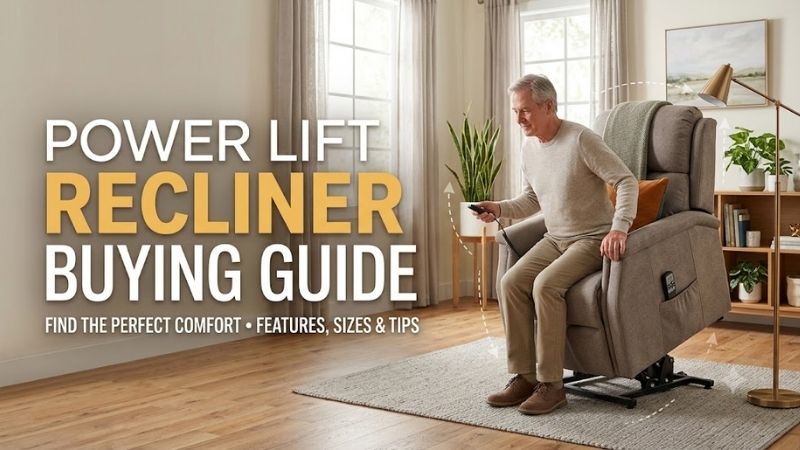
A power lift recliner buying guide should start with the person using the chair, not a feature checklist. Seat height, depth, width, weight capacity, control layout, and safe transfer ability determine whether a model is appropriate. Learn how motor systems, lifting geometry, clearance, power backup, upholstery, and service terms affect daily use.
What Is a Power Lift Recliner?
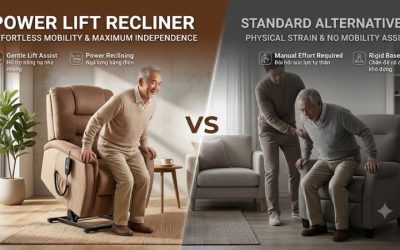
A power lift recliner is a motorized chair designed to assist an appropriate user in transitioning from sitting toward standing.
The chair raises and tilts its seat structure, changing the occupant’s position before the person completes the transfer.
Many lift recliners also provide powered backrest and legrest adjustment for ordinary relaxation.
However, reclining and standing assistance are different functions.
A conventional power recliner may adjust posture without raising the user into a supported standing position.
How the Lift Mechanism Works
During the lift cycle, the chair’s motorized structure changes the seat’s height and angle.
The intended result is to reduce some of the effort required to rise from a low seated position.
However, the person must still participate appropriately.
The chair does not automatically stabilize the user’s legs or correct impaired balance.
For a person unable to bear weight safely, different transfer equipment or caregiver assistance may be necessary.
Who May Benefit?
Lift recliners may be useful for adults who experience difficulty rising from ordinary seating but can complete the transfer with appropriate support.
The exact benefit depends on strength, balance, movement control, and understanding of the chair.
A lift recliner should not be treated as a universal mobility device or replacement for professional transfer assessment.
Step 1: Determine the Actual Transfer Need
Before examining brands, describe the movement the user finds difficult.
Is the main problem pushing up from the seated position? Is it maintaining balance after standing? Does the user struggle to position their feet beneath them? Or do they need help transferring from the chair to another mobility device?
These situations have different implications.
Difficulty Rising From a Low Seat
If the person can stand safely once positioned higher, a properly selected lift chair may be relevant.
Seat height, lifting geometry, and the person’s ability to place their feet appropriately become important.
A chair that tilts too far or does not fit the user’s proportions may be uncomfortable or difficult to use.
Difficulty Maintaining Standing Balance
A lift mechanism does not guarantee stability after the person leaves the chair.
Someone with poor balance may still require supervision, an appropriate mobility aid, or another transfer strategy.
The standing area in front of the chair must remain unobstructed.
Inability to Bear Weight
If the person cannot bear sufficient weight through the legs, a conventional lift recliner may not be appropriate for independent transfers.
The chair should not be used to force standing.
Professional assessment is particularly important.
Step 2: Measure the User, Not Just the Chair
A lift recliner’s weight capacity is important but insufficient.
The user’s body dimensions determine how they fit within the seat, how they reach the floor, and how the chair supports them.
Seat Height
Seat height is measured from the floor to the seating surface according to the manufacturer’s specification.
An 18-inch seat may suit a shorter person, while a 21-inch seat may be more suitable for someone with longer legs.
However, these are not universal prescriptions.
The user’s feet should be positioned appropriately during sitting and transfer preparation.
Cushion compression can change the effective height.
Seat Depth
A seat that is too deep may prevent the user from resting comfortably against the back while keeping the knees appropriately positioned.
If the seat is too shallow, it may provide insufficient thigh support.
Pride Genesis provides a clear example: the small model has an 18-inch seat depth, while the medium uses 20 inches.
That difference can materially change the fit.
Seat Width
Seat width is the usable area between the arms, not the total exterior chair width.
A 35-inch-wide chair may have a comparatively narrow internal seating space.
The user should not be compressed against the arms or lose necessary support through an overly wide seat.
Back Height
The backrest should suit the user’s torso and provide appropriate support in the intended positions.
A tall user may find a petite chair uncomfortable even if its published weight capacity is sufficient.
Step 3: Choose the Right Weight Capacity
Manufacturers publish maximum load ratings for specified models.
For example, Pride Genesis LC-150 has a 325-pound capacity, while several VivaLift! models list 400 pounds.
Certain Pride Evolution configurations are rated at 500 or 600 pounds.
These ratings are not interchangeable.
A chair’s capacity should accommodate the intended user in accordance with manufacturer requirements.
Do not purchase a lower-rated chair simply because its upholstery or price is attractive.
Capacity Does Not Equal Physical Fit
A chair rated at 400 pounds may still have a narrow seat or unsuitable depth.
Likewise, a smaller adult may require a particular petite design even though virtually every chair’s maximum load is higher than their body weight.
Consider capacity and geometry separately.
Heavy-Duty Models
Heavy-duty chairs may include different frames, seat widths, motors, and support systems.
They can be substantial pieces of furniture requiring more delivery and room space.
Only choose a heavy-duty model when its specific features meet the user’s requirements.
Step 4: Understand Motor and Positioning Systems
Three-Position Recliners
Traditional three-position chairs commonly coordinate backrest and legrest movement.
These systems are relatively straightforward and may suit buyers primarily interested in normal reclining and standing assistance.
However, the term three-position does not establish identical angles or control functions across manufacturers.
Infinite-Position Recliners
Infinite-position systems allow a broader range of resting configurations, often through independent backrest and legrest control.
This can be useful for everyday comfort.
However, greater flexibility also increases the importance of clear remote operation.
The intended user must understand how to return the chair to an appropriate position for standing.
Zero-Gravity and Tilt Features
Some chairs use the terms zero gravity, Trendelenburg, or tilt.
These refer to particular positioning arrangements or manufacturer-defined functions.
Do not assume they provide medically proven treatment benefits for every user.
People with clinical positioning requirements should follow their clinician’s instructions.
Powered Headrest and Lumbar Adjustment
Additional powered zones may improve subjective comfort for users who spend substantial time sitting.
However, they add components and can make the handset more complex.
The value depends on whether the user can operate them and actually prefers those positions.
Step 5: Assess the Full Lift and Recline Footprint
A power lift recliner must have enough room to move safely.
This includes rear clearance, forward footrest travel, vertical lifting movement, and space for the person to stand.
Rear Clearance
Some small models require approximately 13–18 inches behind the chair, while other configurations need different distances.
Do not assume every model marketed as space-saving is a wall-hugger.
Front Clearance
The legrest extends forward during reclining.
Nearby tables, walkers, and other furniture must remain outside the operating area.
A chair can fit perfectly while upright yet strike a coffee table when reclined.
Standing Clearance
The user needs an appropriate unobstructed area in front of the chair.
After lifting, they must be able to stand and move safely.
This is especially important when the chair is placed near a bed, doorway, or wheelchair.
Nearby Children and Pets
Motorized mechanisms create moving areas where fingers, feet, clothing, or pets may become caught.
Keep children, animals, and loose objects away from the chair during operation.
Do not operate a lift recliner when someone is underneath or beside the moving mechanism.
Step 6: Evaluate the Remote Control
The remote should be easy to reach, understand, and operate.
For someone with reduced grip strength, a small or complicated handset may be difficult.
Button Arrangement
Simple controls may make basic lift functions easier to access.
Advanced remotes provide more adjustment possibilities but can create confusion.
The appropriate balance depends on the user’s abilities.
Remote Storage
A remote holder or side pocket can prevent the handset from falling between cushions.
A chair that requires the user to bend or reach awkwardly to retrieve the remote may create unnecessary risk.
Corded Versus Wireless Controls
Some chairs use a corded handset, while others include different control methods.
Cord routing and battery requirements should be considered.
Never allow the controller cord to become caught in moving components.
Step 7: Plan for a Power Outage
A power failure can affect the user’s ability to return from a reclined position.
Battery backup is therefore a meaningful purchasing criterion.
However, backup systems differ.
Included Backup
Some Pride models incorporate battery backup as standard.
The buyer should confirm the exact model’s operational limits and battery maintenance requirements.
Optional Backup
Some residential lift recliners offer emergency batteries separately.
A product listing may describe backup capability without including the required battery.
Check the completed order rather than relying on the general feature description.
Emergency Limitations
Backup power may support limited movement rather than unrestricted operation.
Do not assume multiple full recline and lift cycles are available.
A user who depends heavily on the chair should have a suitable contingency plan.
Step 8: Compare Upholstery and Cleaning
Lift recliners may be used for extended periods each day.
Upholstery comfort, cleaning, and durability therefore matter.
Woven Fabric
Textile upholstery can offer a soft surface and many color options.
However, cleaning requirements vary.
A performance label does not guarantee stain-proofing.
Faux Leather
Polyurethane-coated upholstery may be easier to wipe under appropriate conditions.
However, coatings can deteriorate and should not be exposed to unsuitable cleaners.
Heat and Massage Features
Heat and massage can add comfort, but they are optional features.
People with reduced skin sensation or other relevant medical considerations should obtain appropriate guidance before using heat functions.
The lift mechanism and fit remain higher priorities.
Step 9: Check Service, Warranty, and Delivery
The chair’s motorized mechanism makes after-sales support particularly important.
Manufacturer Warranty
Determine what is covered for the frame, motor, actuator, controller, upholstery, and labor.
A lifetime frame warranty does not mean electrical parts have lifetime coverage.
Local Repair Availability
Ask whether service technicians can attend the home and whether replacement components are available.
Shipping an entire lift chair back to a retailer can be expensive and impractical.
Delivery and Assembly
Lift recliners can weigh more than 100 pounds and sometimes substantially more.
Check doorways, stairs, assembly requirements, and whether the seller provides setup.
The chair should be tested through its operating sequence after installation.
Step 10: Understand Potential Medicare Coverage
Medicare may cover certain medically necessary seat-lift mechanisms for eligible beneficiaries under specified criteria.
Coverage should not be assumed for the entire recliner, upholstery, or comfort accessories.
The prescribing and supplier requirements may affect eligibility.
A buyer should verify applicable rules and documentation before purchase rather than rely on a retailer’s broad claim that the chair is Medicare-approved.
Common Buying Mistakes
Choosing by Weight Capacity Alone
Weight rating does not establish comfortable seat width, height, or depth.
Buying Extra Features Instead of a Suitable Fit
Massage and USB charging cannot compensate for unsafe transfer geometry.
Confusing Lift Recliners With Patient Lifts
A seat-lift chair assists selected sit-to-stand movements. It is not a substitute for full-body lifting equipment when the user cannot bear weight.
Ignoring Emergency Power
A user may be unable to return the chair upright during an outage without an appropriate backup arrangement.
Failing to Check the Standing Area
A chair must have room for the person to stand and leave safely, not merely for the mechanism to move.
Frequently Asked Questions
How Do I Choose the Correct Power Lift Recliner Size?
Compare the intended user’s seat height, depth, width, back height, and weight with the manufacturer’s recommended sizing. A physical fit trial or professional assessment can be valuable when mobility is impaired.
Is a Dual-Motor Lift Chair Better Than a Single-Motor Model?
It offers more positioning flexibility when the backrest and footrest can move independently. A simpler model may be sufficient when basic lifting and reclining are the main needs.
Can Someone Who Cannot Walk Use a Lift Recliner?
Not necessarily. The chair does not replace full-body transfer equipment. When someone cannot bear weight or stabilize safely, professional assessment of transfer needs is essential.
How Much Room Does a Power Lift Recliner Require?
It depends on the exact model. Account for rear clearance, full footrest extension, chair travel during lifting, and a safe area for standing.
Should I Buy a Chair With Battery Backup?
Backup power may be important when the user depends on powered movement during outages. Verify what the backup actually supports and whether it is included.
Is a Power Lift Recliner a Medical Device?
Certain models from specialized manufacturers are marketed as FDA Class II medical devices. That classification should not be assumed for every reclining chair, and it does not guarantee that the product is appropriate for a particular person.
Conclusion
A power lift recliner should be selected around safe transfer requirements, correct body dimensions, dependable controls, and appropriate room clearance. Compare motor systems only after confirming seat fit and weight capacity. Battery backup, upholstery, delivery, and service can influence the chair’s long-term usefulness. A properly selected chair can assist certain sit-to-stand movements, but it does not replace individualized mobility assessment or full-body transfer support when those are needed.