A sofa bed mattress buying guide should help you select a replacement that supports comfortable sleeping and folds safely into the existing furniture. Mattress thickness, frame dimensions, foam density, firmness, and construction all influence the result. This guide explains the essential specifications, common compatibility problems, and maintenance decisions that matter before purchase.
First, Determine Whether the Mattress Can Be Replaced
Not every sofa bed uses a removable mattress.
Traditional pull-out sleepers commonly store a separate mattress inside a folding frame. In many of these designs, replacing the worn mattress is possible when a compatible product is available.
Other convertible sofas use the original seat and back cushions as the sleeping surface. These may not support an independent replacement mattress.
This distinction must be resolved before shopping because a conventional sleeper replacement cannot simply be installed in every fold-flat or click-clack sofa.
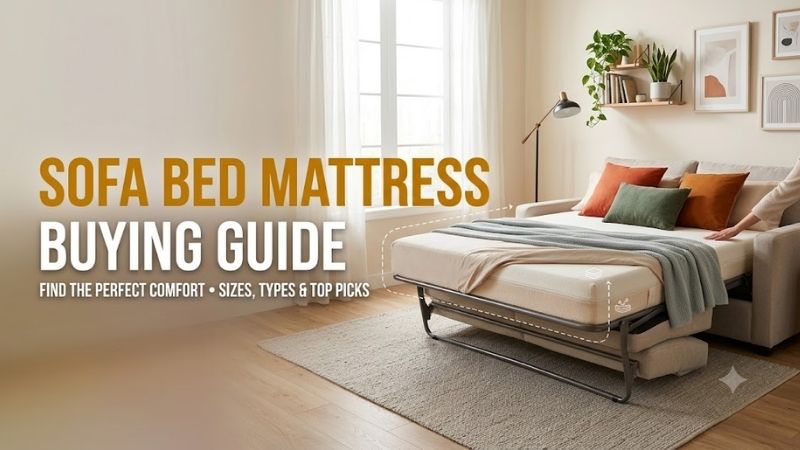
Traditional Pull-Out Systems
A traditional sleeper mechanism unfolds a mattress and support frame from inside the sofa.
The replacement must match the dimensions and folding requirements of that mechanism.
Thickness is particularly important because the folded mattress occupies space within the sofa structure.
Convertible Cushion Systems
A cushion-conversion sofa may have no separate mattress compartment.
The sleeping surface may be created by sliding, rotating, or flattening upholstery components.
When those cushions become uncomfortable, replacement options depend on the sofa manufacturer.
A loose mattress placed over the unfolded surface is not necessarily compatible with normal conversion or storage.
Platform Sleepers
Some premium sleepers use a platform rather than a traditional metal-bar arrangement.
These systems may accept different mattress constructions, but the replacement still needs manufacturer approval.
Do not assume a premium platform permits any ordinary bedroom mattress.
Step 1: Measure the Sleeper Frame
The most reliable fit assessment begins with the mechanism in its fully open position.
Measure the inside of the supporting frame, including any narrowing or cutout sections.
An old mattress can provide useful information but may no longer reflect the original dimensions accurately.
Measure Width
Measure the clear distance between the support rails.
Take measurements at several points.
If one area is narrower because of hardware, that restriction may determine the suitable mattress width.
Measure Length
Measure the usable sleeping length between the head and foot supports.
Do not assume a queen sleeper uses an 80-inch mattress.
Many traditional sofa replacements are approximately 72 inches long.
Measure Thickness and Closure Space
Review the original mattress specification where possible.
A replacement that is too thick can bind during folding.
The correct mattress must function properly in both the open and closed positions.
Identify Special Shapes
Some frames require angled or trimmed mattress corners.
A custom-size supplier may be needed.
A rectangular mattress with the correct maximum width can still interfere with the mechanism if its corner geometry is incorrect.
Common Sofa Mattress Dimensions
| Sofa-bed size category | Example dimensions |
|---|---|
| Single | 24 × 72 in |
| Twin | 35 × 72 in |
| Twin wide | 38 × 72 in |
| Full | 52 × 72 in |
| Full wide | 54 × 72 in |
| Queen | 58 × 72 in |
| Queen wide | 60 × 72 in |
These dimensions are examples from a manufacturer’s sleeper replacement range, not universal standards.
Other suppliers may use different widths or lengths under the same category name.
This variation is why measurements matter more than labels.
Step 2: Choose an Appropriate Thickness
Mattress thickness affects both sleeping comfort and folding compatibility.
A mattress needs enough material to provide cushioning and support, but additional thickness can create problems when the mechanism closes.
Four-Inch Mattresses
Four-inch mattresses are common in traditional replacement categories.
They can be suitable when the sleeper mechanism has limited clearance.
The main concern is whether the foam provides adequate support over bars, webbing, or another underlying structure.
4.5-Inch Mattresses
A 4.5-inch mattress can allow a comfort layer above a supportive base.
However, it must fit within the mechanism’s approved folded clearance.
The half-inch difference from a four-inch replacement should not be dismissed.
Five-Inch Mattresses
Some mechanisms permit five-inch replacements.
Others do not.
Do not select a thicker mattress based on a generic recommendation. The exact sleeper design governs compatibility.
Why Extra Thickness Can Cause Damage
A folding mechanism stores the mattress in several bent sections.
Additional thickness increases the space those folds occupy.
Forcing the frame closed can stress mechanical parts, damage the mattress, or prevent proper latching.
If the mattress does not fold normally, stop and resolve the mismatch.
Step 3: Understand Foam Density and Firmness
Foam density and firmness are often confused in product marketing.
They describe different properties.
Foam Density
Density is the mass of foam per unit volume, often expressed in pounds per cubic foot.
A replacement foam core may have a disclosed density such as 1.8 or 2.5 lb/ft³.
This information can help identify differences in material construction.
However, density alone does not determine the firmness the sleeper feels.
Firmness
Firmness describes the resistance of the foam to compression under specified test conditions.
Some suppliers use indentation force deflection, or IFD, measurements.
Higher IFD generally represents greater resistance under the relevant test.
However, comparisons need consistent procedures and material specifications.
Why Both Matter
Consider two hypothetical mattresses with the same four-inch thickness.
One uses a relatively soft, low-density foam. The other uses a denser support foam formulated with moderate firmness.
Both may initially feel comfortable, but they can respond differently to prolonged loading.
That does not prove the second will last a particular number of years, but it illustrates why the words high-density and soft describe separate characteristics.
Support Bars and Bottoming Out
A sleeper may feel the underlying bar when the mattress compresses too far.
A supportive core can reduce that risk.
However, a damaged frame or poorly positioned support bar may remain uncomfortable regardless of the replacement material.
Inspect the frame instead of assuming that every discomfort originates in the mattress.
Step 4: Compare Mattress Materials
Conventional Polyurethane Foam
A solid foam core can provide consistent support within a shallow profile.
It may be a practical choice for occasional guests or budget replacements.
However, firmness and durability vary widely.
A low-cost foam block should not automatically be treated as equivalent to a purpose-built sleeper mattress.
Memory Foam
Memory foam generally contours slowly under pressure.
This may provide a softer sensation around certain body regions.
However, thin sofa mattresses require adequate support beneath the comfort layer.
Too much soft material without sufficient core support can create excessive compression.
Gel Memory Foam
Gel is incorporated into certain foam products to influence thermal behavior.
However, the effect depends on formulation and construction.
A gel label does not guarantee all-night cooling.
Evaluate the mattress’s support layers and fit first.
Latex
Latex provides a more responsive feel than many traditional memory foams.
It can be appealing to sleepers who move frequently.
However, latex replacements are often more expensive and still require correct folding-compatible construction.
Innerspring
Innerspring sofa mattresses use relatively shallow coil systems.
They may provide a different support response, but limited thickness can restrict spring travel and cushioning.
A conventional thick bedroom innerspring mattress should not be substituted for a folding sleeper replacement.
Step 5: Match the Mattress to Sleeping Position
Side Sleepers
Side sleepers may need sufficient cushioning around the shoulders and hips.
A mattress that is excessively firm can create uncomfortable pressure.
However, a thin mattress that compresses completely is not a good solution either.
The balance between comfort layer and support core matters.
Back Sleepers
Back sleepers may prefer a surface that provides comfortable support without excessive sagging.
However, the ideal firmness is individual.
A mattress’s medium-firm label does not guarantee the same result for people with different weights or body proportions.
Stomach Sleepers
A soft surface that allows pronounced sinking may feel uncomfortable to certain stomach sleepers.
However, a very hard mattress is not automatically better.
Comfort should be evaluated according to individual preferences and any relevant medical advice.
Couples
Two sleepers can create different loading patterns from one sleeper.
The mattress’s width, support structure, and permitted load matter.
A short or narrow sleeper may be unsuitable for two adults regardless of its foam quality.
Step 6: Evaluate the Mattress Cover
The cover protects the foam and influences surface comfort.
However, some heavily padded or quilted covers can behave differently when repeatedly folded.
Sewn Covers
A securely sewn cover may help the mattress maintain its intended construction.
Some sleeper specialists prefer relatively flat ticking because heavily quilted fabric can bunch in folded sections.
However, this preference depends on the actual mattress design.
Removable Covers
A removable cover can simplify surface care.
Yet not every removable cover is machine-washable.
Follow the exact instructions.
Moisture Protection
A compatible mattress protector may help manage spills.
However, it should not interfere with the mechanism.
Additional padding may need to be removed before closing the sleeper.
Step 7: Check Frame Condition Before Replacing the Mattress
A worn mattress is not the only possible source of discomfort.
Metal support bars, fabric decking, hinges, or other components can deteriorate.
Inspect Support Components
Open the sleeper fully and look for damaged or visibly deformed supports.
Do not use a mechanism that appears structurally unsafe.
A new mattress cannot compensate for broken support hardware.
Check Folding Movement
The mechanism should operate according to its original design.
Unusual binding or misalignment can indicate a mechanical problem.
Do not force closure.
Evaluate Repairs
For an expensive sleeper sofa, repairing appropriate components may be more economical than replacing the entire furniture piece.
However, repairs should use compatible parts and follow manufacturer guidance.
Step 8: Consider Long-Term Ownership
Frequency of Use
Occasional guest mattresses face different wear from mattresses used nightly.
However, long periods stored folded can also affect certain materials.
Use a replacement intended for the storage pattern.
Mattress Cleaning
Many foam cores require spot cleaning.
Follow cover and core instructions separately.
Warranty
A warranty may cover particular defects but exclude ordinary changes in comfort.
Read the conditions rather than judging quality by warranty length alone.
Returns and Custom Orders
Custom-size mattresses may have more restrictive return terms.
Confirm dimensions before ordering.
Practical Buying Scenarios
An Older Queen Sleeper With a Worn Four-Inch Mattress
Begin by measuring the interior frame and confirming the original four-inch requirement.
A four-inch high-density foam replacement may be more appropriate than a thicker premium mattress.
If a structural support bar is damaged, resolve that issue first.
A Guest Sofa Used Every Weekend
Prioritize supportive construction, comfort preferences, and maintenance.
A layered foam or suitable latex replacement may be worth considering when the mechanism permits it.
However, the sleeping surface must be long and wide enough for the intended guests.
A Sleeper With Unusual Corner Hardware
Custom sizing may be preferable.
Provide accurate drawings or measurements to a supplier familiar with sofa-bed mechanisms.
Do not modify an ordinary mattress by cutting its corners unless the manufacturer expressly supports that process.
Frequently Asked Questions
How Thick Should a Sofa Bed Mattress Be?
The correct thickness depends on the specific mechanism. Four- and 4.5-inch replacements are common, but there is no universal thickness suitable for every sleeper.
Can I Use a Queen Mattress From My Regular Bed?
Usually not in a traditional folding mechanism. Conventional queen mattresses are typically longer and thicker than sofa replacements, and their construction may not tolerate folding.
Is High-Density Foam Better?
Density can provide useful construction information, but it does not directly measure firmness or guarantee comfort. Compare the complete mattress design and intended load.
Can a Topper Fix an Uncomfortable Sofa Bed?
A topper may change surface comfort when the existing mattress and frame are sound. It cannot reliably fix a damaged mechanism, and it may require removal before storage.
Should I Replace the Mattress or the Entire Sofa?
Replace the mattress when the mechanism is sound and the replacement can fit properly. Consider repair or furniture replacement when the frame is damaged or the sleeper cannot accommodate an appropriate sleeping surface.
How Do I Know Whether the Mattress Will Fold?
Check the sofa’s original requirements and the replacement manufacturer’s compatibility guidance. If necessary, ask the supplier to verify the dimensions and folded thickness. Do not force the mechanism during installation.
Conclusion
A successful sofa bed mattress replacement begins with the existing mechanism rather than a mattress advertisement. Measure the interior frame, verify folding clearance, compare foam support and comfort materials, and inspect the sofa structure before ordering. A thinner, accurately fitted mattress can be a better investment than a more luxurious product that cannot close correctly. Prioritize compatibility and dependable support over thickness or marketing claims.