Key takeaways
-
Total exterior dimensions of the complete arrangement.
-
Chaise orientation and actual projection.
-
Width and depth of every module.
-
Seat height and usable seat depth.
-
Available walking and doorway clearance.
-
Whether a chaise can genuinely be reversed.
-
How modules connect.
-
Whether compatible components can be purchased later.
-
Upholstery cleaning requirements.
-
Delivery-box dimensions.
-
Storage access requirements, if applicable.
-
Total cost of the intended configuration.
A modular sectional sofa for small spaces can provide comfortable seating without committing your living room to one permanent layout. However, modular does not automatically mean compact. Deep seats, wide arms, and oversized chaise sections can overwhelm an apartment despite being delivered in separate pieces. This guide explains how to measure, configure, and choose a sofa that truly fits.
Why Modular Furniture Can Work in Small Living Rooms
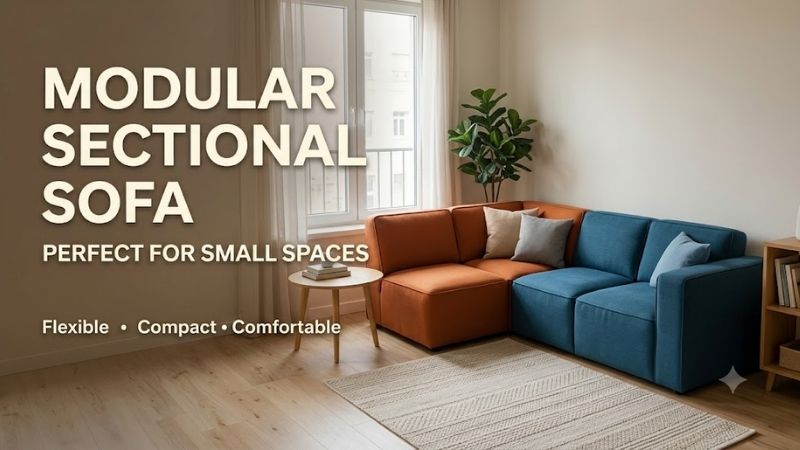
A modular sectional consists of seating components designed to connect in supported arrangements. Depending on the system, the components may include individual seats, corner modules, armrests, chaises, ottomans, and storage sections.
The main advantage for compact living rooms is flexibility. A buyer may begin with a two-seat configuration, add another compatible module later, or rearrange existing pieces when furniture or household needs change.
However, this advantage only exists when the modules produce useful configurations within the available floor space.
A sectional with unusually deep seats may consume more room than a conventional sofa of similar seating capacity. Likewise, a corner module and chaise can create a large footprint even when the total number of seats is small.
The correct buying strategy is to calculate the finished layout rather than assuming modular furniture inherently saves space.
Modular Versus Compact: Two Different Concepts
A modular sofa can be separated and rearranged. A compact sofa occupies relatively little floor space.
These are independent characteristics.
A large modular cloud sectional may have oversized seating units designed for expansive living rooms. Although each unit can be moved separately, the finished sofa may still be impractical in a narrow apartment.
Conversely, a smaller conventional sofa may fit a compact room perfectly but offer little ability to change its shape.
For a small-space purchase, look for both useful modularity and appropriate overall dimensions.
Why Configuration Flexibility Matters for Renters
Renters may change apartments more frequently than homeowners with permanent living-room arrangements.
A sofa designed around one fixed right-facing chaise can become awkward when the next apartment has a door or window on the opposite wall.
A truly reconfigurable system may allow the owner to reposition compatible modules or move the chaise to another supported location.
However, do not assume every modular sectional offers reversible chaise placement. Some collections use dedicated left-facing and right-facing components.
Verify exactly which arrangements the manufacturer permits.
Start With a Living-Room Floor Plan
A successful small-space layout depends on the room’s usable dimensions, not simply the wall length.
Doors, heating equipment, windows, desk areas, and circulation routes can reduce the practical seating area.
Before comparing products, draw a basic floor plan using actual measurements.
Measure the Wall and Open Floor Area
Record the wall where the main sofa section will sit.
Then measure how far a chaise or corner component can extend into the room without blocking movement.
For example, a room may have 110 inches of wall space, but that does not necessarily mean a 108-inch sectional is appropriate. A door casing, baseboard heating unit, or nearby table may reduce usable space.
The final sofa should also leave practical clearance for walking and using adjacent furniture.
Include the Chaise Projection
A chaise is often the component that makes a compact sectional feel oversized.
While a straight sofa occupies a relatively consistent depth, a chaise projects farther into the room.
This can divide an apartment’s living area or obstruct access to a balcony door.
Check the chaise’s total exterior depth and its intended orientation.
A movable ottoman may provide similar occasional leg support while allowing more flexibility.
Account for the Coffee Table
A sectional should not be measured independently of the coffee table.
For comfortable everyday use, many furniture-planning references suggest leaving approximately 14–18 inches between a sofa seat edge and coffee table, depending on the occupants and furniture.
This is a planning range rather than a mandatory rule.
If the room cannot accommodate a sectional and a conventional coffee table comfortably, consider nesting tables, a small side table, or an ottoman arrangement.
Example: Planning a Sectional for a 10 × 12-Foot Living Room
Consider a hypothetical rectangular living room measuring 120 inches by 144 inches.
Suppose one 120-inch wall is available for seating and a doorway occupies part of the adjacent wall.
A sectional measuring 96 inches along the main wall might initially seem suitable.
However, if the chaise extends 65 inches into the room, the remaining usable area becomes substantially smaller.
A 30-inch-deep straight sofa with a movable ottoman may offer better practical flexibility, even if the sectional provides a more substantial lounging surface.
The correct comparison includes furniture depth and walking paths, not just total room width.
Compare Common Modular Layouts
| Layout | Best use | Space advantage | Important drawback |
|---|---|---|---|
| Two-seat modular sofa | Very small living room | Shorter overall span | Limited seating |
| Three-seat modular sofa | Narrow rectangular room | Straight footprint | Less lounging flexibility |
| Compact L-shaped sectional | Small family living area | Uses adjacent walls | Corner and chaise projection |
| Reversible chaise sectional | Rental apartments | Can adapt to room orientation | Reversibility varies by design |
| Sofa plus movable ottoman | Multipurpose studio | Flexible floor use | Ottoman may shift |
| Modular sectional with storage | Limited storage apartments | Combines seating and storage | Larger and heavier modules |
| U-shaped sectional | Large shared seating area | Many seats facing inward | Usually poor fit for tight rooms |
Seat Depth Is Often More Important Than Seat Count
A sofa’s seat depth influences both comfort and the amount of room it occupies.
A very deep seat can be appealing for reclining, but it may not suit a person who wants to sit upright with their feet supported.
In a small living room, deep seating also increases the furniture’s projection into the usable floor area.
Standard-Depth Seating
A more conventional seat depth may be comfortable for everyday sitting, conversation, and watching television.
However, published seat-depth measurements must be interpreted carefully. Some refer to the distance from the front edge to the back support structure, while others describe usable depth with cushions installed.
If the sofa has thick back cushions, the actual sitting space may be less than expected.
Deep Lounge Seating
Deep seating is useful for curling up or reclining.
However, smaller adults may need extra back cushions to sit upright comfortably.
That can increase clutter and reduce the practical depth advantage.
If the living room serves as both an office and relaxation area, consider whether most sofa use involves upright sitting or lounging.
Low Seat Height
Many contemporary modular sectionals have relatively low seating.
This can create a visually relaxed profile, but standing up from a low seat may require more effort for some occupants.
Seat height, cushion compression, and body proportions should be considered together.
A visually low sofa is not automatically the best choice for a small room.
Choose the Right Module Width
Individual module width affects both room fit and seating comfort.
Wider modules can create spacious individual seats, but they also limit the number of configurations that fit a particular wall.
Narrower modules may offer more arrangement flexibility.
However, a very narrow seat can feel restrictive, especially when occupants prefer generous personal space.
Why Module Width Affects Future Expansion
Suppose a sofa uses modules that are 35 inches wide.
Adding a third module can increase the seating span by approximately 35 inches, before accounting for arms or other components.
In a narrow apartment, that may exceed the available wall.
The ability to expand therefore has value only when the resulting dimensions remain practical.
Corner Modules Require Special Attention
A corner section may have different dimensions from an ordinary seat.
It can also create an area that is less comfortable for upright sitting.
When counting seating capacity, do not assume every module provides one equally usable seating position.
Review the intended layout and think about how people will actually sit.
Modular Sectional Versus Sofa With Ottoman
For very small rooms, a conventional two- or three-seat sofa paired with a movable ottoman can sometimes be more practical than a full sectional.
The ottoman can function as occasional leg support, an extra seat when designed for that use, or a movable surface with an appropriate tray.
The key advantage is that the ottoman can be relocated when the room needs more open floor area.
However, separate furniture pieces may shift on smooth floors. They also may not create the same continuous lounging surface as a chaise.
Choose according to daily use rather than the assumption that one layout is universally more spacious.
Upholstery Choices for Compact Living Spaces
Small apartments frequently require the living room to serve several purposes. The sofa may be used for eating, working, reading, entertaining, and relaxing.
That increases the importance of practical upholstery.
Removable, Washable Covers
Removable covers can simplify maintenance when their care instructions permit machine washing.
This may be valuable in households with children or pets.
However, removing large covers can require effort, and reinstalling them properly may be time-consuming.
Check both the cleaning method and the ease of removing the covers.
Performance Fabrics
Performance upholstery may have treatments or construction intended to improve resistance to certain spills or stains.
However, the term does not guarantee waterproofing or immunity to abrasion.
Check the actual fabric information.
Textured Upholstery
Textured weaves can create visual interest in a small room.
However, pronounced loops or loose yarns may be vulnerable to snagging, particularly in homes with pets.
Evaluate the fabric’s practical characteristics as well as its color.
Leather and Leather-Look Materials
Leather can be attractive for certain interiors, but care requirements vary according to finish and construction.
Leather-look alternatives also vary significantly in durability.
Do not choose solely on appearance or broad easy-clean claims.
Modular Sofas With Storage
Hidden storage can be especially useful when a small apartment lacks space for a separate cabinet.
A sectional with storage seats may hold throws, games, and other lightweight household belongings.
However, the storage design introduces practical trade-offs.
Access Clearance
A seat that lifts upward needs enough room to open.
If the coffee table must be moved every time the compartment is used, the storage may become inconvenient.
Measure access clearance in the final furniture arrangement.
Weight and Portability
Storage modules may be heavier or more complicated than basic seating modules.
This can make rearrangement less convenient.
A sofa that is technically modular but difficult to move may provide less everyday flexibility than expected.
What Should Go Inside?
Store only appropriate items within the manufacturer’s stated limits.
Avoid placing heavy objects or items that could interfere with opening mechanisms.
Keep fabrics clean and dry before storage.
Delivery and Assembly in Apartments
A modular sofa can be easier to move through a narrow doorway than a large fixed sectional because its pieces are separate.
However, the individual modules can still be substantial.
Measure entrances, stairwells, elevators, hallways, and room doors before ordering.
Box Dimensions
Shipping-box dimensions can differ considerably from the finished furniture measurements.
A module that fits through a doorway after unpacking may arrive in a box that does not.
Review delivery guidance and whether unpacking before entering the room is practical and permitted.
Assembly Requirements
Some systems use tool-free connectors. Others require brackets, screws, or other hardware.
Check whether assembly can be completed safely in the available space.
Do not assume modular means no assembly.
Moving the Sofa Later
A genuine benefit of separate modules is the ability to transport furniture in smaller pieces.
However, detached parts need protection during moving, and connectors must be reinstalled correctly.
Buying Checklist for Small Rooms
Before ordering, confirm:
-
Total exterior dimensions of the complete arrangement.
-
Chaise orientation and actual projection.
-
Width and depth of every module.
-
Seat height and usable seat depth.
-
Available walking and doorway clearance.
-
Whether a chaise can genuinely be reversed.
-
How modules connect.
-
Whether compatible components can be purchased later.
-
Upholstery cleaning requirements.
-
Delivery-box dimensions.
-
Storage access requirements, if applicable.
-
Total cost of the intended configuration.
Frequently Asked Questions
Are Modular Sectionals Good for Small Living Rooms?
They can be, provided the finished configuration fits the available floor space. Modular components allow some systems to adapt to different layouts, but oversized seats and deep chaises can still overwhelm compact rooms.
What Is the Best Modular Layout for a Studio Apartment?
A straight two- or three-seat modular sofa, or a smaller configuration with a movable ottoman, is often a practical starting point. A compact L shape can work when the room has suitable adjacent walls and sufficient walking clearance.
Are Modular Sectionals Easy to Move?
They may be easier to transport than large fixed sectionals because they separate into components. However, individual modules can still be heavy, and the connectors must be removed and reinstalled correctly. Measure the actual delivery route.
Is a Reversible Chaise Worth It?
It can be valuable for renters or anyone expecting to rearrange furniture. However, some designs use dedicated left- or right-facing chaise modules and are not genuinely reversible. Check the supported configurations before buying.
Do Modular Sectionals Stay Together on Hardwood Floors?
Properly designed systems use connectors or other stabilizing components. Their stability depends on correct installation and design. Follow the manufacturer instructions rather than assuming the weight of the modules will prevent movement.
What Color Sofa Makes a Small Living Room Look Bigger?
Light colors can create a visually open appearance, but wall colors, lighting, contrast, and furniture proportions also matter. An appropriately sized darker sofa may work better than an oversized pale sectional.
Conclusion
A modular sectional sofa for small spaces works best when its actual footprint, seat depth, and supported configurations fit the room’s daily needs. Start with a measured floor plan, choose only the modules you need, and consider a movable ottoman when a permanent chaise would obstruct circulation. Prioritize comfortable seating, practical upholstery, secure connectors, and manageable delivery over the promise of unlimited modular flexibility.