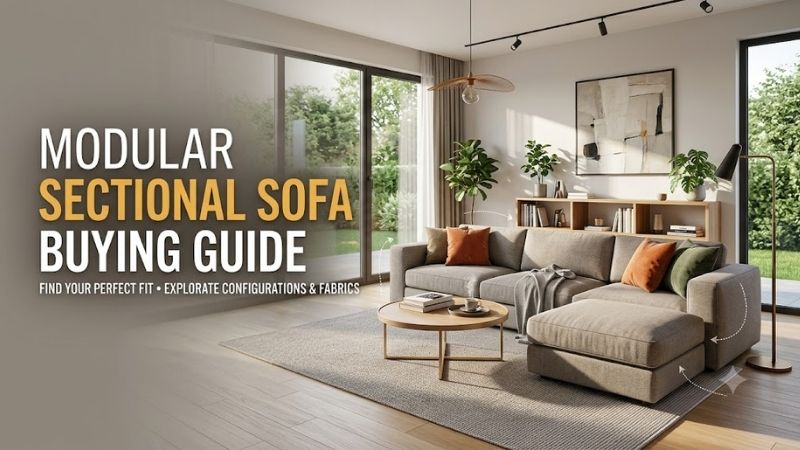
A modular sectional sofa buying guide should help you evaluate more than the number of seats or available upholstery colors. The best system fits your room, supports comfortable everyday sitting, and allows useful changes without complicated assembly or excessive costs. This guide explains modular construction, seating geometry, fabric quality, connectors, delivery requirements, and long-term ownership.
What Is a Truly Modular Sectional Sofa?
A modular sectional is made from compatible furniture components that can be assembled into multiple supported seating configurations.
However, not every product marketed as modular provides the same degree of flexibility.
Some systems use independent seat, corner, and side components that can be rearranged or expanded. Others consist of two large sectional pieces that connect in one predetermined arrangement.
Both may be described as sectional furniture, but their long-term adaptability is quite different.
True Modular Systems
A genuine modular system allows compatible components to serve different positions within supported configurations.
For example, separate seats and sides may be rearranged to form a straight sofa, an L-shaped sectional, or a seating area with an ottoman.
Some systems also allow additional modules to be purchased later.
However, the available arrangements depend on component design. A corner section may not function as a regular straight seat, and a left-facing chaise may not be convertible into a right-facing version.
Fixed Sectionals With Multiple Pieces
Some sectionals are delivered in separate sections simply because one large furniture frame would be difficult to transport.
The sections may connect securely but have only one intended configuration.
This can be entirely appropriate when the buyer already knows the desired layout.
However, it should not be confused with a flexible modular system capable of meaningful reconfiguration.
Why This Distinction Matters
Modularity often carries a price premium.
If the buyer will never rearrange the furniture, the extra flexibility may have little practical value.
Before paying more, identify which alternative layouts you realistically expect to use.
Compare the Main Modular Sectional Layouts
| Layout | Main strength | Main limitation | Best use |
|---|---|---|---|
| Straight modular sofa | Familiar seating footprint | Limited corner lounging | Narrow living rooms |
| L-shaped sectional | Seats and lounging area | Can obstruct circulation | Family rooms |
| U-shaped sectional | Group seating arrangement | Large floor footprint | Spacious shared rooms |
| Sofa with movable ottoman | Flexible lounging | Ottoman may move separately | Multipurpose apartments |
| Reversible-chaise sectional | Can adapt orientation | Reversibility is model-specific | Renters |
| Storage sectional | Combines seating and organization | Heavier, complex modules | Limited-storage homes |
| Modular pit sectional | Large continuous lounging area | Very deep footprint | Dedicated media rooms |
Measuring the Room Correctly
The finished sectional must be evaluated as part of the room layout.
A product’s width alone does not establish whether it fits.
A sectional may leave enough space along the wall while projecting too far into the room.
Measure the Full Exterior Width
The total span should include arms, side panels, corners, and any other structural components.
Do not assume that multiplying the number of seats by the advertised module width gives an exact final measurement.
Some systems have arms that contribute additional width, while others place connecting components differently.
Use the manufacturer’s configuration-specific dimensions.
Measure the Chaise Depth
A chaise can extend far beyond ordinary sofa depth.
That affects whether people can walk around the furniture and whether doors or drawers can open.
For a narrow living room, this measurement can determine whether a sectional is practical.
Check Circulation Routes
Consider how occupants move between the seating area, doorway, kitchen, and other spaces.
Furniture should not obstruct emergency exits or required access.
A configuration that looks balanced in a photograph may feel crowded when people use the room.
Measure Delivery Access
Doorway width, hallways, stairwells, and elevators matter.
One advantage of modular furniture is that individual components may be easier to transport than an enormous fixed sectional.
However, modules and shipping boxes still have minimum dimensions.
Check both the boxed and unpacked sizes.
Understanding Seat Depth and Seat Height
Seating geometry strongly influences comfort.
A sofa that looks attractive may feel unsuitable if the seat is too deep, too low, or too firm.
Seat Depth
Seat depth describes the available sitting area from front to back.
However, manufacturers may measure it differently.
A thick back cushion can reduce actual usable depth.
Someone who sits upright may prefer a shallower seat, while someone who lounges may enjoy a deeper one.
The correct depth also depends on the user’s height and leg proportions.
Seat Height
Seat height influences how the feet meet the floor and how easily a person stands.
A low contemporary sofa may feel relaxed but require more effort to rise from.
A higher seat may feel more practical for conversation or frequent standing.
Compare the published seat height with the actual cushion compression.
Cushion Firmness
Firmness is subjective, and one manufacturer’s medium-firm may feel different from another’s.
A cushion that initially feels soft can become firmer when compression reaches the underlying support.
A particularly soft seat may also require more effort when standing.
For expensive furniture, sitting on an assembled model can be valuable when possible.
Comparing Cushion Construction
Cushion comfort depends on material, shape, density, and support structure.
No single material guarantees superior durability or comfort.
Polyurethane Foam
Polyurethane foam is common in sofa cushions.
Its firmness and density vary.
Density describes material mass per unit volume, while firmness describes resistance to compression.
A high-density label is not sufficient to determine how the cushion feels.
Layered Foam
Layered foam cushions may combine different materials or firmness levels.
This can create a balance between initial softness and structural support.
However, the actual result depends on layer thickness and construction.
A three-layer cushion is not automatically better than a well-designed single-layer cushion.
Pocket Springs
Some modular sofa systems use pocket springs beneath or within seating components.
Springs can provide a different support response from foam-only constructions.
However, spring count and material alone do not establish how comfortable the finished sofa will feel.
Fiber and Feather Back Cushions
Back cushions may contain fiberfill, feathers, foam, or combinations.
Looser filling can create a soft, relaxed feel but may require fluffing.
A tighter foam-backed design can maintain a more structured appearance.
Choose based on comfort and willingness to maintain the cushions.
Frame Construction and Structural Strength
A modular sofa relies on both the strength of its individual components and the way they connect.
A strong-looking frame does not automatically create a stable finished sectional if its connectors are unsuitable.
Solid Wood and Engineered Wood
Sofa frames may use solid wood, plywood, engineered wood, or combinations.
Quality depends on material specifications, joints, supports, and manufacturing.
Neither a solid-wood claim nor an engineered-wood label independently establishes durability.
Metal Components
Metal may be used for connector hardware, frames, springs, or support brackets.
The relevant issue is whether those components suit the intended load and repeated use.
Support Webbing and Springs
Some sofas use webbing beneath cushions, while others rely on spring systems.
Both can be suitable when properly designed.
A buyer should evaluate documented construction and warranty support rather than assuming one support type always lasts longer.
Why Module Connectors Matter
A modular system should behave like stable seating when correctly assembled.
If sections separate or shift during ordinary use, the arrangement can become frustrating and potentially unsafe.
Clips and Brackets
Some systems use dedicated clips or brackets that connect adjacent modules.
The hardware must be installed correctly.
Do not assume modules are designed to remain together solely through their weight.
Proprietary Connection Systems
Some manufacturers develop proprietary hardware that works only within their own furniture collection.
This can produce an integrated system but also limit compatibility with later products from another brand.
Before purchasing, investigate whether replacement connectors and compatible modules are available.
Reconfiguration Effort
A modular sofa may be marketed as easy to rearrange, but individual pieces can be heavy.
If changing the layout requires moving large components, removing covers, or handling hardware, the process may not be convenient to perform frequently.
Choose a system whose real operating requirements match how often you expect to rearrange it.
Upholstery Materials and Cleaning
Upholstery affects appearance, comfort, stain management, and long-term ownership.
For households with pets or children, cleaning may be as important as cushion softness.
Removable Covers
A removable-cover system allows certain fabrics to be cleaned separately from the furniture.
However, removable does not necessarily mean machine-washable.
Follow the exact care instructions.
Performance Upholstery
Performance fabrics may be designed to resist certain stains or wear.
However, performance is not a standardized promise of complete protection.
Different finishes and fiber constructions have different limitations.
Velvet and Chenille
Velvet and chenille can provide soft texture.
However, pile orientation, snagging, and cleaning requirements deserve attention.
A household with pets should evaluate the actual fabric rather than relying solely on broad pet-friendly marketing.
Leather
Leather can create a different appearance and feel.
Its maintenance depends on finish and type.
Some leathers show scratches or patina more readily, while others have more protective finishes.
Color and Everyday Use
Light upholstery can show certain stains or dirt more clearly.
Dark upholstery may reveal lint or pet hair.
Pattern and texture can influence visual maintenance, but neither replaces proper cleaning.
Modular Sofas for Homes With Pets and Children
Households with young children or pets may benefit from washable covers and replaceable components.
However, no fabric or construction is indestructible.
Cushion and Cover Replacement
If one module’s cover becomes damaged, replacement may be possible without recovering the entire sofa.
This is valuable only when the manufacturer sells the required components separately.
Stain Management
Spills should be treated according to the upholstery instructions.
Do not assume a fabric described as stain-resistant can tolerate every household cleaning chemical.
Pet Claws and Snagging
Certain open weaves and textured fabrics may be vulnerable to snagging.
Consider a tighter fabric construction if claw damage is a concern, while recognizing that no upholstery is completely scratch-proof.
Child Safety
A sectional should remain properly assembled and stable.
Do not let children climb onto unsecured stacked modules or use storage compartments as play spaces.
Follow manufacturer instructions for storage-seat mechanisms and furniture stability.
How Much Should You Spend?
A modular sectional’s price depends on the number of modules, construction, upholstery, accessories, and delivery.
Comparing prices requires defining the same seating arrangement.
Budget Configurations
Budget systems may use simpler upholstery and construction while still providing useful modularity.
The main risk is comparing a low advertised starting price with the cost of a more complete system.
Midrange Systems
Midrange sofas may offer more upholstery choices, flexible configurations, and different seat constructions.
Evaluate whether those features match your needs.
Premium Systems
Premium modular collections may provide extensive upholstery replacement, storage options, specialized accessories, and more configuration choices.
However, paying for maximum flexibility is unnecessary if a simple layout will remain sufficient.
Total Cost of Ownership
Consider replacement covers, extra modules, assembly, shipping, and potential repairs.
A sofa that can be maintained and expanded may provide good value, but only when replacement parts remain available at reasonable cost.
Common Buying Mistakes
Buying Before Measuring the Finished Layout
Module measurements do not automatically equal the full sectional footprint.
Use configuration-specific dimensions.
Assuming Every Chaise Is Reversible
Some systems use fixed left- and right-facing components.
Verify the actual design.
Choosing a Deep Sofa Based Only on Appearance
Deep seating can be uncomfortable for users who prefer upright sitting.
Compare actual seat depth and height.
Ignoring Connection Hardware
A modular system should be assembled using its specified connectors.
Never rely on improvised fastening.
Assuming All Removable Covers Are Washable
Some covers require spot cleaning or professional care.
Read the selected upholstery instructions.
Counting on Unlimited Future Expansion
Furniture collections change.
Future modules and fabric colors may not remain available indefinitely.
Frequently Asked Questions
Are Modular Sectional Sofas Better Than Fixed Sectionals?
They provide more flexibility when their components genuinely support rearrangement or expansion. Fixed sectionals may offer better value when one layout is already ideal. The right choice depends on whether modularity will actually be used.
How Long Do Modular Sectionals Last?
There is no universal lifespan. Durability depends on frame construction, connectors, cushion quality, upholstery, loading, and maintenance. A modular design alone does not guarantee longer service life.
Can I Add More Seats Later?
Some systems are designed for expansion using compatible modules. However, new components must match the existing system, and availability can change. Check the manufacturer’s product ecosystem before purchasing.
Are Modular Sofas Difficult to Assemble?
Assembly requirements vary. Some use tool-free connectors, while others require hardware or brackets. Review the instructions and ensure sufficient room for setup.
Is Foam or Pocket-Spring Seating Better?
Both can provide comfortable support when properly designed. Foam construction varies in firmness and density, while pocket springs offer a different response. The complete cushion and support system matter more than the material name alone.
Are Modular Sofas Worth the Extra Money?
They can be when rearrangement, expansion, replacement covers, or specialized modules provide meaningful long-term advantages. If your layout will remain fixed, a conventional sectional may be more economical.
Conclusion
The best modular sectional sofa is a well-fitted seating system with comfortable geometry, dependable connections, practical upholstery, and configurations you can genuinely use. Measure the finished layout, compare seat height and depth, evaluate the frame and cushion construction, and calculate the cost of compatible future components. Choose modularity for the flexibility it provides, not simply because it is a fashionable furniture label.