Key takeaways
- Standard heat output: 4,600 to 5,100 BTU (about 1,350 to 1,500 watts on high). This heats roughly 300-400 sq. ft. with 8-foot ceilings – enough for most living rooms, family rooms, and open-plan apartments.
- Low-heat / flame-only mode: 750 watts (around 2,500 BTU) or flame effect with no heat for ambience year-round. Flame-only typically uses 10-30 watts, similar to an LED light bulb.
- Heat source: Forced-fan heater located at the front or bottom of the insert. Warm air blows outward, not upward, so it won’t directly heat your TV if clearances are respected.
- Thermostat and timer: Most 2026 models include an adjustable thermostat (68°F to 82°F), auto shut-off when the room reaches temperature, and a 30-minute to 9-hour timer.
What's inside
- How Much Heat Does an Entertainment Center with Fireplace Actually Provide?
- Safety Clearances and Placement Rules
- How to Size an Entertainment Center with Fireplace to Your TV and Room
- Choosing Construction and Features by Your Situation
- Assembly, Moving, and Durability Realities
- What to Check Before You Buy
An entertainment center with fireplace is an electric fireplace TV stand that provides supplemental heat for 300-400 sq. ft., requires zero venting, and should be 6-12 inches wider than your TV for balanced proportions and safe airflow. For most living rooms, a 60- to 70-inch wide unit with a 23-28 inch insert rated at 4,600-5,100 BTU is the sweet spot for heating, safety, and scale.
- How Much Heat Does an Entertainment Center with Fireplace Actually Provide?
- Safety Clearances and Placement Rules
- How to Size an Entertainment Center with Fireplace to Your TV and Room
- Choosing Construction and Features by Your Situation
- Assembly, Moving, and Durability Realities
- What to Check Before You Buy
How Much Heat Does an Entertainment Center with Fireplace Actually Provide?
Almost all entertainment centers with fireplaces use a 120V electric insert. They are not primary heaters, but they are effective zone heaters that let you lower your central thermostat.
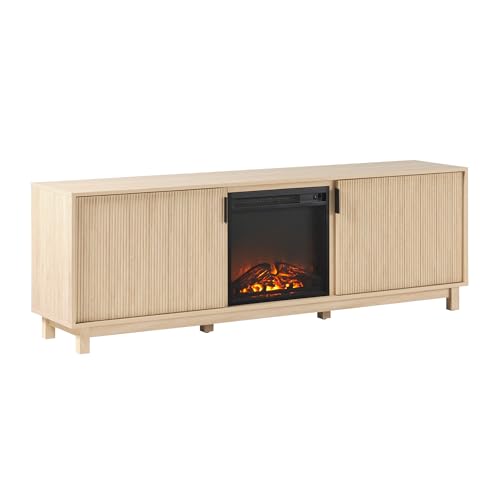
Walker Edison Arundo Reeded TV Stand with Fireplace & Storage, 70" Fireplace, Coastal Oak
Included for 'Entertainment Center with Fireplace: Heating, Safety and Sizing Guide' because the listing specifies 70" Fireplace and Coastal Oak, details this guide uses to compare options.
View on Amazon
Walker Edison Chloe Reeded TV Stand with Fireplace Insert, 65 Inch, 60 inch, Coastal Oak
Included for 'Entertainment Center with Fireplace: Heating, Safety and Sizing Guide' because the listing specifies 65 Inch and 60 inch, details this guide uses to compare options.
View on Amazon
MXV 80″ Fluted Fireplace TV Stand, Mid Century Modern TV Stand with 36″ Fireplace for TVs Up to 90", Entertainment Center with Sliding Door & Solid Wood Legs, for Living Room, Walnut
Included for 'Entertainment Center with Fireplace: Heating, Safety and Sizing Guide' because the listing specifies Entertainment Center with Sliding Door & Solid Wood Legs and for Living Room, details this guide uses to compare options.
View on Amazon
PRAISUN 70'' Fireplace TV Stand with 48'' Electric Fireplace
Included for 'Entertainment Center with Fireplace: Heating, Safety and Sizing Guide' as a relevant option in this category; details come from the product listing.
View on Amazon- Standard heat output: 4,600 to 5,100 BTU (about 1,350 to 1,500 watts on high). This heats roughly 300-400 sq. ft. with 8-foot ceilings – enough for most living rooms, family rooms, and open-plan apartments.
- Low-heat / flame-only mode: 750 watts (around 2,500 BTU) or flame effect with no heat for ambience year-round. Flame-only typically uses 10-30 watts, similar to an LED light bulb.
- Heat source: Forced-fan heater located at the front or bottom of the insert. Warm air blows outward, not upward, so it won’t directly heat your TV if clearances are respected.
- Thermostat and timer: Most 2026 models include an adjustable thermostat (68°F to 82°F), auto shut-off when the room reaches temperature, and a 30-minute to 9-hour timer.
Energy Use and Operating Cost
Energy use is straightforward because wattage is fixed. At the U.S. average electricity rate of $0.15-$0.18 per kWh in 2026, expect:
| Mode | Wattage | Cost per Hour | Best For |
|---|---|---|---|
| High Heat | 1,500W | $0.23 – $0.27 | Cold evenings, supplemental heating |
| Low Heat | 750W | $0.11 – $0.14 | Maintaining warmth, smaller rooms |
| Flame Only (No Heat) | 15-30W | $0.003 – $0.005 | Year-round ambience, summer use |
| Heater + Flame on High for 5 hrs/day | 1,500W | $1.15 – $1.35 / day | ~$34 – $40 / month if used daily |
To cut costs, use the built-in thermostat rather than running on high continuously. Once the room hits your set temperature, the unit cycles to flame-only and only kicks the heater back on when needed. Zone heating a single occupied room is almost always cheaper than raising whole-house heat by 3-4 degrees.
Safety Clearances and Placement Rules
Electric fireplace entertainment centers are UL/CSA certified for indoor use and stay cool to the touch on the glass front, but you still need proper clearances for airflow and fire safety. These are not wood-burning fireplaces – no chimney, venting, or gas line is required.
- Front clearance: Keep at least 36 inches of open space in front of the heater outlet. Do not block the fan with a rug, blanket, or ottoman.
- Sides and top: Leave 6 inches of clearance on each side and 6-12 inches above the insert portion if it is enclosed. Most consoles are designed with this built in, but don’t push curtains or bookcases flush against the vents.
- Behind the unit: Leave 2-4 inches from the wall for cord and air circulation unless the model is specifically rated for zero-clearance. Never use an extension cord or power strip; plug directly into a grounded 15A outlet on its own circuit if possible.
- TV clearance: Keep the bottom of the TV at least 4-6 inches above the top of the heater vent if the vent is top-front facing. Most inserts vent from the front below the glass, which is ideal for TV placement. If the vent is on top, choose a different model for TV use.
- Kids and pets: The glass stays warm, not scalding, typically 90°F-115°F during heating, but the metal heater grille can reach 140°F+. Use the child lock, keep the 3-foot rule for combustibles, and enable auto-shutoff.
Safety features to look for: overheat protection with automatic shut-off, cool-touch glass, tip-over protection on taller units, and ETL/CSA certification. Avoid covering the unit, drying clothes on it, or placing it near water sources.
How to Size an Entertainment Center with Fireplace to Your TV and Room
Scale matters more than style. A console that is too small looks unstable and concentrates heat; one that is too large overwhelms a small room and blocks traffic flow.
1. Match Width to TV Size
Your entertainment center should be wider than your TV. Aim for 6-12 inches of total overhang (3-6 inches visible on each side) to create visual balance and to keep speakers, consoles, and decor from crowding the screen edges.
| TV Size (Diagonal) | TV Width (approx.) | Ideal Console Width | Common Fireplace Insert Size |
|---|---|---|---|
| 55 inch | 48 inches | 58 – 65 inches | 23 inches |
| 65 inch | 57 inches | 60 – 72 inches | 23 – 26 inches |
| 75 inch | 66 inches | 70 – 80 inches | 26 – 32 inches |
| 85 inch | 75 inches | 80 – 95 inches | 32 – 42 inches (linear) |
Weight limit also matters. Most 60-inch engineered wood consoles support 80-120 lbs on top for the TV (well above a 50-65 lb modern flat-screen) and 20-30 lbs per enclosed shelf. If you have a heavy older plasma or a soundbar with subwoofer, check the top panel capacity in the specifications and distribute weight evenly.
2. Match Height for Viewing Comfort
For comfortable viewing, the center of your TV screen should be at seated eye level, typically 42-48 inches from the floor. Most fireplace entertainment centers are 28-34 inches tall. With TV legs or a low-profile stand adding 2-4 inches, a 55-65 inch TV on a 30-inch console puts the screen center right in that range for a standard 15-18 inch high sofa. If your console is taller than 34 inches, wall-mount the TV 4-6 inches above it instead of placing it directly on top to avoid neck strain.
3. Fit to Living Room Layout
- Small room (10×12 ft or 120 sq. ft.): Choose a 48-58 inch wide console. Leave at least 36 inches for walkways in front of the fireplace heater and 30 inches between the console and coffee table. A linear or wide fireplace will dominate here; stick to a 23-inch insert.
- Medium room (12×16 ft to 14×18 ft): A 60-70 inch console is ideal. This is the most common size and heats the space efficiently without blocking windows or doors. Center it on the longest uninterrupted wall.
- Large/open plan (16×20 ft+): Go 70-85 inches wide with a 32-42 inch linear fireplace insert for visual scale. You will still only heat the immediate 400 sq. ft. zone, so consider placement near the main seating area, not in a distant corner.
- Corner vs. flat wall: Corner fireplaces save floor space but usually max out at 48-54 inches wide and 23-inch inserts. They are best for apartments where wall space is limited.
- Doorways and stairs: Measure your delivery path. Console boxes often ship in two cartons at 90-150 lbs total and require 29-32 inch doorway clearance. Many units need 4-6 inches of depth clearance beyond their stated 15-18 inch depth for plugs and baseboard trim.
Choosing Construction and Features by Your Situation
Material affects price, durability, and heat resistance more than appearance. Use this decision matrix to filter options quickly.
| Your Situation | Recommended Choice | Why |
|---|---|---|
| Small apartment / renter | 60-in engineered wood with 23-in insert, infrared heat | Lightest weight (90-110 lbs assembled), easy to move, no permanent installation, usually $350-$600 |
| Kids and pets at home | MDF with laminate + tempered glass doors, cool-touch front, tip-kit strap | Wipes clean, resists fingerprints, stays cooler, anchor to wall to prevent tipping |
| Want longevity / heavy TV | Solid wood + plywood frame, plywood shelves | Higher weight capacity (120-200 lbs top), resists sagging and peeling from heat cycling, usually $700-$1,100 |
| Modern look, large TV (75in+) | Metal frame + wood panels, linear 36-42 in fireplace | Stronger structure for wide spans, better heat distribution, less prone to warping |
| Need storage for consoles/routers | Open shelving + closed cabinets with cutouts | Open shelves prevent game consoles from overheating; closed cabinets hide clutter but must have wire management holes |
Material Trade-Offs at a Glance
| Material | Pros | Cons | Price Range (2026) |
|---|---|---|---|
| Solid wood (pine, oak, acacia) | Most durable, best heat tolerance, refinishes well | Heaviest (130-180 lbs), most expensive, can expand/contract | Usually $700 – $1,300 |
| Engineered wood / MDF with veneer/laminate | Affordable, smooth finish, lighter | Susceptible to moisture and heat delamination over 5+ years if vents blocked | Usually $300 – $700 |
| Metal + wood composite | High strength for long spans, modern industrial look | Metal can show dust, colder to touch in winter | Usually $500 – $950 |
Assembly, Moving, and Durability Realities
Product listings rarely mention what ownership is actually like. Expect 60-90 minutes of assembly with two people for a 60-70 inch unit, including attaching the insert, doors, and hardware. The insert itself is often pre-assembled and simply slides in. You will need a Phillips screwdriver and included Allen wrench; a power drill speeds up the process but can strip MDF if over-tightened.
Plan for wear points: the laminate around the heater vent is the first area to discolor if airflow is blocked, and door hinges loosen over time under repeated opening. Cable management cutouts in the back panel reduce heat buildup for game consoles and streaming devices – avoid fully enclosing a hot-running console without ventilation.
If you move frequently, look for units with cam-lock assembly and removable backs rather than glued dowels. Keep the original foam corners for transport. Most finishes scratch easily during moves, so lift rather than drag, and use felt pads to protect floors from the concentrated weight (up to 35 lbs per leg on a four-leg design).
What to Check Before You Buy
- Electrical: Ensure you have a standard 120V outlet within 4-6 feet. The cord is typically 6 feet long on the right or left rear. Do not use with a GFCI outlet that trips frequently or shares a circuit with a space heater or microwave.
- Heater location: Front-venting inserts are safest for TVs. Top-venting inserts can blow hot air directly onto the TV bottom edge.
- Fireplace size vs. console size: A 23-inch insert in a 60-inch console leaves more usable storage. A 32-42 inch linear fireplace looks impressive but reduces enclosed storage width by 30-40%.
- Remote and controls: Check for included remote, app control, or compatibility with your existing setup. Some inserts offer adjustable flame color, brightness, and ember bed color independent of heat.
- Noise level: Forced-fan heaters produce 38-45 dB on high, similar to a quiet desk fan. Infrared quartz heaters are slightly quieter but cost more.
An entertainment center with fireplace should solve three problems at once: proportionally supporting your TV, adding flexible zone heat without renovation, and providing enclosed storage that stays ventilated. Size it 6-12 inches wider than your TV, leave the required 36-inch heater clearance, and choose solid wood or metal-frame construction if you want it to handle heat cycling and heavy use for 7-10 years.