Our Top Picks
A TV stand on wheels is worth buying if you need to move your TV frequently, share one screen between rooms, or want flexible viewing angles in a small space or office — but only if you choose the right wheel type, locking system, and weight capacity for your floor and TV size.
How a TV Stand on Wheels Actually Works
Unlike a fixed TV console, a mobile TV stand uses a vertical column mounted to a wheeled base. The TV is attached via a VESA bracket (the standard mounting holes on the back of your TV), not just set on a shelf. This design shifts the weight high and centered, which is why stability, wheel quality, and base design matter more than with regular furniture.
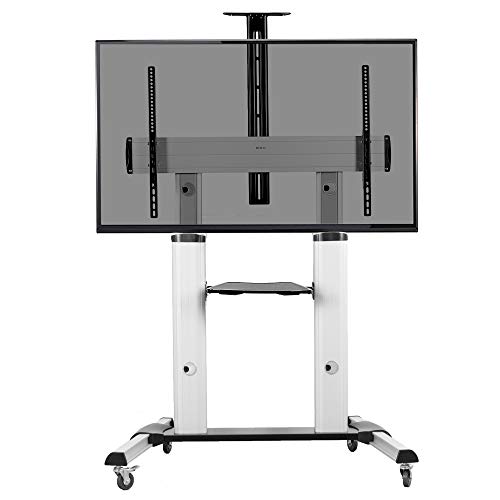
VIVO Ultra Heavy Duty Mobile 32 to 100 inch TV Stand for Flat Screens, Adjustable, Rolling TV Cart Mount with Wheels STAND-TV22S
Chosen because it specifies Adjustable and Rolling TV Cart Mount with Wheels STAND-TV22S.
View on Amazon
VIVO Ultra Heavy Duty Mobile TV Cart Stand for 32 to 70 inch Dual Screens up to 110 lbs Each, LCD LED OLED 4K Smart Flat, Curved Panels, Shelf, Wheels, Max VESA 600x400, Silver, STAND-TV12H
Chosen because it specifies LCD LED OLED 4K Smart Flat and Curved Panels.
View on Amazon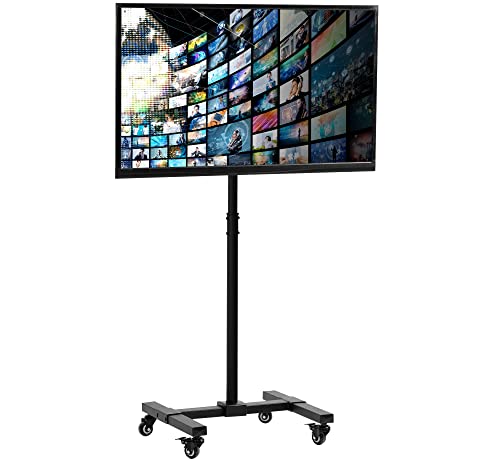
VIVO Height Adjustable TV Cart with Wheels for 13-50 in Screens
Picked as a relevant option in this category.
View on Amazon
VIVO Aluminum Mobile TV Cart for 32 to 100 inch Screens up to 220 lbs, LCD LED OLED 4K Smart Flat and Curved Panels, Heavy Duty Stand, Shelf, Wheels, Max VESA 1000x600, Black, STAND-TV22B
Chosen because it specifies LCD LED OLED 4K Smart Flat and Curved Panels and Heavy Duty Stand.
View on AmazonMost models fall into two categories:
- Mobile TV Cart with Open Base: A T-shaped or U-shaped base on 4 wheels with a height-adjustable column. Often includes a small media shelf. Best for offices, classrooms, and small apartments where you need to roll the TV aside.
- Rolling TV Console Cabinet: Looks like a low, traditional TV stand (30-60 inches wide) but sits on 4-6 caster wheels, often hidden. Offers enclosed storage and looks more like living room furniture. Better for permanent living room use where you only move it to clean or reconfigure.
Weight Limits, TV Size, and VESA: What Really Matters
Don’t shop by screen size alone. A 55-inch OLED can weigh 35 lbs while a 55-inch budget LED with a heavy bezel can weigh 45 lbs. Always check both the weight limit and the VESA range.
| TV Size (Common Range) | Typical TV Weight | Minimum Stand Capacity to Look For | Common VESA Pattern | Base Width Needed for Stability |
|---|---|---|---|---|
| 32 – 43 inch | 15 – 25 lbs (6.8 – 11.3 kg) | 55 lbs (25 kg) or more | 100×100 to 200×200 mm | 24 – 28 inches |
| 50 – 58 inch | 28 – 45 lbs (12.7 – 20.4 kg) | 77 lbs (35 kg) or more | 200×200 to 400×400 mm | 28 – 34 inches |
| 60 – 70 inch | 45 – 65 lbs (20.4 – 29.5 kg) | 88 – 110 lbs (40 – 50 kg) | 300×300 to 600×400 mm | 34 – 40 inches |
| 75 – 86 inch | 65 – 100 lbs (29.5 – 45.4 kg) | 132 lbs (60 kg) or more | 400×400 to 600×400 mm | 40+ inches, ideally U-shaped base |
For safety, keep the total load (TV + soundbar + streaming devices on the shelf) under 75% of the stand’s rated limit. A stand rated for 88 lbs holding a 65-lb TV plus a 12-lb soundbar is already at 87% capacity before cables and tilt stress.
Wheel Types and Locking Systems Compared
Wheels determine where the stand can safely go and whether it stays put when you want it to.
| Wheel Type | Best Floor Type | Locking Mechanism | Pros | Cons |
|---|---|---|---|---|
| Dual-wheel locking casters (2-3 inch, rubber) | Hardwood, laminate, vinyl, tile | Foot brake on 2 wheels (4-wheel lock is better) | Smooth, quiet, floor-friendly; locks prevent drift | Can dent soft vinyl if heavily loaded and parked long-term |
| Large single-wheel casters (3-4 inch, rubber/polyurethane) | Low-pile carpet, hard floors | Step lever brake | Rolls easiest over carpet transitions and thresholds | Less stable for very large TVs unless base is wide |
| Small hard plastic casters (1.5-2 inch) | Hard floors only | Twist or small lever lock | Low cost, low profile on rolling consoles | Noisy, rattles, digs into carpet, weak brakes |
| Ball casters / sphere casters | Office carpet | Often no lock | 360-degree movement in tight spaces | Not suitable for home use with heavy TVs; poor locking |
The rule for stability: at least two wheels should lock, and ideally all four. A two-lock system on a lightweight cart holding a 65-inch TV will still creep on a hard floor if bumped. If you have kids or pets, demand four locking casters. For a rolling console that will sit against a wall 90% of the time, concealed casters with a central locking bar offer a cleaner look while still allowing you to pull it out for cleaning.
Stability on Carpet vs. Hard Floors
The same stand behaves very differently depending on the floor.
On hard floors (hardwood, LVP, tile): Rolling is effortless, but the risk is unwanted movement. Look for soft rubber or polyurethane wheels that won’t scratch and won’t slide when locked. Add felt pads under the base if the manufacturer includes them. On uneven tile with deep grout lines, small 2-inch wheels can catch — choose 3-inch or larger.
On carpet (especially medium to high-pile, over 0.5 inch): Rolling resistance increases dramatically. A 50-lb TV on a 30-lb stand can require 15-20 lbs of push force to get moving on plush carpet, compared to 3-5 lbs on hardwood. Small casters sink and may not lock effectively because the carpet fiber prevents the brake pad from gripping. Choose large 3- to 4-inch wheels and a lighter TV. In a 10×12 ft bedroom with carpet, a U-shaped base that straddles the pile distributes weight better than a small square base.
Tipping risk: Tall carts (over 60 inches high) with a narrow 24-inch base are top-heavy. If your TV is 65 inches or larger and your floor is carpet, prioritize a base that is at least 50% of your TV’s width and keep the column at its lowest comfortable height. Most carts allow height adjustment from about 40 inches (center of TV) to 65 inches.
When a Rolling Stand Is Ideal (and When It Isn’t)
Ideal use cases:
- Studio or small apartment (under 600 sq ft): A rolling cart lets one TV serve as both living room TV and bedroom TV. Roll it 6-8 feet between zones instead of buying a second screen. Leave 30-36 inches of clearance in front of the stand to rotate it without hitting a sofa or bed.
- Home office and conference room: Move the screen for presentations, video calls, or to clear floor space for workouts. Carts with cable management and a laptop shelf are designed for this.
- Renters who can’t wall-mount: No drilling, no wall anchors. A mobile stand gives you height adjustment and tilt without losing your security deposit.
- Open-plan living where layout changes often: Rolling consoles let you reconfigure for guests, cleaning, or seasonal furniture moves. They fit through standard interior doorways (28-32 inches wide) if the overall width is under 55 inches.
Skip it when:
- You need heavy storage — game consoles, vinyl records, or a large center channel speaker. A fixed low-profile stand (16-20 inches high, 60-70 inches wide) with solid wood support holds 150+ lbs more securely and won’t roll when a child climbs.
- Your TV is 75 inches or heavier than 80 lbs and you have thick carpet or uneven floors. A fixed stand or wall mount is safer.
- You want a very low, cinematic viewing height. Most carts hold the TV center at 42-55 inches high, which is higher than the ideal 36-42 inch eye level when seated on a standard 15-18 inch high sofa at 8-10 feet viewing distance.
Choosing by Your Situation
| Your Situation | Best Choice | Key Spec to Prioritize |
|---|---|---|
| Small apartment, hard floors, 50-55 inch TV | T-shaped mobile cart with 4 locking rubber wheels | Height adjustment + 77 lb capacity + base under 30 inches wide to fit tight corners |
| Office / video calls, 43-65 inch TV | Height-adjustable cart with tilt (+/- 15 degrees) and media shelf | Large 3-4 inch wheels, cable management, VESA up to 600×400 |
| Living room, kids and pets, hardwood | Rolling console cabinet with 4-6 locking concealed casters | Low center of gravity, anti-tip strap, four-wheel lock, enclosed storage |
| Renters with carpet, 55 inch or smaller | U-shaped base cart with 4-inch polyurethane wheels | All-wheel lock, wide base (32+ inches), total height under 60 inches |
| Need storage for consoles and soundbar | Fixed stand or wide rolling console (50+ inches) with reinforced shelves | Shelf weight limit 40-50 lbs each, not just TV column limit |
Materials, Durability, and What Wears First
Construction affects wobble, noise, and lifespan more than appearance.
| Material | Weight and Stability | Durability | Trade-off |
|---|---|---|---|
| Steel column + steel base | Heaviest, most stable; best for 60+ inch TVs | Powder coating chips if scratched; bolts can loosen over time | Industrial look; heavier to assemble (box weight 40-55 lbs) |
| Steel column + MDF/wood shelves | Good balance of stability and storage | MDF shelves sag if overloaded or exposed to humidity; laminate can peel at edges | Most common mid-range option; usually $150-$400 |
| All engineered wood rolling console | Lighter, can feel wobbly at full height | Casters pull out of particleboard under heavy load | Looks like real furniture; not ideal for heavy TVs |
| Solid wood rolling console with metal caster plates | Very stable at low heights | Most durable; caster plates reinforce screw points | Highest cost, usually $400-$800; box weight 60-80 lbs and requires two-person assembly |
Assembly and moving realities: Expect a flat-pack box 45-55 inches long and 25-35 lbs for a cart, or 55-65 inches and 50-75 lbs for a console. Most carts assemble in 30-45 minutes with two people; you will need to lift the TV onto the bracket after the column is built, so have a second person for any screen over 50 inches. Check doorway and elevator width before buying — U-shaped bases over 36 inches wide may not fit through narrow apartment hallways. What wears first is almost always the wheel brakes and the tilt mechanism; tighten all bolts after the first two weeks of use and every six months after, and avoid over-tightening plastic cable clips that crack.
Quick Measurement Checklist Before You Buy
- Measure your TV’s VESA pattern (distance between mounting holes) and weight, not just diagonal size.
- Measure viewing distance: For a 55-inch TV, 7-9 feet is comfortable; for 65-inch, 8-11 feet. The cart should let you place the screen in that range without blocking walkways.
- Leave 4-6 inches of ventilation behind the TV if the cart will be near a wall, and 2-3 inches on each side inside a console cabinet for consoles and soundbars.
- Confirm floor clearance: The bottom shelf is typically 10-16 inches off the floor — enough for a soundbar but not for a large subwoofer.
- Test your outlet locations. Carts need a longer cable run; plan for a 10-12 foot power cable or a floor cord cover to avoid a tripping hazard when rolling.
A tv stand on wheels solves flexibility problems that fixed furniture cannot, but it trades some absolute stability for mobility. If you match the wheel size to your floor, insist on multi-wheel locking, and stay well under the stated weight limit with a base wide enough for your screen, you get a safe, practical setup that adapts to small spaces and shared rooms without sacrificing viewing comfort.