Key takeaways
- “Genuine leather” without the words top-grain or full-grain; it is usually bonded or split leather.
- “Leather match” or “leather gel” in the materials, meaning vinyl on every surface you do not sit on.
- Full sectional priced under $1,000 and described as 100 percent leather; real hides cost more than that in raw material.
- No foam density listed, only “high-density foam” as a phrase.
- Frame described as “solid wood and engineered wood” without saying which parts are which.
- Total shipping weight under 200 pounds for a three-piece sectional.
- Warranty that excludes peeling, cracking, or “normal wear” on the cover in the first year.
- Photos showing a perfectly uniform grain with no variation anywhere, which indicates a printed surface.
Leather sectionals fail in a predictable order, and none of it shows in the product photos. First the seat cushions flatten, because the foam was 1.5 pounds per cubic foot instead of 1.8 or higher. Then the “leather” starts peeling at the seams and on the seat fronts, because it was bonded leather or polyurethane rather than a real hide. Then the corner piece sags, because the frame under the heaviest-used seat was particleboard held together with staples. Buyers who end up there almost always made the same mistake: they judged the sectional by color, shape, and price, and never looked at the three lines in the spec sheet that determine whether it lasts 3 years or 15. Here is how to read those lines before you buy.
Decide These 3 Things First
Real leather or a leather look. Full-grain and top-grain leather are the only materials that get better with age. Bonded leather, bicast leather, and polyurethane faux leather all wear out from the surface down, typically in 2 to 5 years of daily use. Decide whether you are buying a durable sectional or an affordable one that looks like leather for a while, because the price gap is $1,000 or more.
Our top picks


As an Amazon Associate we earn from qualifying purchases at no extra cost to you.
How the sectional will be used. A family room where people lie down, kids climb, and a dog naps on the chaise needs protected (pigmented) top-grain leather and a hardwood frame. A formal room that sees a few hours a week can use softer aniline leather.
The footprint and the door. Measure the wall lengths, subtract 6 to 12 inches for clearance, and note the narrowest door or stairwell on the delivery path. Leather sectionals are heavy, 250 to 450 pounds total, and unlike compressed fabric sofas, most cannot be squeezed through a tight turn.
Leather Grade and Finish
Full-grain leather keeps the entire natural surface of the hide; it shows scars and grain variation and is the most durable, typically 1.2 to 1.6 millimeters thick on sofas. Top-grain leather has the surface lightly sanded and is then finished with pigment; it is slightly thinner at 0.9 to 1.2 millimeters, more uniform, and more stain-resistant. Within those grades, the finish matters as much as the grade. Pure aniline leather is dyed through with no protective topcoat, so it feels the softest and absorbs spills. The Poly & BARK Napa 104.5-inch Left-Facing Sectional in full-grain pure-aniline Italian leather, with feather-down cushions and a kiln-dried solid wood frame at about $2,498.40, is what the top of this category looks like; it will develop a patina and needs conditioning, and it belongs in a room without muddy dogs. Semi-aniline adds a light protective coat and is the best compromise for most homes. Pigmented or protected leather has an opaque finish that wipes clean and is the right call for kids and pets. Below all of these sit bonded leather (10 to 20 percent leather fiber glued to a backing) and polyurethane faux leather, which cannot be conditioned and will peel.
Frame Construction
The frame determines whether the sectional is still square in a decade. Kiln-dried hardwood, meaning oak, maple, ash, or poplar dried to 6 to 8 percent moisture content, is the standard for a lifetime frame; plywood of 11 or more plies is nearly as good and is common in mid-range pieces. Softwood, particleboard, and MDF frames flex and loosen at the joints under daily use. Look for corner blocks glued and screwed at every joint, and doweled or mortise-and-tenon joinery rather than staples. A hardwood-frame sectional section weighs 90 to 150 pounds; if a three-piece sectional ships at under 200 pounds total, the frame is not hardwood. Frame warranties tell the story: lifetime or 10-year frame warranties are common on hardwood, while 1-year warranties usually accompany engineered wood.
Suspension and Cushions
Under the seat, eight-way hand-tied coil springs are the traditional premium standard, but well-made sinuous (zig-zag) springs of 8- or 9-gauge steel spaced 3 to 4 inches apart perform nearly as well and cost less. Webbing-only suspensions sag within a few years. On top, seat foam should be high-resiliency polyurethane of at least 1.8 pounds per cubic foot density, with 2.0 to 2.5 being better; density is different from firmness and is what determines whether the cushion holds its shape. A foam core wrapped in Dacron fiber or in a down-feather envelope adds softness without sacrificing support. Seat depth of 21 to 24 inches suits upright sitting; 26 inches and deeper is a lounging seat. Seat height of 17 to 20 inches works for most adults. Cushions that are removable and reversible double their life.
Size and Configuration
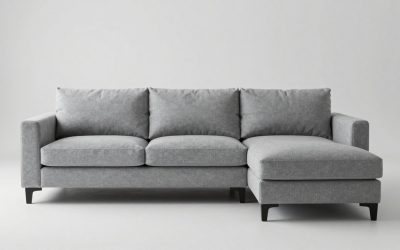
Sectionals come in L-shapes with a chaise, L-shapes with a corner seat, U-shapes, and modular sets where every piece is a separate unit. Compact L-shapes run 85 to 100 inches on the main run and seat three to four; the 96-inch L-Shaped Sectional Leather Couch with a chaise lounge, a compressed boneless design at about $324.99, shows how far the low end has moved toward fabric-sofa construction, using dense foam blocks rather than a wood frame, in a faux leather cover. Standard L-shapes run 100 to 120 inches; U-shapes run 110 to 140 inches and need a room at least 14 feet wide. Modular designs let you reconfigure and replace individual pieces, which extends life, but each piece has its own frame and legs, so the joints between them must have connectors. Check that the chaise or return depth, often 60 to 70 inches, fits your room’s shorter dimension with a walkway.
Price Tiers
Under $600 you are buying faux leather over foam or engineered wood; the TYBOATLE Brown Faux Leather Modular Convertible L-Shaped Sectional with USB and ottoman at about $469.99 is representative, with a useful life of 3 to 5 years in a busy room. From $700 to $1,500 you find better faux leather with thicker polyurethane and hardwood or plywood frames, and some bonded or split-leather seating surfaces with vinyl sides and backs sold as “leather match”; the EASE MOOSE Faux Leather Sectional Sleeper Modular Sofa in white at about $1,199.99 sits here. From $1,500 to $3,000 top-grain and full-grain leather become standard, with kiln-dried hardwood frames, sinuous or coil suspensions, and 1.8- to 2.2-pound foam; the Poly & BARK Napa marks the upper edge of the tier. Above $3,000 you get full-grain aniline hides on every surface, eight-way hand-tied springs, down-blend cushions, and made-to-order configurations.
Warranty and Delivery
A durable leather sectional carries at minimum a 10-year frame warranty, 3 to 5 years on springs and cushions, and 1 to 2 years on the leather against cracking and peeling. Faux leather rarely carries more than a 1-year warranty, and peeling is often excluded as “wear.” Delivery is a real cost: a three-piece leather sectional ships freight at 250 to 450 pounds in three to five boxes. Threshold delivery leaves them at the door; white-glove service that carries pieces in, assembles legs and connectors, and removes packaging runs $150 to $400 and is worth it on anything over $1,500. Confirm that pieces fit your doors; individual sections are typically 32 to 40 inches deep and 30 to 36 inches tall, so a 32-inch doorway is tight for deep-seat designs.
Spec Checklist
| Spec | Budget ($300 to $800) | Mid ($800 to $2,000) | Premium ($2,000 to $5,000) |
|---|---|---|---|
| Cover material | Polyurethane faux leather or bonded leather | Top-grain on seating surfaces, vinyl match on sides and back | Full-grain or top-grain on all surfaces |
| Finish | Printed grain, no conditioning possible | Pigmented or semi-aniline | Semi-aniline or pure aniline |
| Frame | Engineered wood, foam block, or softwood | Plywood or mixed hardwood | Kiln-dried solid hardwood |
| Suspension | Webbing or light sinuous springs | 8- to 9-gauge sinuous springs | Eight-way hand-tied coils or heavy sinuous |
| Seat foam | 1.5 to 1.8 lb/cu ft | 1.8 to 2.0 lb/cu ft, fiber wrap | 2.0 to 2.5 lb/cu ft, down or fiber wrap |
| Seat depth | 20 to 24 in | 21 to 26 in | 22 to 28 in, often selectable |
| Total weight (3 pieces) | 150 to 250 lb | 250 to 350 lb | 350 to 500 lb |
| Frame warranty | 1 year | 3 to 10 years | Lifetime |
| Leather warranty | None or 1 year | 1 to 2 years | 2 to 5 years |
| Delivery | Boxed, self-assembly | Threshold, legs and connectors | White-glove included or optional |
Red Flags
- “Genuine leather” without the words top-grain or full-grain; it is usually bonded or split leather.
- “Leather match” or “leather gel” in the materials, meaning vinyl on every surface you do not sit on.
- Full sectional priced under $1,000 and described as 100 percent leather; real hides cost more than that in raw material.
- No foam density listed, only “high-density foam” as a phrase.
- Frame described as “solid wood and engineered wood” without saying which parts are which.
- Total shipping weight under 200 pounds for a three-piece sectional.
- Warranty that excludes peeling, cracking, or “normal wear” on the cover in the first year.
- Photos showing a perfectly uniform grain with no variation anywhere, which indicates a printed surface.
FAQ
How long should a leather sectional last?
A top-grain or full-grain sectional on a kiln-dried hardwood frame should last 15 to 25 years with conditioning every 6 months and occasional cushion refoaming. Bonded leather or polyurethane faux leather typically shows peeling within 2 to 5 years, regardless of how good the frame is.
Is top-grain or full-grain leather more durable?
Full-grain is slightly thicker and stronger, but for a sectional the finish matters more than the grade. A pigmented top-grain hide will resist spills and pet claws better than an unfinished full-grain aniline hide, even though the aniline is the more expensive material.
What foam density should a leather sectional have?
At least 1.8 pounds per cubic foot in the seat cushions, with 2.0 or higher preferred for a piece that sees daily lounging. Back cushions can be lower density or fiber-filled. Density is about longevity; firmness is a separate rating and a matter of preference.
Are modular leather sectionals as durable as fixed ones?
They can be, provided each module has its own hardwood frame and the pieces lock together with metal connectors. The advantage is that a worn chaise or corner can be replaced individually. In 2026 many manufacturers sell replacement modules for 5 to 10 years after purchase, which effectively extends the sectional’s life well beyond a fixed design.