Key takeaways
- WD-40 or other penetrating oils. They dissolve grease and evaporate. Use lithium grease or silicone.
- Overtightening pivot bolts. Pivots need free movement; bind them and you get a new squeak and faster wear.
- Working on a power recliner while plugged in. Motors can activate if the remote is bumped.
- Replacing only one spring. Mismatched tension pulls the mechanism crooked.
- Ignoring bent arms. A bent linkage arm rubs its neighbor; grease will not fix it, and it will eventually seize.
- Tipping the chair forward. The footrest can spring open and hit you.
- Spraying near fabric. Grease stains upholstery permanently; mask with a towel.
A squeaking recliner is almost always a 15-minute fix, but it is also easy to turn into a 2-hour one. The classic mistake is spraying a penetrating oil like WD-40 into the mechanism. It quiets the squeak for a week, then evaporates, washes away the factory grease it dissolved, and leaves bare steel that squeaks louder and starts to wear. The second mistake is tightening every bolt as hard as possible; recliner pivots need a little play to move, and an overtightened pivot binds, squeaks in a different pitch, and can crack the wood block it is bolted to. The third is ignoring a squeak that is actually a stretched or broken tension spring, which will eventually let the footrest drop or slam. Diagnose first, lubricate with the right product, and replace the $5 to $10 part if that is what is really making the noise.
What You Need
| Item | Why | Optional? |
|---|---|---|
| Flashlight or headlamp | Mechanisms are dark and you need both hands | No |
| White lithium grease (spray or tube) or silicone spray | Long-lasting lubricant for steel pivots that does not attract dust | No |
| Socket set or adjustable wrench (typically 7/16, 1/2, and 9/16 inch) | Snugging pivot bolts and frame screws | No |
| Phillips and flat screwdrivers | Frame screws and mechanism plates | No |
| Needle-nose pliers or spring puller | Removing and installing tension springs | Yes, needed for spring replacement |
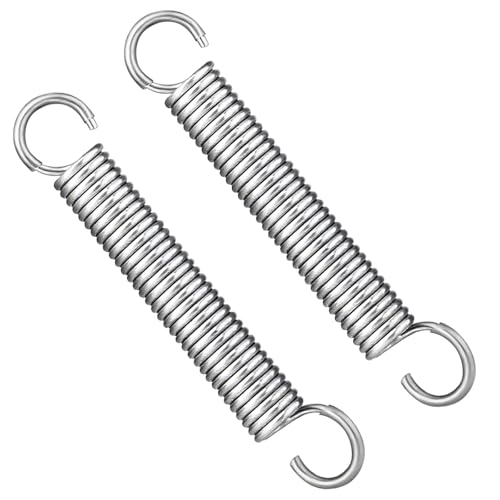
| Replacement tension springs (measure yours first) | Stretched or broken springs cause squeaks and slack; common sizes are 3-5/8 inch long-neck (about $9 for two) and 5-1/8 inch stainless (about $10 for two) | Only if a spring is stretched or broken |
| Old towels or a moving blanket | Protect floor and upholstery when you tip the chair | Recommended |
| Paraffin wax or a bar of soap | Quiets wood-on-wood squeaks in the frame | Yes |
| Wood glue and a few 1.5-inch screws | Repairs a loose corner block or cracked frame rail | Yes |
| Safety glasses and work gloves | Springs under tension can snap back | Recommended |
Step-by-Step
1. Locate the squeak (5 minutes)
Sit in the chair and recline it slowly, then close it, listening for where in the travel the noise happens. A squeak at the start of the recline is usually the back pivots or the seat-box hinges. A squeak as the footrest extends is the footrest linkage or its tension springs. A squeak when you shift your weight without moving the mechanism is the frame, not the mechanism. Have someone else recline the chair while you put your ear near the base to narrow it down.
Our top picks

As an Amazon Associate we earn from qualifying purchases at no extra cost to you.
2. Unplug and tip the chair (5 minutes)
If it is a power recliner, unplug the transformer. Lay a blanket down, remove loose cushions, and carefully tip the chair onto its back or side so the mechanism faces you. Most recliners weigh 70 to 120 pounds; get help with anything over 90. Do not tip a recliner face-forward, which can snap the footrest open.
3. Inspect the mechanism (10 minutes)
With the flashlight, check every pivot point, which are the rivets and bolts where steel arms cross. Look for rust, dry gray metal where grease has worn away, and bent arms. Check the tension springs, usually 2 to 4 coil springs about 3 to 5 inches long hooked between mechanism arms. A healthy spring has tightly closed coils; a stretched one shows visible gaps between coils, and a broken one is missing or hanging by one hook. Wiggle the mechanism where it bolts to the wood seat box; any movement there means loose bolts or a cracked block.
4. Tighten what is loose, gently (10 minutes)
Snug the bolts that hold the mechanism to the frame; these should be tight. Frame screws and corner-block screws should be tight too. Pivot bolts on the mechanism itself, however, should be only snug enough to remove side play, with the arms still swinging freely. If a pivot bolt has a nylon lock nut, turn it a quarter turn at a time and test motion. If a wood block is cracked or a screw spins without biting, remove it, fill the hole with wood glue and a toothpick, let it cure an hour, and redrive the screw.
5. Lubricate the pivots (10 minutes)
Spray white lithium grease or silicone lubricant directly onto each pivot from about 4 inches away, one at a time, working the mechanism a few times after each application so the grease spreads into the joint. Aim for the seam where the two arms meet. Wipe drips immediately so they do not reach fabric. Hit the footrest linkage pivots, the back pivots, the seat-box hinge points, and where the release handle cable or lever enters the mechanism. Do not use penetrating oil; it will wash out the grease that is already there.
6. Replace stretched or broken springs (15 to 20 minutes)
Measure the old spring from hook to hook and note the hook style; long-neck hooks and short hooks are not interchangeable. Buy a matching pair, since springs on both sides age together. Wearing safety glasses, unhook one end of the old spring with pliers, then the other. Hook the new spring on the fixed end first, then stretch it with pliers or a spring puller to the moving end. Repeat on the other side. Springs cost $5 to $10 a pair, and a fresh set restores footrest closing force as well as removing the squeak the loose spring made rubbing on the arm.
7. Treat frame squeaks (10 minutes)
If the noise persists when you shift weight without moving the mechanism, it is wood on wood. Find the joint by pressing on frame members while listening. Rub paraffin or bar soap into the joint, or work a little wood glue into the gap and clamp or screw it tight. Squeaks where the seat springs (sinuous springs under the seat deck) meet the frame can be quieted with a dab of grease on each clip.
8. Test and clean up (5 minutes)
Set the chair upright, replace cushions, plug it back in if powered, and cycle the recline fully five or six times. The grease needs a few cycles to distribute. If a faint squeak remains, note where and repeat the spray on that one pivot. Wipe any overspray off the floor, since silicone and grease are slippery on hard surfaces.
Mistakes to Avoid
- WD-40 or other penetrating oils. They dissolve grease and evaporate. Use lithium grease or silicone.
- Overtightening pivot bolts. Pivots need free movement; bind them and you get a new squeak and faster wear.
- Working on a power recliner while plugged in. Motors can activate if the remote is bumped.
- Replacing only one spring. Mismatched tension pulls the mechanism crooked.
- Ignoring bent arms. A bent linkage arm rubs its neighbor; grease will not fix it, and it will eventually seize.
- Tipping the chair forward. The footrest can spring open and hit you.
- Spraying near fabric. Grease stains upholstery permanently; mask with a towel.
How Often
Lubricate the pivots once a year for a chair used daily, or every two years for occasional use. Check the tension springs at the same time; they usually last 5 to 10 years before stretching. Tighten frame and mechanism mounting bolts annually as well, since wood shrinks and swells with seasons and screws loosen. A squeak that returns within three months of lubricating points to a worn pivot bushing or a bent arm rather than dryness.
When to Call a Pro or Replace
Call a furniture repair technician when a mechanism arm is visibly bent or cracked, when a rivet has sheared, when the release cable is frayed, or when the seat box wood is split along the mechanism bolts. Mechanism replacement runs $150 to $350 installed, and complete replacement mechanisms cost $80 to $200 as parts. For a power recliner, a motor that hums but does not move, or a squeak accompanied by grinding, means the actuator is failing and is a $100 to $250 part.
Replace the chair when it is more than 10 years old with a budget particleboard frame, when the repair estimate exceeds half the cost of a comparable new chair (typically $400 to $900 for a mid-range manual recliner in 2026), or when the frame itself has cracked in more than one place. A squeak alone is never a reason to replace a chair; a squeak plus a wobbling seat box or a footrest that drops on its own often is.
FAQ
What is the best lubricant for a recliner mechanism?
White lithium grease, in spray form for reach or in a tube for precise application. It stays on steel pivots for a year or more, resists dust, and does not drip once set. Silicone spray is the second choice and is safer near fabric because it does not stain. Avoid penetrating oils and general-purpose spray oils, which are solvents first and lubricants second.
Why does my recliner squeak only when I lean back?
The back pivots and the rear seat-box hinges take the load in that motion. Tip the chair and grease the two bolts where the back frame meets the mechanism and the pivots at the rear of the seat box. If the squeak continues, check whether the back is fully seated in its brackets; on most recliners the back lifts off, and a back that has ridden up 0.25 inch will creak.
How do I know if a tension spring needs replacing?
Look at the coils with the chair closed. A good spring has coils touching each other with no gaps. A stretched spring shows daylight between coils and the footrest closes weakly or does not stay closed. A broken spring is obvious. Measure hook to hook, match the hook style, and replace both sides together.
Can I fix a squeaky power recliner the same way?
Yes. Unplug it first, then follow the same steps. Power recliners have the same steel linkage as manual ones, plus a linear actuator that pushes it. Do not grease the actuator’s threaded rod unless the manual says to; most are sealed. If the noise is a whine or grind from the motor rather than a squeak from a pivot, that is an actuator problem, not a lubrication problem.