Our Top Picks
 Bosimeca 3-Tier Wine Rack Freestanding Floor Cabinet Corner3-Tier Wine Rack 0716.6 x 15.4 x 29.5 inches1 PoundsCheck on Amazon
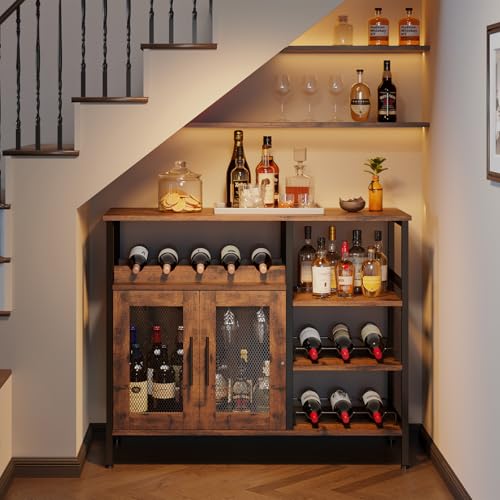 X-cosrack Wine Bar Rack Cabinet with Detachable Wine37.8"*13.4"*31.1"(L*W*H)37.8 x 13.4 x 31.1 Inches42 poundsCheck on Amazon
A side table with a wine rack makes sense if you keep roughly 3 to 12 bottles on hand and drink them within a few months, because a living room is too warm for long-term aging; the right one holds bottles horizontally in cradles at least 3.5 inches wide, sits at arm height next to your sofa (within about 2 inches of the arm), and is sturdy enough for 20 to 40 pounds of glass. If you are collecting wine to age for years, a wine fridge is the better buy, and the side table becomes a serving station.
What Bottles Actually Need
Most wine racks are designed around the standard 750 ml Bordeaux bottle, but your collection probably includes other shapes. Check the cradle or cubby size against these common bottles before buying:

X-cosrack Wine Rack Freestanding Floor, Mini Bar Table Wine Holder Stand Liquor Cabinet with Glass Holder Wood Tabletop 14 Bottles Floor Wine Storage for Home Bar Kitchen Living Room
Picked as a relevant option in this category.
View on AmazonBosimeca 3-Tier Wine Rack Freestanding Floor Cabinet Corner Bar Cabinet Bar Cart,12 Individual Wine Storage Bottle Compartments Corner Bar Cabinet Holder,Wood + Black Frame Liquor Cabinet
Chosen because it specifies Wood + Black Frame Liquor Cabinet.
View on AmazonX-cosrack Wine Bar Rack Cabinet with Detachable Wine Rack, Coffee Bar Cabinet with Glass Holder, Small Sideboard and Buffet Cabinet with Mesh Door, Rustic Brown, Large
Chosen because it specifies Coffee Bar Cabinet with Glass Holder and Small Sideboard and Buffet Cabinet with Mesh Door.
View on Amazon
FAVOOSTY Wine Rack Freestanding Floor, 24 Bottles Wine Shelf, Rustic Brown
Chosen because it specifies 24 Bottles Wine Shelf and Rustic Brown.
View on Amazon| Bottle type | Diameter | Height | Full weight |
|---|---|---|---|
| Bordeaux (Cabernet, Merlot) | About 3.0 in | About 11.5–12 in | 2.6–3.3 lb |
| Burgundy (Pinot Noir, Chardonnay) | About 3.3–3.5 in | About 11.5 in | 2.8–3.5 lb |
| Sparkling / Champagne | About 3.5 in | About 12 in | 3.3–4 lb |
| Riesling / flute style | About 3.0 in | About 13–14 in | 2.6–3 lb |
| Magnum 1.5 L | About 4 in | About 14 in | 6–7 lb |
A rack sized only for Bordeaux bottles, with cubbies around 3.25 inches, will reject sparkling wine and many Burgundy bottles. Cubbies or cradles of 3.5 to 3.75 inches handle almost everything except magnums. Depth matters too: a side table only 12 inches deep leaves bottle necks hanging out, which looks fine on an open rack but blocks a drawer or door in a closed cabinet.
Horizontal, Angled or Upright
- Horizontal cradles: best for natural cork, which stays moist when wine touches it. Fine for any wine you keep longer than a few weeks.
- Slight downward angle: similar benefit, and labels show better. Common on X-shaped lattice racks.
- Upright slots: acceptable for screw caps and wine you will open within a couple of weeks. Not for long storage of cork-sealed bottles.
Heat and Light Next to a Sofa
Wine keeps best around 55°F with steady temperature, and a typical living room sits at 68 to 74°F. Wine stored at room temperature away from swings and sun is fine for drinking within roughly 3 to 6 months. Shorten that window if the table sits near a heating vent, a sunny window, a fireplace or the back of a TV or game console, all of which can push local temperatures 5 to 15 degrees higher. Closed cabinet doors or a lower shelf away from windows protect against light.
Side Table vs Sofa Table With Wine Rack
The two terms describe different furniture with different jobs:
| Feature | Side / end table with wine rack | Sofa / console table with wine rack |
|---|---|---|
| Typical size | 18–24 in wide, 16–24 in deep | 48–72 in long, 12–16 in deep |
| Height | 22–26 in (match sofa arm) | 28–32 in (match sofa back) |
| Bottle capacity | 3–9 bottles | 6–18 bottles |
| Stemware | Rarely; sometimes 2–4 glasses | Often a hanging rail for 4–8 glasses |
| Placement | Beside sofa or armchair | Behind sofa, in dining room or against a wall |
| Typical price | $80–$300 | $150–$600 |
If you mainly want a glass and a bottle within reach while you sit, choose the side table. If you entertain and want a mini bar station with glasses, choose a sofa table placed behind a floating sofa or along a dining room wall.
Stemware Storage: Check Before You Assume
Hanging stemware rails need slots about 0.5 to 1 inch wide to hold stems, and the glass needs vertical room. Standard red wine glasses are 8 to 9.5 inches tall, and large Bordeaux or Burgundy bowls can exceed 9.5 inches with bowls 4 inches wide. Many tables leave only 6 to 8 inches under the rail, which suits small all-purpose or white wine glasses. Measure your tallest glass and the clearance under the rail.
Construction and Weight Capacity
Nine bottles weigh about 25 to 30 pounds before you add a lamp, books or a decanter on top. That load sits low, which helps stability, but it also stresses shelves.
| Construction | Strength | Weak point |
|---|---|---|
| Solid wood with lattice rack | Strong, refinishable | Price, weight to move |
| Engineered wood (MDF / particleboard) with cubbies | Affordable, clean look | Shelf sag over 24 in spans; edges swell if wine spills |
| Metal frame, wood top | Light, open look, holds weight well | Wobble if joints are not tightened; bottle-cradle wires can scratch labels |
| Metal with wine-bottle holes in top | Compact novelty design | Upright storage only; little tabletop space |
Spills are the overlooked risk. A dripping bottle in a particleboard cubby can swell the board within hours. Sealed solid wood, metal, or engineered wood with a laminated (not paper-foil) finish handle it better. A felt or cork liner in cubbies also cuts noise and scratching.
Stability and Kids
A side table with 6 or more bottles is bottom-heavy and fairly stable. A tall, narrow sofa table with a wine rack on top and open space below is not; anchor anything over 30 inches tall to a wall or the sofa frame. If young children are around, choose closed cabinet doors or a rack positioned at least 24 inches off the floor, since bottles at toddler height get pulled out.
Which One Fits You
- Apartment with no room for a bar cart: 20-inch-square end table with a 4 to 6 bottle lattice below and a drawer for openers.
- Entertaining guests often: 60-inch sofa table with 12 bottles, a stemware rail for 6 glasses and a top deep enough for a tray.
- Holding wine longer than 6 months: a compact wine fridge, often 12 to 18 bottles, with the side table used only for serving.
- Mixed bottle shapes: cradles of 3.5 inches or more and at least 13 inches of depth.
- Homes with small kids: closed cabinet with a door, or a high rack position, and wall anchoring for taller pieces.
Assembly Notes
Most flat-packed wine side tables take 30 to 60 minutes. Lattice racks made of interlocking slats are the fiddliest part; assemble them loosely, square the frame, then tighten. After loading bottles, check for rocking on the floor and adjust leveling feet, since a slight wobble with full bottles turns into a loose frame over time.