Key takeaways
- You have a patio, driveway, or yard: a single-burner high-pressure propane floor cooker rated 65,000–160,000 BTU. Bayou Classic, King Kooker, and Eastman Outdoors all build this category, usually $90–$250, with a 20 lb propane tank adding $50–$70.
- You already have an outdoor kitchen or built-in grill: a built-in power burner or side burner from Blaze, Bull, Napoleon, Summerset, Coyote, Twin Eagles, Lynx, or Delta Heat, rated 15,000–60,000 BTU. Budget $300–$1,200 for the burner and $150–$600 for the plumber or gas fitter.
- You rent, or your kitchen is tiny: a countertop butane cassette stove (Iwatani, GAS ONE, SENGOKU) or a folding propane camp burner (Snow Peak, Coleman, Kovea). These run 8,000–15,000 BTU, sit in a 13 × 11 inch footprint, and store in a cabinet.
- You cook indoors and can install a real hood: a pro-style range with a dedicated wok burner — Wolf, Thermador, BlueStar, Capital, American Range, and Dacor all build them, and value brands like NXR, Thor Kitchen, and ZLINE have moved into the 18,000–22,000 BTU range at a fraction of the price.
- You want indoor heat without combustion: a countertop or drop-in induction wok cooker. Residential units run 1,800–3,500 W; commercial-grade wok induction from CookTek, Vollrath, Cadco, and Garland runs 3,500–5,000 W on 208–240 V.
For most home cooks, the best wok burner is a 65,000–160,000 BTU outdoor propane floor burner used on a patio or driveway — it produces the blistering, dry, slightly smoky sear known as wok hei that no residential rangetop can match, and it typically costs $90–$250. If you must cook indoors, the realistic choices are a pro-style range with an 18,000–25,000 BTU wok-rated burner (roughly $1,800 for value brands up to $8,000+ for premium) or a commercial-style induction wok cooker rated 3,000–5,000 W. Both require ventilation that most kitchens do not have out of the box, and that single constraint — where the exhaust goes — decides more purchases than any BTU number on a spec sheet.
Quick Picks by Situation
- You have a patio, driveway, or yard: a single-burner high-pressure propane floor cooker rated 65,000–160,000 BTU. Bayou Classic, King Kooker, and Eastman Outdoors all build this category, usually $90–$250, with a 20 lb propane tank adding $50–$70.
- You already have an outdoor kitchen or built-in grill: a built-in power burner or side burner from Blaze, Bull, Napoleon, Summerset, Coyote, Twin Eagles, Lynx, or Delta Heat, rated 15,000–60,000 BTU. Budget $300–$1,200 for the burner and $150–$600 for the plumber or gas fitter.
- You rent, or your kitchen is tiny: a countertop butane cassette stove (Iwatani, GAS ONE, SENGOKU) or a folding propane camp burner (Snow Peak, Coleman, Kovea). These run 8,000–15,000 BTU, sit in a 13 × 11 inch footprint, and store in a cabinet.
- You cook indoors and can install a real hood: a pro-style range with a dedicated wok burner — Wolf, Thermador, BlueStar, Capital, American Range, and Dacor all build them, and value brands like NXR, Thor Kitchen, and ZLINE have moved into the 18,000–22,000 BTU range at a fraction of the price.
- You want indoor heat without combustion: a countertop or drop-in induction wok cooker. Residential units run 1,800–3,500 W; commercial-grade wok induction from CookTek, Vollrath, Cadco, and Garland runs 3,500–5,000 W on 208–240 V.
Burner Output: What the BTU Number Does and Does Not Tell You
Manufacturers rate gas burners in BTU per hour (BTU/hr). One BTU is the energy needed to raise one pound of water by one degree Fahrenheit, so 100,000 BTU/hr is a genuinely large flame — it is roughly the total output of a mid-range residential range with every burner lit at once.

CONCORD THE WOK BLOCK 12" Single Propane Outdoor Burner with Built in Wok Ring. 45,000 BTU Great for Stir Frying, Camping, Use as a Side Burner, and More!
Included for 'Best Wok Burners for High-Heat Cooking' because the listing specifies 000 BTU Great for Stir Frying and Camping, details this guide uses to compare options.
View on Amazon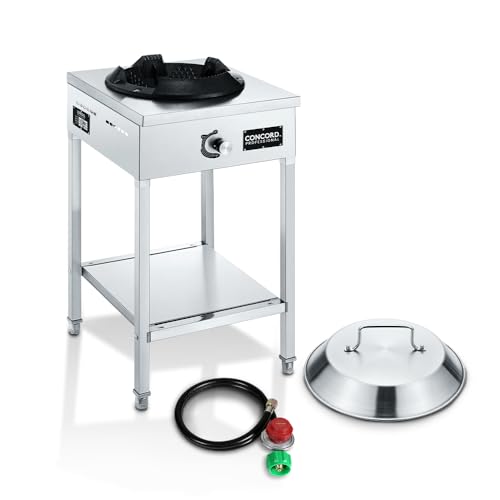
Concord Professional Vortex Burner Stainless Steel Commercial Wok Range Single Burner Outdoor Propane Stove. Great for Stir Fry, Outdoor Kitchen, Asian Cuisine
Included for 'Best Wok Burners for High-Heat Cooking' because the listing specifies Outdoor Kitchen and Asian Cuisine, details this guide uses to compare options.
View on Amazon
Cuisinart Outdoor Wok Station with Rear Wheels, 14" Steel Pan, 50,000 BTU
Included for 'Best Wok Burners for High-Heat Cooking' because the listing specifies 14" Steel Pan and 000 BTU, details this guide uses to compare options.
View on Amazon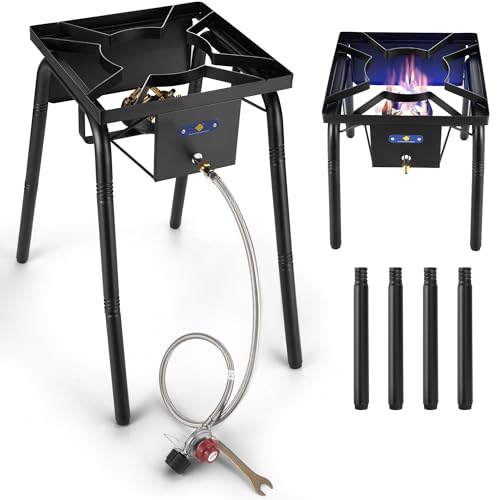
ARC Propane Burner for Outdoor Cooking, High-Pressure 220,000 BTU Single Burner Propane Stove Wok Jet Burner Gas Burner,ideal for Woks, Skillets and Pots, Height Adjustable Legs
Included for 'Best Wok Burners for High-Heat Cooking' because the listing specifies High-Pressure 220 and ideal for Woks, details this guide uses to compare options.
View on AmazonThe number is not the temperature your wok reaches. It is the rate of energy input, and only a fraction of it ends up in the food. An open gas burner loses most of its heat to the air around the pan: the flame licks up the sides of a round-bottomed wok, heats the kitchen, and never touches the food. Realistic transfer efficiency for an open gas burner under a wok is somewhere around 30–45 percent, and a badly matched wok-to-ring setup can be worse. This is why a 100,000 BTU wok burner is not absurd overkill — it is roughly the equivalent of 35,000–45,000 BTU actually reaching the metal.
Induction inverts that math. A 3,500 W induction wok cooker draws about 12,000 BTU/hr of electrical energy, but 85–90 percent of it goes into the pan rather than the room. In practical terms, a 3,500 W induction unit heats a carbon steel wok about as fast as a 25,000–30,000 BTU gas burner, and it does so without dumping combustion products or waste heat into the kitchen. The trade-off is that induction cannot produce wok hei — the characteristic char comes partly from flame and from oil vapor igniting above the food, which induction simply cannot replicate.
Output Tiers and What Each One Can Do
| Output tier | Typical rating | What it handles | Realistic limitations |
|---|---|---|---|
| Portable butane cassette | 8,000–15,000 BTU/hr | Stir-fries for 2 people, fried rice, noodles, small batches of vegetables | Falls off sharply when you overload the wok; struggles to keep a 14 in wok above 400°F |
| Standard residential rangetop burner | 9,000–15,000 BTU/hr | Flat-bottomed wok cooking, braises, moderate stir-fry | Round-bottom woks sit too far from the flame; recovery time after adding cold food is slow |
| Pro-style range wok burner | 18,000–30,000 BTU/hr | Genuine high-heat stir-fry, 12–14 in carbon steel wok, restaurant-style tossing | Needs a hood rated 600–1,200 CFM; many homes need a gas line upgrade |
| Built-in outdoor power burner | 15,000–60,000 BTU/hr | Outdoor wok work, large-batch frying, boiling, crawfish and crab boils | Permanent installation, gas line or propane plumbing, weather exposure |
| Outdoor propane floor burner | 65,000–210,000 BTU/hr | Full restaurant-grade wok hei, 14–18 in woks, rapid searing, deep frying | Outdoor only, needs 10 ft of clearance, consumes propane fast, loud and bright |
| Induction wok cooker | 1,800–5,000 W (6,000–17,000 BTU/hr equivalent) | Indoor stir-fry, boiling, steaming, precise temperature holding | Requires a flat-bottomed or specially shaped wok; no char flavor; high-output models need 240 V |
One caution on shopping by BTU alone: ratings are measured at the burner, not at the wok, and they are measured at a specific inlet pressure. A burner rated 160,000 BTU/hr on propane (11 in water column inlet pressure) will not deliver that number if your regulator is undersized, your hose is too long, or your tank is nearly empty and frosting over. Propane tanks chill as they draw vapor, and a 20 lb tank at 40°F ambient can struggle to vaporize enough fuel to feed a 160,000 BTU burner continuously. This is the single most common reason a big burner underperforms — not a defect, just cold propane.
Fuel Type: The Decision That Shapes Everything Else
Fuel determines your maximum practical output, where you can legally cook, what the burner weighs, and how much per hour you spend on heat.
Propane (LP)
Propane is the default for high-output outdoor wok burners because it delivers enormous heat from a portable tank. One gallon of propane contains roughly 91,500 BTU. A standard 20 lb barbecue tank holds about 4.6 gallons when filled to the 80 percent safety limit, which works out to roughly 420,000 BTU of usable energy.
| Burner output | Runtime on a full 20 lb tank | Practical sessions per tank |
|---|---|---|
| 65,000 BTU/hr | About 6.5 hours at full throttle | 20–25 stir-fry sessions |
| 100,000 BTU/hr | About 4.2 hours at full throttle | 12–18 sessions |
| 160,000 BTU/hr | About 2.6 hours at full throttle | 7–10 sessions |
| 210,000 BTU/hr | About 2 hours at full throttle | 5–8 sessions |
Those numbers assume full throttle, which almost nobody uses for the whole cook. Real stir-fry sessions alternate between 30 seconds of maximum flame and a few minutes at part throttle, so most owners get a month or two of regular cooking from one tank. If you plan to cook several times a week, budget for a second tank so you always have a spare.
Propane also requires a regulator. High-pressure outdoor burners use an adjustable 0–20 psi or 0–30 psi regulator with a hose, usually 3–4 ft long, sometimes 5–10 ft. Low-pressure built-in burners use a 10–11 in water column regulator and a 3/8 or 1/2 in supply line. Mixing the two is a common and dangerous mistake — never connect a high-pressure regulator to a built-in appliance.
Natural Gas
Natural gas is delivered at low pressure through your home’s lines and contains roughly 1,030 BTU per cubic foot. It is convenient, never runs out, and costs less per BTU than propane in most markets. Its weakness is peak output: because it arrives at 7 in water column (about 0.25 psi), the burner must be physically larger to hit the same BTU rating, and large burners need large pipes.
| Pipe size (black iron, natural gas, ~0.5 in WC drop) | 10 ft run | 20 ft run | 30 ft run | 50 ft run |
|---|---|---|---|---|
| 1/2 in | ~130,000 BTU/hr | ~92,000 BTU/hr | ~73,000 BTU/hr | ~56,000 BTU/hr |
| 3/4 in | ~278,000 BTU/hr | ~190,000 BTU/hr | ~152,000 BTU/hr | ~115,000 BTU/hr |
| 1 in | ~520,000 BTU/hr | ~350,000 BTU/hr | ~285,000 BTU/hr | ~215,000 BTU/hr |
These are approximate figures for typical installations and will vary with the gas utility’s delivery pressure, the number of fittings, and local code. Treat them as a reason to hire a licensed gas fitter rather than a reason to buy pipe. The practical takeaway: if you want a 25,000 BTU wok burner plus a 22,000 BTU power burner plus a water heater and furnace on the same 1/2 in branch, you will likely need a larger line run.
Butane
Butane cassette stoves are the quiet workhorses of small kitchens and rental apartments. They burn hot and clean, they are certified for indoor use with proper ventilation, and they need no plumbing. The catch is energy density per canister. An 8 oz (227 g) butane canister holds roughly 10,000 BTU of energy, so a 10,000 BTU/hr stove burns a full canister in about an hour at maximum output — closer to two hours of real cooking at part throttle. Canisters cost $2–$5 each in multi-packs, which makes butane the most expensive way to buy heat per BTU if you cook heavily.
Induction
Induction is electric, so it sidesteps combustion, gas lines, and clearance rules entirely. It heats the pan directly through a magnetic field, which is why it is fast and why the cooktop surface itself stays comparatively cool. The requirement is a ferrous pan — carbon steel and cast iron work; aluminum and most stainless without a magnetic base do not. Portable units run on 120 V and draw 1,200–1,800 W, which is at or near the limit of a standard 15 A kitchen circuit. Higher-output wok induction (3,000–5,000 W) requires a dedicated 240 V circuit, typically 20 A.
| Fuel | Typical achievable output | Indoor use | Heat delivered to pan | Cost profile |
|---|---|---|---|---|
| Propane | 65,000–210,000 BTU/hr | Outdoors only | ~30–45% | Low per session; $50–$70 per tank refill |
| Natural gas | 15,000–60,000 BTU/hr | Indoors with ventilation | ~30–45% | Lowest per BTU; requires plumbing |
| Butane | 8,000–15,000 BTU/hr | Indoors with ventilation | ~35–50% | Highest per BTU; $2–$5 per canister |
| Induction | 6,000–17,000 BTU/hr equivalent | Indoors, no combustion | ~85–90% | Low per session; higher equipment cost |
Pan Support: The Most Overlooked Spec on the Box
A wok burner lives or dies by how it holds the wok. A round-bottomed wok balanced on a flat grate sits 2–3 inches above the flame, and at that distance even a 60,000 BTU burner performs like a 15,000 BTU one. Pan support is where cheap burners give themselves away.
Wok Rings and Cradles
A wok ring is a conical collar, usually cast iron or heavy stamped steel, that sits on the grate and cradles the wok’s curve. Ring diameter matters: a 14 in wok with a 7–9 in ring seats properly; a ring that is too small lets the wok sink and wobble, and one that is too large leaves the base hovering. Many outdoor floor burners include a ring or a three-arm cradle; many indoor ranges include a reversible ring that flips from wok duty to flat-bottom duty.
Round-Bottom vs. Flat-Bottom Woks
| Wok type | Base diameter | Best burner match | Notes |
|---|---|---|---|
| Traditional round-bottom carbon steel | Point contact | Outdoor floor burner with ring; dedicated indoor wok burner with ring | Best heat concentration and tossing action; requires a ring on every other surface |
| Flat-bottom carbon steel | 4–6 in | Standard rangetop, induction, portable butane | Stable everywhere; slightly less heat concentration; the only shape that works on induction |
| Hybrid (round body, small flat base) | 2–3 in | Most burners, with or without a ring | Compromise shape; popular for mixed kitchens |
| Cast iron wok | Varies | Any, but heavy | Excellent heat retention, poor responsiveness, 6–9 lb empty; hard to toss |
| Carbon steel, 12–14 in, 14-gauge | Varies | All high-heat burners | The standard for stir-fry; seasons like cast iron, weighs 2–3.5 lb, responds instantly |
Carbon steel is the material that matters most here. A 14 in, 14-gauge carbon steel wok weighs 2–3.5 lb, costs $25–$60, and after seasoning performs better than anything else at high heat. It is also the only wok material that reacts fast enough to a flame adjustment to be useful on a 100,000 BTU burner — thin enough to respond, thick enough not to warp.
Flame Control: Simmer to Searing on the Same Burner
Raw output is easy to advertise; control is hard to engineer. A burner that goes from 160,000 BTU to nothing is useless for anything except searing. What you want is a wide turndown ratio — the ability to hold a genuine simmer at the low end without the flame snuffing out.
What to Look For
- Needle valve or adjustable regulator. Outdoor floor burners typically use a needle valve or an adjustable regulator to throttle the flame. A needle valve gives finer control than a ball valve; a good adjustable regulator gives you a usable range from a bare flicker to full blast.
- Dual-ring or dual-stack burners. Many pro-style indoor burners use two concentric rings — a small inner ring for simmering and a large outer ring for high heat. Running only the inner ring gives you a stable 500–900 BTU simmer; running both gives full output.
- Simmer rating. Look for an explicitly stated minimum output. A burner that will hold 800–1,500 BTU/hr is a genuine simmer burner. If the manufacturer only publishes the maximum, assume the low end is coarse.
- Continuous grates. On indoor ranges, continuous cast iron grates let you slide a wok or pot between burners without lifting. On outdoor floor burners, a three- or four-arm cradle is what you get instead.
- Air shutter adjustment. A proper burner has an adjustable air shutter so you can tune the flame from yellow and lazy to blue and sharp. Yellow tips mean incomplete combustion and soot on the bottom of your wok.
Burner Design and Heat Pattern
For wok cooking, a ring-shaped flame that wraps the lower third of the wok is better than a single central jet. Central jets create a hot spot that scorches the center of the wok while the sides stay cool — the opposite of what stir-fry needs. This is why outdoor wok burners often use a cast iron burner head with dozens of ports arranged in a circle, and why commercial wok ranges use a ring burner with a wide flame spread. When you compare two burners of similar BTU rating, favor the one with a wider, more circular port pattern.
Safety Features and Clearances
This is the section most buying guides skip, and it is the one that determines whether your setup is legal, insurable, and safe.
Features That Matter
- Thermocouple or flame-failure device. Standard on indoor ranges and required on many commercial-style units. If the flame goes out, the gas shuts off within seconds. Outdoor floor burners generally do not have this — you are the safety device.
- Oxygen depletion sensor (ODS). Found on indoor-rated butane and propane heaters and on some indoor-rated portable stoves. It shuts the unit down when oxygen drops. Not a substitute for ventilation.
- Tip-over shutoff. Common on portable indoor butane stoves. If the unit tips, gas stops. Worth having in a small kitchen where counter space is tight.
- Overpressure protection. Some butane cassettes include a pressure-sensing shutoff that locks the canister out if internal pressure spikes — usually a hot-weather or direct-sun issue.
- Certification. Look for ANSI Z21.1 / CSA 1.1 for household gas cooking appliances, and ANSI Z21.58 / CSA 1.6 for outdoor cooking gas appliances. For commercial-style indoor wok ranges, expect NSF and UL listings. An uncertified burner is a real risk, not a bargain.
- Gas leak detection. Soapy water on every joint is the standard field test. Never use a flame to check for leaks.
Clearance Numbers You Actually Need
| Installation | Clearance to combustibles | Vertical clearance | Ventilation requirement |
|---|---|---|---|
| Outdoor propane floor burner | At least 10 ft from walls, overhangs, fences, and structures | Never under any roof or overhang | Open air only; never in a garage, shed, or tent |
| Built-in outdoor power burner | Typically 21–24 in to a combustible sidewall; follow the manual | 24–30 in to a combustible overhang, or a listed outdoor hood | Outdoor, uncovered or under a rated outdoor hood |
| Indoor gas range with wok burner | 24 in to a combustible sidewall; 30 in to unprotected combustible above | Range hood at 24–30 in above the cooking surface | Hood rated 600–1,200 CFM for a 20,000+ BTU wok burner |
| Portable butane cassette | 6 in from walls and 12 in from anything above | Not under upper cabinets while lit | Open a window; never in a sealed room |
| Induction wok cooker | 2–4 in side and rear clearance for airflow | Check the manual for hood clearance | No combustion, but still ventilate for steam and oil smoke |
Two hard rules bear repeating. First, a propane floor burner is an outdoor appliance, full stop — carbon monoxide from a 160,000 BTU burner in a garage will reach dangerous concentrations in minutes, and garages are also where the gasoline, paint, and solvents live. Second, a wok burner in an indoor kitchen without a real exhaust hood will coat your walls in aerosolized oil within a few months. If you cannot install a hood that vents outside, choose induction or cook outdoors.
Carbon Monoxide and Ventilation Math
Combustion produces CO. A well-tuned blue flame produces very little; a yellow, sooting flame produces a lot. As a rough guide, a range hood should move at least 100 CFM per 10,000 BTU/hr of burner output for high-heat cooking, which means a 25,000 BTU wok burner wants a 250–400 CFM hood at minimum, and a 60,000 BTU outdoor-style power burner used indoors would want 600+ CFM. Add a CO alarm within 15 ft of the cooking area regardless of what you install.
Countertop Footprint and Storage
If your wok burner has to live on a counter and go back in a cabinet, footprint matters as much as output.
| Type | Footprint | Height | Weight | Storage |
|---|---|---|---|---|
| Butane cassette stove | ~13.5 × 11.5 in | 3.5–4 in | 3.5–5 lb | One cabinet shelf; canisters store upright nearby |
| Folding propane camp burner | ~14 × 12 in folded | 3.5–5 in folded | 3–6 lb | Folds to the size of a laptop bag |
| Portable induction wok cooker | ~20 × 16 in | 6–9 in | 15–25 lb | Needs a full shelf; heavier than it looks |
| Single outdoor propane floor burner | ~15.5 in diameter | 12–14 in | 12–20 lb | Garage or shed; not a cabinet item |
| Built-in outdoor power burner | Cutout ~12–14 × 16–18 in | Flush or low-profile | 15–30 lb | Permanent |
A 13.5 × 11.5 in butane stove fits on virtually any counter and, critically, fits in the dead space beside a microwave. A portable induction wok cooker at 20 × 16 in does not — it needs its own landing zone, and at 15–25 lb it is awkward to move twice a day. If you are choosing between the two for a small kitchen, weigh how often you will actually lift it.
There is also a heat-clearance footprint issue on countertops. A butane stove needs 6 in of clear space to the sides and 12 in above, which means it cannot sit directly under upper cabinets while lit. Measure from the top of the stove to the bottom of the cabinet before you commit.
Indoor vs. Outdoor: Choosing Your Side of the Wall
| Factor | Indoor | Outdoor |
|---|---|---|
| Maximum practical output | 18,000–30,000 BTU/hr gas; 3,500–5,000 W induction | 65,000–210,000 BTU/hr propane |
| Wok hei potential | Limited; a strong indoor wok burner gets close | Full, restaurant-grade |
| Ventilation | Hood required, 600–1,200 CFM for high output | Open air |
| Installation cost | $0–$400 for a plug-in; $1,500–$6,000+ for a hood and gas line | $0 for a floor burner; $500–$2,000 for a built-in with gas plumbing |
| Weather exposure | None | Burner, hose, and regulator degrade in sun and rain; cover when not in use |
| Convenience | Cook in any weather, any hour | Weather-dependent, and often too hot or too cold to stand over |
| Smoke and oil aerosol | Deposits on every surface in the room | Disperses; a light breeze helps |
| Best for | Weeknight cooking, apartments, renters, anyone without a patio | Serious stir-fry, large batches, entertaining, wok hei |
The honest answer for most people who want real wok cooking is both: a $150 outdoor propane burner for the two or three times a week you want maximum heat, plus a butane cassette or a good indoor burner for everything else. That combination costs less than a single mid-range pro-style range and outperforms it on the one metric that matters.
Decision Matrix: Match the Burner to Your Situation
| Your situation | What to buy | Expected spend |
|---|---|---|
| Renting a small apartment, no patio | Countertop butane cassette stove (Iwatani, GAS ONE, SENGOKU) plus a 12 in flat-bottom carbon steel wok | $60–$130 |
| House with a driveway or patio, want maximum heat | 65,000–160,000 BTU propane floor burner with ring, plus a 20 lb tank | $140–$320 |
| Existing outdoor kitchen with a gas stub | Built-in 15,000–60,000 BTU power burner, natural gas or LP | $450–$1,800 installed |
| Indoor cook, willing to install a hood | Pro-style range with a 20,000+ BTU wok burner, or a value brand with an 18,000–22,000 BTU burner | $1,800–$8,000 plus hood |
| Indoor cook, cannot vent outside | Portable or drop-in induction wok cooker, 1,800–3,500 W | $120–$900 |
| Cooking for 6+ people regularly | Outdoor floor burner at 100,000+ BTU, or a built-in 60,000 BTU power burner | $250–$1,500 |
| Camping, tailgating, balcony only | Folding propane camp burner or butane cassette; check balcony rules first | $40–$180 |
| Limited hand strength or reach | Induction wok cooker with front controls; avoid heavy cast iron woks | $150–$900 |
| Small kitchen, one burner to do everything | Pro-style range with a wide-turndown wok burner, or a 3,500 W induction wok cooker | $1,800–$4,000 |
| Deep frying, boiling, and wok work outdoors | Outdoor floor burner with a wide pot support and a ring; 100,000–160,000 BTU | $150–$300 |
Outdoor Propane Floor Burners: The High-Heat Benchmark
This is the category that defines “best wok burners” for anyone with outdoor space. A single cast iron burner head on a welded steel frame, fed by a hose and an adjustable high-pressure regulator, rated 65,000–210,000 BTU/hr. Bayou Classic, King Kooker, and Eastman Outdoors are the names most consistently associated with it, and the category has been stable for decades because the design is essentially solved.
What Separates a Good One From a Bad One
- Frame gauge and weld quality. Look for at least 16-gauge tubular steel. Thin frames flex under a heavy cast iron wok and the burner head drifts off center.
- Burner head material. Cast iron holds up far better than stamped steel, which warps and cracks at the ports after a few dozen high-heat sessions.
- Air shutter. An adjustable shutter lets you tune the flame blue. Fixed shutters are a cost-cutting sign.
- Leg height and stability. You want the wok rim at roughly 30–34 in above the ground for comfortable tossing — about the same height as a standard kitchen counter. Short burners force you to bend; tall ones make the wok hard to control.
- Ring or cradle included. A three-arm cradle handles both round-bottom woks and flat pots. A cast iron ring holds a round-bottom wok more securely but does not support a stockpot.
- Hose length and regulator type. 3–4 ft is standard; longer hoses drop pressure. Confirm the regulator is rated for your burner’s BTU and inlet pressure.
Practical Realities
These burners are loud. A 160,000 BTU burner at full throttle sounds like a small jet, and you will not be able to hold a conversation next to it. They also throw a lot of radiant heat downward, so they scorch grass and stain concrete. A 24 in square of concrete pavers or a metal drip tray underneath solves both the grass problem and the grease problem.
They consume propane fast, they need 10 ft of clearance from anything combustible, and they should never be used under a roof, in a garage, or on a wooden deck without a non-combustible barrier and generous clearance. Wind is their enemy — a gusty day will push the flame sideways and drop your pan temperature by 100°F or more. A simple three-sided wind screen made from a piece of sheet metal helps enormously.
Expect to pay $90–$250 for the burner, $50–$70 for a full 20 lb tank, and $15–$30 for a spare regulator and hose. That is the entire cost of restaurant-grade stir-fry at home.
Built-In Outdoor Power Burners
If you already have an outdoor kitchen, a built-in power burner or side burner integrates into the counter and runs off the same gas line as your grill. Blaze, Bull, Napoleon, Summerset, Coyote, Twin Eagles, Lynx, and Delta Heat all build this category, typically rated 15,000–60,000 BTU/hr.
Why They Are Worth It
A built-in burner never runs out of fuel, never needs a tank swap mid-cook, and lives under a cover. It also keeps your wok at a comfortable counter height with no bending, which matters more than most people expect once you are tossing a 3 lb wok for ten minutes.
What to Check Before Buying
- Cutout dimensions. Typically 12–14 in wide by 16–18 in deep, but they vary by brand. Measure your counter before ordering, and confirm the cutout is at least 3 in from any counter edge and 6 in from a combustible wall.
- Gas type and orifice. Most ship set up for one fuel with a conversion kit for the other. Conversion is not just an orifice swap on every model — some require a new valve or regulator. Confirm before you buy.
- Ignition. Push-button or rotary electronic ignition is standard; battery-powered ignition is common on value models. A burner you have to light with a wand in the wind is annoying.
- Cover. A fitted cover roughly doubles the life of the burner head, the igniter, and the control knobs. Budget $30–$80.
- Wind management. Look for a recessed burner head or a raised bezel. Exposed heads blow out in a moderate breeze.
Output Expectations
A 30,000 BTU built-in power burner is a genuinely useful wok burner. It will not match a 160,000 BTU floor burner, but it will produce a respectable sear and it does it at counter height with unlimited fuel. If you are choosing between a 15,000 BTU side burner and a 30,000–60,000 BTU dedicated power burner, the power burner is the one worth the counter space.
Countertop Butane and Portable Propane Burners
This is the category for renters, dorm kitchens, small apartments, balconies, and anyone who wants high heat without a gas line.
Butane Cassette Stoves
Iwatani, GAS ONE, and SENGOKU are the names most commonly found in this category. They run on 8 oz butane canisters that snap into a compartment on the side or back of the unit. Output is typically 8,000–15,000 BTU/hr, and most units have a magnetic or pressure-sensing safety lock that prevents the canister from being inserted incorrectly.
Strengths: they are cheap ($30–$120), light (3.5–5 lb), genuinely indoor-rated when used with ventilation, and they produce a clean blue flame with very little soot. They heat up a 12 in carbon steel wok adequately for two-person stir-fries.
Weaknesses: canister cost, limited output, and cold-weather performance. Butane does not vaporize well below about 40°F, so these stoves become sluggish in an unheated space in winter. They also do not tolerate overload — dump a pound of cold chicken into a hot wok and the temperature crash is severe and slow to recover.
Folding Propane Camp Burners
Snow Peak, Coleman, and Kovea build small propane burners that run on 1 lb disposable cylinders or a hose to a 20 lb tank. These typically run 8,000–12,000 BTU/hr, fold flat, and weigh 3–6 lb. A hose adapter to a 20 lb tank turns one of these into a much more economical setup, though you lose the portability.
These are outdoor-rated only in most cases. A 1 lb propane cylinder burner used on a balcony is a common setup, but check your building’s rules — many prohibit open flame on balconies entirely, and for good reason.
How They Compare
| Butane cassette | Folding propane | |
|---|---|---|
| Output | 8,000–15,000 BTU/hr | 8,000–12,000 BTU/hr |
| Fuel cost per hour at full blast | $2–$4 (one 8 oz canister) | $1.50–$3 on 1 lb cylinders; far less on a 20 lb tank |
| Cold weather | Poor below 40°F | Better; propane vaporizes down to about -40°F |
| Indoor rating | Common, with ventilation | Usually outdoor only |
| Weight | 3.5–5 lb | 3–6 lb |
| Best for | Apartment kitchens, small batches | Camping, balconies, tailgating |
Indoor Pro-Style Ranges With Wok Burners
If you want high heat inside, this is where the money goes. Wolf, Thermador, BlueStar, Capital, American Range, Dacor, and Smeg all build ranges with at least one burner rated for wok duty, and the value tier — NXR, Thor Kitchen, ZLINE, Bertazzoni, Verona — has pushed 18,000–22,000 BTU burners into the $1,800–$4,000 range.
What Makes a Burner a Real Wok Burner
- 18,000 BTU/hr minimum, 22,000–30,000 preferred. Below 18,000 you are cooking stir-fry, not searing it.
- A wide turndown. A dedicated wok burner should also hold a true simmer, usually 500–1,500 BTU/hr on the inner ring.
- A wok ring included or available. Many pro-style ranges ship with a cast iron wok ring that fits the largest burner. If it is not included, confirm the accessory exists before you buy — a round-bottom wok on a flat grate is a waste of a good burner.
- Sealed or open burners. Open burners are easier to clean around and often allow more airflow for higher output; sealed burners are easier to wipe down. For wok work, open burners with a removable grate are generally preferred.
- Continuous grates. Cast iron, continuous, and heavy enough not to rattle. Thin grates flex under a wok and let it rock.
- Ignition and re-ignition. Electronic ignition with automatic re-ignition is standard on pro-style ranges and worth having — a burner that relights itself after a boil-over saves a lot of cursing.
The Ventilation Bill Nobody Mentions
A 25,000 BTU indoor wok burner needs a hood that moves roughly 250–500 CFM at minimum, and realistically 600–1,200 CFM to keep oil aerosol and combustion byproducts out of the room. A 600 CFM hood typically requires a 6–8 in duct, and a 1,200 CFM hood requires an 8–10 in duct plus a makeup air provision in many jurisdictions. If your kitchen has a recirculating microwave hood, it will not work — recirculating hoods filter grease and odors but return the combustion products to the room.
Budget $600–$2,500 for the hood, $400–$1,500 for installation and ducting, and possibly more if the duct route requires opening walls. This is often more than the price difference between a standard range and a pro-style one, and it is the reason many people end up cooking outdoors instead.
Commercial-Style Indoor Wok Ranges
Beyond residential pro-style ranges, there is a genuine commercial category: dedicated gas wok ranges from Garland, Vulcan, Imperial, and Montague, built for restaurant kitchens. These are rated 60,000–130,000 BTU/hr per burner, use a ring burner sized to cradle a round-bottom wok directly, and typically require a Type I or Type II hood, fire suppression, and a commercial-grade gas supply.
They occasionally show up in high-end home kitchens and in accessory dwelling units converted to serious cooking spaces. If you go this route, expect:
- 120–240 V electrical for ignition and controls, plus a dedicated circuit
- A commercial hood with fire suppression, often $4,000–$15,000 installed
- A gas line sized for 100,000+ BTU/hr at the appliance, which usually means 3/4 in pipe minimum
- Clearance and code requirements that vary significantly by jurisdiction
For most homes this is impractical. It is worth knowing it exists so you understand what the ceiling of indoor wok cooking actually looks like — and so you can recognize that a 25,000 BTU residential wok burner is a compromise, not a failure.
Induction Wok Cookers
Induction is the only way to get serious indoor heat without combustion. Residential countertop units run 1,800 W on 120 V; drop-in and commercial units run 3,000–5,000 W on 208–240 V. CookTek, Vollrath, Cadco, Garland, and Spring USA build commercial-grade wok induction; several consumer brands build portable versions.
Why the Wattage Matters More Than It Looks
A 3,500 W induction unit draws about 12,000 BTU/hr of electrical energy but delivers 85–90 percent of it to the pan, so the effective heating rate is comparable to a 25,000–30,000 BTU gas burner. A 1,800 W portable delivers about 6,000 BTU/hr equivalent, roughly on par with a good butane cassette. The gap between a $150 portable and a $900 drop-in is mostly about watts and coil diameter, not features.
Practical Requirements
- A magnetic wok. Carbon steel works best. A flat-bottomed carbon steel wok with a 5–6 in base is the standard pairing. Some induction wok cookers use a curved coil and a matching curved wok, which is more efficient but locks you into that wok.
- Circuit capacity. A 1,800 W unit draws 15 A at 120 V, which is the entire capacity of a standard kitchen circuit. Do not share it with a microwave or kettle. A 3,500 W unit needs a dedicated 240 V, 20 A circuit.
- Pan flatness. Induction demands contact. A warped wok bottom will cause hot spots and may trigger the pan-detection circuit.
- No wok hei. This is the fundamental limit. Induction gives you heat, control, and cleanliness, but not char. If wok hei is the goal, induction is the wrong tool.
Where Induction Wins
Induction is unbeatable for indoor kitchens without hoods, for apartments with gas restrictions, for anyone sensitive to combustion byproducts, and for precise temperature work like tempering chocolate, holding a braise, or deep frying at a stable 350°F. It also cools down fast and wipes clean in seconds, which matters more on a weeknight than peak output.
Installation, Plumbing, and Moving Realities
These are the details that turn a good purchase into a bad experience.