Key takeaways
- One additional seat that does not require rearranging the sofa.
- A visual anchor for an empty corner or a blank wall segment beside a window.
- A way to introduce a second color or texture without reupholstering the sofa.
- A reading or phone-call spot that is separate from the TV-facing sofa.
- A movable seat you can pull into a conversation circle when guests arrive.
The Short Answer
Yes, if your sofa alone cannot seat everyone who regularly sits in the room at the same time. That is the one condition that matters. A standard 84-inch sofa comfortably seats three adults; if your household or your usual guest list is four or more, an accent chair is not decoration, it is the missing seat. If you live alone or as a couple and rarely host, the chair becomes optional, and the decision shifts to whether you want a dedicated reading spot or a way to fill an empty corner.
The cost of getting it right is modest. A well-made upholstered accent chair with a metal or hardwood frame runs $100 to $150 at the entry level, $200 to $400 for mid-range pieces with thicker cushions and better fabric, and $500 or more for designer or solid-hardwood frames. Most living rooms do not need to spend past the $150 mark to get a chair that lasts five to eight years.
Our top picks

As an Amazon Associate we earn from qualifying purchases at no extra cost to you.
What You Actually Get
An accent chair is a single-seat upholstered chair that is styled to contrast with, rather than match, your sofa. Compared with a club chair or recliner, it is lighter and smaller. Typical dimensions are 26 to 32 inches wide, 28 to 34 inches deep, and 30 to 36 inches tall, with a seat height of 17 to 19 inches and a seat depth of 20 to 22 inches. Weight runs 25 to 45 pounds, which means one person can move it for a party and move it back afterward.
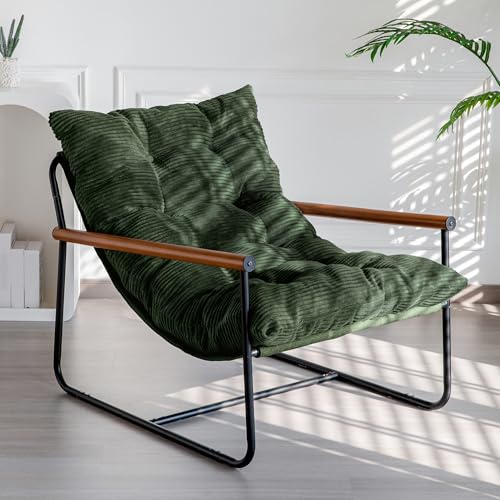
The MAXYOYO Modern Accent Chair with a metal frame is a useful benchmark for the entry tier. At roughly $105 to $110 depending on the colorway, it uses a powder-coated steel frame, which resists wobble better than the stapled softwood frames common at this price. Chairs in this class typically use 1.8-to-2.0-pound-per-cubic-foot foam in the seat, which feels firm at first and softens over the first month. Expect a seat height near 18 inches and a total weight around 30 pounds.
In practical terms, an accent chair gives you:
- One additional seat that does not require rearranging the sofa.
- A visual anchor for an empty corner or a blank wall segment beside a window.
- A way to introduce a second color or texture without reupholstering the sofa.
- A reading or phone-call spot that is separate from the TV-facing sofa.
- A movable seat you can pull into a conversation circle when guests arrive.
Pros
- Adds a seat for $100 to $150. Expanding to a bigger sofa or sectional to gain one seat costs four to eight times more.
- Breaks up a sofa-and-TV layout. A chair angled toward the sofa turns a viewing room into a conversation room.
- Fixes visual imbalance. A long sofa on one wall with nothing opposite reads lopsided. A chair on the far side evens the weight of the room.
- Easy to swap. Reupholstering or replacing a $110 chair is trivial compared with changing a sofa. Style updates get cheaper.
- Works in tight rooms. At 28 to 30 inches wide, a compact accent chair fits where a loveseat cannot.
- Metal-frame models are stable. Steel frames do not loosen at the joints the way stapled softwood frames do after a few years.
Cons
- Often less comfortable than the sofa. Accent chairs prioritize shape over cushion depth. Seat cushions are usually 3 to 4 inches thick versus 5 to 7 inches on a sofa.
- Becomes a laundry pile. A chair nobody sits in turns into a coat rack. If you buy it purely to fill space, be honest about whether it will get used.
- Takes 9 to 12 square feet. Including clearance, a chair claims about a 3-by-3-foot or 3-by-4-foot footprint. In a 10-by-12-foot room, that is nearly 10 percent of the floor.
- Cheap fabric pills quickly. Entry-level polyester velvet and linen-look weaves show wear at the front edge of the seat within a year of daily use.
- Style mismatch is easy. “Accent” does not mean “anything goes.” A chair with a very different leg height or arm style than the sofa can look like an afterthought.
- Assembly required. Most sub-$200 chairs ship in two or three pieces. Budget 15 to 30 minutes and a screwdriver.
Who Should Buy It
- Households of four or more, or anyone who hosts more than a couple of times a month. The extra seat pays for itself.
- Rooms with a sofa on one wall and dead space opposite or in a corner. The chair balances the layout.
- Anyone who reads, works on a laptop, or takes calls in the living room and wants a spot that is not the TV sofa.
- Renters who want to change the look of a room without touching the sofa or the walls.
- Open-plan homes where a chair can mark the edge of the living zone.
Who Should Skip It
- Living rooms under about 120 square feet where the sofa already fills the long wall. A chair will block the walkway.
- Singles or couples who never host and never sit anywhere but the sofa. Spend the money on a better sofa cushion instead.
- Anyone whose main need is a nap or recline spot. An accent chair will disappoint; a recliner or chaise is the right tool.
- Homes where the corner in question is already a traffic path to a hallway or door.
- Buyers who want the chair to match the sofa exactly. That is a loveseat or a matching armchair from the same collection, and it is a different purchase.
Cheaper Alternatives
| Option | Cost | Trade-off |
|---|---|---|
| Entry-level upholstered accent chair with metal frame | $100 to $150 | Baseline. Firm foam, thin fabric, but a stable frame and a proper backrest. |
| Storage ottoman or pouf (16 to 18 inches tall) | $40 to $90 | Seats one in a pinch and hides blankets. No back support, so it is a 20-minute seat, not an evening seat. |
| Folding or stacking chair kept in a closet | $25 to $60 | Solves the guest-seat problem with zero daily footprint. Adds nothing to the room’s look. |
| Floor cushion or oversized bean bag | $50 to $120 | Casual and popular with kids. Hard to get out of for older adults, and it reads as a playroom piece. |
| Secondhand armchair, recovered with a slipcover | $20 to $80 plus $30 to $60 slipcover | Often better built than new budget chairs. Takes time to find and may need cleaning. |
| Dining chair borrowed for guests | $0 | Free and already in the house. Uncomfortable past an hour and visually out of place in the living room. |
FAQ
How much space do I need for an accent chair?
Plan on the chair’s footprint plus 18 inches of clearance in front for legs and 30 to 36 inches for any walkway that passes beside it. A 30-by-30-inch chair therefore needs roughly a 30-by-48-inch zone at minimum. Keep it 14 to 18 inches from a coffee table or side table so a drink is reachable without leaning.
Should the accent chair match my sofa?
No, but it should share one element. Pick a chair that repeats the sofa’s leg finish, one color from a throw pillow, or a similar arm height. Contrast in fabric is fine; a velvet chair next to a linen sofa looks intentional. What looks wrong is a chair with a wildly different seat height, since sitting 3 inches lower or higher than the person next to you is awkward in conversation.
Is one accent chair enough, or do I need two?
One chair balances a sofa in rooms up to about 14 by 16 feet. Two matching chairs opposite the sofa make sense in larger rooms, or when you want a symmetrical layout around a fireplace or TV. Two chairs also cost two chairs, so in 2026 pricing that is $200 to $300 at the entry tier. Start with one, live with it for a month, and add a second only if the room still feels unbalanced.
What seat height works best with a standard sofa?
Match the sofa within an inch. Most sofas have a seat height of 17 to 19 inches; look for a chair in the same range. A chair with an 18-inch seat height and a 20-to-22-inch seat depth suits most adults between 5 feet 2 inches and 6 feet 2 inches. Deeper seats are more comfortable for lounging but harder to sit upright in, which matters if the chair is meant for conversation.