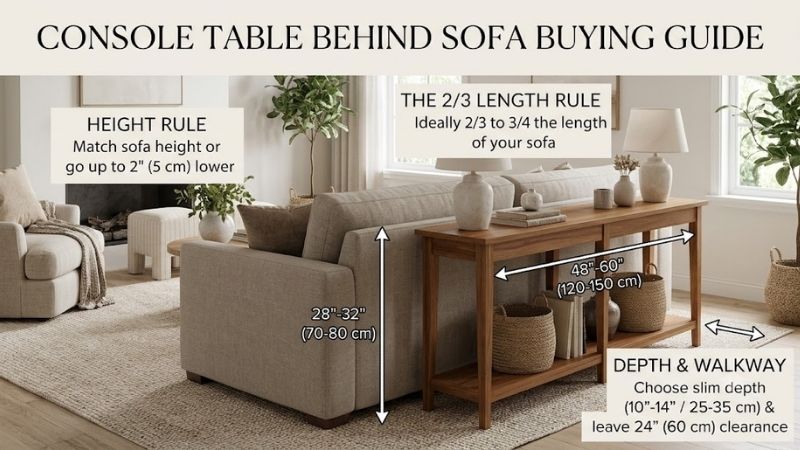
A console table behind sofa buying guide should help you choose furniture that fits securely behind your seating and remains useful every day. Console length, depth, height, stability, storage access, and electrical features all affect the decision. Learn how to measure the sofa, compare construction, route charging cables, and avoid common placement mistakes before purchasing.
What Is a Behind-Sofa Console Table?
A behind-sofa console table is a relatively long, narrow piece of furniture placed along the back of a sofa.
It may sit between the sofa and wall or behind a sofa positioned in the middle of a room.
Its purpose can include holding lamps, photos, books, charging accessories, or other appropriate objects.
However, a behind-sofa console is not necessarily the same as an ordinary entryway table.
A standard entryway console may be too deep or too tall for the available sofa-wall gap.
Some dedicated behind-couch tables are only about six inches deep and are designed primarily as charging ledges.
Choosing the correct type begins with understanding the placement.
Compare the Main Behind-Sofa Table Types
| Type | Primary function | Main limitation |
|---|---|---|
| Ultra-slim console | Small accessories and charging | Limited tabletop depth |
| Standard narrow console | Display and general surface use | Needs more space |
| Console with outlets | Convenient device charging | Electrical cord management |
| Adjustable-height console | Matches varying sofa heights | More locking hardware |
| Console with shelves | Additional storage | Access may be obstructed |
| Console with drawers | Concealed organization | Drawer-opening clearance |
| Solid-looking farmhouse console | Decorative statement | May be heavier and deeper |
| Modular multi-section console | Adaptable length | More joints and assembly |
Step 1: Measure Sofa Length
Start with the sofa’s full rear length.
This is the horizontal reference for selecting the table.
A console can be shorter than the sofa, approximately equal to its length, or in some layouts extend beyond it.
However, a table that projects beyond the sofa may interfere with movement or appear disproportionate.
Short Consoles
A 30–40-inch table may suit a loveseat or one segment of a sectional.
It can hold a lamp or a limited number of accessories.
Medium Consoles
A 40–60-inch model can serve a conventional sofa without occupying the full back edge.
This may be appropriate when the sofa sits near a doorway.
Extra-Long Consoles
Tables around 70–80 inches can span a large sofa.
However, long frames may require careful leveling, and the exact assembled length must fit between surrounding furniture.
Step 2: Measure the Available Depth
Depth determines whether a table fits behind the sofa.
This is especially important when the sofa is positioned against a wall.
Five to Six Inches
A very slim ledge can provide a place for phones or small accessories.
It may be useful when charging access is the main objective.
However, such narrow tops are not suitable for every lamp base or decorative arrangement.
Seven to Nine Inches
This range offers somewhat more space for lightweight everyday objects.
It may still work in a relatively tight gap.
Ten to Twelve Inches
A medium-depth console can provide more useful storage and display space.
However, it may require the sofa to move significantly farther into the room.
Thirteen to Sixteen Inches
A more conventional console can support larger permitted objects.
This depth is generally more appropriate behind a floating sofa with adequate surrounding space.
These are practical size categories, not mandatory construction standards.
Step 3: Check Sofa-Back Height
Height affects appearance, access, and stability.
Measure from the floor to the top of the sofa’s backrest, then compare that figure with the console’s overall height.
Matching the Sofa Back
A surface close to sofa-back height may create a coordinated appearance and make some objects accessible.
However, whether the table should be slightly higher or lower depends on its function.
Lower Consoles
A lower console may remain partially hidden behind the sofa.
It could still be useful for accessible storage from the rear, but objects placed on top may be difficult to reach from the seated side.
Taller Consoles
A taller table may provide a decorative background or room-dividing effect.
However, its stability and the placement of objects need careful consideration.
Heavy or fragile objects should not be positioned where they could fall toward seated occupants.
Adjustable-Height Tables
Some narrow tables offer several height settings.
Confirm that the correct setting is permitted and securely locked before use.
Step 4: Compare Fixed and Adjustable Designs
A fixed-height console generally has fewer adjustment components.
An adjustable table can help when the sofa’s back height is unusual or the furniture may change later.
However, adjustability is useful only when the system is correctly assembled and stabilized.
A long, shallow table at a taller setting may have different tipping characteristics from a lower configuration.
Follow the exact manufacturer instructions.
Step 5: Examine Stability and Anti-Tip Requirements
This is one of the most important steps.
A behind-sofa table can be long and narrow, with a relatively small base depth compared with its height.
Why Narrow Furniture Needs Care
A sideways pull or push can create tipping forces.
The risk depends on the table’s structure, center of mass, load distribution, and floor conditions.
A sofa positioned in front of the table should not be assumed to function as a certified anti-tip restraint.
Anchoring
If the manufacturer requires an anti-tip device, install it into an appropriate structure using the correct hardware.
Do not attach it only to materials that cannot support the specified load.
Adjustable Feet
Some console tables include feet that allow leveling on slightly uneven floors.
This may reduce wobble.
However, leveling does not replace required anchoring.
Weight Limits
Respect the published maximum load for the tabletop and any shelves.
A table that appears sturdy may still have limited permitted loading.
Do not allow children to climb or hang from the table.
Step 6: Evaluate Electrical Outlets
Integrated outlets can make a behind-sofa table more useful.
However, the electrical system should be assessed separately from the furniture.
Outlet Placement
Consider whether the power module is accessible from the intended seats.
A charging point hidden behind a large cushion may be inconvenient.
USB Connections
USB-A and USB-C ports may be provided on selected models.
However, the connector type alone does not establish charging speed or compatibility with every device.
Check published power output.
Power-Cord Routing
Keep the cord away from recliner mechanisms, sofa legs, walking paths, and other moving furniture.
Do not pinch the cord between heavy objects.
Power Ratings
Follow the manufacturer’s total electrical load limits.
A console outlet module should not be assumed suitable for heaters or other high-demand appliances.
Step 7: Compare Materials
Particleboard and MDF
Engineered wood materials are common in affordable consoles.
They can be suitable for ordinary household use but should be protected from water damage, particularly along exposed or damaged edges.
Laminate and Wood-Look Finishes
These can reproduce different wood tones at relatively accessible prices.
However, they should not be confused with solid hardwood.
Wood Veneer
Wood veneer provides a genuine wood surface over a supporting substrate.
Maintenance and repair options depend on the finish.
Solid Wood
Solid wood may offer different repair and refinishing possibilities.
However, it can be heavier and can respond to changes in humidity.
Metal Frames
Metal supports are common in narrow industrial-style tables.
Construction quality depends on welding, fasteners, frame geometry, and surface finish.
Bamboo
Bamboo-based furniture can provide a natural-looking alternative.
However, exact construction, coatings, and loading remain product-specific.
Step 8: Decide Whether Storage Matters
Simple Top
A narrow single surface can be sufficient for phone charging or a small lamp.
It is also relatively easy to clean.
Open Shelves
Shelves can organize books or accessories.
However, their value depends on access.
A lower shelf trapped between the sofa and wall may be inconvenient.
Drawers
Drawers can hide clutter.
But they need room to open, and the drawer direction must suit the furniture placement.
Storage Baskets
Some open-frame consoles can accommodate baskets on lower shelves.
However, baskets must fit within the available dimensions and should not exceed shelf-loading limits.
Step 9: Plan Delivery and Assembly
Long consoles may arrive in several panels or frame sections.
The assembly instructions should be followed closely, particularly where multiple support sections connect.
Check Package Dimensions
A 78-inch finished table may arrive in a smaller package, but that cannot be assumed.
Confirm shipping dimensions if the table must pass through narrow stairways or corridors.
Align Support Members
Incorrectly aligned brackets or fasteners can create wobble.
Do not force components into place or operate adjustable parts before assembly is complete.
Final Inspection
Once assembled, verify that the table is level and stable in its intended location.
Check that it does not contact moving sofa components.
Confirm cords and electrical accessories are correctly positioned.
Step 10: Evaluate Long-Term Ownership
A console table may be inexpensive to buy but inconvenient to maintain if it is difficult to access.
Consider whether you will regularly clean behind the sofa, move the furniture, or change the room layout.
A very long table may be harder to relocate than two smaller pieces.
A powered table introduces electrical components in addition to the frame.
A table with open shelves may collect dust in locations that are difficult to reach.
The most practical design is the one that matches your actual routine.
Buying Checklist
| Criterion | What to verify |
|---|---|
| Sofa length | Console fits proportionately |
| Sofa-back height | Surface is at useful height |
| Available gap | Maximum depth fits |
| Base geometry | Legs clear sofa and baseboards |
| Sofa movement | Reclining and rocking remain unobstructed |
| Stability | Anti-tip requirements understood |
| Tabletop rating | Intended objects are permitted |
| Charging | Outlet output and cord routing |
| Storage | Shelves and drawers remain accessible |
| Materials | Suitable cleaning and moisture care |
| Assembly | Correct hardware and installation |
| Returns | Full delivered cost and return terms |
Frequently Asked Questions
How Do I Choose a Console Table Behind a Sofa?
Measure sofa length, back height, and available depth first. Then compare the table’s maximum assembled dimensions, intended loading, stability, storage access, and electrical features.
Should a Behind-Sofa Table Be the Same Height as the Sofa?
Similar height can provide a balanced appearance, but the correct relationship depends on how the tabletop will be used. The surface may be slightly higher or lower when appropriate.
How Deep Should a Console Table Behind a Sofa Be?
Very narrow charging models may be around six inches deep, while conventional consoles can exceed fourteen inches. Choose based on the actual available gap and intended objects.
Do I Need to Anchor a Behind-Sofa Console Table?
Follow the manufacturer’s anti-tip instructions. Long narrow furniture may require anchoring, especially where children can reach it.
Is a Console Table With Outlets Safe?
It can be suitable when the electrical components are appropriately rated, used correctly, and connected without damaged or pinched cords.
Can I Use a Console Table as a Desk?
Some offer sufficient surface for occasional lightweight tasks, but a narrow sofa console generally lacks the depth and ergonomic configuration of a proper desk.
Conclusion
A console table behind sofa buying guide should prioritize accurate measurements, stability, and daily usefulness before decorative style. Compare length, height, depth, frame construction, outlet placement, load ratings, storage accessibility, and installation requirements. The best table should remain convenient without blocking movement, damaging electrical cords, or creating unnecessary furniture hazards.