
Key takeaways
- Warranty Description: 2 Year Manufacturer
- Tension Supported: 1000 pounds
- Handle Type: Fixed Handle
A power cage is the one piece of home gym equipment where the spec sheet actually tells you something. Two racks can look identical in a product photo and behave completely differently under a loaded bar: 11-gauge steel measures roughly 0.120 inches thick, 14-gauge measures about 0.075, and that 40 percent difference in wall thickness is what separates a rack that sits dead still under 315 pounds from one that shivers on every rep. Add upright dimensions — 3×3-inch tubing versus 2×2 — and you have most of what determines whether the cage feels like a building or like furniture.
Space is the other half of the equation, and it is the half most buyers underestimate. A cage with a 48-inch depth and an 80-inch height needs more than its listed footprint: budget at least 24 inches behind it for a bar path on rack pulls, a foot of clearance overhead for a standing press, and enough width for J-cup and spotter-arm swing. Measure your ceiling before you shop, then subtract two inches for the bar in your hands. The six cages below are sorted by how they trade steel for square footage.
Our top picks
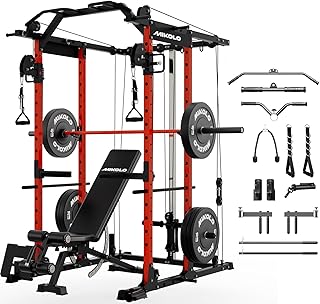
 ULTRA FUEGO Power Cage
- Warranty Description: 2 Year Manufacturer
- Tension Supported: 1000 pounds
- Handle Type: Fixed Handle

 DP01 Power Cage
- Warranty Description: 2 year
- Tension Supported: 2000 pounds
- Grip Size: Standard


As an Amazon Associate we earn from qualifying purchases at no extra cost to you.
As an Amazon Associate we earn from qualifying purchases.

Quick Comparison
| Rack | Uprights / Gauge | Listed Capacity | Height Options | Best For |
|---|---|---|---|---|
| Rep Fitness PR-4000 | 3×3 in, 11-gauge | 1,000 lb | 80 in / 93 in | Serious lifters who want to configure everything |
| Rogue RML-390F | 3×3 in, 11-gauge | Heavy-duty, no bolting | ~90 in | Concrete floors and rental garages |
| Titan Fitness T-3 | 2×3 in, 11-gauge | ~1,100 lb | 82 in / 91 in | Real steel on a tighter budget |
| PRx Profile Rack | 3×3 in, 11-gauge | 1,000 lb+ | Wall-mounted | Garages that still park a car |
| Force USA MyRack | 2×2 in, heavy gauge | ~1,000 lb | ~89 in | Attachment-driven all-in-one setups |
| Fitness Reality 810XLT | 2×2 in, 14-gauge | 800 lb | ~83 in | Beginners and light-to-moderate loads |
How to Choose
- Match gauge to your working weight, not your goal weight. If your heaviest squat is under 225 pounds and likely to stay there, 14-gauge steel is honest value. Past roughly 315, 11-gauge and thicker uprights stop being a luxury.
- Check hole spacing where it matters. One-inch (Westside) spacing through the bench and pull range lets you fine-tune safety pins and J-cups; two-inch spacing elsewhere is fine and cheaper. Racks with uniform two-inch spacing often leave you an inch short on a close-grip bench.
- Decide early whether you can drill. Bolt-down racks are more rigid and use less material. Flat-foot and wide-base designs cost more steel but leave the slab untouched, which matters in a lease.
- Confirm hardware diameter and pin type. One-inch hardware with pin-and-pipe safeties handles dropped bars far better than 5/8-inch bolts and flat strap safeties, which dent and deform over time.
- Count the attachments you will actually buy. Lat pulldowns, dip bars, and landmines only fit systems designed for them. Buying a cage now and discovering the attachment ecosystem is closed later is the most common expensive mistake.
Top Picks Reviewed
Rep Fitness PR-4000
This is the configurator’s rack. You choose height, depth, upright count, and finish, then bolt on a pulley tower or plate storage when funds allow. The 3×3-inch 11-gauge uprights with one-inch hardware put it in commercial territory, and the numbered holes make resetting J-cups after a partner uses it a five-second job rather than a guessing game. The tradeoff is footprint and assembly time — plan on a couple of hours and a second set of hands for the crossmembers.
Rogue RML-390F Flat Foot Monster Lite
The flat-foot stabilizers extend forward instead of downward, which means no anchors and no drilling into a slab you do not own. Under heavy front squats it stays planted because the base geometry converts tipping force into downward pressure. The 3×3-inch uprights use 5/8-inch hardware, slightly lighter than Rep’s, but the welds and powder coat are the reference standard. Expect to pay for that, and expect the crate to be heavy enough that you want the delivery driver’s help.
Titan Fitness T-3
The T-3 gets you 11-gauge steel at a price that usually buys 14-gauge. Uprights are 2×3 inches rather than 3×3, so there is marginally more flex at maximal loads, but for anyone squatting in the three-hundreds it is a non-issue. Westside spacing runs through the critical bench and pull zone. Finish quality is the compromise: chipped powder coat on arrival is common, and the hole tolerances can require a rubber mallet on pin inserts.
PRx Profile Rack
A wall-mounted rack that folds to roughly four inches of depth solves a problem no floor-standing cage can. Pull the pin, swing the uprights flat, and the car goes back in the garage. Steel quality matches full cages because the wall studs carry much of the load — which is also the constraint: you need solid framing or concrete block and a willingness to mount into it permanently. Depth options limit rack-pull range compared to a four-post cage.
Force USA MyRack
The MyRack’s argument is the attachment catalog. Lat tower, functional trainer pulleys, dip handles, landmine, and multi-grip bars all mount to the same frame, letting one footprint replace three machines. Uprights are 2×2 inches, so it feels less monolithic than a 3×3 cage, though the rated capacity is high and the numbered holes are laser-cut cleanly. This is the pick if you want a single station to cover pressing, pulling, and cable work.
Fitness Reality 810XLT Super Max
At 14-gauge steel and an 800-pound rating, this is a beginner’s cage and it does not pretend otherwise. The upright adjustment covers 19 positions, the included lat attachment is genuinely usable for lighter work, and the whole thing assembles with basic tools in an afternoon. Loaded near capacity you will feel the frame move. For learning form, building a base, and finding out whether you will still be lifting a year from now, it is enough rack.
Frequently Asked Questions
Do I need to bolt my power cage to the floor?
Only if the manufacturer specifies it or you plan to do kipping pull-ups and heavy rack pulls. Most four-post cages with a wide base and loaded plate storage stay put through normal barbell work. Bolting adds rigidity and eliminates walking, so it is worth doing on a slab you own.
What ceiling height do I need?
An 80-inch rack fits under a standard eight-foot ceiling with clearance to spare, but overhead pressing inside the cage needs closer to nine feet depending on your height and arm length. Measure to the lowest obstruction — garage door tracks and light fixtures decide this more often than the ceiling itself.
Is 14-gauge steel actually unsafe?
No, within its rating. The failure mode at moderate loads is flex and creaking, not collapse. Problems arise when lifters outgrow the rating and keep loading, or when safeties made from thin flat stock take repeated dropped-bar impacts. Pin-and-pipe safeties handle that abuse far better.
Can a squat stand replace a full cage?
For a lifter with a spotter or one who stays clear of true limit sets, yes, and it saves considerable floor space. Training alone to failure is where the four posts earn their keep: adjustable safeties inside a cage catch the bar in a fixed plane, which no stand can guarantee.
Final Thoughts
Buy for the load you will handle in two years, then buy the smallest footprint that still allows a full bar path. Most regret in this category comes from one of two directions — a thin-walled rack that flexes once the lifter gets strong, or a commercial-grade cage that swallowed a garage bay it was never going to earn. If you have the space and the ceiling, 11-gauge steel with three-inch uprights is the version you stop thinking about. If space is genuinely tight, a folding wall-mount beats a cramped cage you cannot walk around. Steel and square footage are the two variables that matter; everything else is an attachment you can add later.
8 Best Gym Mats for Home: Rubber vs Foam Picks for Any Floor
Best gym mat for home choices come down to material density and...
8 Best Rowers for Home Gym: Air, Magnetic and Water Compared
Best rowers for home gym shortlists usually collapse once someone measures the...
8 Best Weight Home Gyms: 6 All-in-One Machines for Small Rooms
Best weight home gym decisions come down to two numbers before brand...
8 Best Home Gym Equipment for Beginners: The Starter Setup
Best home gym equipment for beginners is not a machine – it...
Best Treadmills for Home Gym: 5 Picks by Deck and Motor
Best treadmills for home gym decisions come down to two specifications and...
8 Best Home Gym Compact Setups: 6 Space-Saving Picks Ranked
Best home gym compact claims usually quote a stored footprint and stay...
Best Adjustable Bench for Home Gym: 5 Picks Ranked by Use
Best adjustable bench for home gym decisions turn on three numbers most...
Best Cable Machine for Home Gym: 5 Picks and Pulley Ratios
Best cable machine for home gym shortlists collapse quickly once you convert...
8 Best Cable Machines for Home Gym: 5 Types and Their Limits
Best cable machines for home gym use are not one product category...
8 Best Home Gym Setups: Floors, Ceilings, Noise and Layout
Best home gym setup guides talk about equipment and skip the room,...
Write Your Review
No reviews yet. Be the first to share your experience!