Key takeaways
- Measure the delivery box, not just the assembled console. A 72-inch unit may arrive in a carton longer than 75 inches.
- Check elevator, stairwell, and doorway clearance. For a large cabinet, a clear passage of about 30 inches is safer than relying on a tight diagonal turn.
- Assemble near its final position. Long consoles are awkward to rotate once doors and shelves are installed.
- Use two adults for a console wider than 60 inches or heavier than roughly 75 pounds.
- Do not drag a loaded console. Lift it to protect legs, flooring, and corner joints.
Best Media Consoles for Stylish TV and Device Storage
The best media consoles are wide enough to support your television with a safety margin, deep enough for your equipment, and sturdy enough to resist tipping, while matching the way you actually store devices, games, remotes, and cables.
Quick picks by living situation
| Situation | Best console type | Specifications to prioritize | Typical price range |
|---|---|---|---|
| Small apartment or 10×12 ft room | Low-profile, 48–60-inch console | 14–16-inch depth, wall clearance, adjustable shelves | $180–$500 |
| Kids or pets | Wide, enclosed console with anti-tip hardware | Stable plinth or legs, doors, rounded corners, 24-inch minimum depth for large TVs | $300–$900 |
| Renter who cannot drill into walls | Freestanding console with built-in cable routing | Leveling feet, rear cord openings, substantial base, included wall strap | $250–$800 |
| Many consoles, speakers, or a game system | 72–84-inch open-and-enclosed hybrid | Ventilated compartments, wide shelves, 18–20-inch depth | $500–$1,500 |
| Back or neck discomfort | Console sized for a raised TV position | Check seated eye level; consider a 24–30-inch console or a secure riser | $250–$1,200 |
How wide should a media console be?
Choose a console that is at least 4–8 inches wider than the TV on each side. This proportion looks balanced and leaves room for a soundbar, decor, or speakers. A console can be wider than the television, but it should not be narrower unless the TV is securely wall-mounted and the furniture is being used only for storage.
| TV size | Approximate TV width | Practical console width | Useful room fit |
|---|---|---|---|
| 43 inches | 38 inches | 48–54 inches | Small apartment, bedroom, or compact den |
| 55 inches | 48 inches | 60–72 inches | Most apartments and medium living rooms |
| 65 inches | 57 inches | 72–84 inches | Medium or large living room |
| 75 inches | 65 inches | 80–96 inches | Large room with adequate viewing distance |
Measure the television’s actual width rather than relying only on its diagonal size. Also measure the TV stand feet: some models use widely spaced feet that will not fit on a narrow top even when the overall screen does. Leave approximately 3 inches behind the console for cables and at least 2 inches from each side wall so doors and drawers can open.
Open storage versus enclosed storage
Open shelving
Open shelves provide the easiest access for game consoles, streaming boxes, routers, and controllers. They also improve airflow around heat-producing equipment. Choose shelves with at least 10–12 inches of vertical clearance for typical electronics and 14–16 inches of depth so cables do not force devices against the front edge.
The disadvantage is visual clutter. Open compartments expose dust, power strips, and mismatched equipment, so they work best when you have similar devices or are willing to use cable sleeves and labeled bins.
Doors and drawers
Enclosed storage hides remotes, games, manuals, and small accessories. Slatted, perforated, or mesh-front doors are preferable to solid doors when an infrared remote must communicate with a device. If a solid door is your preferred look, check whether the cabinet includes an infrared repeater or leave the door slightly open while using the equipment.
Drawers are convenient for controllers and cables but usually offer less ventilation. Avoid placing a receiver, game console, or router in a fully enclosed drawer unless the drawer has rear ventilation and the manufacturer permits it.
The most flexible layout
A hybrid console—open center shelves with doors or drawers at the sides—usually suits households with mixed storage needs. Put heat-producing electronics in the open section, and use closed compartments for items that do not need ventilation. Adjustable shelves add more value than a large number of fixed cubbies because equipment heights vary.
Materials and finish durability
| Construction | Advantages | Trade-offs | Best use |
|---|---|---|---|
| Solid wood | Repairable, substantial, distinctive grain, long service life | Heavier, more expensive, may expand or contract with humidity | Long-term furnishing and traditional interiors |
| Engineered wood with laminate or veneer | Consistent dimensions, lower cost, many colors, easier to move | Edges can swell after water exposure; damaged laminate is difficult to repair | Most households seeking value and style variety |
| Metal frame with wood or glass panels | Good structural rigidity, light visual appearance, contemporary style | Can transmit vibration; glass shows fingerprints and needs careful handling | Modern rooms and consoles with long spans |
For daily durability, inspect the edges more closely than the center panel. High-touch corners, door edges, drawer fronts, and the area beneath the TV are usually the first places to show wear. A textured laminate hides small marks better than a glossy painted finish. Veneer looks more natural, but it should be protected from standing water and direct heat.
Stability, weight limits, and cable management
Do not judge stability by width alone. A long console with thin legs can rack or wobble, while a shorter cabinet with a full-width plinth may feel much more secure. Look for a rigid back panel, joined corners, adjustable leveling feet, and a broad base. For households with children or climbing pets, attach the console to a wall stud using the supplied anti-tip strap; a heavy television does not make an unsecured cabinet safe.
Check the manufacturer’s weight capacity for both the top and each shelf. A 65-inch television may weigh 35–70 pounds depending on its design, while a soundbar, center speaker, or decorative object adds more. Keep the combined load below the stated limit rather than treating the limit as a target. Long shelves also need a center divider or reinforced front edge to prevent sagging.
Good cable management consists of more than a circular hole. Look for multiple rear openings, a recessed back, space for a power strip, and enough clearance to turn plugs without sharply bending them. Separate power cables from HDMI and audio cables where possible, and leave a service loop of about 6 inches behind each device so equipment can be removed without unplugging everything.
Assembly and moving realities
Assembly difficulty rises sharply with console length and door count. A basic open shelf may take 30–60 minutes, while a 72–84-inch cabinet with drawers, hinges, and adjustable feet can take two to four hours. The difficult steps are usually aligning doors, keeping a long carcass square, and tightening fasteners without stripping engineered-wood panels.
- Measure the delivery box, not just the assembled console. A 72-inch unit may arrive in a carton longer than 75 inches.
- Check elevator, stairwell, and doorway clearance. For a large cabinet, a clear passage of about 30 inches is safer than relying on a tight diagonal turn.
- Assemble near its final position. Long consoles are awkward to rotate once doors and shelves are installed.
- Use two adults for a console wider than 60 inches or heavier than roughly 75 pounds.
- Do not drag a loaded console. Lift it to protect legs, flooring, and corner joints.
Before buying, confirm whether the listed shelf capacity applies to evenly distributed weight and whether the back panel is structural or merely decorative. A thin fiberboard back may keep dust out but contribute little to rigidity.
Best media consoles by design priority
For a small room
Choose a 48–60-inch console no deeper than 16 inches, with doors on the lower half and an open center shelf. In a 10×12-foot room, this leaves more walking space than a deep cabinet while still fitting a 55-inch TV in many layouts. Keep at least 30 inches of clear walking space in front of the console where possible.
For a clean, minimalist look
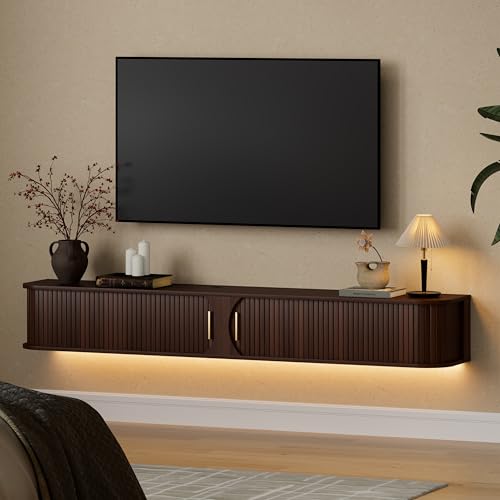
Select a floating-style or low-plinth console with concealed cable openings and mostly enclosed storage. This style looks best when the top is not overloaded. Verify that a floating appearance does not mean wall mounting unless you are permitted to drill and the wall can support the required hardware.
For serious device storage
Choose an 18–20-inch-deep hybrid cabinet with ventilated open shelves, removable backs, and at least one adjustable shelf. Prioritize airflow and access over an uninterrupted front. A beautiful cabinet that traps heat can shorten the life of electronics.
Final buying checklist
- Is the console 8–16 inches wider than the TV?
- Do the TV feet fit on the top with room from the edges?
- Is there enough depth for plugs, cables, and ventilation?
- Are the open compartments tall enough for every device?
- Does the top and each shelf support the intended load?
- Does it include anti-tip hardware and leveling feet?
- Can the box and assembled unit pass through your home?
- Will the finish tolerate spills, pets, and frequent cleaning?
The right choice is not necessarily the widest or most expensive model. Match the console’s width to the TV, its storage pattern to your equipment, and its construction to the risks in your room. That combination produces the best media console for both appearance and everyday use.