Our Top Picks
 Heavy-Duty Metal Low Bunk Bed Twin Over TwinTwin - Twin77.83 x 41.15 x 53.94 inches47 PoundsCheck on Amazon
 Max & Lily Fundamental Twin Low Bunk BedTwin/Twin Low Bunk80 x 54.25 x 49.25 inches81 PoundsCheck on Amazon
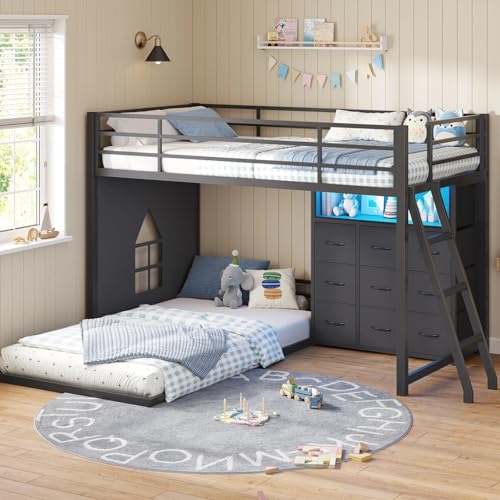 Bunk Bed Twin Over Twin with 9 StorageTwin over Twin77.8 x 76.8 x 53.6 inches91.1 poundsCheck on Amazon
For a room with a low or sloped ceiling, the best overall pick here is the Max & Lily Fundamental Twin Low Bunk Bed: it is a solid-wood twin-over-twin design with strong wooden slats, non-toxic finishes and a high stated weight capacity, built to sit lower than a standard bunk. A “low” bunk bed keeps the top mattress closer to the floor, which leaves more headroom for the sleeper above and more air between the top bunk and the ceiling, fans and lights. Always compare the overall height on the product page with your own ceiling before you buy.
Quick List
- Heavy-Duty Metal Low Bunk Bed – best for teens and kids who want a slim metal frame
- JOYMOR Solid Wood Low Bunk – best for a no-box-spring wood design with guardrails and ladder
- ZJIAH Solid Wood Floor Bunk – best for the lowest, floor-level bunk look
- Max & Lily Fundamental Twin Low Bunk – best for a sturdy, non-toxic-finish wood frame
- KOMFOTT Solid Wood Low Bunk – best for a space-saving wood bunk with a built-in ladder
- Twin Floor Bunk with 9 Storage Drawers – best for small rooms that need built-in storage and lighting
Which One Is Right for You?
| If you… | Choose |
|---|---|
| Want a durable wood bunk with sturdy slats and stated non-toxic finishes | Max & Lily Fundamental Twin Low Bunk |
| Prefer a slim metal frame for teens or a modern look | Heavy-Duty Metal Low Bunk Bed |
| Want the guardrail-and-ladder basics without buying a box spring | JOYMOR Solid Wood Low Bunk |
| Need the bunk to sit as close to the floor as possible | ZJIAH Solid Wood Floor Bunk |
| Want a space-saving wooden bunk with a built-in ladder | KOMFOTT Solid Wood Low Bunk |
| Need drawers and lights built into the bed | Twin Floor Bunk with 9 Storage Drawers |
Ceiling height is the first filter, so write down your ceiling measurement before browsing. Material is the second: wood frames feel warmer and are usually heavier, metal frames are slimmer and visually lighter, and storage models trade a bit of simplicity for utility. Whatever you choose, follow the maker’s age and weight guidance, and remember that the top bunk is not for children under six.
Heavy-Duty Metal Low Bunk Bed Twin Over Twin for Kids and Teens, Black
Chosen because it specifies Black.
View on Amazon
JOYMOR Solid Wood Low Twin Over Twin Bunk Bed for Kids/Junior, Bunk Bed Frame with Guardrails & Ladder for Boys Girls, No Box Spring Needed (White)
Chosen because it specifies Bunk Bed Frame with Guardrails & Ladder for Boys Girls and No Box Spring Needed (White).
View on Amazon
ZJIAH Low Bunk Bed Twin Over Twin, Solid Wood Floor Bunk Bed Frame with Ladder & Safety Guardrails, Twin Bunk Beds for Kids Boys and Girls, Saving Space, No Box Spring Needed, Gray
Chosen because it specifies Twin Bunk Beds for Kids Boys and Girls and Saving Space.
View on AmazonMax & Lily Fundamental Twin Low Bunk Bed, Kids Solid Wood Modern Bed Frame with Strong Wooden Slats, Non-Toxic Finishes, High Weight Capacity, White
Chosen because it specifies Kids Solid Wood Modern Bed Frame with Strong Wooden Slats and Non-Toxic Finishes.
View on Amazon
KOMFOTT Low Bunk Bed Twin Over Twin, Solid Wood Bunk Bed Frame with Built-in Ladder & Safety Guardrails, Space-Saving Low Bunk Bed for Kids, Teens, No Box Spring Needed
Chosen because it specifies Space-Saving Low Bunk Bed for Kids and Teens.
View on AmazonBunk Bed Twin Over Twin with 9 Storage Drawers, Open Shelf and Led Lights | Kids Twin Floor Bunk Beds with Montessori Storage,L Shaped Bunk Bed for Kids with Safety Guardrail and Inclined Stairs,Black
Chosen because it specifies Open Shelf and Led Lights and Kids Twin Floor Bunk Beds with Montessori Storage.
View on AmazonAll 6 Picks in Detail
1. Heavy-Duty Metal Low Bunk Bed – Best for Teens and Kids Who Want a Slim Metal Frame
As an Amazon Associate we earn from qualifying purchases at no extra cost to you.

This listing describes a heavy-duty metal low bunk bed, twin over twin, for kids and teens, in black. The metal frame has thinner posts than most wooden models, which can make a small room feel less cramped.
Who it suits: families with older kids and teens, rooms with modern decor, and anyone who prefers a frame that cleans easily and does not show wood grain. The listing name is short, so check the height, the weight capacity per bunk, whether the ladder is attached on one side, and whether slats or a mesh deck are included. Metal beds can squeak over time if bolts loosen, so plan on periodic tightening.
Fit notes: slim metal posts take less visual space, but they also tend to have less surface for guardrail height, so verify how far the rails rise above the mattress. Teens will want a reliable ladder and a firm deck, so check whether the lower bunk uses slats or a full platform and how much the frame is rated to hold per level.
- Twin over twin configuration
- Heavy-duty metal construction
- Low-profile design aimed at kids and teens
- Finish: black
- Overall height and weight capacity: confirm on the listing
Pros
- Slim frame can feel less bulky
- Easy to wipe clean
Cons
- Listing is short on details
- Metal frames can loosen and squeak without upkeep
Compared with the wood models, it looks lighter but gives fewer details to check before ordering.
2. JOYMOR Solid Wood Low Bunk – Best for a No-Box-Spring Wood Design

The JOYMOR is a solid wood low twin-over-twin bunk for kids and juniors, with guardrails and a ladder, and the listing states that no box spring is needed. That last point matters in low rooms because a box spring on the top bunk would raise the sleeping surface and eat headroom.
Who it suits: parents of younger school-age children who want a traditional wood look and a straightforward build. The guardrails help meet the usual safety expectations for the top bunk, and the ladder is part of the design. Check the listing for the overall height, the mattress thickness the guardrails are designed for and the weight limit.
Fit notes: a bed that skips the box spring is easiest to match with a slim mattress of about six to eight inches, which keeps the guardrails at the required height. Measure the room for the ladder swing and confirm which end the ladder can be mounted on, since a door or closet might block one side.
- Solid wood construction
- Low twin-over-twin layout
- Guardrails and ladder included
- No box spring needed, per the listing
- Overall height and capacity: confirm on the listing
Pros
- No box spring means more headroom for the top sleeper
- Wood construction feels sturdy
Cons
- Heavier and bulkier to assemble
- Guardrail height depends on mattress thickness
Compared with the Max & Lily, it is similar in concept but the listing does not highlight finishes.
3. ZJIAH Solid Wood Floor Bunk – Best for the Lowest, Floor-Level Look

The ZJIAH listing calls it a low bunk bed, twin over twin, in solid wood, with a ladder and safety guardrails, for boys and girls. The “floor bunk” wording suggests a frame that sits very close to the ground, though you should confirm the exact dimensions on the page.
Who it suits: rooms with sloped ceilings or dormer spaces, where every inch counts, and for parents who want a shorter fall from the top bunk. A lower bunk also makes it easier for the child on top to climb up and down. Because the name is cut off, check the weight limit and whether slats are included.
Fit notes: a floor-level frame can feel cozy for the lower sleeper but leaves less sitting room, so check the listed clearance between the lower mattress and the upper deck. Sloped-ceiling rooms often work best when the bed is placed with its tall side under the highest part of the ceiling.
- Twin over twin, solid wood
- Floor-style low profile, per the listing
- Ladder and safety guardrails
- Designed for kids
- Overall height and mattress thickness limit: confirm on the listing
Pros
- Very low profile for tight spaces
- Guardrails and ladder included
Cons
- Lower bunk may feel more enclosed
- Details cut off in the listing name
It is the closest rival to the KOMFOTT in form and differs mostly in how the listing frames it.
4. Max & Lily Fundamental Twin Low Bunk – Best for a Sturdy, Non-Toxic-Finish Wood Frame

This model is described as a twin low bunk bed in solid wood with a modern frame, strong wooden slats, non-toxic finishes and a high weight capacity. Those features make it the most fully described wooden option on the list.
Who it suits: families who value finish details and a stated high capacity, and parents who want a bed that is likely to last through the school years. The non-toxic finish claim is helpful for sensitive households, though you should read the exact certification wording on the listing. Confirm the dimensions and the recommended mattress height.
Fit notes: a bed with high stated capacity can serve a growing teen, but only if the ceiling height and guardrail rules still work as a child grows. Look at whether the frame can be split into two separate twin beds later, which extends its useful life and is a handy option if the room layout changes.
- Solid wood frame
- Strong wooden slats
- Non-toxic finishes, per the listing
- High weight capacity; confirm the number on the listing
- Low bunk twin configuration
Pros
- Clear emphasis on sturdy slats and finishes
- Likely suitable for older children
Cons
- Wood frames take time to assemble
- Exact height depends on the model variant
Compared with the JOYMOR, it highlights finish and capacity more clearly.
5. KOMFOTT Solid Wood Low Bunk – Best for a Space-Saving Bunk With a Built-In Ladder

KOMFOTT lists a low twin-over-twin bunk in solid wood with a built-in ladder and safety guardrails, calling it a space-saving design for kids. A built-in ladder takes up less floor space than a leaning one.
Who it suits: smaller bedrooms where a leaning ladder would be in the way, and families who want a simple wooden bunk without extra drawers or lights. Look at where the ladder attaches and whether it can be placed on either end to fit your room layout.
Fit notes: a ladder built into the frame uses the bed’s own footprint, so measure the full width including the ladder and the clearance needed to climb. Confirm that the guardrails fully cover the sleeping area on the open sides, and check the slat spacing for the mattress you plan to use.
- Twin over twin, solid wood
- Built-in ladder
- Safety guardrails
- Space-saving low design
- Overall height and capacity: confirm on the listing
Pros
- Built-in ladder saves floor space
- Simple, classic styling
Cons
- Limited details on finishes
- Ladder position may limit layout choices
Next to the ZJIAH, it is similar, but its listing stresses the built-in ladder and space saving.
6. Twin Floor Bunk with 9 Storage Drawers – Best for Small Rooms That Need Storage and Lighting

This listing describes a twin-over-twin floor bunk with nine storage drawers, an open shelf and LED lights, with Montessori-style storage and an L-shaped layout. The extra storage can replace a dresser, which is helpful in a small room.
Who it suits: kids’ rooms where floor space is scarce and the bed has to do double duty. The L-shaped description suggests an arrangement that differs from a standard stacked bunk, so check the product images and dimensions to see how it fits your room and how much headroom it leaves. Drawer boxes and LED wiring add complexity, so read the assembly and electrical details carefully.
Fit notes: large drawer banks need floor clearance to open, so leave space in front. LED lighting should be rated for children’s rooms and wired safely, so check the plug type, the control and whether the lights can be turned off at the bed. Heavy storage should stay in the lower drawers, never on the top bunk.
- Twin over twin, floor bunk style
- Nine storage drawers and an open shelf
- LED lights
- L-shaped layout, per the listing
- Overall height, footprint and power details: confirm on the listing
Pros
- Built-in storage reduces other furniture
- Lighting adds night visibility
Cons
- Larger footprint than a plain bunk
- More parts to assemble and maintain
Compared with the plain wood models, it adds storage and light at the cost of simplicity and floor space.
Specs Compared
| Model | Size | Material | Ladder and guardrails | Extras |
|---|---|---|---|---|
| Heavy-Duty Metal Low Bunk Bed | Twin over twin | Metal | Confirm on listing | Black finish, kids and teens |
| JOYMOR Solid Wood Low Bunk | Twin over twin | Solid wood | Yes, guardrails and ladder | No box spring needed |
| ZJIAH Solid Wood Floor Bunk | Twin over twin | Solid wood | Yes, ladder and safety guardrails | Floor-level style |
| Max & Lily Fundamental Twin Low Bunk | Twin low bunk | Solid wood | Confirm on listing | Strong slats, non-toxic finishes |
| KOMFOTT Solid Wood Low Bunk | Twin over twin | Solid wood | Yes, built-in ladder and guardrails | Space-saving design |
| Twin Floor Bunk with 9 Storage Drawers | Twin over twin | Confirm on listing | Confirm on listing | 9 drawers, open shelf, LED lights |
How We Chose These
This guide is built from desk research on the six low bunk beds in the current catalog set. We compared the stated configuration, material, ladder and guardrail features, and extras such as storage, and we read general safety guidance from the Consumer Product Safety Commission on bunk beds and standard recommendations for room clearance. Because low-ceiling suitability depends on overall height, which several listings do not state in their names, we recommend you confirm each height on the product page. Rankings reflect stated features and published safety guidance only.
What to Look For
Measuring for a low ceiling
Measure your ceiling height at the exact spot where the bed will stand, including any sloped sections, fans and light fixtures. Then compare it with the overall height listed for the bed. A widely used rule of thumb is to leave at least 30 inches between the top mattress surface and the ceiling so the sleeper can sit up. Worked example: with an 84-inch ceiling and a bed whose overall height is 58 inches, the top mattress surface will sit roughly 5 inches or more below the top of the guardrail, so about 50 inches off the floor. That leaves about 34 inches to the ceiling, which clears the 30-inch rule. If the ceiling were 78 inches, the same bed would leave only 28 inches, so you would need a lower model or a different room. Always use the listed height, not an estimate.
Guardrails, openings and age limits
The Consumer Product Safety Commission and the American Academy of Pediatrics both advise that children under six should not sleep on the top bunk. Guardrails should be on both sides of the upper bunk, and their tops should be at least five inches above the top of the mattress, which limits how thick a mattress you can use. Openings in the bed structure should be smaller than about 3.5 inches or larger than about 9 inches to avoid entrapment. Check that the mattress thickness recommended by the bed maker keeps the guardrails at the correct height, and do not add a thicker mattress than the manufacturer allows.
Wood versus metal and slat strength
Solid wood is stiff and quiet and can be refinished, but it adds bulk. Metal frames are slimmer and often lighter, though bolts and joints may loosen over time. Either way, look for slats rather than a loose board, check how far apart they are, and confirm whether a box spring is required. Many low bunks use slats only so the mattress can sit directly on top, which reduces height. Look for a stated weight capacity per bunk and make sure it exceeds the weight of the child plus bedding.
Ladders, storage and layout
A built-in ladder saves floor space, while a leaning ladder is easier to replace. Storage drawers and shelves are handy but add depth and weight, so measure the footprint. L-shaped or floor-style designs change how you position the bed. Plan for a clear path from the door, avoid placing the bed beneath a ceiling fan or hanging light, and keep cords and decorations away from the top bunk to reduce entrapment and strangulation risks.
Sloped ceilings, fans and room layout
Attic rooms and basements bring extra constraints. In a room with a slope, place the bed so the taller end of the frame sits under the highest part of the ceiling, and keep the sleeping side away from the low edge so nobody bumps their head. Remove or relocate ceiling fans and pendant lights, because a spinning blade within reach of a top bunk is a hazard. In a basement with exposed ducts or beams, measure to the lowest obstruction above the bed, not the ceiling itself. Finally, leave a clear path to the ladder and keep the bed away from windows and blind cords.
Assembly and ongoing checks
Plan a couple of hours and two adults for assembly. Tighten all bolts after the first week and again every few months, and inspect slats, guardrails and ladder attachments for movement. Never allow roughhousing on the bed, and keep the ladder in good condition.
Questions
What is a low bunk bed?
A low bunk bed is a twin-over-twin design built shorter than a standard bunk, so the top mattress is closer to the floor and farther from the ceiling. Heights vary by model, so check the listing, and remember that a lower top bunk also means a shorter climb and a shorter fall for the child using it.
How much ceiling height do I need?
Look for at least 30 inches between the top mattress surface and the ceiling, then add room for fans and lights. Measure the room and compare it with the bed’s overall height.
At what age can a child use the top bunk?
Safety guidance from the Consumer Product Safety Commission advises that children under six should not use the top bunk. Always follow the manufacturer’s age and weight limits.
Do low bunk beds need a box spring?
Many do not and use slats instead, which also keeps the bed low and the guardrails at the right height. Check the listing for each model to be sure, and follow the maker’s guidance on mattress type and thickness, since a thick mattress can reduce the effective guardrail height.
Can adults use a low bunk bed?
Some models state higher weight capacities, but most are designed for children and teens. Check the capacity per bunk before you buy, confirm the sleeping length fits an adult and follow the maker’s age and weight guidance rather than assuming the frame is suitable.
Which is better, wood or metal?
Wood feels sturdy and warm, while metal is slim and can look lighter. The best choice depends on your room, your child’s age and how well you will maintain the hardware.
Update History
- October 20, 2026 – Initial publication; product set drawn from current catalog listings.
- Check the product page for current specifications and availability before buying.
Sources
- Retailer listing titles and specification fields for all six products
- U.S. Consumer Product Safety Commission bunk bed guidance and regulations summaries
- Manufacturer product pages for Max & Lily and other brands where available