Key takeaways
- Use one continuous lighting plan across adjoining cabinets so colour and brightness remain consistent.
- Test the light in the evening before permanently fixing it; glare that seems minor in daylight can be distracting at night.
- Choose a warm setting for entertaining and a neutral setting for detailed food preparation if your model allows it.
- Leave room to remove rechargeable lights for charging, cleaning, and battery replacement.
What's inside
Good under-cabinet lighting does more than brighten a worktop. It reduces shadows while chopping, makes a kitchen feel warmer in the evening, and adds useful light to shelves, wardrobes, stairs, and display units. The best option depends less on maximum brightness than on where the light will go, how often you use it, and whether you want a tidy rechargeable system or a permanent installation.
This guide explains what to look for in 2026, including brightness, colour temperature, controls, charging, installation, and appearance. It also compares the main types of lighting so you can choose confidently without paying for features that will not improve everyday comfort.
As an Amazon Associate we earn from qualifying purchases.


Choose the Right Type for Your Space
Rechargeable bar lights are usually the simplest choice for renters, small kitchens, and areas without a convenient socket. They attach with magnets or adhesive mounts, can be removed for charging, and avoid trailing cables. The MCGOR 10-inch lights are a sensible example for compact areas, particularly when motion activation is useful in a pantry, hallway, or under a wall cabinet.
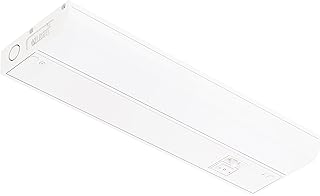
For a wider run of cabinets, a connected strip-light kit gives more even coverage. Plug-in kits generally offer stronger, steadier output than small battery-powered bars, making them better for food preparation. The WOBANE Under Cabinet LED Lighting Kit uses multiple 20-inch strips and a remote, while the six-bar 12-inch Under Cabinet LED Lighting Kit is aimed at brighter, more extensive counter coverage. Check whether the kit is designed for plug-in use, hardwiring, or both before ordering.
Get Brightness and Coverage Right
Think about the job the light needs to perform. Soft illumination is adequate for ambience or finding items in a cupboard, but a chopping surface needs stronger, evenly distributed light. Several short bars often work better than one very bright point because they reduce dark patches between cabinets.
Look at the stated lumen output where it is provided, but treat it as a starting point rather than a guarantee of real-world performance. Cabinet depth, backsplash colour, diffuser quality, and mounting position all affect the result. Install lights toward the front underside of the cabinet, rather than pushed against the wall, so they illuminate the worktop instead of casting your hands into shadow. A diffuser is also valuable because it softens individual LED hotspots.
Pick a Comfortable Colour Temperature
Colour temperature changes the feel of the entire kitchen. Warm white, commonly around 2700K to 3000K, creates a relaxed evening atmosphere and pairs well with timber, cream, and traditional finishes. Neutral white, around 3500K to 4000K, tends to make work surfaces look clearer without feeling overly clinical. Cooler light can appear crisp, but may be less comfortable in a living space.
Adjustable colour temperature is helpful if the same lights need to serve different purposes. The Gritin 10.2-inch lights offer three colour temperatures and five brightness levels, while the three-pack Wireless Under Cabinet Lighting with a power display also provides three colour options. If you are installing several lights, check that they can be set consistently; mismatched tones are more noticeable than many buyers expect.
Consider Controls, Sensors, and Battery Life
Motion sensors are convenient for late-night visits to the kitchen, but they are not ideal for every task. A sensor may switch the light off while you are sitting relatively still, and repeated activation can use more battery. Manual touch controls or a remote are preferable when you want continuous task lighting.
For rechargeable models, check how often the lights will need charging and whether the battery status is visible. A power display, as found on the three-pack Wireless Under Cabinet Lighting, can prevent unexpected darkness. The RUIKORING 8.5-inch six-pack is worth considering when you want several compact rechargeable lights with motion sensing and three colour settings. For a larger installation used for long periods, a mains-powered kit avoids battery management altogether.
Plan Installation Before You Buy
Measure each cabinet section, including gaps around extractor hoods, trim, and end panels. A light that is too long may overhang or need repositioning, while one that is too short can leave an obvious dark section. For rechargeable lights, confirm that the charging port remains accessible after mounting.
Magnetic mounting is convenient because it makes removal easy, but adhesive pads may be more secure on surfaces that are not magnetic. Clean and dry the underside of the cabinet before applying adhesive, and allow it to bond according to the manufacturer’s instructions. For wired systems, plan the cable route before fixing the strips. Hide cables along cabinet edges where possible, but do not place them near heat, moisture, or moving doors. Hardwiring is best left to a qualified electrician.
Tips
- Use one continuous lighting plan across adjoining cabinets so colour and brightness remain consistent.
- Test the light in the evening before permanently fixing it; glare that seems minor in daylight can be distracting at night.
- Choose a warm setting for entertaining and a neutral setting for detailed food preparation if your model allows it.
- Leave room to remove rechargeable lights for charging, cleaning, and battery replacement.
Frequently Asked Questions
Are rechargeable under-cabinet lights worth buying?
They are a good choice when you want a quick, low-disruption installation or do not have a nearby outlet. They are particularly practical for cupboards, shelves, and occasional task lighting. For a main kitchen worktop used every day, a plug-in or hardwired system is usually more convenient because it provides continuous power.
How many lumens do I need under kitchen cabinets?
There is no single ideal number because cabinet length and surface colour make a difference. Use modest output for accent lighting and choose a brighter, distributed system for chopping and cooking. Multiple bars or strips generally produce more useful coverage than one concentrated lamp with a high headline lumen figure.
Should under-cabinet lights point forward or toward the wall?
Mounting them toward the front underside of the cabinet usually lights the work surface more effectively and reduces shadows from your body. However, move them slightly back if the LEDs create glare when viewed from normal standing height. A diffuser or dimmer can help refine the final result.
Do motion-sensor lights work well in kitchens?
They work well for short visits, pantry access, and night-time navigation. They are less dependable as the only light over a busy preparation area, where movement may pause and trigger an unwanted shutoff. Look for models with manual operation or adjustable timing if you want both convenience and control.
Conclusion
The best under-cabinet lighting is the system that matches your routine: rechargeable magnetic bars for flexibility, or a multi-strip mains-powered kit for dependable whole-counter illumination. Prioritise even coverage, comfortable colour, accessible controls, and an installation you can maintain. Taking a few minutes to measure the cabinets and test the light position will usually make a bigger difference than choosing the most powerful model on the shelf.