Key takeaways
- Best Overall for Bedrooms: Levoit Core 300S-P.
- Best for Small Bedrooms: Levoit Core 200S-P.
- Best for Simple Manual Operation: Levoit Core 300-P.
- Best Compact HEPA Alternative: Winix A230.
- Best for Medium-Sized Living Rooms: Winix C545.
- Best for Larger-Room Filtration: Coway Airmega AP-1512HH Mighty.
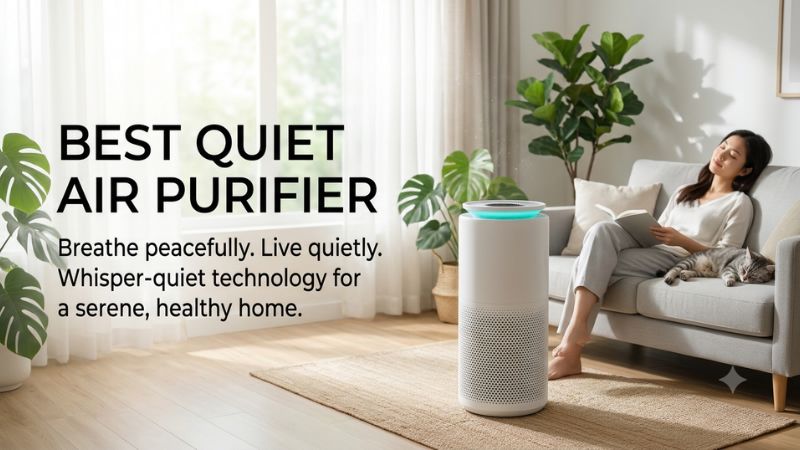
Finding the best quiet air purifier requires balancing effective particle filtration with comfortable operating noise. Bedrooms, home offices, and shared living areas benefit from appliances that deliver sufficient clean air without disrupting daily activities. Compare these six models to find the right fit for your home.
Quick Verdict
Choosing a quiet air purifier is more complicated than comparing advertised decibel ratings. A model that operates almost silently at its lowest setting may provide insufficient airflow for a large bedroom. Meanwhile, a more powerful purifier operating at an intermediate speed may offer a better combination of particle removal and acoustic comfort.
The following recommendations address different room sizes, operating preferences, and household requirements:
- Best Overall for Bedrooms: Levoit Core 300S-P.
- Best for Small Bedrooms: Levoit Core 200S-P.
- Best for Simple Manual Operation: Levoit Core 300-P.
- Best Compact HEPA Alternative: Winix A230.
- Best for Medium-Sized Living Rooms: Winix C545.
- Best for Larger-Room Filtration: Coway Airmega AP-1512HH Mighty.
The Core 300S-P is a particularly attractive starting point for users who want connected controls and quiet nighttime settings. The Winix C545 and Coway Airmega Mighty provide greater published particle filtration capacity for households requiring more airflow.
However, these recommendations are based on specific household applications rather than a definitive ranking of measured acoustic performance. Noise measurements taken under different conditions cannot establish which appliance delivers the most clean air at an identical sound level.
Best Quiet Air Purifier Comparison Table
| Product | Best For | Published CADR | Minimum Advertised Noise | Main Trade-Off |
|---|---|---|---|---|
| Levoit Core 300S-P | Bedrooms and smart controls | 141 CFM | 22 dB | Moderate maximum airflow |
| Levoit Core 200S-P | Small rooms | 90 CFM | 27 dB | Limited room capacity |
| Levoit Core 300-P | Manual operation | 143 CFM | 24 dB | No integrated smart controls |
| Winix A230 | Compact HEPA filtration | 147 CFM smoke | 25 dB | Electronic treatment feature |
| Winix C545 | Medium-sized rooms | 232 CFM smoke | 27 dB | Larger cabinet |
| Coway Airmega AP-1512HH | Greater airflow requirements | Approximately 233 CFM dust | Approximately 24 dB | Audible maximum-speed operation |
Published CADR figures may describe different particle categories, depending on the manufacturer’s documentation. Minimum noise ratings represent the lowest advertised operating conditions rather than maximum-speed filtration.
Neither column should be interpreted as a simultaneous measurement of noise and airflow.
How We Selected the Best Quiet Air Purifiers
Noise Performance and Acoustic Comfort
Quiet operation is an important purchasing consideration for appliances intended to run for extended periods. Unlike a vacuum cleaner or blender, an air purifier may operate throughout an entire working day or sleeping period.
The selection process considers published minimum sound levels, available fan settings, nighttime functionality, and the practical relationship between airflow requirements and operating noise.
A low minimum noise specification is useful, but it does not establish performance at medium or maximum speed. For this reason, recommendations also consider whether the appliance offers sufficient maximum airflow for its intended room.
The character of the sound matters as well. Smooth airflow can be less distracting than an intermittent mechanical vibration, even when both produce similar measured sound levels.
Clean Air Delivery Rate
Clean air delivery rate, commonly abbreviated as CADR, describes how quickly an air purifier delivers particle-filtered air under specified testing conditions.
A purifier with an impressive filter efficiency claim may still provide limited room-wide filtration if its fan moves insufficient air. CADR offers a more useful starting point for comparing complete appliance performance.
The selected products cover several airflow classes, from compact devices intended for smaller rooms to appliances better suited to medium-sized living spaces.
The evaluation does not assume that maximum CADR remains available during sleep mode.
Filtration Technology and Household Compatibility
Different air purifiers use different filtration arrangements. Some rely primarily on mechanical particle filtration, while others include activated carbon, ionization, electrostatic assistance, or additional treatment technologies.
The product recommendations account for these differences because buyers may have particular preferences regarding electronic air treatment, replacement filters, and maintenance requirements.
A mechanical particle filter addresses a different problem from activated carbon intended for certain gaseous pollutants. Neither technology should be described as a universal solution for every indoor air quality concern.
Controls and Long-Term Ownership
An air purifier must be convenient enough to use consistently. Physical controls, scheduling, display settings, filter access, and automatic fan adjustments can significantly influence the ownership experience.
The evaluation also considers whether an appliance is likely to fit the intended room without obstructing furniture or household movement.
Recommendations are based on manufacturer specifications, published product information, and editorial technical assessment. They do not represent firsthand testing or independently measured noise comparisons across every selected model.
Detailed Quiet Air Purifier Reviews
Levoit Core 300S-P Smart Air Purifier
The Levoit Core 300S-P combines moderate filtration capacity with connected controls and a relatively low advertised minimum noise level. It is especially relevant to buyers looking for a bedroom purifier that can operate consistently without requiring repeated manual adjustments.
Its position between miniature desktop purifiers and larger household appliances makes it suitable for many enclosed residential rooms.
Best For: Bedrooms, home offices, apartment residents, and buyers interested in smart scheduling.
Why We Picked It: The combination of a published 141 CFM CADR, an advertised minimum operating noise of 22 dB, and connected controls creates a useful balance between capacity and convenience.
Key Specifications:
- Published CADR: 141 CFM.
- Advertised minimum noise: 22 dB.
- Three-stage filtration system.
- Automatic operating mode.
- Smart connectivity.
- Sleep mode.
- Replaceable filtration assembly.
Features and Benefits
Smart scheduling allows users to establish operating routines around typical household activities. For example, the purifier can operate more actively before bedtime and transition to a quieter setting during sleeping hours.
Remote controls are particularly useful when the appliance is positioned across a room or when users want to adjust settings without interrupting work.
The automatic operating mode can respond to detected particle conditions. This may reduce the need for frequent manual adjustment, although sensor readings do not represent every possible indoor pollutant.
The cylindrical cabinet also offers relatively flexible placement, provided the manufacturer-required clearances remain unobstructed.
Performance and Practical Use
A published CADR of 141 CFM provides a useful starting point for evaluating the Core 300S-P in rooms around 200 square feet under conventional sizing assumptions.
Actual performance depends on fan speed, ceiling height, room layout, and ongoing particle generation.
The lowest advertised noise level should not be interpreted as evidence that the appliance delivers its maximum clean air output while operating at 22 dB.
For a typical bedroom, a practical operating routine may involve running a stronger setting before sleep and maintaining the highest comfortable setting overnight.
Users who are particularly sensitive to unexpected sounds may prefer a fixed manual setting instead of allowing automatic operation to increase fan speed during the night.
What Makes It Different
Compared with the Core 300-P, the Core 300S-P primarily adds convenience through connected functionality and automatic operation. Its maximum published airflow is similar, meaning the smart upgrade should be justified by the controls rather than an expectation of substantially greater filtration capacity.
Pros:
- Low advertised minimum noise.
- Practical airflow for many enclosed bedrooms.
- Convenient remote operation and scheduling.
- Suitable for buyers who prefer automated household routines.
Cons:
- Maximum airflow may be insufficient for large open-plan spaces.
- Connected features may not justify the price difference for every buyer.
- Equivalent low-speed CADR is not established by the minimum noise figure.
Buy If: You want a bedroom purifier that combines useful particle filtration with connected controls and quiet operating options.
Skip If: You require high-volume filtration for a large living room or prefer a basic appliance without wireless connectivity.
Levoit Core 200S-P Smart Air Purifier
The Levoit Core 200S-P targets households that need a compact purifier with connected features. Its smaller airflow capacity makes it particularly important to evaluate the dimensions of the intended room before purchasing.
This model is better understood as a specialized small-room option than a universal household purifier.
Best For: Small bedrooms, dorm rooms, compact offices, and space-constrained apartments.
Why We Picked It: It provides smart controls and dedicated nighttime functionality within a smaller filtration capacity class.
Key Specifications:
- Published CADR: 90 CFM.
- Advertised minimum noise: 27 dB.
- App-based controls.
- Sleep mode.
- Multiple fan settings.
- Replaceable filtration system.
Features and Benefits
The compact design makes the Core 200S-P useful in rooms where larger appliances would occupy valuable floor space.
Connected controls allow users to adjust operation remotely, establish schedules, and manage routine use without repeatedly interacting with the physical control panel.
For renters or students, a smaller purifier can also be easier to relocate when furniture arrangements change.
The practical advantage of reduced size must nevertheless be balanced against lower airflow.
Performance and Practical Use
A 90 CFM CADR is appropriate as a starting point for evaluating rooms around 135 square feet under the commonly used two-thirds sizing guideline.
Consider a bedroom measuring 10 feet by 12 feet with an 8-foot ceiling. Its air volume is approximately 960 cubic feet.
At a theoretical clean air delivery rate of 90 CFM, the purifier could provide approximately 5.6 equivalent air changes per hour under ideal mixing assumptions.
This example describes maximum rated capacity rather than measured sleep-mode performance.
The Core 200S-P may therefore be practical in a genuinely small bedroom, but it becomes less attractive when used in a large studio apartment with connected sleeping, cooking, and living areas.
What Makes It Different
Its primary advantage over the larger Core 300 models is its suitability for smaller environments and compact installation areas. Buyers should not assume its smaller construction automatically makes it quieter at equivalent filtration output.
A larger purifier may deliver the same quantity of clean air at a more comfortable operating setting.
Pros:
- Compact household installation.
- Useful connected features.
- Dedicated quiet operating mode.
- Appropriate capacity for certain smaller rooms.
Cons:
- Lower maximum airflow than the Core 300 series.
- Limited suitability for open-plan apartments.
- May require stronger fan settings when used near its capacity limit.
Buy If: You need a compact connected purifier for a small enclosed room.
Skip If: Your room dimensions require greater clean air delivery or you want additional airflow headroom for nighttime operation.
Levoit Core 300-P Air Purifier
The Levoit Core 300-P offers a straightforward alternative for buyers who prefer traditional appliance controls. Its published maximum airflow is similar to the connected Core 300S-P, making it particularly relevant to shoppers who prioritize filtration capacity rather than smart functionality.
The appliance’s simplicity can be an advantage for users who want predictable operation.
Best For: Buyers seeking straightforward bedroom filtration without application-based controls.
Why We Picked It: A published 143 CFM CADR and low advertised minimum noise make it a practical candidate for conventional residential rooms.
Key Specifications:
- Published CADR: 143 CFM.
- Advertised minimum noise: 24 dB.
- Three-stage filtration.
- Physical controls.
- Multiple operating speeds.
- Sleep mode.
Features and Benefits
Manual operation allows users to establish a preferred fan setting without connecting the appliance to a household wireless network.
This can be particularly useful for buyers who do not want additional applications, account requirements, or software-dependent features.
The cylindrical design is familiar and relatively straightforward to accommodate around bedroom furniture.
Users can operate the purifier at a higher speed during periods of increased particle generation and select a more comfortable setting during quieter activities.
Performance and Practical Use
The Core 300-P provides enough published airflow to be considered for many ordinary bedrooms and home offices.
For a 180-square-foot room with an 8-foot ceiling, a theoretical CADR of 143 CFM corresponds to approximately six equivalent air changes per hour.
This calculation assumes maximum rated clean air delivery and reasonably mixed air. Actual results may differ when the appliance operates at reduced speeds.
A buyer comparing the Core 300-P and Core 300S-P should consider whether automatic adjustments and scheduling improve their daily routine.
If the purifier will remain at a fixed setting throughout most of the day, the manual model may provide better practical value.
What Makes It Different
The Core 300-P focuses on traditional control functionality while retaining similar published maximum airflow to the smart Core 300S-P.
This makes it a useful option for buyers who want to avoid paying specifically for connected convenience.
Pros:
- Straightforward physical controls.
- Practical published filtration capacity.
- Low advertised minimum operating noise.
- No reliance on wireless connectivity for normal operation.
Cons:
- No integrated application-based scheduling.
- Requires manual adjustment when filtration needs change.
- Not intended as a high-capacity whole-home solution.
Buy If: You want uncomplicated bedroom filtration with useful airflow and quiet operating options.
Skip If: Remote scheduling, automatic operation, and connected functionality are important purchasing requirements.
Winix A230 Air Purifier
The Winix A230 combines compact construction with documented pollutant-specific CADR ratings and a mechanical HEPA filtration component. Its relatively useful smoke CADR makes it an attractive alternative to compact purifiers that publish less detailed filtration specifications.
The appliance also includes PlasmaWave technology, which buyers should evaluate separately from mechanical filtration.
Best For: Small bedrooms, apartments, and buyers seeking compact HEPA filtration.
Why We Picked It: Its published smoke CADR of 147 CFM provides useful capacity relative to its compact design.
Key Specifications:
- Smoke CADR: 147 CFM.
- Dust CADR: 149 CFM.
- Pollen CADR: 154 CFM.
- Advertised minimum noise: 25 dB.
- True HEPA filtration.
- PlasmaWave technology.
Features and Benefits
The A230 provides separate clean air delivery figures for different particle categories. This information can help buyers understand filtration capacity without relying exclusively on generalized room coverage claims.
Its compact cylindrical cabinet can be useful in bedrooms where available installation areas are limited.
The inclusion of a HEPA filtration component addresses common particle-control requirements, while additional treatment features distinguish the product from simpler mechanical designs.
Buyers interested exclusively in mechanical filtration should verify the operating behavior and control options of its electronic treatment feature.
Performance and Practical Use
A 147 CFM smoke CADR is a useful starting point for approximately 220 square feet of floor area under the conventional sizing guideline.
This does not mean the appliance will necessarily achieve the same performance throughout every 220-square-foot room. Ceiling height, furniture placement, air mixing, and pollution sources influence actual outcomes.
The relatively strong published capacity may provide greater operating flexibility than miniature purifiers when used in smaller bedrooms.
However, buyers cannot determine its low-speed performance simply by combining the maximum CADR with the advertised 25 dB minimum sound level.
Routine prefilter and filter maintenance is important, particularly in rooms containing pets, carpets, and substantial textile fibers.
What Makes It Different
The A230 offers compact construction together with published smoke, dust, and pollen CADR figures. This makes it particularly useful for buyers who want more detailed particle-specific performance information.
Its electronic treatment technology remains an important distinction from mechanical-only alternatives.
Pros:
- Useful published smoke CADR.
- Compact physical footprint.
- Separate ratings for multiple particle categories.
- Low advertised minimum operating noise.
Cons:
- Electronic treatment may not appeal to buyers seeking purely mechanical filtration.
- Maximum airflow remains limited compared with larger household appliances.
Buy If: You want a compact purifier with documented HEPA filtration and useful particle-specific CADR ratings.
Skip If: You prefer an appliance without electronic air-treatment technology or require greater room capacity.
Winix C545 Air Purifier
The Winix C545 addresses households that need greater filtration capacity than smaller cylindrical bedroom purifiers can provide. Its published smoke CADR makes it a practical candidate for medium-sized living rooms, larger bedrooms, and shared household environments.
The appliance is particularly relevant when a compact purifier would need to operate at demanding fan speeds for extended periods.
Best For: Medium-sized living rooms, larger bedrooms, and connected household filtration.
Why We Picked It: Its 232 CFM smoke CADR provides substantially greater maximum filtration capacity than the compact models in this selection.
Key Specifications:
- Smoke CADR: 232 CFM.
- Dust CADR: 243 CFM.
- Pollen CADR: 246 CFM.
- Advertised minimum noise: 27 dB.
- True HEPA filtration.
- Wi-Fi connectivity.
- PlasmaWave technology.
Features and Benefits
The additional airflow capacity gives users more flexibility when choosing an operating setting.
In a moderately sized room, this may allow the purifier to operate below its maximum speed while still providing useful particle filtration. The exact clean air delivery at each speed requires separate performance data.
Connected functionality can make it easier to manage the appliance when positioned across a living room or in another occupied household space.
Its larger cabinet also accommodates a filtration arrangement intended for greater overall capacity.
Performance and Practical Use
The C545’s published smoke CADR corresponds to a starting room-area estimate of approximately 348 square feet under the two-thirds guideline.
For a 300-square-foot room with an 8-foot ceiling, the theoretical maximum clean air delivery corresponds to approximately 5.8 equivalent air changes per hour.
A household with substantial particle generation, higher ceilings, or open connections to adjacent rooms may need additional capacity.
The appliance is an attractive candidate for users who want more airflow headroom, particularly when the intended operating speed must remain comfortable during conversation or television viewing.
Its larger physical dimensions should be evaluated against available floor space and furniture arrangements.
What Makes It Different
Compared with the Winix A230, the C545 provides substantially greater maximum published smoke CADR and adds connected convenience.
Its larger cabinet is a reasonable trade-off when greater particle filtration capacity matters more than minimizing the appliance’s physical footprint.
Pros:
- Greater maximum airflow than compact bedroom models.
- Separate pollutant-specific CADR ratings.
- Connected controls.
- Useful operating flexibility for medium-sized rooms.
Cons:
- Requires more installation space.
- Higher-speed operation can remain noticeable.
- Electronic treatment functionality may require additional evaluation.
Buy If: You want more filtration capacity for a larger bedroom or medium-sized living room.
Skip If: Your intended room is very small or you require an exceptionally compact appliance.
Coway Airmega AP-1512HH Mighty Air Purifier
The Coway Airmega AP-1512HH Mighty is a conventional rectangular purifier offering greater filtration capacity than many compact cylindrical appliances. It is particularly relevant to users who need substantial airflow but still want the flexibility to operate at lower fan settings.
Its established filtration arrangement and accessible controls make it worth evaluating alongside larger connected alternatives.
Best For: Larger bedrooms, medium-sized household rooms, and users seeking straightforward higher-capacity filtration.
Why We Picked It: Its published particle filtration capacity provides a meaningful alternative to smaller purifiers that may struggle to serve larger residential spaces.
Key Specifications:
- Published dust CADR: approximately 233 CFM.
- Advertised minimum operating noise: approximately 24 dB.
- Mechanical HEPA filtration component.
- Prefilter.
- Deodorizing filter.
- Automatic operating functionality.
- Optional ionization functionality.
Features and Benefits
The filtration arrangement addresses larger airborne debris, suspended particles, and certain odor-related concerns through separate components.
Automatic operation can adjust fan settings according to detected conditions, while manual operation allows users to prioritize predictable sound.
The rectangular cabinet provides an alternative to cylindrical designs and may be more convenient in rooms with a suitable wall-adjacent placement area.
Its greater published filtration capacity makes it particularly interesting for buyers who want more airflow without relying on a compact purifier running at maximum speed.
Performance and Practical Use
The Mighty is better suited to households requiring greater airflow than typical miniature bedroom purifiers.
Its maximum operating capacity may be useful after activities that introduce airborne particles or when a room experiences increased outdoor particle infiltration.
At lower fan settings, the appliance may provide more comfortable operation, although its exact filtration performance and acoustic characteristics should be evaluated together.
Users should also distinguish the optional ionization functionality from the appliance’s conventional mechanical filtration components.
For buyers concerned about electronic treatment, verify how the optional function can be controlled and follow the manufacturer’s instructions.
What Makes It Different
Compared with the connected Winix C545, the Coway Mighty offers a different approach centered on conventional controls and a well-established household filtration arrangement.
Its suitability depends on whether the buyer prefers its filter configuration, operating controls, physical design, and ownership requirements.
Pros:
- Greater filtration capacity than many compact purifiers.
- Multiple operating options.
- Accessible conventional control arrangement.
- Useful candidate for larger residential rooms.
Cons:
- Maximum-speed operation can be noticeable.
- Larger cabinet requires appropriate installation space.
- Optional electronic treatment may not appeal to every user.
Buy If: You want a higher-capacity household purifier and prefer conventional operation.
Skip If: You need a miniature appliance, advanced connected scheduling, or exclusively mechanical equipment without optional electronic treatment.
How to Choose the Best Quiet Air Purifier
Calculate the Correct Airflow for Your Room
Room size is one of the most important considerations when choosing a purifier. An undersized appliance may need to operate at maximum power for long periods, increasing noise while still providing limited filtration.
Measure the room’s length, width, and ceiling height before shopping.
The following table provides starting estimates for conventional residential spaces:
| Floor Area | Approximate Starting CADR |
|---|---|
| 100 sq. ft. | 67 CFM |
| 150 sq. ft. | 100 CFM |
| 200 sq. ft. | 133 CFM |
| 250 sq. ft. | 167 CFM |
| 300 sq. ft. | 200 CFM |
| 400 sq. ft. | 267 CFM |
| 500 sq. ft. | 333 CFM |
These estimates use the common guideline of approximately two-thirds of room area in square feet. Additional capacity may be appropriate for unusually high ceilings, substantial particle sources, or connected floor plans.
Consider whether the appliance will operate at maximum, intermediate, or minimum fan settings during typical use.
Understand the Relationship Between Noise and Airflow
Fans generally produce more sound as operating speed increases. This creates a fundamental trade-off between filtration intensity and acoustic comfort.
A purifier that advertises 22 dB minimum noise and 140 CFM maximum CADR does not necessarily deliver 140 CFM while producing 22 dB of sound.
The most meaningful performance comparison would identify how much clean air each appliance delivers at an equivalent sound level.
Unfortunately, many product specification sheets do not provide complete speed-specific measurements.
When comparable data is unavailable, prioritize appropriate room capacity, multiple fan settings, and credible independent acoustic testing where possible.
Compare Operating Noise at the Listening Position
A purifier positioned beside a pillow may sound considerably more noticeable than the same appliance located several feet away.
Distance, furniture, flooring, room acoustics, and the appliance’s sound character all influence perceived comfort.
The following ranges provide approximate descriptive context:
| Sound Level | General Description |
|---|---|
| Below 25 dB | Very quiet |
| 25–35 dB | Gentle background sound |
| 35–45 dB | Noticeable airflow |
| 45–55 dB | Clearly audible operation |
| Above 55 dB | Potentially distracting |
These categories are not universal comfort thresholds. Individual sensitivity, background noise, and measurement conditions can change the experience.
Avoid assuming that a small difference between two manufacturer-published noise ratings establishes a meaningful real-world advantage.
Select the Appropriate Filtration Technology
Mechanical particle filters address suspended particles such as dust, pollen, pet dander, and smoke particles.
HEPA filtration is a common approach, but the appliance’s overall performance also depends on airflow and how effectively the filter fits within the cabinet.
Activated carbon can address certain odors and gaseous pollutants, depending on the quantity of carbon, contact time, and pollutant characteristics.
Electronic treatment technologies require separate evaluation. Buyers seeking mechanical-only operation should check the exact product design and control options.
Avoid appliances intentionally designed to generate ozone in occupied household environments.
Consider Air Changes Per Hour
Air changes per hour offers a useful way to compare clean air delivery with total room volume.
The simplified equation is:
Equivalent ACH = CADR × 60 ÷ Room Volume
A 200-square-foot room with an 8-foot ceiling contains approximately 1,600 cubic feet of air.
A purifier delivering 150 CFM would theoretically provide approximately 5.6 equivalent air changes per hour.
A purifier delivering only 50 CFM at its quietest setting would provide approximately 1.9 equivalent air changes per hour in the same room.
This illustrates why advertised minimum noise should be evaluated alongside usable airflow.
These calculations assume reasonably mixed room air and do not account for every real-world condition.
Evaluate Replacement Filter Costs
Replacement filters can represent a substantial portion of long-term ownership expenses.
Before purchasing, identify the exact filter model and check its typical price and availability.
A lower-priced purifier may become more expensive over several years if its filters cost significantly more than those used by competing appliances.
Consider the following hypothetical example:
| Ownership Expense | Purifier A | Purifier B |
|---|---|---|
| Purchase price | $100 | $150 |
| Annual filter expenses | $60 | $30 |
| Three-year total | $280 | $240 |
This example excludes electricity and illustrates how ongoing expenses can reverse the apparent value of an initial purchase.
Actual replacement frequency depends on manufacturer instructions, operating time, and household conditions.
Consider Electricity Consumption During Extended Use
Quiet air purifiers frequently operate for many hours each day.
Even modest power consumption becomes relevant when the appliance operates continuously throughout the year.
A hypothetical purifier consuming an average of 20 watts would use approximately 175 kilowatt-hours annually if operated continuously.
At an illustrative electricity rate of $0.16 per kilowatt-hour, this corresponds to approximately $28 in annual electricity costs.
A purifier averaging 40 watts would consume approximately twice as much electricity under the same operating schedule.
Compare actual model-specific power information rather than assuming that every compact purifier is more energy-efficient than a larger appliance.
Choosing a Quiet Air Purifier for Different Household Needs
Bedrooms and Sleeping Areas
Bedrooms require a balance between particle filtration and minimal nighttime disruption.
Choose an appliance with enough airflow for the room rather than relying solely on an unusually low advertised noise rating.
The Levoit Core 300S-P and Core 300-P are useful starting points for conventional bedrooms. The Core 200S-P may be appropriate for smaller enclosed rooms.
Users with larger bedrooms should consider whether a higher-capacity appliance operating at an intermediate setting would provide more useful filtration.
Display lights, automatic speed changes, and the sound of button interactions can also influence nighttime comfort.
Home Offices and Remote Working Spaces
A home office purifier should provide predictable operation without interfering with concentration, phone calls, or recorded audio.
Manual operating modes can be particularly useful during meetings because they prevent unexpected fan-speed increases.
Position the appliance away from microphones where practical, while maintaining the airflow clearances specified by the manufacturer.
A compact model may be sufficient for a small enclosed office, but larger shared working environments require additional capacity.
Living Rooms and Shared Household Spaces
Living rooms frequently connect to dining rooms, hallways, or kitchens.
These connections can increase the effective air volume that a portable purifier serves.
The Winix C545 and Coway Airmega Mighty provide greater published filtration capacity than the compact Levoit models in this selection.
Evaluate the entire connected space when selecting capacity, and consider whether multiple appropriately sized purifiers would work better across separated rooms.
Homes With Pets
Pets can contribute airborne dander, textile fibers, hair, and odor-related concerns.
A purifier with accessible filtration components can simplify maintenance, particularly when larger debris accumulates on the prefilter.
However, particle filtration does not replace cleaning pet bedding, vacuuming floors, grooming animals appropriately, or addressing odor sources.
Choose a model with sufficient capacity for the occupied room and maintain its filters according to the manufacturer’s instructions.
Apartments With Limited Floor Space
Apartment residents may need to accommodate an air purifier around beds, desks, storage furniture, and walking areas.
Compact construction is valuable, but it should not result in inadequate filtration capacity.
A smaller purifier may be appropriate in a closed bedroom, while a higher-capacity model may be necessary in an open studio apartment.
Check both cabinet dimensions and required airflow clearances before making a purchase.
How to Make an Air Purifier Operate More Comfortably
Place the Purifier on a Stable Surface
An unstable surface can contribute vibration, rattling, or unwanted mechanical sound.
Position the purifier on a level surface that can support its weight. Ensure that it does not touch furniture that could amplify vibration.
Follow model-specific instructions regarding suitable floor or tabletop installation.
Keep Intake and Outlet Openings Clear
Restricted airflow can interfere with filtration performance and may contribute unwanted sound.
Avoid positioning the appliance directly behind curtains, inside closed furniture compartments, or against objects that obstruct its air openings.
Different cabinet designs have different clearance requirements.
Follow the exact manufacturer’s instructions rather than applying a universal clearance distance to every purifier.
Maintain the Filters Properly
A heavily loaded filter can increase airflow resistance and affect appliance performance.
Follow the manufacturer’s recommended inspection, cleaning, and replacement procedures.
Do not wash disposable particle filters unless the product documentation explicitly identifies them as washable.
If unusual noise continues after appropriate maintenance, consult the manufacturer’s troubleshooting guidance.
Establish a Predictable Operating Routine
A practical routine may involve operating the purifier at higher speeds during periods of increased particle generation and selecting comfortable settings during quieter activities.
For bedrooms, this can mean stronger operation before bedtime followed by a tolerable overnight setting.
However, reduced-speed operation also reduces airflow. The appropriate routine depends on room dimensions and ongoing particle sources.
Automatic modes may be convenient, but manual settings can provide more predictable sound for noise-sensitive users.
Common Mistakes When Buying Quiet Air Purifiers
Choosing the Lowest Advertised Decibel Rating
Minimum sound levels are useful but incomplete.
A purifier that delivers very little clean air at its lowest setting may be less appropriate than a larger appliance operating slightly louder while providing more meaningful filtration.
Ignoring Ceiling Height
Floor area does not fully describe room volume.
High ceilings increase the amount of air that must be treated, making simple square-foot coverage claims less informative.
Assuming Expensive Models Are Automatically Quieter
Price can reflect additional features, cabinet construction, connected controls, filtration capacity, or brand positioning.
It does not independently establish superior acoustic performance.
Expecting Complete Odor Removal
Particle filters cannot remove every gaseous pollutant or household odor.
Persistent smells may require source removal, appropriate ventilation, or filtration designed specifically for relevant gases.
Neglecting Long-Term Maintenance
An appliance with difficult-to-find replacement filters may become inconvenient or expensive to maintain.
Confirm filter compatibility before purchasing, especially when comparing closely related models from the same brand.
Frequently Asked Questions
What Is the Quietest Type of Air Purifier for Sleeping?
There is no universally quietest design. Fan construction, cabinet engineering, airflow capacity, operating speed, and placement influence the sound occupants experience.
A properly sized purifier with multiple operating settings is generally a better starting point than an appliance chosen exclusively for its advertised minimum noise.
Is a 22 dB Air Purifier Completely Silent?
No. A 22 dB rating indicates relatively quiet operation under the relevant measurement conditions.
Users may still hear the appliance depending on listening distance, room background noise, and the frequency characteristics of the sound.
It is also important to determine which operating setting produces the advertised figure.
Can a Quiet Air Purifier Run All Night?
Many residential purifiers are designed for extended operation.
Follow the exact manufacturer’s operating instructions, maintain the filters, and keep air openings unobstructed.
Choose an overnight setting that provides useful filtration without causing excessive disruption.
Are Larger Air Purifiers Better for Quiet Operation?
A larger appliance may offer greater airflow capacity and more flexibility to operate at intermediate settings.
However, larger construction does not guarantee quieter performance. Fan engineering, cabinet design, and actual speed-specific measurements remain important.
Do Quiet Air Purifiers Remove Smoke and Cooking Odors?
Particle filters can help reduce airborne smoke particles when the appliance provides sufficient clean air delivery.
Cooking odors and gaseous pollutants require additional consideration. Activated carbon may reduce certain compounds, but ventilation and source control remain important.
A portable purifier does not replace appropriate kitchen exhaust ventilation.
How Long Does an Air Purifier Filter Last?
Filter lifespan depends on the exact product, operating schedule, indoor particle concentrations, and maintenance requirements.
Follow manufacturer guidance and check replacement availability before purchasing.
Do not assume that every filter lasts for the same number of months or that visibly similar filters are interchangeable.
Conclusion
The Levoit Core 300S-P offers a practical balance of quiet operating options, moderate airflow, and smart convenience for many bedrooms, while the Core 300-P provides straightforward manual operation. The Core 200S-P and Winix A230 address compact household spaces, and the Winix C545 and Coway Airmega Mighty provide greater filtration capacity for larger rooms. Ultimately, the most suitable quiet air purifier is the one that delivers sufficient clean air at an operating speed you can comfortably tolerate, with compatible replacement filters and practical ownership costs.
More from Amazon
Programs that pair well with the guide above. Offers and eligibility are set by Amazon and may change.
Collect the home and kitchen items you want in one registry that guests can shop from.
Create a wedding registrySet up recurring deliveries of everyday items on eligible products. Terms and savings are set by Amazon.
Explore Subscribe & SaveFree shipping on eligible items, Prime Video and more. Eligible new members can start with a free trial.
Start a Prime free trialAudiobooks and podcasts to listen to on the go. Eligible new members can start with a free trial.
Try Audible freeAs an Amazon Associate we earn from qualifying purchases.