Key takeaways
- Best for basic humidity management: Frigidaire FFAD2234W1.
- Best compact storage design: Midea Cube MAD20S1QWT.
- Best for moderate humidity: Danby DDR030EBWDB.
- Best for smart humidity management: GE ADHL22LA.
- Best for higher moisture loads: Midea EasyDry MAD35C1AWS.
- Best compact alternative: Danby DDR020BIWDB.
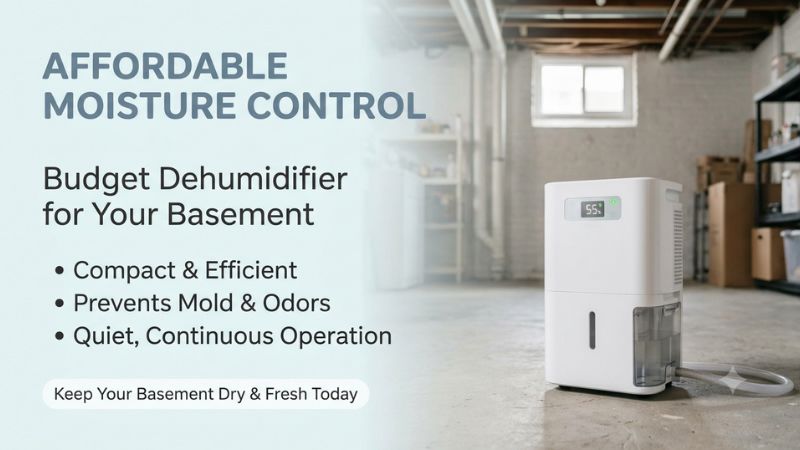
A reliable budget dehumidifier for basement moisture control should provide sufficient extraction capacity without unnecessary premium features. Comparing smaller compressor appliances, humidity controls, drainage options, and long-term electricity expenses can help homeowners find practical value without sacrificing essential performance.
Quick verdict
The most economical basement dehumidifier is not necessarily the appliance with the lowest purchase price. An undersized unit that operates continuously without controlling humidity can become a poor long-term investment.
These six models represent practical lower- and intermediate-capacity alternatives to premium high-capacity basement appliances.
- Best for basic humidity management: Frigidaire FFAD2234W1.
- Best compact storage design: Midea Cube MAD20S1QWT.
- Best for moderate humidity: Danby DDR030EBWDB.
- Best for smart humidity management: GE ADHL22LA.
- Best for higher moisture loads: Midea EasyDry MAD35C1AWS.
- Best compact alternative: Danby DDR020BIWDB.
Budget suitability depends on the actual selling price. These selections emphasize practical configurations and appropriately sized extraction capacity rather than an unverified claim that they are currently the cheapest products available.
Quick comparison table
| Product | Rated capacity | Best for | Main advantage | Trade-off |
|---|---|---|---|---|
| Frigidaire FFAD2234W1 | 22 pints/day | Basic moisture management | ENERGY STAR certification | Limited severe-moisture capacity |
| Midea Cube MAD20S1QWT | 20 pints/day | Small basement rooms | Nesting design | Lower extraction rating |
| Danby DDR030EBWDB | 30 pints/day | Moderate dampness | Intermediate capacity | Less capacity than 50-pint models |
| GE ADHL22LA | 22 pints/day | Everyday humidity control | Smart Dry functionality | Not intended for severe moisture loads |
| Midea EasyDry MAD35C1AWS | 35 pints/day | Regular basement dampness | Higher extraction rating | May cost more than smaller appliances |
| Danby DDR020BIWDB | 22 pints/day | Compact utility rooms | Practical capacity class | Limited substantial-moisture capability |
How we selected affordable basement dehumidifiers
Budget-oriented dehumidifier recommendations should consider the relationship between purchase price, extraction capability, maintenance requirements, and expected operating conditions.
The selected models were evaluated using published product descriptions and rated moisture extraction capacity. Recommendations are editorial assessments rather than results from firsthand testing.
Capacity appropriate for residential basements
A low-cost dehumidifier must remove enough moisture to make a measurable difference in its intended space.
Products with extremely small collection reservoirs or extraction ratings significantly below conventional residential appliances were excluded because they may be unsuitable for meaningful basement humidity management.
Essential features rather than premium extras
An appliance does not need advanced connectivity, elaborate displays, or integrated pumps in every household.
For buyers with convenient gravity drainage or manageable reservoir access, a straightforward compressor appliance may provide a practical balance of initial cost and functionality.
Long-term operating value
Published efficiency information, appliance sizing, and maintenance requirements influence total ownership expenses.
Products were not ranked by unverified electricity consumption, unsupported durability claims, or fluctuating retail discounts.
Best budget dehumidifier for basement use
Frigidaire FFAD2234W1 – Best for basic humidity management
The Frigidaire FFAD2234W1 offers a 22-pint capacity class suitable for homeowners managing modest moisture loads. Its ENERGY STAR certification makes it a relevant candidate for buyers who want to consider operating efficiency alongside purchase cost.
Best for: Small basement rooms with recurring moderate humidity.
Why we picked it: Its identifiable capacity and published efficiency certification provide useful starting points for an informed budget purchase.
Key specifications
- Model: FFAD2234W1.
- Rated capacity: 22 pints per day.
- Appliance type: Portable residential dehumidifier.
- Efficiency designation: ENERGY STAR certified.
Features and benefits
The model’s capacity provides a meaningful step above miniature moisture-collection appliances. For a small basement with manageable moisture conditions, buying a correctly sized lower-capacity appliance may avoid unnecessary spending on a larger model.
ENERGY STAR certification provides an efficiency-related purchasing reference, although actual electricity use still depends on operating conditions.
Performance and practical use
A small finished basement or enclosed storage room experiencing seasonal humidity may benefit from this capacity class.
If the appliance cannot achieve an appropriate humidity target despite suitable placement and temperature, the homeowner should investigate moisture load and potential capacity limitations.
What makes it different: Its published certification and conventional 22-pint configuration provide a useful combination for basic residential moisture control.
Pros
- Published ENERGY STAR certification.
- Appropriate capacity for modest moisture loads.
- Avoids the need to purchase a high-capacity model unnecessarily.
Cons
- Less extraction capacity than 35- or 50-pint alternatives.
- Unsuitable as a substitute for repairing active leaks.
Buy if: You need straightforward humidity management for a small, moderately damp basement.
Skip if: Your basement experiences severe or persistent moisture accumulation.
Midea Cube MAD20S1QWT – Best compact storage design
The Midea Cube MAD20S1QWT combines a 20-pint extraction rating with a distinctive lift-and-twist design. Its nesting configuration can make seasonal storage more convenient than some conventional appliance designs.
Best for: Homeowners with limited storage space and modest basement moisture.
Why we picked it: Its configuration addresses practical space constraints without relying on an extremely low-capacity thermoelectric system.
Key specifications
- Model: MAD20S1QWT.
- Rated capacity: 20 pints per day.
- Configuration: Cube design.
- Storage feature: Nesting and extended operating configurations.
Features and benefits
The Cube design allows the appliance to switch between different physical configurations according to manufacturer instructions. This can be helpful for households that only need basement moisture management during certain seasons.
A compact storage configuration should not be confused with permission to operate the appliance in any confined location.
Performance and practical use
This model may suit a basement hobby room, small storage area, or finished room where humidity rises during warm weather.
Its 20-pint rating provides less extraction capability than intermediate- and high-capacity alternatives, so it should be chosen according to measured moisture conditions.
What makes it different: The nesting design offers a storage-related benefit beyond conventional capacity considerations.
Pros
- Practical design for seasonal storage.
- Meaningful room-scale extraction capacity.
- Suitable for moderately damp compact rooms.
Cons
- Lower extraction rating than larger Cube models.
- May be inadequate for a continuously wet basement.
Buy if: Space-conscious storage and moderate moisture removal are priorities.
Skip if: Your basement requires substantial daily water extraction.
Danby DDR030EBWDB – Best for moderate dampness
The Danby DDR030EBWDB offers a 30-pint extraction rating, positioning it between smaller 20- to 22-pint appliances and larger 35- to 50-pint models.
Best for: Homeowners seeking intermediate moisture extraction capacity.
Why we picked it: Its capacity class provides additional extraction potential without automatically requiring a high-capacity basement appliance.
Key specifications
- Model: DDR030EBWDB.
- Rated capacity: 30 pints per day.
- Appliance format: Portable residential dehumidifier.
- Application: Intermediate moisture management.
Features and benefits
The intermediate capacity is relevant when smaller appliances may struggle with regular humidity increases but severe moisture conditions do not justify a larger model.
This makes the Danby a practical candidate for buyers who want to compare performance requirements against the actual purchase price.
Performance and practical use
A basement laundry room or regularly occupied recreation space may experience varying moisture loads. A 30-pint appliance can provide additional capacity compared with a 22-pint unit under comparable rating conditions.
Actual operating effectiveness depends on room temperature, airflow, and the amount of moisture continuously entering the space.
What makes it different: Its intermediate rating fills the gap between smaller entry-capacity appliances and larger basement-oriented models.
Pros
- Intermediate moisture extraction capability.
- Practical alternative to smaller appliances.
- Suitable for recurring moderate dampness.
Cons
- Lower rated capacity than 50-pint models.
- Actual value depends on the current purchase price.
Buy if: A smaller dehumidifier appears insufficient for your basement’s regular moisture load.
Skip if: Your basement requires dedicated high-capacity moisture management.
GE ADHL22LA – Best for smart humidity management
The GE ADHL22LA is a 22-pint portable dehumidifier featuring Smart Dry functionality. Its combination of conventional extraction capacity and humidity-management controls makes it relevant for routine residential use.
Best for: Small basement rooms where convenient humidity control matters.
Why we picked it: Its identified capacity and control feature provide practical benefits without requiring buyers to prioritize remote connectivity or premium accessories.
Key specifications
- Model: ADHL22LA.
- Rated capacity: 22 pints per day.
- Appliance type: Portable dehumidifier.
- Control feature: Smart Dry.
Features and benefits
Humidity-management controls can help the appliance respond to changing indoor conditions according to its selected operating mode.
This can be useful in basement rooms where humidity fluctuates throughout the day rather than remaining consistently elevated.
Performance and practical use
A basement office or small recreation room may benefit from an appliance that can manage ordinary humidity changes without requiring frequent manual adjustments.
However, smart operating controls cannot compensate for insufficient extraction capacity or continued groundwater intrusion.
What makes it different: Its Smart Dry functionality provides a clearly identified control feature in the 22-pint capacity category.
Pros
- Suitable capacity for modest humidity.
- Smart Dry functionality.
- Practical everyday residential application.
Cons
- Limited high-moisture extraction capability.
- Exact drainage and installation requirements should be confirmed.
Buy if: You want convenient everyday humidity management in a compact basement.
Skip if: You need a higher-capacity appliance for severe moisture conditions.
Midea EasyDry MAD35C1AWS – Best for higher moisture loads
The Midea EasyDry MAD35C1AWS provides a 35-pint extraction rating. It is a practical upgrade candidate for budget-conscious homeowners who need more substantial moisture removal than lower-capacity models offer.
Best for: Basements with regular dampness or larger accessible air volumes.
Why we picked it: Its higher extraction rating can justify additional purchase expense when lower-capacity alternatives would be undersized.
Key specifications
- Model: MAD35C1AWS.
- Rated capacity: 35 pints per day.
- Product series: EasyDry.
- Appliance type: Residential dehumidifier.
Features and benefits
The increased extraction rating offers additional moisture-removal capability under standardized conditions.
For households experiencing frequent humidity increases, a properly sized intermediate-capacity appliance may provide better practical value than purchasing a smaller unit that cannot maintain the desired conditions.
Performance and practical use
Consider this model for a basement laundry area or an open storage room where humidity remains elevated for extended periods.
If substantial water continues entering the basement, however, correcting the moisture source remains essential regardless of appliance capacity.
What makes it different: It offers the highest rated extraction capacity among the six selected budget-oriented candidates.
Pros
- Higher extraction rating than 20- and 22-pint appliances.
- Practical for recurring basement dampness.
- Reduces the risk of selecting an unnecessarily undersized appliance.
Cons
- May cost more than lower-capacity models.
- Potentially unnecessary for lightly damp rooms.
Buy if: Your basement requires more extraction capacity than smaller residential appliances provide.
Skip if: A lower-capacity model can adequately maintain your target humidity.
Danby DDR020BIWDB – Best compact alternative
The Danby DDR020BIWDB is a 22-pint residential dehumidifier suitable for comparison with other lower-capacity compressor appliances.
Best for: Small utility rooms and modest basement moisture conditions.
Why we picked it: Its capacity class provides an additional purchasing option for homeowners comparing similarly sized residential models across different brands.
Key specifications
- Model: DDR020BIWDB.
- Rated capacity: 22 pints per day.
- Appliance type: Portable dehumidifier.
- Intended application: Residential humidity management.
Features and benefits
A conventional 22-pint appliance can be a reasonable choice when a basement has limited floor space and a manageable moisture burden.
Before purchasing, compare the appliance’s dimensions, drainage arrangement, warranty terms, and efficiency information with competing models.
Performance and practical use
A small enclosed utility room with recurring seasonal humidity is a suitable potential application.
The model should not be selected solely according to advertised room coverage. Measure room conditions and evaluate whether its extraction capacity is appropriate.
What makes it different: It offers an alternative manufacturer and configuration within the widely relevant 22-pint capacity class.
Pros
- Practical capacity for modest moisture loads.
- Alternative to competing entry-capacity appliances.
- Avoids unnecessary high-capacity purchasing in suitable rooms.
Cons
- May struggle with severe moisture conditions.
- Current price and operating efficiency require comparison.
Buy if: You are comparing conventional 22-pint appliances for a small basement.
Skip if: Your room requires substantial sustained moisture extraction.
How to choose a budget dehumidifier for basement conditions
A successful budget purchase balances upfront expense with operating efficiency and moisture-control capability. Saving money on nonessential features is generally preferable to sacrificing necessary capacity or electrical safety.
Avoid choosing capacity by price alone
An undersized appliance can operate for extended periods while failing to achieve acceptable humidity.
Begin by measuring room humidity and assessing moisture sources. Determine an appropriate capacity range before comparing prices.
A 20- or 22-pint unit may be adequate for modest moisture, while a 30- or 35-pint unit may offer better value when humidity remains persistently elevated.
Compare total ownership costs
The complete cost of a dehumidifier includes more than its original purchase price.
Consider:
- Initial appliance cost.
- Electricity consumption.
- Drainage accessories.
- Maintenance requirements.
- Replacement components when applicable.
- Warranty coverage and repair availability.
A cheaper appliance is not automatically the most economical option over several years.
Use electricity estimates carefully
Electricity expenses depend on average power consumption, actual operating hours, and the local utility rate.
For illustration, an appliance drawing 400 watts while operating for an average of eight hours daily would consume approximately 96 kilowatt-hours over a 30-day month. At an assumed rate of $0.16 per kilowatt-hour, that would cost approximately $15.36.
This is a hypothetical example, not a measured consumption figure for any recommended product.
Prioritize drainage when the appliance runs frequently
Manual reservoir emptying can become inconvenient when an appliance collects substantial water.
A gravity-drain configuration may provide better everyday value than paying for an integrated pump when a suitable lower drain is already available.
Check whether the necessary hose or adapter is included before comparing total purchase costs.
Pay attention to operating temperature
Cool basement temperatures can reduce compressor dehumidifier performance.
Compare each model’s supported temperature range and defrost capabilities. A discounted appliance that cannot operate effectively in your basement conditions is not a worthwhile purchase.
Avoid miniature appliances for substantial moisture
Low-cost miniature thermoelectric products can appear attractive because of their compact size and low initial price.
However, their limited extraction capability often makes them unsuitable for persistently damp basement rooms.
Buying an appropriately sized compressor appliance is generally a more practical starting point for room-scale moisture control.
How to reduce basement dehumidifier operating costs
Repair leaks and improve drainage
Inspect the basement for plumbing leaks, foundation seepage, and condensation. Correct exterior drainage problems where appropriate.
Reducing the amount of moisture entering the basement reduces the extraction burden placed on the appliance.
Maintain an appropriate humidity setting
For many residential basements, an initial target around 45% to 50% RH is practical.
Avoid unnecessarily aggressive settings that cause prolonged operation without a meaningful household benefit.
Maintain filters and airflow
Follow the manufacturer’s filter-cleaning schedule. Accumulated dust and restricted airflow can interfere with normal operation.
Maintain the required clearance around the air intake and exhaust.
Monitor results using a hygrometer
An independent humidity meter helps determine whether the appliance is achieving suitable conditions throughout the room.
If humidity remains elevated, investigate the cause rather than simply lowering the appliance’s target setting.
Frequently asked questions
What is the cheapest type of dehumidifier for a basement?
Miniature moisture absorbers and thermoelectric appliances often have lower initial costs, but they are generally unsuitable for substantial room-scale basement moisture removal. A correctly sized compressor appliance is usually a more practical budget investment.
Is a 22-pint dehumidifier sufficient for a basement?
It may be sufficient for a small, moderately damp basement room. Larger or more persistently damp areas may require a higher extraction capacity.
Does a larger dehumidifier always cost more to operate?
No. Actual electricity expenses depend on efficiency, runtime, humidity conditions, and capacity suitability. A larger appliance may operate for fewer hours when appropriately sized.
Should I purchase a used dehumidifier?
A used appliance may save money, but inspect its condition, recall status, electrical components, drainage system, and available warranty. Avoid appliances with evidence of damage or unsafe repairs.
Is ENERGY STAR certification worth considering?
Yes. It provides a useful efficiency reference when comparing suitable appliances. However, certification does not establish that a particular model will have the lowest operating cost in every household.
Can a cheap dehumidifier eliminate basement mold?
No. A suitable appliance can help manage airborne moisture, but existing mold contamination and continuing water intrusion require appropriate corrective action.
Conclusion
The Frigidaire FFAD2234W1, Midea Cube MAD20S1QWT, GE ADHL22LA, and Danby DDR020BIWDB are practical lower-capacity candidates for modest basement moisture. The Danby DDR030EBWDB and Midea EasyDry MAD35C1AWS offer additional extraction capability for more demanding rooms. Compare actual purchase prices, drainage requirements, and energy efficiency before choosing the model that provides the best overall value.
More from Amazon
Programs that pair well with the guide above. Offers and eligibility are set by Amazon and may change.
Collect the home and kitchen items you want in one registry that guests can shop from.
Create a wedding registrySet up recurring deliveries of everyday items on eligible products. Terms and savings are set by Amazon.
Explore Subscribe & SaveFree shipping on eligible items, Prime Video and more. Eligible new members can start with a free trial.
Start a Prime free trialAudiobooks and podcasts to listen to on the go. Eligible new members can start with a free trial.
Try Audible freeAs an Amazon Associate we earn from qualifying purchases.