Key takeaways
- Below 50% RH: Additional dehumidification may not be necessary.
- 50% to 60% RH: Monitor conditions and evaluate seasonal moisture changes.
- Above 60% RH: Persistent readings warrant investigation and moisture management.
- Visible condensation or seepage: Investigate the underlying moisture source.
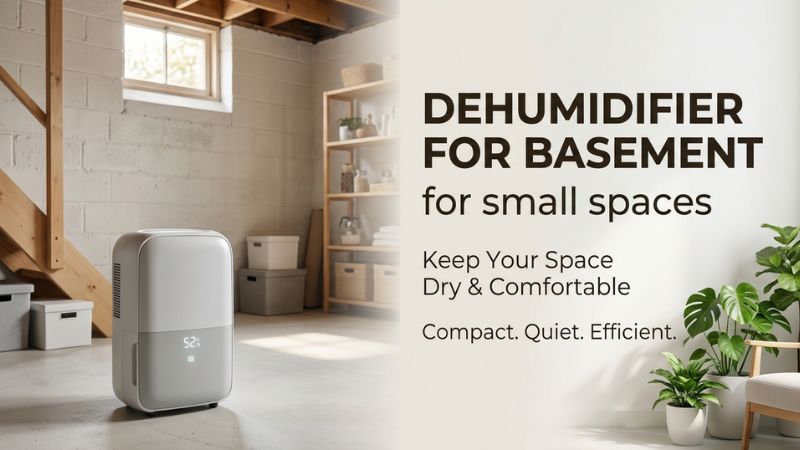
Choosing a dehumidifier for basement for small spaces requires more than finding the smallest appliance available. Extraction capacity, operating temperature, drainage access, and airflow determine whether a compact model can effectively manage humidity without consuming unnecessary floor space or electricity.
What size dehumidifier works in a small basement?
A 20- to 22-pint compressor dehumidifier is a reasonable starting point for many small, moderately damp basement rooms. A 30- to 35-pint model may be more appropriate when humidity remains elevated for extended periods or when laundry and foundation moisture create additional demand.
The physical size of the appliance and its moisture extraction capacity are separate considerations. A compact appliance with insufficient extraction capacity may operate continuously without achieving the desired humidity level.
Understand your basement’s moisture conditions
Before shopping, measure relative humidity using a digital hygrometer. Take readings over several days and at different times, especially after rainfall or laundry activities.
Consider these general conditions:
- Below 50% RH: Additional dehumidification may not be necessary.
- 50% to 60% RH: Monitor conditions and evaluate seasonal moisture changes.
- Above 60% RH: Persistent readings warrant investigation and moisture management.
- Visible condensation or seepage: Investigate the underlying moisture source.
The Environmental Protection Agency recommends maintaining indoor humidity below 60%, preferably between 30% and 50% when practical.
Distinguish floor area from moisture load
A 250-square-foot basement storage room with persistent foundation moisture may require more extraction capacity than a 500-square-foot finished basement with occasional humidity increases.
Advertisements emphasizing maximum square footage do not fully account for foundation conditions, ceiling height, temperature, airflow restrictions, or moisture-producing activities.
Use square footage as an initial reference rather than a definitive sizing calculation.
Compare common capacity classes
| Rated capacity | Suitable application | Main limitation |
|---|---|---|
| Miniature thermoelectric | Localized, very light moisture | Limited room-scale extraction |
| 20–22 pints/day | Small, moderately damp rooms | May struggle with persistent moisture |
| 30–35 pints/day | Compact but regularly damp basements | Potentially larger appliance footprint |
| 50 pints/day | Severe moisture loads | May be unnecessary for modest humidity |
The appropriate capacity depends on operating conditions rather than room dimensions alone.
Essential features of a dehumidifier for basement for small spaces
Compact basement installations benefit from appliances that minimize unnecessary floor-space requirements while maintaining adequate airflow and convenient access to controls, filters, and drainage components.
Compact dimensions and practical clearances
Measure the available floor area before purchasing. Account for the appliance’s width, depth, height, power cable, drainage hose, and manufacturer-required ventilation clearances.
A unit that technically fits between a cabinet and a wall may still operate poorly if its air intake or exhaust becomes obstructed.
Allow additional space for:
- Removing and carrying the water reservoir.
- Accessing the air filter.
- Connecting the drainage hose.
- Reading and adjusting controls.
- Moving the appliance for cleaning.
Evaluate the entire operating footprint rather than the appliance dimensions alone.
Continuous drainage
Small basement rooms may lack convenient access to a sink or floor drain. A continuous drainage option can simplify operation when an appropriate discharge point is available.
Gravity drainage requires a suitable downward hose route. If collected water must travel upward, a compatible pump-equipped appliance may be necessary.
For occasional use, a removable water reservoir can remain sufficient. However, homeowners should consider how frequently the reservoir needs attention.
Automatic humidity control
An adjustable humidistat allows homeowners to select a preferred humidity level rather than operating the dehumidifier continuously.
A starting target around 45% to 50% RH is reasonable for many residential basements. Confirm the actual room humidity using a separate hygrometer positioned away from the appliance’s exhaust.
Automatic humidity control can improve convenience and reduce unnecessary operation once the target is reached.
Defrost capability
Basements often remain cooler than above-ground rooms. Refrigerant-based dehumidifiers can develop frost on their evaporator coils when operating under unfavorable temperature conditions.
An automatic defrost function can help manage frost during supported operation. Nevertheless, it does not mean the appliance can operate effectively at any temperature.
Always verify the manufacturer’s minimum operating temperature before using a dehumidifier in an unheated basement.
Noise and vibration management
Dehumidifiers contain fans and, in compressor models, refrigeration components that produce operating noise.
Noise becomes especially important in basement offices, bedrooms, recreation rooms, and areas adjoining occupied living spaces.
Avoid relying exclusively on marketing descriptions such as quiet operation. Comparable sound measurements and clearly identified operating conditions provide more useful evidence.
Compare compact dehumidifier technologies
Different dehumidification technologies vary substantially in extraction capability, temperature sensitivity, energy consumption, and suitability for residential basement conditions.
Compressor dehumidifiers
Compressor models draw humid air across a cold surface, causing moisture to condense into collected water. The appliance then releases relatively dry air back into the room.
Advantages
- Suitable for meaningful room-scale moisture removal.
- Available in multiple residential capacity classes.
- Frequently available with automatic humidity controls.
Limitations
- Extraction efficiency can decline in colder conditions.
- Compressor and fan operation produce noise.
- Requires appropriate drainage or reservoir maintenance.
For most small basement rooms within normal supported operating temperatures, a compressor dehumidifier is the preferred starting point.
Desiccant dehumidifiers
Desiccant appliances use moisture-absorbing materials and a regeneration process to remove water from indoor air.
They can be relevant in cooler environments where some compressor appliances become less effective.
However, powered desiccant units may consume substantial electricity and introduce additional heat into the room. Compare documented temperature-dependent performance and energy consumption before purchasing.
Thermoelectric dehumidifiers
Thermoelectric appliances use a solid-state cooling mechanism to condense moisture. Their compact dimensions make them attractive for closets, cabinets, and other confined areas.
Their limited extraction capability makes them unsuitable as the primary moisture-management appliance for most persistently damp basement rooms.
Choose this technology only when the moisture load is genuinely small and measurable.
Disposable moisture absorbers
Passive moisture absorbers use hygroscopic materials to collect moisture without electricity.
They may supplement humidity management inside isolated cabinets or storage containers, but they are not a practical substitute for a properly sized powered appliance in a damp basement.
Keep collection containers away from children and pets, and follow the manufacturer’s handling instructions.
Choose a model according to your basement layout
A compact appliance should match the room’s intended function, available electrical connections, and practical drainage arrangements. The following scenarios illustrate how different household requirements affect product selection.
Small basement storage room
Storage rooms frequently contain cardboard boxes, furniture, clothing, and other moisture-sensitive materials. Restricted airflow between stored objects can create localized dampness even when the room’s average humidity appears acceptable.
Choose a compressor dehumidifier with adjustable humidity control and sufficient extraction capacity.
Keep belongings away from damp walls and avoid obstructing air circulation around the appliance.
Basement laundry room
Washing machines, wet clothing, and inadequate dryer ventilation can increase the moisture burden within a small laundry room.
A 30- to 35-pint appliance may be more suitable than a lower-capacity model when humidity increases frequently.
Repair faulty dryer exhaust connections and address plumbing leaks. A dehumidifier should supplement proper appliance ventilation rather than replace it.
Small finished basement office
A finished basement office requires humidity management without excessive noise, heat, or interference with workspace organization.
Prioritize a suitable operating sound profile, automatic humidity control, convenient drainage, and an unobstructed installation location.
Avoid positioning the appliance where discharged air blows directly toward the user’s seating area if that causes discomfort.
Unheated basement utility room
Measure both humidity and temperature before selecting an appliance.
A conventional compressor model may struggle if temperatures fall near or below its supported operating range. A suitable low-temperature or desiccant model may provide a more practical alternative, depending on documented performance and operating costs.
Do not operate electrical appliances outside their specified environmental conditions.
What features are worth paying for?
When shopping within a limited budget, prioritize features that directly influence moisture extraction and everyday usability rather than paying for convenience functions that do not improve the intended application.
| Feature | Priority | Reason |
|---|---|---|
| Adequate extraction capacity | Essential | Determines moisture-removal capability |
| Automatic humidity control | High | Supports controlled operation |
| Full-reservoir shutoff | High | Helps prevent reservoir overflow |
| Continuous drainage | High for frequent use | Reduces manual maintenance |
| Automatic defrost | Important in cooler rooms | Supports operation under appropriate conditions |
| Washable filter | Useful | Simplifies routine maintenance |
| Wi-Fi controls | Optional | Adds remote convenience |
| Integrated pump | Situation-dependent | Helps when upward drainage is required |
A straightforward appliance with adequate capacity and convenient drainage can represent better value than a smaller premium appliance with insufficient extraction capability.
How to install a compact basement dehumidifier
Prepare the installation location
Select a stable, level surface that satisfies the manufacturer’s operating clearances. Ensure the air intake and exhaust remain unobstructed.
Avoid locations exposed to standing water, active plumbing leaks, or physical damage from household activities.
Establish a suitable drainage route
Determine whether you will use the reservoir, continuous gravity drainage, or an integrated pump.
Secure the hose according to the appliance instructions. Check connections for leakage and avoid routing hoses through frequently used walkways.
Connect the appliance safely
Use an appropriate grounded electrical outlet that complies with manufacturer requirements and applicable electrical safety rules.
Avoid extension cords and overloaded power strips unless the manufacturer explicitly permits a specific arrangement.
Consult a qualified electrician when existing basement electrical conditions are unsuitable.
Monitor performance after installation
Record the starting humidity, selected humidity target, and subsequent readings.
Evaluate results over several days under typical household conditions. If the appliance operates frequently without achieving the intended humidity level, investigate airflow, temperature, capacity, and continuing moisture sources.
Common mistakes when buying a small basement dehumidifier
Choosing the smallest available appliance
Compact dimensions do not establish adequate extraction capacity. A miniature appliance may collect visible water without meaningfully changing room humidity.
Ignoring ongoing moisture intrusion
Foundation leaks and water seepage can continuously introduce moisture. Increasing dehumidifier capacity without correcting the source may increase operating costs while leaving the building problem unresolved.
Installing the appliance inside a closed cabinet
Restricted air circulation prevents the appliance from treating the surrounding room effectively. Follow manufacturer clearance requirements even when available floor space is limited.
Selecting an unnecessarily low humidity target
Extremely low settings can increase energy consumption without providing meaningful additional benefits. Choose an appropriate target based on room conditions and actual household needs.
Frequently asked questions
Is a 20-pint dehumidifier enough for a small basement?
It can be sufficient for a moderately damp enclosed basement room. Persistent moisture intrusion or higher humidity loads may require a larger appliance and building repairs.
Can I put a dehumidifier underneath a table?
Only when the placement satisfies manufacturer airflow and clearance requirements and allows safe access to the controls, reservoir, and filter.
Can a small dehumidifier prevent mold?
It can reduce environmental moisture that supports mold growth if it maintains suitable humidity. Existing mold contamination and active water intrusion require separate corrective measures.
Do compact dehumidifiers consume less electricity?
Not necessarily. A smaller appliance may run longer than a properly sized larger model. Compare published energy efficiency and actual moisture-control requirements.
Should I buy a dehumidifier with a pump for a small basement?
A pump is worthwhile when collected water cannot reach an appropriate lower drainage location. If manual emptying or gravity drainage is practical, a pump may be unnecessary.
Conclusion
The right compact basement dehumidifier combines adequate extraction capacity, manageable dimensions, convenient drainage, and compatibility with the room’s operating temperature. Begin with a 20- to 22-pint compressor appliance for modest moisture conditions, consider 30- to 35-pint options for persistent dampness, and address underlying leaks before relying on additional appliance capacity.
More from Amazon
Programs that pair well with the guide above. Offers and eligibility are set by Amazon and may change.
Collect the home and kitchen items you want in one registry that guests can shop from.
Create a wedding registrySet up recurring deliveries of everyday items on eligible products. Terms and savings are set by Amazon.
Explore Subscribe & SaveFree shipping on eligible items, Prime Video and more. Eligible new members can start with a free trial.
Start a Prime free trialAudiobooks and podcasts to listen to on the go. Eligible new members can start with a free trial.
Try Audible freeAs an Amazon Associate we earn from qualifying purchases.