Key takeaways
- Best overall for flexible drainage: Midea Cube 50-Pint with Pump.
- Best for conventional basement use: Frigidaire FHDD5034W1.
- Best for large, damp spaces: hOmeLabs HME1003.
- Best for compact basement rooms: Midea Cube 35-Pint.
- Best for moderate moisture: GE ADHE35BWF.
- Best alternative for substantial moisture: Danby DDR50B1BDB.
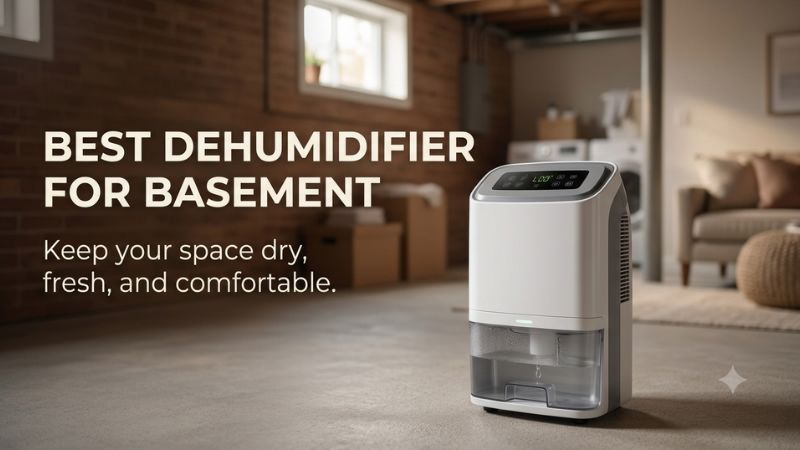
Finding the best dehumidifier for basement moisture control means balancing extraction capacity, drainage convenience, energy consumption, and operating temperature. Whether your basement serves as a storage area, laundry room, or finished living space, the right appliance can help maintain manageable humidity throughout the year.
Quick verdict
The Midea Cube 50-Pint Dehumidifier with Pump is a versatile option for homeowners who need substantial moisture removal and flexible drainage. Its integrated pump makes it particularly practical in basements without a conveniently positioned floor drain.
However, smaller spaces and moderately damp basements may benefit from a lower-capacity appliance that requires less space and potentially costs less upfront.
- Best overall for flexible drainage: Midea Cube 50-Pint with Pump.
- Best for conventional basement use: Frigidaire FHDD5034W1.
- Best for large, damp spaces: hOmeLabs HME1003.
- Best for compact basement rooms: Midea Cube 35-Pint.
- Best for moderate moisture: GE ADHE35BWF.
- Best alternative for substantial moisture: Danby DDR50B1BDB.
These recommendations reflect product configurations and practical household suitability rather than firsthand laboratory testing.
Quick comparison table
| Product | Rated capacity | Best for | Main advantage | Trade-off |
|---|---|---|---|---|
| Midea Cube MAD50PS1QWT | 50 pints/day | Flexible drainage | Integrated pump | Larger capacity than some rooms require |
| Frigidaire FHDD5034W1 | 50 pints/day | Damp basements | Conventional portable design | Requires drainage planning |
| hOmeLabs HME1003 | 50 pints/day | Large basement areas | Substantial moisture extraction capacity | Requires suitable floor space |
| Midea Cube MAD35S1QWT | 35 pints/day | Compact basements | Space-conscious design | Lower extraction capacity |
| GE ADHE35BWF | 35 pints/day | Moderate humidity | Smart Dry functionality | Less suitable for severe moisture |
| Danby DDR50B1BDB | 50 pints/day | Larger basement rooms | High-capacity configuration | May be excessive for lightly damp rooms |
Rated capacities represent standardized moisture extraction conditions rather than guaranteed daily water collection in every basement.
How we selected the best dehumidifier for basement use
Basement conditions differ substantially from those of bedrooms and conventional living rooms. Cooler temperatures, foundation moisture, restricted airflow, and limited drainage can affect how effectively a portable dehumidifier operates.
The selection criteria emphasize practical moisture management rather than relying exclusively on advertised square footage.
Moisture removal capacity
A dehumidifier’s daily extraction rating indicates how much water it can remove under standardized test conditions. Residential appliances commonly fall into capacity classes around 20, 35, and 50 pints per day.
Higher capacity becomes useful when a basement experiences persistent humidity or contains moisture-producing appliances. Nevertheless, extraction ratings should not be interpreted as guaranteed output under cooler or drier conditions.
Drainage convenience
Basement dehumidifiers may collect water in a removable reservoir, discharge through a gravity-fed hose, or use an integrated pump.
A gravity drain can reduce manual maintenance when a suitable lower drainage point is available. A pump provides additional flexibility when collected water must travel upward to an approved discharge location.
Operating temperature and efficiency
Cold basement conditions can reduce the effectiveness of compressor-based appliances. Buyers should verify the manufacturer’s supported operating temperature and defrost functionality before selecting a model.
Energy efficiency also matters because basement dehumidifiers may operate for extended periods during humid weather.
Household compatibility
The selected appliance should fit its intended installation location without obstructing walkways, storage shelves, utility equipment, or ventilation openings.
Controls, reservoir accessibility, filter maintenance, and drainage requirements influence how convenient a dehumidifier remains after installation.
Best dehumidifiers for basement moisture control
Midea Cube MAD50PS1QWT – Best overall for flexible drainage
The Midea Cube 50-Pint Dehumidifier with Pump combines substantial rated moisture removal with a drainage system that accommodates more complicated basement layouts. It is particularly relevant for homeowners who cannot conveniently route water downward into a nearby floor drain.
Best for: Medium to large damp basements requiring flexible drainage.
Why we picked it: Its combination of a 50-pint extraction rating, Cube configuration, and integrated pump addresses several common basement installation challenges.
Key specifications
- Model: MAD50PS1QWT.
- Rated moisture removal: 50 pints per day.
- Appliance type: Portable compressor dehumidifier.
- Drainage: Integrated pump.
- Configuration: Cube-style reservoir design.
Features and benefits
The Cube configuration provides an alternative to conventional front-access reservoir designs. Its integrated pump is particularly useful where the intended drainage destination sits above the appliance.
This reduces dependence on manual bucket emptying when the drainage system is correctly installed according to manufacturer instructions.
Performance and practical use
A homeowner with a basement laundry area and an accessible utility sink may find the pump-equipped configuration more convenient than a gravity-only appliance.
The larger extraction rating also provides additional capacity when moisture enters through normal seasonal humidity, laundry activities, or moderately damp foundation surfaces.
Actual moisture collection depends on temperature, humidity, room conditions, and the selected humidity setting.
Pros
- Substantial rated moisture removal.
- Integrated pump supports flexible drainage.
- Practical configuration for demanding basement environments.
Cons
- May be unnecessarily large for a lightly damp utility room.
- Pump installation adds maintenance considerations.
Buy if: Your basement requires substantial humidity control and lacks convenient gravity drainage.
Skip if: You only need occasional moisture removal in a small enclosed room.
Frigidaire FHDD5034W1 – Best for conventional basement use
The Frigidaire FHDD5034W1 provides a conventional portable dehumidifier configuration with a 50-pint capacity rating. It is appropriate for homeowners who prefer a traditional appliance rather than a specialized Cube design.
Best for: Homeowners managing persistent basement humidity.
Why we picked it: Its rated extraction capacity makes it a reasonable candidate for demanding residential moisture-control applications.
Key specifications
- Model: FHDD5034W1.
- Rated capacity: 50 pints per day.
- Appliance format: Portable compressor dehumidifier.
- Application: Residential humidity control.
Features and benefits
The conventional upright design can be practical in basements where homeowners have established appliance locations and sufficient space around the unit.
A high-capacity portable appliance can also be repositioned when household moisture patterns change, provided the electrical and drainage arrangements remain suitable.
Performance and practical use
This model is relevant for finished basements, storage areas, and utility rooms experiencing recurring humidity increases during warmer months.
Homeowners should evaluate drainage compatibility before installation. Do not assume that all Frigidaire 50-pint models include an integrated pump, since configurations differ between model numbers.
Pros
- High rated extraction capacity.
- Conventional residential appliance configuration.
- Suitable for persistent seasonal humidity.
Cons
- Drainage features require exact-model verification.
- May occupy more space than a compact appliance.
Buy if: You need a conventional high-capacity basement dehumidifier.
Skip if: An integrated pump is essential and the selected configuration does not provide one.
hOmeLabs HME1003 – Best for large basement areas
The hOmeLabs HME1003 is another 50-pint-class residential appliance worth considering for larger basement environments. Its extraction capacity makes it more relevant to sustained humidity management than miniature countertop dehumidifiers.
Best for: Open basement areas with recurring dampness.
Why we picked it: Its high-capacity configuration addresses households that require more substantial moisture extraction than a compact appliance can typically provide.
Key specifications
- Model: HME1003.
- Rated capacity: 50-pint class.
- Appliance type: Portable compressor dehumidifier.
- Intended application: Residential moisture management.
Features and benefits
A portable high-capacity dehumidifier provides flexibility for households that do not need a permanently installed basement humidity-control system.
Its principal benefit is the ability to address a meaningful moisture load without immediately requiring a professionally installed whole-home appliance.
Performance and practical use
An unfinished basement with open airflow may benefit from a centrally positioned appliance. However, walls, closed doors, shelving, and separate rooms can restrict the movement of dry air throughout the space.
The hOmeLabs model should therefore be sized according to the accessible air volume and moisture conditions rather than total basement square footage alone.
Pros
- Substantial rated extraction capacity.
- Appropriate for demanding residential applications.
- Portable alternative to permanent installation.
Cons
- Larger appliance footprint than small-capacity units.
- Drainage and exact reservoir configuration require confirmation.
Buy if: You need meaningful moisture removal in an open basement.
Skip if: Your basement contains isolated rooms that require independently controlled humidity.
Midea Cube MAD35S1QWT – Best for compact basements
The Midea Cube 35-Pint model offers a lower-capacity alternative to larger 50-pint appliances. It is particularly suitable for enclosed basement rooms where moisture levels are elevated but not severe enough to justify a larger unit.
Best for: Compact basement rooms, storage spaces, and moderately damp areas.
Why we picked it: Its intermediate capacity and Cube-style design provide a practical balance between extraction capability and household space requirements.
Key specifications
- Model: MAD35S1QWT.
- Rated capacity: 35 pints per day.
- Appliance type: Compressor dehumidifier.
- Configuration: Cube-style design.
Features and benefits
A mid-capacity dehumidifier can provide adequate humidity management without requiring homeowners to purchase the highest-capacity appliance available.
The Cube design is relevant when appliance placement, reservoir access, and storage flexibility are important considerations.
Performance and practical use
Consider a small finished basement office that experiences elevated humidity during summer. A properly sized 35-pint appliance may provide adequate moisture removal without requiring the capacity of a larger model.
However, a small basement with active water seepage may still require more substantial moisture management and building repairs.
Pros
- Practical intermediate extraction capacity.
- Space-conscious configuration.
- Suitable for moderately damp enclosed rooms.
Cons
- Lower rated extraction than 50-pint alternatives.
- May struggle with substantial continuous moisture intrusion.
Buy if: Your basement has moderate humidity and limited appliance space.
Skip if: Your moisture conditions consistently exceed the appliance’s practical extraction capability.
GE ADHE35BWF – Best for moderate humidity
The GE ADHE35BWF belongs to the 35-pint capacity class and incorporates GE’s Smart Dry functionality. It is a practical candidate for homeowners seeking an intermediate-capacity appliance for routine basement moisture control.
Best for: Finished basements and moderately humid utility rooms.
Why we picked it: Its capacity and humidity-management functionality address everyday residential conditions without automatically requiring a 50-pint appliance.
Key specifications
- Model: ADHE35BWF.
- Rated capacity: 35 pints per day.
- Appliance type: Portable dehumidifier.
- Control feature: Smart Dry.
Features and benefits
Humidity-management controls help homeowners maintain their intended indoor conditions without relying exclusively on continuous operation.
An appropriately sized appliance can cycle as necessary when moisture conditions change, although actual cycling behavior depends on the selected operating mode and surrounding environment.
Performance and practical use
The GE model is relevant for basement recreation areas, storage rooms, and home offices where humidity rises seasonally.
Its intermediate capacity may be less appropriate when a basement contains continuously wet materials or substantial moisture entering from outside.
Pros
- Balanced moisture extraction rating.
- Smart Dry functionality.
- Suitable for moderate residential humidity.
Cons
- Lower capacity than larger models.
- Exact drainage configuration should be checked before purchase.
Buy if: You want routine humidity control in a moderately damp basement.
Skip if: Your basement requires sustained high-capacity moisture extraction.
Danby DDR50B1BDB – Best high-capacity alternative
The Danby DDR50B1BDB provides another 50-pint option for homeowners comparing portable basement dehumidifiers. Its rated capacity makes it relevant for larger spaces or recurring seasonal moisture problems.
Best for: Homeowners comparing conventional high-capacity appliances.
Why we picked it: It offers substantial rated moisture removal and provides an alternative to other major residential dehumidifier configurations.
Key specifications
- Model: DDR50B1BDB.
- Rated capacity: 50 pints per day.
- Appliance type: Portable residential dehumidifier.
- Application: Higher-capacity humidity management.
Features and benefits
A 50-pint appliance provides additional extraction capacity compared with smaller residential units under comparable standardized rating conditions.
This can be useful when a basement experiences recurring moisture increases after humid weather or everyday household activities.
Performance and practical use
The Danby model may be appropriate for an open basement where a smaller appliance operates frequently without maintaining the intended humidity level.
Before purchasing, confirm the exact unit’s drainage options, electrical requirements, operating temperature, and maintenance instructions.
Pros
- High rated moisture extraction capacity.
- Suitable for demanding residential spaces.
- Provides an alternative to other 50-pint models.
Cons
- May be excessive for small, lightly damp rooms.
- Additional model-specific installation details require verification.
Buy if: You need a conventional 50-pint appliance for substantial basement humidity.
Skip if: A smaller appliance already maintains acceptable humidity consistently.
How to choose the best dehumidifier for basement conditions
Choosing a suitable dehumidifier begins with understanding the basement’s actual moisture load. Room size matters, but persistent seepage, ventilation, temperature, laundry activities, and foundation conditions can be equally important.
Match capacity to moisture conditions
| Capacity class | Typical application |
|---|---|
| 20 pints/day | Small spaces with modest moisture loads |
| 35 pints/day | Intermediate residential moisture management |
| 50 pints/day | Larger or more persistently damp basement areas |
| Dedicated whole-home system | Extensive or interconnected humidity problems |
These are general selection categories rather than guaranteed room-size limits.
A small but severely damp basement may require a higher-capacity appliance than a larger, relatively dry finished basement.
Choose the appropriate drainage system
Manual reservoir emptying is reasonable for occasional use, particularly when the appliance is easily accessible.
Continuous gravity drainage is preferable when an approved lower drainage point is available. A pump-equipped model becomes more relevant when collected water must travel upward.
Avoid placing drainage hoses where they create trip hazards or interfere with household equipment.
Evaluate energy efficiency
Compare the energy efficiency of appliances within relevant capacity classes. ENERGY STAR certification and published integrated energy factor information can help buyers assess moisture removal relative to electricity consumption.
A low-wattage appliance is not necessarily more economical if it must operate for substantially longer to achieve the same humidity target.
Consider basement temperature
Compressor dehumidifiers generally become less effective as operating temperatures decrease.
Before buying, confirm the supported temperature range and defrost capabilities. Homeowners with unusually cold basements may need a specialized humidity-control strategy instead of assuming that a conventional appliance will operate effectively under all conditions.
Set a realistic humidity target
The Environmental Protection Agency recommends keeping indoor relative humidity below 60%, preferably within the 30% to 50% range when possible.
A setting around 45% to 50% can be a reasonable starting point for many residential basements. Use a separate hygrometer to check conditions away from the appliance.
Persistent humidity above the desired range may indicate inadequate capacity, restricted airflow, or an unresolved moisture source.
Address underlying moisture problems
A dehumidifier controls moisture in the air. It does not repair foundation cracks, prevent groundwater intrusion, correct faulty plumbing, or remove existing mold contamination.
If moisture continues entering the basement, investigate the building conditions rather than relying exclusively on a larger appliance.
Frequently asked questions
Is a 50-pint dehumidifier enough for a basement?
A 50-pint appliance can be appropriate for many residential basements. Its suitability depends on moisture load, operating temperature, airflow, and basement layout.
A large basement with ongoing water intrusion may require professional moisture-control measures.
Should a basement dehumidifier run continuously?
Continuous operation may be useful during initial drying or periods of elevated humidity. Once conditions stabilize, automatic humidity control can allow the appliance to operate according to demand.
Follow manufacturer instructions regarding continuous operation.
Where should a basement dehumidifier be placed?
Choose a stable, level location with unobstructed airflow, a suitable electrical outlet, and convenient drainage. Avoid placing the appliance directly against walls or furniture unless the manufacturer permits that arrangement.
Can a dehumidifier remove basement mold?
A dehumidifier can reduce moisture conditions that encourage mold growth, but it cannot remove established mold contamination. Existing mold and its moisture source require appropriate remediation.
Is a built-in pump necessary?
A pump is useful when collected water must travel upward or when gravity drainage is impractical. It is not essential if a suitable lower drain is available or manual emptying is manageable.
Why is my basement still humid after using a dehumidifier?
Possible causes include insufficient extraction capacity, cold operating conditions, blocked airflow, incorrect humidity settings, drainage problems, or continued moisture entering the building.
Conclusion
The Midea Cube 50-Pint with Pump is a versatile choice for homeowners requiring substantial basement moisture removal and flexible drainage. The Frigidaire, hOmeLabs, and Danby 50-pint models provide alternative high-capacity configurations, while the Midea Cube and GE 35-pint appliances suit more moderate conditions. Select a model according to measured humidity, drainage access, operating temperature, and the underlying moisture load.
More from Amazon
Programs that pair well with the guide above. Offers and eligibility are set by Amazon and may change.
Collect the home and kitchen items you want in one registry that guests can shop from.
Create a wedding registrySet up recurring deliveries of everyday items on eligible products. Terms and savings are set by Amazon.
Explore Subscribe & SaveFree shipping on eligible items, Prime Video and more. Eligible new members can start with a free trial.
Start a Prime free trialAudiobooks and podcasts to listen to on the go. Eligible new members can start with a free trial.
Try Audible freeAs an Amazon Associate we earn from qualifying purchases.