Key takeaways
- Best for general airborne humidity: Compressor dehumidifier.
- Best alternative for certain cooler environments: Powered desiccant dehumidifier.
- Best for suitable outdoor drying conditions: Controlled ventilation.
- Best for cooling and supplemental moisture removal: Air conditioning.
- Best for enclosed storage containers: Passive moisture absorbers.
- Best for groundwater intrusion: Foundation drainage and waterproofing improvements.
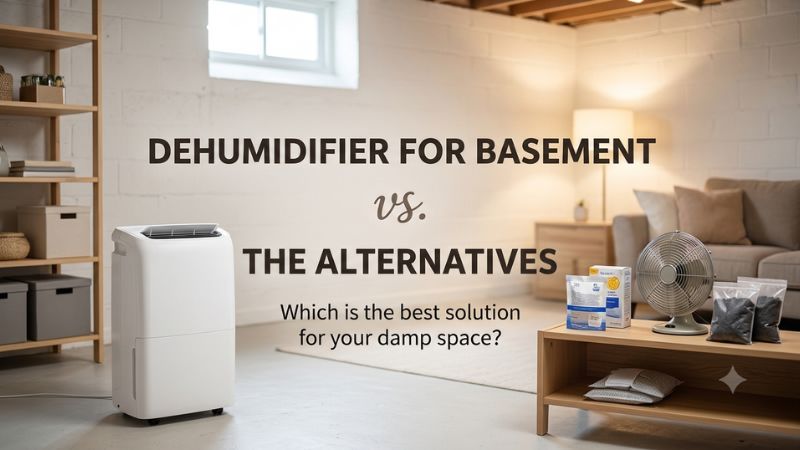
Comparing a dehumidifier for basement vs alternatives helps homeowners determine whether powered moisture extraction, ventilation, air conditioning, passive absorbers, or building improvements provide the most appropriate solution. Each approach addresses different moisture conditions, and choosing the wrong method can increase expenses without correcting persistent dampness.
Quick verdict
A compressor dehumidifier is generally the most practical standalone appliance for controlling airborne moisture in a moderately warm, persistently humid basement.
However, alternative methods may be more appropriate when the underlying problem involves groundwater intrusion, plumbing leaks, unusually cold temperatures, or inadequate ventilation.
- Best for general airborne humidity: Compressor dehumidifier.
- Best alternative for certain cooler environments: Powered desiccant dehumidifier.
- Best for suitable outdoor drying conditions: Controlled ventilation.
- Best for cooling and supplemental moisture removal: Air conditioning.
- Best for enclosed storage containers: Passive moisture absorbers.
- Best for groundwater intrusion: Foundation drainage and waterproofing improvements.
These solutions are not always interchangeable. Some address airborne humidity, while others prevent moisture from entering the building.
Quick comparison table
| Solution | Operating principle | Best application | Energy requirement | Main limitation |
|---|---|---|---|---|
| Compressor dehumidifier | Refrigerated condensation | General basement humidity | Electricity | Temperature-sensitive performance |
| Powered desiccant dehumidifier | Moisture adsorption and regeneration | Certain cooler rooms | Electricity | Heat output and operating expenses |
| Mechanical ventilation | Indoor and outdoor air exchange | Suitable outdoor conditions | Fan electricity | Can introduce additional moisture |
| Air conditioning | Cooling with moisture condensation | Occupied, conditioned basements | Electricity | Moisture removal depends on cooling demand |
| Passive moisture absorber | Hygroscopic moisture collection | Small enclosed storage areas | None during passive operation | Very limited room-scale capacity |
| Waterproofing and drainage | Reduces liquid water intrusion | Foundation and groundwater problems | Varies by system | May require substantial installation work |
The best choice depends on where moisture originates, how much moisture enters the basement, and whether the intended solution removes airborne water vapor or prevents moisture intrusion.
How basement dehumidifiers compare with alternative solutions
A basement moisture problem can originate from indoor air, outdoor air, foundation materials, plumbing, groundwater, or household activities. Understanding the underlying mechanism is necessary before comparing equipment and building improvements.
Compressor dehumidifier
A compressor dehumidifier draws humid air across a refrigerated evaporator surface. Water vapor condenses into liquid and drains into a collection reservoir or suitable drainage system.
The appliance returns relatively dry air to the room while releasing some heat.
Key characteristics
- Available in multiple residential extraction capacities.
- Generally suitable for room-scale humidity management.
- Requires electricity and collected-water management.
- Performance depends on operating temperature and humidity.
Advantages
- Directly removes water vapor from indoor air.
- Can operate independently of household cooling demand.
- Often includes adjustable humidity controls.
- Available in portable configurations.
Disadvantages
- May become less effective in colder conditions.
- Produces fan and compressor noise.
- Does not prevent groundwater or plumbing leaks.
Choose this option if: Your basement experiences recurring airborne humidity and remains within the appliance’s supported operating conditions.
Powered desiccant dehumidifier
Powered desiccant dehumidifiers use moisture-absorbing materials to extract water from the air. Many designs regenerate the moisture-absorbing material through a heating process.
Unlike conventional compressor systems, their moisture-removal mechanism does not depend entirely on maintaining a refrigerated condensation surface.
Key characteristics
- Uses moisture-absorbing materials.
- Requires a regeneration process.
- Can introduce additional heat into the room.
- Performance varies substantially by appliance design.
Advantages
- Certain models perform effectively in cooler conditions.
- Can provide meaningful powered moisture extraction.
- May suit environments where conventional compressor performance declines.
Disadvantages
- Potentially substantial electricity consumption.
- Additional heat may be undesirable.
- Requires model-specific performance comparisons.
Choose this option if: Your basement remains relatively cool and documented performance supports a desiccant appliance for those conditions.
Mechanical ventilation
Mechanical ventilation exchanges indoor air with outdoor air using fans or a designed ventilation system.
Unlike a dehumidifier, ventilation does not necessarily remove moisture through condensation or collection. Its effectiveness depends on the moisture content of incoming outdoor air relative to indoor conditions.
Key characteristics
- Relies on air exchange.
- May help manage odors and indoor contaminants.
- Moisture-control performance depends on outdoor conditions.
- Installation can influence building pressure.
Advantages
- Provides fresh-air exchange.
- Can reduce moisture when incoming air contains less water vapor.
- May address ventilation deficiencies.
Disadvantages
- Humid outdoor air can worsen basement dampness.
- May increase heating or cooling demand.
- Improper exhaust arrangements can create building-pressure problems.
Choose this option if: Outdoor conditions support drying and the ventilation arrangement is appropriate for the building.
Air conditioning
Air conditioners remove heat from indoor air through a refrigeration cycle. During cooling, moisture can condense on the evaporator and drain away.
Consequently, air conditioning can provide supplemental dehumidification while meeting the room’s cooling needs.
Key characteristics
- Provides active cooling.
- Removes some moisture during suitable operation.
- Depends on equipment sizing and runtime.
- May require ductwork, condensate drainage, or outdoor equipment.
Advantages
- Combines cooling and moisture removal.
- Improves thermal comfort in warm occupied basements.
- May reduce humidity without another appliance under suitable conditions.
Disadvantages
- Limited moisture removal when cooling demand is low.
- Can overcool an already cool basement.
- Oversized cooling equipment may operate in short cycles.
Choose this option if: The basement requires both cooling and humidity management during warm weather.
Passive moisture absorbers
Passive moisture absorbers use hygroscopic substances that attract and collect moisture from the surrounding air.
These products can be useful in cabinets, storage containers, and small enclosed areas where powered appliances are impractical.
Key characteristics
- No electricity required during passive operation.
- Limited moisture extraction capability.
- Absorbing material eventually requires replacement.
- Primarily intended for localized moisture management.
Advantages
- Simple operation.
- Compact dimensions.
- No fan or compressor noise.
- Useful in small enclosed storage areas.
Disadvantages
- Insufficient for most persistently damp basement rooms.
- Recurring replacement expenses.
- Collected liquid or chemicals require appropriate handling.
Choose this option if: You need supplemental moisture management inside a genuinely small enclosed area.
Foundation waterproofing and drainage
Waterproofing and drainage improvements address moisture entering the building through foundation walls, floors, surrounding soil, or inadequate exterior water management.
Possible measures depend on building conditions and may include gutter improvements, grading corrections, foundation repairs, drainage systems, or sump equipment.
Key characteristics
- Addresses certain underlying liquid-water sources.
- May involve exterior or interior building work.
- Requires assessment of actual moisture pathways.
- Installation complexity varies considerably.
Advantages
- Can reduce continuing moisture intrusion.
- Addresses problems beyond airborne humidity.
- May reduce the ongoing burden on dehumidification equipment.
Disadvantages
- Potentially substantial installation expense.
- May require professional assessment.
- Does not automatically eliminate every airborne humidity source.
Choose this option if: Your basement experiences seepage, groundwater intrusion, or recurring liquid-water accumulation.
Technical comparison of dehumidifier for basement vs alternatives
The alternatives differ in moisture removal, energy consumption, temperature compatibility, and installation requirements. Evaluating these criteria consistently helps identify which approach addresses the actual problem.
Moisture removal capability
Compressor and powered desiccant dehumidifiers directly remove water vapor from indoor air.
Air conditioners also remove moisture through condensation, but their primary function is temperature control.
Ventilation changes indoor moisture conditions through air exchange. Passive absorbers collect relatively small quantities of moisture, while waterproofing reduces certain sources of moisture entering the building.
| Solution | Direct airborne moisture removal | Prevents water intrusion |
|---|---|---|
| Compressor dehumidifier | Yes | No |
| Powered desiccant dehumidifier | Yes | No |
| Air conditioning | Yes, during suitable cooling | No |
| Ventilation | Conditional | No |
| Passive absorber | Yes, at limited scale | No |
| Waterproofing | Not its primary function | Can address suitable intrusion sources |
When substantial airborne humidity is the primary problem, powered dehumidification provides a more direct solution than passive alternatives.
Operating temperature compatibility
Conventional compressor appliances perform within manufacturer-specified temperature ranges. Their extraction capability can decrease in cooler environments, particularly when frosting interrupts normal operation.
Certain desiccant appliances may offer advantages under cooler conditions.
Air conditioning is generally less suitable when the basement is already cool and has little demand for additional temperature reduction.
Ventilation depends on both outdoor and indoor environmental conditions, while passive absorbers remain limited by their extraction rate.
Energy efficiency
There is no universal energy-efficiency ranking that applies to every basement and every alternative.
Compressor dehumidifier efficiency depends on capacity, temperature, humidity, and runtime. Desiccant appliances may require substantial energy for regeneration.
Ventilation consumes fan electricity and may influence the building’s heating and cooling requirements. Passive absorbers avoid direct electrical consumption but introduce replacement-material costs.
Waterproofing may reduce future dehumidification demand when it successfully addresses a major moisture source.
Installation complexity
Portable dehumidifiers generally require suitable electricity, airflow, and drainage arrangements.
Mechanical ventilation may require ductwork, external openings, balanced airflow, or professional design. Air conditioning installation depends on equipment type and building compatibility.
Foundation waterproofing can involve substantial construction work and professional evaluation.
Passive absorbers typically have the simplest installation requirements but also offer the most limited extraction capability.
Maintenance requirements
| Solution | Typical maintenance considerations |
|---|---|
| Compressor dehumidifier | Filter, reservoir, drainage hose |
| Powered desiccant appliance | Filter and manufacturer-specified components |
| Ventilation | Fans, filters, ducts, exterior openings |
| Air conditioning | Filters, coils, condensate drainage |
| Passive absorbers | Replacement material and collection container |
| Waterproofing system | Drains, sump equipment, inspection of moisture pathways |
Exact maintenance requirements depend on the selected equipment and installation.
Noise and household comfort
Compressor dehumidifiers and air conditioners contain moving components that can produce audible operating noise.
Powered desiccant appliances and mechanical ventilation systems also commonly use fans.
Passive moisture absorbers have no powered moving parts during ordinary operation.
Homeowners using a basement as an office, bedroom, or recreation area should consider documented operating sound measurements and appliance placement rather than relying on subjective marketing descriptions.
Dehumidifier vs ventilation for basement humidity
Ventilation can be an effective supporting measure when outdoor air contains less moisture than indoor air. However, opening windows or increasing exhaust airflow during humid weather can introduce additional water vapor into the basement.
Why outdoor relative humidity can be misleading
Relative humidity describes moisture content in relation to the air’s temperature.
Warm outdoor air can contain more water vapor than cooler basement air even when its relative humidity percentage is lower.
When this warmer air enters the basement and cools, its relative humidity can rise, potentially increasing condensation risk.
Outdoor dew point and indoor moisture conditions provide more useful context than comparing relative humidity percentages alone.
When ventilation helps
Ventilation may support basement drying when incoming outdoor air is sufficiently dry and the building can exchange air safely.
It may also improve general indoor air quality by addressing ventilation deficiencies.
When a dehumidifier is preferable
A powered dehumidifier is often more practical during humid weather when outdoor air would introduce additional moisture.
It can remove water vapor while limiting dependence on favorable outdoor drying conditions.
When to combine both approaches
Some homes benefit from correctly designed ventilation combined with controlled dehumidification.
The ventilation system addresses appropriate fresh-air requirements, while the dehumidifier manages residual moisture.
Building-pressure considerations and combustion-appliance safety should be evaluated by qualified professionals where relevant.
Dehumidifier vs air conditioner for basement comfort
Air conditioners and compressor dehumidifiers both use refrigeration principles, but their intended functions and effects on indoor temperature differ.
Differences in temperature control
An air conditioner transfers heat away from the conditioned space while removing some moisture.
A portable compressor dehumidifier generally releases heat into the same room during operation.
If the basement is warm and uncomfortable, air conditioning may address both temperature and part of the moisture burden. If the basement is already cool, a dehumidifier may provide more appropriate humidity management.
Differences in operating demand
An air conditioner typically responds primarily to temperature requirements. Once the desired temperature is reached, cooling operation may decrease even if humidity remains elevated.
A dehumidifier with humidity-based control responds to relative humidity rather than requiring additional cooling demand.
Best choice for finished basements
Finished basements with adequate cooling and low humidity may not require a separate dehumidifier.
Where humidity remains elevated despite comfortable temperature conditions, dedicated moisture extraction can provide additional control.
Dehumidifier vs moisture absorbers for basement storage
Passive moisture absorbers offer simplicity and small physical dimensions, but their extraction capacity should not be confused with that of a powered residential appliance.
Small enclosed storage areas
A passive absorber can be useful inside certain cabinets or enclosed storage containers where moisture accumulation is limited.
Follow the product instructions regarding placement, replacement, and safe handling.
Open basement rooms
An open basement contains a much larger volume of air and may receive additional moisture continuously.
Passive absorbers generally cannot manage substantial room-scale moisture loads efficiently.
A suitably sized powered dehumidifier is more appropriate when the goal is to maintain acceptable humidity throughout the room.
Combined storage protection
Homeowners may use a powered dehumidifier to manage room humidity while employing passive absorbers in suitable isolated storage areas.
The passive product supplements rather than replaces primary humidity management.
Dehumidifier vs waterproofing for basement water problems
Waterproofing and dehumidification address different stages of moisture management. Waterproofing aims to prevent certain moisture sources from entering the basement, while dehumidification removes water vapor already present in the indoor air.
Visible groundwater intrusion
Water appearing through foundation walls, floor cracks, or other building openings requires investigation of the underlying water pathway.
Installing a larger dehumidifier does not repair these conditions.
Appropriate corrective measures depend on foundation construction, site drainage, soil conditions, and the source of water intrusion.
Condensation without visible leakage
Condensation can occur when humid indoor air contacts a sufficiently cool surface.
Reducing airborne moisture may help address condensation when excessive indoor humidity is the primary cause.
Insulation, thermal improvements, and ventilation changes may also be relevant depending on the building conditions.
Persistent musty odors
A musty odor may indicate damp materials, hidden moisture, or existing mold contamination.
Dehumidification may help reduce favorable conditions for future growth, but existing contamination requires appropriate assessment and remediation.
Do not assume that reducing odor establishes that the underlying moisture problem has been resolved.
Which basement moisture solution should you choose?
The appropriate solution depends on the basement’s actual environmental conditions and the underlying source of moisture rather than the popularity of any particular appliance.
For a moderately damp finished basement
Start with a suitable compressor dehumidifier if humidity remains elevated despite otherwise satisfactory temperature and building conditions.
Select extraction capacity according to moisture load, airflow, and available drainage.
For a cold unfinished basement
Measure temperature and humidity before purchasing.
Compare compressor operating limits with documented desiccant appliance performance. Correct underlying water intrusion where present.
For a basement with visible water seepage
Prioritize investigation and correction of the moisture source.
Use suitable dehumidification as a supporting measure once electrical conditions are safe and liquid-water problems are being addressed.
For a basement used as a home office
Consider the combined effects of humidity, room temperature, noise, and air circulation.
A quiet, appropriately sized dehumidifier or properly designed air-conditioning system may provide suitable conditions depending on whether cooling is also required.
For basement closets and storage cabinets
Passive absorbers can provide localized supplementary moisture management.
If the surrounding basement remains humid, address room-scale moisture conditions first rather than relying exclusively on individual storage products.
For a large basement with multiple rooms
A single portable appliance may not adequately manage separated rooms.
Evaluate independent humidity measurements, airflow between rooms, multiple appliances, or professionally designed ducted dehumidification.
How to create an effective basement moisture-control strategy
A successful strategy identifies moisture sources, establishes realistic environmental targets, and selects the appropriate equipment or building improvements.
Measure existing conditions
Use a hygrometer to record relative humidity in different basement areas.
The Environmental Protection Agency recommends maintaining indoor humidity below 60%, preferably between 30% and 50% when practical.
Measure temperature as well, particularly in unfinished and unheated rooms.
Correct identifiable moisture sources
Investigate plumbing leaks, condensation, drainage problems, and foundation seepage.
Reducing the moisture entering the building can make ongoing humidity control easier and more economical.
Select the appropriate primary solution
Choose powered dehumidification for persistent airborne moisture, suitable waterproofing measures for water intrusion, and correctly designed ventilation when air exchange is necessary.
Use supporting methods where they provide additional practical benefits.
Evaluate results over time
Track relative humidity and inspect vulnerable areas after the selected measures are implemented.
Persistent dampness may indicate insufficient extraction capacity, unfavorable environmental conditions, restricted airflow, or unresolved moisture sources.
Frequently asked questions
Is a dehumidifier better than opening basement windows?
During humid outdoor conditions, a dehumidifier may provide more effective moisture management because opening windows can introduce additional water vapor. Ventilation can help when incoming air is sufficiently dry.
Can air conditioning replace a basement dehumidifier?
It can provide sufficient moisture removal in some basements with regular cooling demand. Dedicated dehumidification may be necessary when humidity remains elevated despite comfortable temperatures.
Are desiccant dehumidifiers better for cold basements?
Certain desiccant appliances may perform more effectively than conventional compressor units in cooler conditions. Compare model-specific temperature limits, extraction ratings, and electricity consumption.
Can moisture absorbers replace electric dehumidifiers?
Not for most persistently damp basement rooms. Passive absorbers are more suitable for localized moisture management in small enclosed areas.
Will waterproofing eliminate the need for a dehumidifier?
It may reduce the need for dehumidification if water intrusion is the primary moisture source. Residual humidity can still result from outdoor air, household activities, and condensation.
Can I use ventilation and a dehumidifier together?
Yes, when both systems are appropriate for the building. Ventilation should address necessary air exchange without introducing excessive moisture, while dehumidification manages the remaining airborne humidity.
Conclusion
A compressor dehumidifier is generally the most practical standalone appliance for managing airborne humidity in a suitable residential basement. Powered desiccant units may provide advantages in cooler environments, air conditioning can supplement moisture removal during cooling, and passive absorbers support localized storage protection. Ventilation and waterproofing address different environmental and building requirements. Select the approach that targets the actual moisture source, combining appropriate solutions when necessary.
More from Amazon
Programs that pair well with the guide above. Offers and eligibility are set by Amazon and may change.
Collect the home and kitchen items you want in one registry that guests can shop from.
Create a wedding registrySet up recurring deliveries of everyday items on eligible products. Terms and savings are set by Amazon.
Explore Subscribe & SaveFree shipping on eligible items, Prime Video and more. Eligible new members can start with a free trial.
Start a Prime free trialAudiobooks and podcasts to listen to on the go. Eligible new members can start with a free trial.
Try Audible freeAs an Amazon Associate we earn from qualifying purchases.