A sofa arm tray buying guide should help you find an accessory that sits securely on your actual couch rather than merely looking attractive in a product photograph. Armrest width, shape, firmness, upholstery, and the tray’s construction determine how useful it will be. This guide explains measurements, material choices, cup-holder designs, stability, cleaning, and long-term ownership considerations.
What Is a Sofa Arm Tray?
A sofa arm tray is a small tabletop or organizer designed to rest on, wrap over, or attach to the armrest of a sofa or chair.
It can hold small accessories such as remotes, phones, drinks, or snacks.
Unlike a conventional side table, the tray does not usually have a floor-supported base.
That makes it attractive for rooms with limited floor space, but it also creates important limitations.
The tray’s stability depends on the sofa arm.
A couch arm is primarily designed to provide support and comfort for a seated person, not necessarily to function as a rigid furniture table.
The correct tray must therefore match the furniture’s construction.
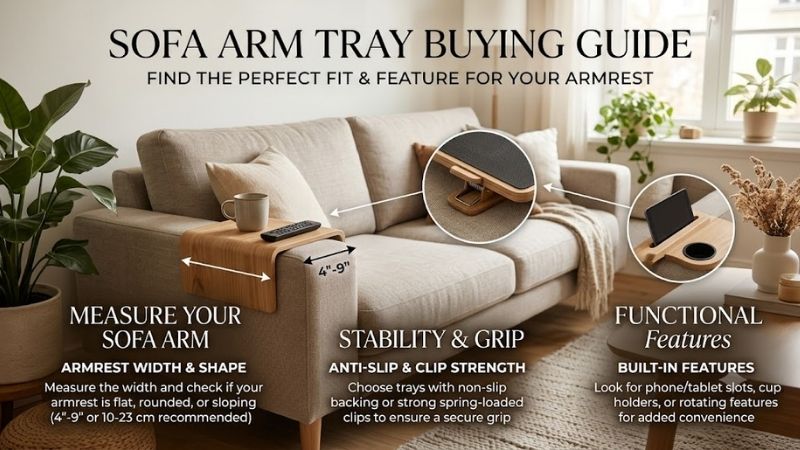
Main Types of Sofa Arm Trays
| Type | Main advantage | Main limitation |
|---|---|---|
| Flexible bamboo wrap | Adaptable to compatible arm shapes | Horizontal area varies |
| Rigid clip-on tray | Firm surface on suitable armrests | Clamp size and pressure |
| Silicone cup-holder organizer | Flexible and drink-focused | Limited rigid tabletop |
| Acacia wood folding tray | Natural appearance | Moisture and finish care |
| Tray with phone holder | Convenient viewing position | More components and less free space |
| Fabric armrest caddy | Pockets and easy storage | Not a stable drink platform |
| Detachable cup-holder tray | Configurable surface | Cup compatibility varies |
Step 1: Measure the Armrest Width
The width across the top of the armrest is the first specification to check.
However, one number may not tell the full story.
Total Armrest Width
Measure from the outer edge to the inner edge of the armrest at the intended tray position.
This provides the overall width.
Usable Flat Width
If the top curves downward, measure how much of the surface is reasonably flat.
A wide rounded arm may offer less level support than a narrower square arm.
Example
Suppose a sofa arm measures nine inches wide overall but has a six-inch reasonably flat center.
A rigid tray requiring eight inches of flat contact may not sit properly.
A flexible design might conform more closely, provided its horizontal support remains stable.
Published Fit Ranges
SPOKKI advertises compatibility with approximately 4.5–14-inch-wide armrests.
This is useful but should not be interpreted as a stability guarantee for all arm shapes in that range.
Always check the product’s complete fit instructions.
Step 2: Evaluate Armrest Shape
Flat Square Arms
A rigid clip-on tray may work well when the arm has sufficient firmness and a suitable gripping surface.
However, upholstery compression can still affect the result.
Rounded Arms
Flexible bamboo and silicone organizers may conform more effectively to gently rounded shapes.
However, they can tilt when the top lacks a stable level area.
Rolled Arms
Rolled arms often have rounded profiles and fabric that curves downward.
A clip-on design may be difficult to secure.
Choose based on published compatibility rather than generic claims.
Sloped Arms
A steeply sloped arm is poorly suited to supporting an open drink.
A side table may be safer than attempting to compensate with a non-slip pad.
Step 3: Check Firmness and Upholstery
A firm armrest can support a tray differently from a soft foam arm.
Soft Cushioning
The tray may sink or lean when loaded.
The supporting surface can also change shape when someone presses against the arm.
Woven Upholstery
Some fabrics provide a textured contact surface.
However, rough tray edges can snag threads.
Leather and Faux Leather
Smooth surfaces may provide less friction with some trays.
Clamping hardware can also leave marks.
Check material compatibility.
Plush Upholstery
Velvet-like fabrics may show pressure marks.
A heavy rigid tray may not be the best choice.
Slipcovered Arms
If the sofa arm is covered with loose fabric, the tray may move with the slipcover.
Grip against the slipcover does not necessarily mean grip against the sofa.
Step 4: Compare Clip-On and Flexible Designs
A clip-on tray uses an attachment arrangement to hold a rigid top.
A flexible tray drapes over the armrest.
Clip-On Advantages
A rigid top can provide a consistent surface.
Some models include phone holders or cup recesses.
However, clip fit is limited by the actual arm dimensions.
Clip-On Disadvantages
Incorrect pressure may damage upholstery.
The clamp may also fail to fit wide, rounded, or very soft arms.
Flexible Tray Advantages
Bamboo slats or silicone construction may follow the sofa’s contours.
Some fold flat for storage.
Flexible Tray Disadvantages
The horizontal surface depends on the armrest.
A flexible product cannot make an unstable couch arm rigid.
Step 5: Understand Cup-Holder Designs
Flat Top
Suitable for appropriately stable objects when the surface is level.
However, drinks can slide or tip.
Circular Recess
Can hold certain cup bases more securely.
However, the diameter must match.
Deep Silicone Holder
May provide more lateral contact with a compatible drink container.
However, the holder’s material can flex under movement.
Detachable Cup Holder
Allows the buyer to switch between different uses.
However, the detachable connection must be secure.
Handled Mugs
Cup handles may interfere with a closely fitted circular opening.
Check whether the holder accommodates the complete cup shape.
Step 6: Evaluate the Usable Surface Area
A product’s overall unfolded dimensions may include folding sides.
Do not assume the full area remains horizontal on the sofa.
Example: Foldable Bamboo
An 18-inch overall width may include several inches that hang down each side.
The usable central surface depends on the armrest.
Example: Rigid Round Tray
A 9.8-inch circular top offers approximately 75 square inches of theoretical surface area.
That may be enough for a drink and remote but is limited for plates or larger devices.
Example: Phone Holder
A phone holder may use part of the tabletop or project above it.
Check how other objects fit around the device.
Step 7: Compare Materials
Bamboo
Bamboo trays can provide a firm surface with a wood-like appearance.
Their coatings and joints determine how well they resist everyday use.
Wipe spills promptly.
Acacia Wood
Acacia provides natural wood styling.
However, the finish must be maintained according to instructions.
Do not assume natural wood is inherently waterproof.
Silicone
Silicone can provide flexibility and grip.
It is particularly relevant for cup-holder organizers.
However, soft construction may not suit objects needing a rigid platform.
Plastic
Plastic trays can be lightweight and inexpensive.
However, stiffness, surface texture, and heat tolerance vary.
Fabric
Fabric organizers are useful for remotes and small objects.
They are generally not substitutes for stable drink surfaces.
Step 8: Understand Non-Slip Features
A product described as non-slip may use silicone pads, textured undersides, foam elements, or hanging sides.
These features can improve retention.
However, they do not create immunity to movement.
Surface Contamination
Dust or residue can affect friction.
Keep the tray underside and upholstery clean according to the respective instructions.
Load Distribution
A heavy object placed near an unsupported edge can increase tipping risk.
Keep permitted objects reasonably centered.
Seated Movement
Leaning against the couch arm can cause an armrest tray to move.
A cup should not be left where it can spill onto a person.
Floor-Supported Alternatives
When stability is critical, a suitable C-shaped side table or conventional end table may provide more reliable support.
Step 9: Check Intended Weight Limits
Sofa arm trays are designed for relatively lightweight objects.
Do not infer capacity from the thickness of bamboo or wood.
A model may appear substantial while relying on flexible slats or small clips.
Check the exact manufacturer’s limits where provided.
Do not sit, lean, or stand on the tray.
Do not use it as a grab handle when standing up from the sofa.
Step 10: Consider Children, Pets, and Hot Drinks
An armrest tray occupies a position close to people.
That is convenient but can increase accidental-contact risks.
Hot Liquids
Use caution with coffee, tea, and other hot drinks.
A lidded cup may reduce splashing but does not make a tray completely safe.
Children
Children may grab the tray or knock it while climbing onto furniture.
Keep hot liquids and fragile objects out of reach.
Pets
A pet jumping on the sofa can cause movement.
Do not assume a tray will remain stable if the couch shifts.
Reclining Furniture
A tray must not interfere with moving recliner components.
Remove the tray when required by the product instructions.
Step 11: Evaluate Cleaning
Bamboo and Wood
Wipe with an appropriately damp cloth and dry promptly.
Avoid prolonged soaking.
Silicone
Clean with a suitable mild soap according to the product instructions.
Dry before replacing on the sofa.
Hardware
Inspect folding connections and clips for looseness or damage.
Underneath the Tray
Clean the contact surface periodically.
Trapped crumbs or moisture may affect upholstery and grip.
Step 12: Calculate Long-Term Value
A lower price can be appealing, but consider how frequently the product will be used.
A simple tray may provide excellent value when it holds a remote every evening.
A multifunctional design may justify extra cost when the cup holder and phone rest are used regularly.
However, a tray that must be adjusted constantly may be less convenient than a stable side table.
Include material care, replacement availability, storage, and return terms in the buying decision.
Buying Checklist
| Criterion | What to verify |
|---|---|
| Armrest width | Compatible with stated range |
| Flat supporting area | Enough for intended design |
| Armrest shape | Square, rounded, rolled, or sloped |
| Firmness | Does not compress excessively |
| Upholstery | Compatible with pads or clips |
| Top dimensions | Enough usable level surface |
| Cup holder | Fits intended container |
| Grip | Suitable retention method |
| Load limits | Appropriate for intended objects |
| Cleaning | Practical care instructions |
| Storage | Fits drawer or shelf when unused |
| Returns | Fit-related return terms |
Frequently Asked Questions
What Size Sofa Arm Tray Should I Buy?
Choose a tray compatible with the usable width, shape, and firmness of the armrest. Overall tray width is not the same as its horizontal tabletop area.
Are Clip-On Sofa Trays Better?
They can be useful on compatible firm arms. Flexible bamboo or silicone designs may work better on some rounded arms.
Can a Sofa Arm Tray Damage Leather?
Improper clamps, hard edges, or repeated friction may leave marks. Check the product and upholstery care instructions.
Are Sofa Arm Trays Stable Enough for Drinks?
Some can be suitable on stable, level armrests, but none should be assumed spillproof. Hot liquids require particular caution.
Is Bamboo More Durable Than Silicone?
They have different properties. Bamboo is rigid and silicone is flexible. Durability depends on the full construction and use.
Can I Use a Sofa Arm Tray for Eating?
A small snack may be practical on an appropriate tray. For larger meals or heavier plates, a stable floor-supported table is generally more suitable.
Conclusion
A sofa arm tray should fit the actual couch arm, provide enough level surface for everyday objects, and remain easy to clean and store. Compare armrest dimensions, shape, firmness, grip, cup compatibility, and material before choosing a design. Bamboo and acacia offer firmer surfaces, while silicone emphasizes flexibility and drink organization. When the sofa cannot support a tray reliably, a floor-standing alternative is the safer practical choice.