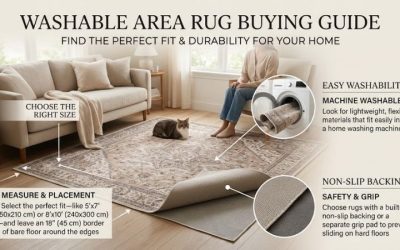
Choosing a washable area rug vs alternatives means weighing more than cleaning convenience. This comparison examines how washable rugs stack up against wool, jute, cotton flatweaves, polypropylene, and traditional carpets in comfort, durability, stain care, and long-term costs, helping you find the right option for your living room.
Washable Area Rug vs Alternatives: Quick Comparison
Washable area rugs are designed to simplify cleaning, but their benefits are not universal. Traditional rugs can offer greater depth, different material characteristics, and a wider selection of handcrafted constructions.
The best rug depends on the room’s traffic level, the household’s cleaning habits, and whether practical maintenance or decorative longevity is the greater priority.
| Rug Type | Machine Washing | Comfort | Maintenance | Best For |
|---|---|---|---|---|
| Washable synthetic rug | Often, model-dependent | Low to high | Relatively convenient | Families and pet owners |
| Traditional wool rug | Usually not recommended | Often comfortable | Specialized care | Formal living rooms |
| Natural jute rug | Generally not recommended | Firm, textured | Dry cleaning methods | Low-spill areas |
| Cotton flatweave | Sometimes | Usually thin | Care-dependent | Casual and budget spaces |
| Polypropylene rug | Model-dependent | Varies | Often easy spot cleaning | Busy indoor or outdoor areas |
| Traditional thick-pile rug | Usually not | Often plush | More demanding | Comfort-focused rooms |
These descriptions represent typical material and construction characteristics. Individual products may differ substantially.
What Makes Washable Area Rugs Different?
A washable area rug is manufactured to tolerate a defined cleaning method, often involving machine laundering.
This requirement influences the materials, backing, thickness, and overall construction.
Many washable rugs use relatively lightweight fibers and low-profile designs to reduce laundry bulk. Others incorporate a removable decorative cover that separates from a supporting pad.
Traditional area rugs are not necessarily designed around machine compatibility. They may use dense wool pile, substantial backing, natural materials, or constructions that require specialized cleaning.
Cleaning Convenience as the Primary Advantage
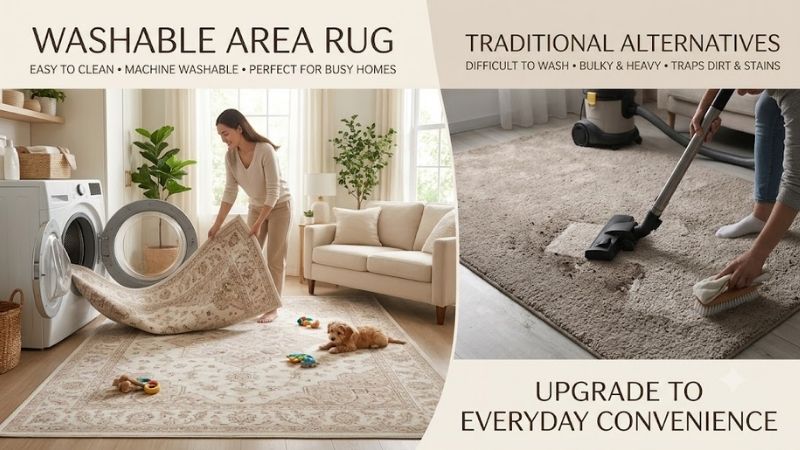
The main appeal of washable rugs is the ability to clean certain spills and accumulated dirt without professional assistance.
For households with children or pets, this can significantly reduce the inconvenience associated with accidents.
However, washable does not mean maintenance-free. Rugs still require vacuuming, prompt spill removal, and proper drying.
Large washable rugs may also require commercial laundry equipment, limiting the convenience that motivated the purchase.
Why Washable Rugs Can Feel Different Underfoot
Machine-washable construction often encourages lighter and thinner designs.
A low-pile washable rug may feel relatively flat compared with a dense wool rug or thick tufted carpet.
Some manufacturers address this by offering cushioned pads or plush washable constructions.
Nevertheless, adding thickness can increase the rug’s laundry bulk and drying requirements.
The best construction is a compromise between cleaning practicality and the level of comfort the homeowner expects.
Washable Area Rug vs. Wool Rug
Wool rugs are a common alternative because they offer natural fibers, attractive texture, and a wide range of traditional and contemporary designs.
Comfort and Appearance
Wool fibers have natural crimp and elasticity, helping many wool rugs provide a resilient surface underfoot.
A dense wool rug can create a substantial feeling in a living room, particularly when paired with upholstered furniture and solid wood pieces.
Traditional wool construction also allows woven textures and decorative patterns that may be difficult to reproduce in inexpensive printed washable rugs.
However, the comfort of a wool rug depends on weave, pile density, and supporting pad. Not every wool rug is thick or soft.
Cleaning and Stain Management
Wool can resist some everyday soiling, but it is not generally suitable for unrestricted machine washing.
Excessive heat, agitation, and unsuitable cleaning products may cause felting, shrinkage, or texture changes.
Many wool rugs require careful spot cleaning or professional care.
A washable synthetic rug may therefore be more convenient when frequent spills are expected.
However, professional cleaning is not necessarily required after every minor accident on a wool rug. Appropriate prompt spot cleaning can handle many everyday situations.
Durability and Value
Quality wool rugs can provide long service life when properly maintained.
However, longevity depends on fiber quality, construction, traffic, sunlight exposure, and maintenance.
A low-cost washable rug may show wear sooner in some environments, but it would be inaccurate to claim that wool always lasts longer than synthetic washable construction.
Choose a washable area rug when: Regular accidents and convenient cleaning are priorities.
Choose wool when: Natural texture, traditional appearance, and willingness to perform specialized maintenance matter more.
Washable Area Rug vs. Jute Rug
Jute rugs provide a distinctive natural texture that complements casual, coastal, rustic, and minimalist interiors.
Their appearance is often appealing to homeowners who want a relatively understated rug without a printed pattern.
Natural Texture and Visual Warmth
Jute fibers create a firm, textured surface with a recognizable woven appearance.
This can add warmth to rooms containing neutral upholstery, wood furniture, and natural decorative materials.
However, jute is generally less cushioned than plush synthetic or wool rugs. Some people also find its coarse texture uncomfortable for extended barefoot use.
A suitable pad may improve cushioning, but it does not completely change the surface texture.
Moisture and Cleaning Limitations
Jute is sensitive to prolonged moisture exposure. Saturating a jute rug may cause discoloration, distortion, or other problems.
Consequently, conventional jute rugs generally should not be placed in a washing machine.
Routine care usually centers on vacuuming and manufacturer-approved dry or minimally damp cleaning methods.
This makes jute less convenient in households where liquid spills are common.
Which Works Better in a Family Living Room?
A washable synthetic rug is generally easier to manage in a room used for frequent meals, children’s activities, or pet play.
Jute may be more appropriate in a lower-spill environment where natural texture is a major design objective.
For households wanting a jute-inspired appearance without traditional jute maintenance, some washable synthetic collections imitate woven natural-fiber patterns.
Choose a washable rug when: Spills, pets, and frequent cleaning are expected.
Choose jute when: Natural texture and an understated decorative appearance matter most.
Washable Area Rug vs. Cotton Flatweave
Cotton flatweaves occupy an interesting middle ground between conventional rugs and modern washable systems.
Many are lightweight, affordable, and relatively easy to handle. Some can be machine washed, making them washable rugs themselves rather than a completely separate category.
Construction and Everyday Comfort
Cotton flatwoven rugs use interlaced yarns without the deep pile found in many carpets.
This creates a relatively flat surface that is practical beneath furniture.
Because the rug is thin, chairs often move more easily across it, and vacuuming can be straightforward.
However, cotton flatweaves usually provide less cushioning than thicker alternatives.
Cleaning Differences
Some cotton flatweaves are machine washable, but their care instructions vary.
Cotton can absorb significant moisture and may shrink when exposed to unsuitable washing conditions.
Synthetic washable rugs may offer different drying characteristics or greater resistance to some common stains, depending on their construction.
Neither material is inherently maintenance-free.
Price and Ownership
Basic cotton flatweaves can be inexpensive compared with elaborate two-piece rug systems.
However, a separate nonslip pad may be necessary, particularly on hardwood or vinyl flooring.
For a small apartment, a machine-washable cotton flatweave may offer excellent value.
For a larger family living room, a removable-cover synthetic system may be easier to clean.
Choose a cotton flatweave when: Natural texture, low cost, and manageable size are priorities.
Choose a synthetic washable system when: Larger coverage and frequent laundering are more important.
Washable Area Rug vs. Polypropylene Rug
Polypropylene is commonly used in affordable rugs, including many indoor-outdoor products.
Its synthetic construction can make it practical for households seeking stain resistance and relatively straightforward maintenance.
Stain and Moisture Resistance
Polypropylene fibers generally absorb little moisture compared with many natural fibers.
This can make surface cleaning easier for certain spills.
However, the complete rug includes more than the fiber itself. Backing materials, adhesives, and overall construction affect how it responds to water.
A polypropylene rug may tolerate spot cleaning or rinsing without being suitable for machine washing.
Durability Under Foot Traffic
Polypropylene rugs can be practical in active spaces, but construction quality matters.
Low-quality products may flatten, develop visible wear, or show backing deterioration over time.
Similarly, washable synthetic rugs vary considerably in density, texture, and resistance to traffic.
Material alone is not enough to predict lifespan.
Indoor and Outdoor Applications
Certain polypropylene rugs are specifically designed for outdoor use, making them suitable for patios or transitional spaces.
Not every washable area rug is intended for outdoor conditions.
When choosing a rug for a covered porch, patio, or moisture-prone area, prioritize products explicitly rated for the environment.
Choose a washable rug when: Machine laundering is a core requirement.
Choose polypropylene when: Easy spot cleaning, affordability, or outdoor suitability matters more than machine washing.
Washable Area Rug vs. Traditional Thick-Pile Rug
Traditional thick-pile rugs can provide a plush, cushioned feeling that thin washable rugs may not fully reproduce.
Comfort and Warmth
A thick rug can make a hard floor feel softer and more comfortable.
This is appealing in living rooms where people regularly sit on the floor or in bedrooms where barefoot comfort matters.
A thick rug may also alter how footsteps sound in a room, although acoustic performance depends on the complete rug-and-pad system.
However, thicker construction can interfere with doors and movable furniture.
Cleaning Challenges
Deep pile can trap hair, crumbs, and other debris.
Routine vacuuming may require more attention, and full cleaning can be difficult when the rug is heavy.
Washable plush rugs provide an alternative, but their increased bulk may demand larger machines and longer drying times.
Furniture Compatibility
A low-pile rug usually makes it easier to move chairs and compact tables.
Thick pile can increase resistance when furniture is repositioned.
For a family living room containing lightweight movable furniture, low-pile washable construction may be preferable.
For a cozy seating area where furniture rarely moves, thick pile can be more appealing.
Choose washable low pile when: Cleaning and furniture movement are priorities.
Choose traditional thick pile when: Plush comfort outweighs cleaning convenience.
Comparing Cleaning Costs Over Time
Initial price is only one component of rug ownership.
A washable rug may cost more upfront than a basic conventional rug but reduce reliance on professional cleaning.
However, machine washing also consumes water, electricity, detergent, and time.
Household Washing Costs
The cost of washing a rug depends on appliance efficiency, detergent use, drying method, and frequency.
If the rug fits the household washer, laundering may be relatively convenient.
If it requires commercial equipment, repeated cleaning can become expensive and time-consuming.
A removable-cover system may reduce bulk, but it can carry a higher purchase price.
Professional Cleaning Costs
Traditional rugs sometimes require professional cleaning, particularly when heavily soiled or made from delicate materials.
The cost varies by region, rug size, fiber, construction, and service.
However, occasional professional cleaning may still be economical when a durable rug provides many years of service.
Comparing only the price of one wash ignores replacement costs and long-term durability.
Replacement and Environmental Considerations
A lower-priced washable rug is not necessarily the more sustainable choice if it requires frequent replacement.
Likewise, a premium natural-fiber rug is not automatically environmentally preferable.
Material sourcing, construction quality, longevity, washing frequency, and disposal all influence environmental impact.
The most practical approach is to choose a rug that performs well in the intended room and maintain it according to the manufacturer’s instructions.
Which Rug Is Best for Different Living Situations?
Families With Young Children
Washable rugs are often particularly convenient for families because spills and accidents are predictable.
A low-pile surface with stable backing is useful for routine cleaning and active movement.
Cushioning may also matter when children play on the floor.
Choose a construction that combines manageable laundering with sufficient comfort.
Pet Owners
Pets introduce hair, tracked-in dirt, and occasional accidents.
A washable rug can simplify cleanup, particularly when the cover is easy to remove.
However, pet accidents should be addressed promptly, including checking the floor beneath the rug.
A washable label does not guarantee that liquid cannot reach the backing or flooring.
Small Apartment Residents
Compact homes benefit from lightweight rugs that are easy to move and clean.
Cotton flatweaves and low-pile synthetic rugs are useful starting points.
Washer capacity is especially important when the apartment contains a compact machine or residents rely on shared laundry facilities.
Formal Living Rooms
Traditional wool and other decorative rugs may be attractive when spills are uncommon and appearance is the primary consideration.
Washable rugs can also work in formal spaces, particularly when they offer textured or sophisticated designs.
The difference is largely one of preferred construction and maintenance, rather than a strict division between casual and formal styles.
High-Traffic Family Rooms
A low-pile washable synthetic rug or suitable polypropylene rug may offer practical advantages.
Both can support straightforward routine cleaning, although full machine washability must be verified individually.
A stable rug pad and durable edge construction are particularly important in active rooms.
Common Misconceptions About Washable Rugs
Washable Rugs Last Longer Than Traditional Rugs
Machine washability does not establish durability.
A rug’s lifespan depends on material quality, construction, traffic, cleaning frequency, and maintenance.
Some washable rugs may show wear after repeated laundering, while some conventional rugs can remain serviceable for many years.
All Washable Rugs Are Stain-Proof
Washable and stain-proof are different claims.
A washable rug can tolerate a specified cleaning process, but difficult stains may remain after laundering.
Spill-resistant coatings may provide cleanup time without creating complete liquid protection.
Washable Rugs Never Need Professional Cleaning
Large washable rugs may require commercial laundry equipment.
Additionally, certain stains or maintenance problems may be difficult to resolve through household washing.
Always follow the manufacturer’s instructions when deciding whether professional assistance is appropriate.
Natural-Fiber Rugs Are Always Better
Natural fibers offer distinctive textures and material characteristics, but they also have maintenance limitations.
Synthetic washable rugs can be more practical for households with frequent spills.
The better choice depends on how the rug will actually be used.
How to Decide Between a Washable Rug and Alternatives
Before purchasing, consider the room’s activities and cleaning requirements.
A busy living room where children eat snacks and pets move between indoor and outdoor spaces creates different demands from a quiet reading room.
The cleaning equipment available to the household also matters. A washable rug requiring a large commercial machine may not deliver the expected convenience.
Finally, consider whether comfort, design, or easy maintenance is the most important objective.
| Your Priority | Recommended Starting Point |
|---|---|
| Frequent spills | Machine-washable synthetic rug |
| Natural texture | Wool or jute |
| Lowest initial expense | Cotton flatweave or basic synthetic rug |
| Outdoor suitability | Outdoor-rated polypropylene |
| Plush cushioning | Thick-pile rug or cushioned washable system |
| Large rug with easier laundering | Removable-cover washable system |
| Compact apartment | Lightweight low-pile washable rug |
The table provides a starting point rather than a universal rule. Individual rug construction and care instructions should determine the final decision.
Frequently Asked Questions
Are Washable Rugs Better Than Wool Rugs?
Washable rugs are generally more convenient when frequent machine cleaning is necessary. Wool rugs can offer distinctive texture, resilient fibers, and long-term decorative value, but often require specialized care.
Do Washable Rugs Last as Long as Traditional Rugs?
It depends on construction and use. Machine washability does not guarantee long life, and conventional rugs vary widely in durability. Proper maintenance is important for both.
Are Washable Rugs Better for Pets?
They are often convenient because pet hair and accidents can require frequent cleaning. A low-pile washable rug with suitable backing is a practical choice, but significant spills must still be cleaned promptly.
What Is Better: Jute or Washable Synthetic Rugs?
Jute is appealing for natural texture and understated styling. Washable synthetic rugs are generally preferable where moisture exposure and frequent spills are likely.
Are Polypropylene Rugs Machine Washable?
Some are, but many are intended for spot cleaning or rinsing. Confirm the manufacturer’s instructions for the complete rug, including its backing.
Are Washable Rugs Less Comfortable?
Some low-profile washable rugs provide less cushioning than thick traditional rugs, but padded systems and plush washable constructions can offer greater comfort.
Is a Washable Rug Worth the Extra Money?
It may be when frequent cleaning would otherwise be inconvenient or expensive. The value depends on initial cost, washer compatibility, washing frequency, durability, and replacement needs.
Conclusion
When comparing a washable area rug vs alternatives, the best choice depends on cleaning frequency, desired comfort, materials, and long-term maintenance. Washable rugs are especially practical for busy households, while wool, jute, cotton, polypropylene, and thick-pile rugs offer different advantages. Choose the construction that matches everyday use rather than assuming any single rug type is universally superior.